FDR had an agreement with Winston Churchill. Though the Japanese had hit Pearl Harbor in the Pacific, the two leaders prioritized the European theater. Meeting on the HMS Prince of Wales, the two men met face to face (for the first time) agreed defeating Hitler’s Germany was job number one.
The US economy transformed quickly. America took the position as the arsenal of democracy for our allies. Jeeps, halftracks, Higgins boats, aircraft, and munitions were produced, largely, all largely produced by thousands of women on assembling lines. The United States was in full warfare mode. Some of these wartime innovations are still around today; ranging from radar to M&M’s to penicillin.
One such innovation came from the work of refugee physicists, Enrico Fermi and Leo Szilard. Both refugees had escaped Hitler’s antisemitic reach. Fermi was a pioneer in nuclear fission, Hungarian-born Szilard, embraced Fermi’s calculations. But Szilard knew he needed assistance to get this theory into the hands of President Roosevelt. Enlisting the help of a former colleague, Szilard contacted Albert Einstein. Though a pacifist, Hitler’s treatment of Jews, moved Einstein to use his celebrity to reach out to the White House.
Events moved quickly after FDR read Einstein’s communication, and that was the genesis of the Manhattan Project. J. Robert Oppenheimer, a physics professor at UC Berkeley was tapped to head the program. He had argued that a remote central laboratory was essential for security and secrecy. New Mexico’s Los Alamos had been a childhood haven for his family and the US Army agreed to the proposed site. Subsequently, universities across the country began to noticed colleagues disappearing from science departments. Gone in secrecy these people were sent by rail to New Mexico.
The horror of Hitler and the Nazi regime fueled the furnace of urgency in the New Mexican desert. The pace itself became a force of its own. The work never ceased. A genocidal German dictator controlled Europe and this weapon became essential to end the war. Eventually in July, 1945 the “Gadget” as the device was nicknamed, stood ready for a test.
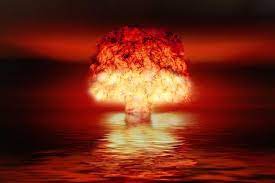
Of course the detonation was successful in a culminating in a horrific, frightening cataclysm.
But by July 1945 the war in Europe was over, and Hitler dead.
FDR too had passed, and Churchill would soon no longer serve as Prime Minister of Great Britain. Suddenly the vice president, Harry Truman found himself President. Inundated with intelligence and war measures, Truman, later remarked he felt as if the moon and stars had fallen upon him. That briefing included the status of the Manhattan Project still frantically underway in Los Alamos.
The rest of the story is known. A new film has been released on the project and on Oppenheimer. To speak plainly the atom bomb was intended for Germany, but dropped upon Japan-twice. And this weapon certainly proved effective in ending the war in the Pacific.
But bombs did not go away. Along with synthetic rubber, flu vaccines, and even computers, the atomic bomb still looms large. Science melded with military matters into what Eisenhower would call “the military industrial complex.” This Cold War triggered an arms race as the bombs grew in scope and in size, leaving all of America in a state of frightened readiness.
As for Oppenheimer, he lingered the rest of his life a tormented man. The why of the effort was never considered during the frenzied development of the weapon. However, once witnessed, in all of its glorious horror, the physicist lived in perpetual agony
In his own words the physicist anguished “I have become death.”
Gail Chumbley is the author of the two part memoir, “River of January,” and “River of January: Figure Eight.” In addition Chumbley has penned two plays, “Clay” a study of Statesman Henry Clay, and “Wolf By The Ears,” exploring the underpinnings of racism.

 Gail Chumbley