The Republican Party and televised journalism have clashed since the early days of the small screen (The 1950’s). GOP politicians, and some Democrats too (see Gary Hart, Bill Clinton, and John Edwards) condemn the scrutiny of television news as it exposes the raw ambition, and ‘win at any cost,’ antics of political figures. Television, for the first time provided the public the opportunity to judge up close, political figures.
Angry with forty years of negative coverage the right wing movement left mainstream media behind and established their own outlet, Fox News. Fox has provided a safe haven to posture, misdirect, lie, and spin their way to electoral success.
Senator Joseph McCarthy, elected after WWII exploited America’s growing fear of Communist expansion. On his path to prominence he waved papers before adoring crowds recklessly accusing the US government of harboring Soviet sympathizers. McCarthy became a forceful favorite of the Right.
But then came the household tv set and McCarthy’s rise came to a screeching halt.
His aggressive tactics faithfully reported in print media had now switched to the small screen. This time McCarthy accused the US Army of harboring Communists. He browbeat witnesses on live tv while bulldozing through hearing procedures. His belligerence did not play well with people watching at home, and shortly after, for this, and other misconduct the Senate voted to censure McCarthy. Still howling about the Communist menace the disgraced Senator died four years later from alcoholism.
Another case in point was Richard Nixon.
His rise to high office came about quickly. Utilizing the dirty tricks that later brought him down Nixon served in the House, the Senate, as Vice President, and by 1960 the Republican nominee for President. Like McCarthy, he too held a hardline against the spread of Soviet Communism. But Nixon’s promising career hit a bump when he appeared with handsome, polished, Democrat John F Kennedy. In the very first of its kind televised debate Nixon stumbled before the viewing audience, appearing ill at ease and perspiring heavily. With questions from the debate moderator, and his unflattering appearance Nixon’s performance and candidacy flopped.
Two-years later Richard Nixon ran for and lost the governorship of California. Defeated, and appearing before the cameras, barely controlling his frustration, Nixon snapped at the press they “didn’t have Nixon to kick around anymore.”
Senator Barry Goldwater was the GOP’s 1964 hardliner nominee. Goldwater’s extreme rhetoric such as advocating use of nuclear weapons in Vietnam did not play well on broadcast airwaves, and he too lost his bid.
But unlike Nixon, this time the Party’s loss translated into a plan of action. A Republican marketer, Richard Viguerie turned to a strategy to dispense with televised press coverage. Viguerie initiated a direct mailing campaign to wealthy Republican donors. Energizing the Far Right, and absent from television coverage, the GOP began to change their luck.
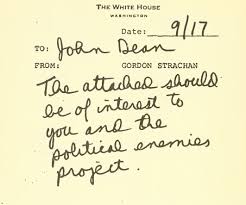
In 1964 Republican candidate Ronald Reagan was elected Governor of California. Four years later Nixon, too, enjoyed a comeback, and in the tumult of the Vietnam War Nixon succeeded to the White House. However, the lengthy televised war in Southeast Asia, coupled with domestic upheaval stateside put great pressure on the Nixon Administration. Reporters, with cameramen in tow, generated a steady diet of unfavorable coverage. By his second term the 37th President had initiated his Enemies List, a list that included prominent television journalists.
As the Watergate scandal and subsequent hearings consumed the country, Nixon’s illegal behavior, backed by audio tapes, eroded his support. To make matters worse for the President his Vice President, Spiro Agnew, no friend of the free press, had to resign his office following revelations of accepting bribes and evading taxes while governor of Maryland.
The public saw nothing but rot oozing from the Nixon Administration.
In the twilight of Vietnam, hyperinflation, and the 1970’s Oil Embargo, Ronald Reagan won the 1980 election in a landslide. Unlike Richard Nixon, or Barry Goldwater, Reagan could handle the tv cameras. Still Reagan also recognized the scrutiny of the small screen didn’t favor conservative politicians. Toward the end of his second term Congress dutifully ended the “Fairness Doctrine,” the FCC’s requirement of presenting both sides of an issue.
Reagan left office in scandal as well, in a sensational episode of secret arms sales to Iran to fund Nicaraguan soldiers in overthrowing a regime in Central America. These Iran-Contra hearings were televised as well.
Conservatives had had enough.
Inside of ten years, in 1996, Fox News began broadcasting under the watchful eye of CEO Roger Ailes. Back when Ailes had been Nixon’s media consultant he experienced first hand the optics problem of the Right. Free to operate with no constraints, Fox News successfully supplied distorted stories that incited viewer outrage presenting “alternative facts” to borrow a phrase from Kellyanne Conway.
So here we are today. The man in the White House presides over lies, misinformation and other lawless abuses while insisting that main stream news is fake. He grifts and riffs nonsense to his devoted, gullible, base. Like Richard Viguerie’s message to wealthy donors, followers want to be validated without the complication of exposure on the small screen.
Sean Hannity of Fox, when asked, explained his network was not news, but entertainment. Sure.
Thoroughly brainwashed by distorted “news” now including OAN, Newsmax, and other outlets, MAGA faithful tolerate, or worse celebrate a convicted rapist and pedophile in the White House.
Ultimately, the GOP couldn’t take the heat, so they found a way to avoid the truth. It’s time to reinstate the Fairness Doctrine because an open democracy lives and dies by an informed electorate.
Gail Chumbley is the author of the two-part memoir “River of January,” and “River of January: Figure Eight,” co-writer of the screenplay, “Dancing On Air” based on those books. She has penned three stage plays on history topics, “Clay” on the life of Senator Henry Clay, “Wolf By The Ears” examining the beginnings of American slavery, and “Peer Review” where 47 is confronted by specters of four past presidents.

 Gail Chumbley