Fifteen Minutes

A number of years ago I attended a seminar on President Lincoln.  The title of the course was “Controlled by Events.”  That name puzzled me when I first read the brochure.  Abraham Lincoln, in my mind, was the most dogged, determined figure in American History. Because of his resolve, the Union was saved.  I later learned that the title came from a moment when the President admitted that he couldn’t manage outcomes once the dogs of war were released, just grapple with the aftermath. Now, after our battle with cancer and my husband’s close brush with death, I realize what our 16th president meant.

Through rigorous exertion Chad, my husband, succeeded in sitting up for fifteen minutes-a significant milestone. Soon after, his doctors determined he was ready for transfer to a rehabilitation hospital. This move was designed to teach Chad how to function again.  Seriously, the man could not lift a styrofoam cup, brush his teeth, shave, or comb what was left of his hair.

The nurse notified us by nine in the morning that he was scheduled for transport to the new facility sometime before lunch. Of course that meant the orderlies arrived around two in the afternoon, and Chad was tucked into his new bed in the new hospital by three. Not too bad for hospital time.  But what we heard at the new facility left me despondent, and Chad frightened and frustrated.

One by one, therapists visited us until six that evening. They introduced themselves, and gently informed us that sitting up for fifteen minutes was only the beginning. His relearning would test his endurance, reaching new levels of exertion. Critically frail, Chad grew deeply stressed because what they were asking seemed impossible. I vicariously felt his fears, and could do nothing to allay them.

I couldn’t do anything about anything.

I bumped along the currents of endless medical advice. After all, he couldn’t come home until he reclaimed something of his former body.

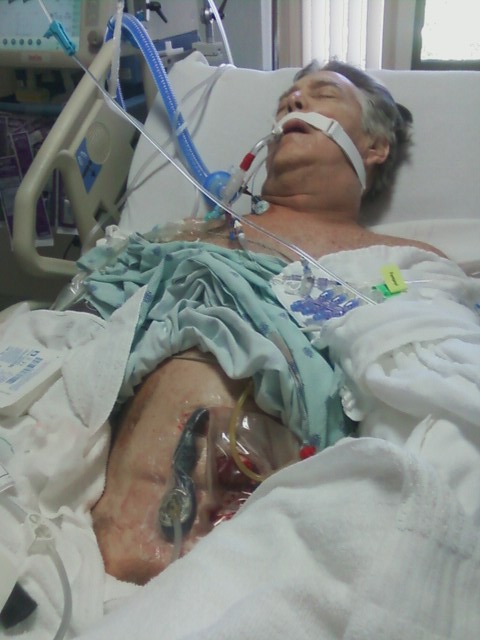
There he lay, bag of feces on his belly, an open, seeping surgical cut, from his naval to his groin, and the hospital was forcing him to get up and live again.

The looming deadline ahead for me was school starting again. There was no question that I had to work. We had to have the insurance, and the income if we were to survive this disaster financially. The medical bills were piling up, and I had no choices but to accept my nightmare. Then events, for a change, turned for the better.

One of my students lived behind our home, and I had hired her to tend our dogs while I spent days at the hospital. It turned out her mother was a registered nurse, who, just steps away, could be at our house within minutes. Wow, what a miracle for when he came home. Secondly, my seventy eight-year-old mother informed me she was coming to care for Chad so I could return to work. Honest to God, I didn’t want to bother other people, but had no other options. And both our neighbor and my mother assured me it was no bother, and they were glad to help. Both parties kindly offering the gift of their time and skills.

After two more excruciating weeks in rehab, I got to bring him home.  That night my mother chauffeured by my brother arrived at our door. I was sure my husband looked so much better after four weeks of hospitals and treatment. But when the both of them came in, and their faces betrayed shock by his poor condition.

In the end, unlike Lincoln, my husband survived our intense, little war. Trapped in the maelstrom, careening from one disaster to another we had no future.

Events controlled us.

Gail Chumbley is the author of “River of January,” and “River of January: Figure Eight,” a two-part memoir. Available at http://www.river-of-january.com and on Kindle.

gailchumbley@gmail.com

Five Minutes

The following was written in August, 2010

Our days crawled by slowly, his recovery measured in increments.  Transferred from the ICU one day earlier, a new face appeared in his hospital room, a physical therapist.  With a breezy air he introduced himself, shook my hand then turned toward Chad. He fulfilled his efficient entrance in one smooth motion.

Medical people no longer inspired reverence for Chad.  He had become weary of the abysmally slow institutional routine, the new faces everyday.  Still despite his disillusion he was never rude to any of the medical staff, but I received a good run down when we were alone.

This particular therapist seemed to have arrived with a plan to rebuild my husband’s ravaged, broken body and depleted endurance.  The regimen, the PT announced would start by having Chad sit up in a chair for five minutes.  And though that sounded harmless enough it quickly became one of the trials of Hercules.  With the help of the nurse, they diverted or unhooked the multitude of attachments to Chad’s body, now including pressure socks to prevent blood clots.  The two then hoisted his body to a chair by the bed.  Though bobbled around, he said nothing while the two stuffed and padded blankets around him like a newborn.  Once he seemed balanced, the PT and nurse left.  They left.

Five minutes can be a very long time in certain situations.  The last five minutes in class. The last five minutes in a dryer cycle. At this particular moment my husband immediately began to sweat, and fretted that he would faint if he didn’t lay down. I scrutinized his movement with the vigilance of a gymnastic spotter, ready to catch him if he toppled.

Wasted muscle covered by white hosiery was all that remained of his legs, his exhausted head bowed in agonizing surrender begging me to help him back into bed. Where was the therapist? Why didn’t he stay?

I waited, searching for words of encouragement, but growing equally anxious. Poor Chad grew visibly physically anguished, swaying forward.  Still no therapist.

“I can’t sit like this any longer,” he wailed.  Panicked, I resolved that if the PT didn’t come back in sixty seconds, one minute, I would press the button for the nurse.  I slowly began to reach over to the bed, for the call button pinned to his sheets.  And that was when the therapist materialized, sweeping briskly into the room followed by the nurse.

“How did that go?” he inquired brightly.  We didn’t answer, as he swiftly bent over Chad,to assess his condition.

“That was five minutes?” Chad gasped.  “Seemed longer.”

“He didn’t do so well,” I added, feeling it my duty to tell the truth. The therapist and nurse didn’t reply as they hoisted him back to bed.

He then spoke up.  “Well, the doctor wants him up to fifteen minutes before the hospital can release him.”

With that, the two blew out of the room, on to other matters, other patients.

Neither of us spoke. After a few moments Chad drifted back to sleep, lightly snoring.  I stared ahead, drained.

Gail Chumbley is the author of the two-part memoir “River of January,” and “River of January: Figure Eight.” Both books are available at http://www.river-of-january.com, and on Kindle.

gailchumbley@gmail.com

Biscayne Bay Syndrome

After eight long days in the ICU, days that included an excruciating extraction of his oxygen tube from his throat, grasping to remember his name, the president’s name and mine, the doctors agreed to transfer him to a regular room.  However, when the medical staff says move, they don’t actually mean it.  “Move” is code for “prepare for an unfulfilled expectation.” 

Teams of orderlies had to be placed on reserve, much like medication, liquid food, or a lab procedure.  As a part of hospital protocol, a regular room also had to be requested on the floor where cancer patients were treated.  So, again, we waited.  Chad, severely weakened, barely with the strength to move his head, drifted into and out of sleep.

To pass my time, and with some effort, I tried to read the new “Time” magazine. It was a special issue commemorating American history, featuring Benjamin Franklin on the cover, (a step in the right direction from the crap I usually consumed).  My comprehension skills limited, I looked at the pictures, and read the captions. 

After an anxious five or six hours, my husband finally moved into his new room.  Promptly a nurse’s aide came in with a bottle of something brown in her gloved hands.  Heavy set, tattooed, and very young, she cheerfully announced Chad’s bath time.  Now I wasn’t sure what I expected, but in one casual, shocking motion she unsnapped his gown and there he lay, naked, emaciated, emasculated and thankfully unaware of his condition.  Jesus taken from the cross.  Horror, shock, embarrassment, pick a word, froze me in place.  Callously robbing him of his modesty felt too much.  My poor Chad was too weakened for the embarrassment I felt for us both.

A regular in the hospital now, my face became familiar to the nurse’s station and cafeteria.  The halls antiseptically bare did feature artwork from former cancer patients.  I noticed underneath the framed pieces were the names of the artists, and their death dates.  I shuttered each time I walked by.  Another source of anguish came from watching other patients creeping along the halls, getting out of their rooms, ambulatory.  Chad’s door had caution signs saying wash your hands, wear gloves and a mask.  Another notice stated “Fall Risk.” 

Daily, the medical staff quizzed him with questions such as, “do you know where you are?”  He often answered, “Miami.”  He warmly told his oncologist that he could come along fishing on Biscayne Bay with him and his son.  Studying the nightmare from my front row seat I repeatedly despaired, “we’re never getting out of here.”  When the room finally emptied, I would try to explain to him that he lay in a hospital bed in Boise, to which he’d yell “knock that off Gail!  My son will be here soon.”

Are You Hungry?

When all of this cancer mess began, my husband weighed in around 180 lbs.  By August, after a summer of radiation and chemo, he pushed the lighter side of 150 lbs.  I blamed myself because I couldn’t seem to squeeze enough nutrition: yogurt, baby food, or canned formula through that little peg tube in his stomach.  On once occasion I pushed so hard on a feeding syringe loaded with strained carrots that it exploded over his torso.  Orange blobs hit the covers, the walls, me, the lamp.  It should have been funny, but instead felt more like a crisis.  In retrospect, I wonder if any food made it through that stiff, plastic obstacle course into his belly.

In the throes of this new catastrophe, I sat beside his stainless steel bed fretting not only for his life, but for his nutrition.  I pleaded with the nurse to find some way to get liquid food that fit his tube.  It had been over twenty-four hours since he had taken in any nutrition, and much of that he had tossed up with the colon perforation.  I realized that I was obsessing, but this issue was the one thing I could help, maybe.

Kindly, the ICU nurse listened to me, the wife, and not just medical notations.  He promised to talk to the doctor about getting some kind of sustenance up to the room as soon as he could.  But despite his intentions, it was easily another six or seven hours with nothing to feed him.  Hospitals make Congress look fast. 

The doctor first had to approve the nutrition, then order the food.  The pharmacy had to fill the order, the bag had to be transported to the floor and the nurse had to find a moment to hook it up.  To make this endless process short, the nutrition finally arrived, and honestly, I was a little chagrined.  The bag was filled with a yellow, clear, liquid, and looked to have no bulk at all.  The liquid was called TPN, and was none too impressive to behold.  But the nurse assured me that it had the substance to keep him going.

Now look, I know that healthy people can go days without food as long as they remain hydrated.  But Chad was so below the norm from the summer, that my fretting turned to anguish.  He hadn’t much to go on when this disaster began. The little bit the hospital provided only slightly took the edge off my dread.

Oh, and the new bed sore.  A spot had appeared at the base of his back and became raw and nasty fast, from lying in a comatose, prone position.  The doctor ordered a new bed, an air bed, with the idea of taking the pressure off his lower back.  Honestly, that order took another seven hours to materialize.  In the end, (no pun intended), his tailbone still bore too much pressure and the sore remained a pestilence until Chad was up and walking weeks later. 

One of nurses happened to remark to me that everyday spent in the ICU costs the patient two weeks of muscle loss.  That meant that for each day Chad lay there, his body deteriorated  fourteen days of lost mass.  Weird, but true.  He remained eight days.  His body grew ravaged and skeletal by the time he was transferred to a regular room.

I showed no physical effects of my own growing depression except I too, couldn’t eat.  After leaving the hospital each afternoon, I floated home in some cloud, fed the dogs, and buried myself in romance novels.  I read the same ones over and over.  Funny, I didn’t feel any hunger pangs either.  Both of us were equally immobilized, equally shut down.  The only difference between the two of us–I could physically leave the hospital. 

Delirium

To maintain that we fell back to sleep after talking to the oncologist, would overstate the minutes until the next phone call.  Our rest was uneasy, more trance-like accompanied by surreal images.  Soon the strained quiet shattered, when the anticipated second call arrived.  This time my sleep had been thin, and finding the phone a simple matter.  It lay where I had placed it no more than forty-five minutes earlier.  Again, for a second time that night, my girl and I lurched straight up in bed.  And for this call my voice flowed clearly, warmed up from the previous conversation.

“Hello.”

“Mrs. Chumbley?”  I am Dr. blah blah.” (Sorry)  “Your husband requires emergency surgery on his colon as a life saving procedure.  I can’t perform the operation without your permission.”

“Yes, of course.  You have my permission.  Thank you doctor.  Should I come down to the hospital?”

“This surgery can take hours.  The morning should be soon enough.”

“Thank you again, doctor.”

“You’re welcome.  Someone will call if there are any problems.”  My silent translation, “if he dies.”

I hung up the phone, and lay back down.  We both silently thought our thoughts, worried our worries, until lightly drifting off.

A thin sleep resumed.  Mine was filled the strangest dreams of the classroom, childhood friends, my parents.

Promptly, at six o’clock, I opened my eyes, just to roll over and see Catherine’s pretty blues looking straight back at me.  “We should get down there,” she whispered.

Quickly dressing, she drove me back to the hospital.  And though still very early, the day promised to be another scorcher.  She asked, “Do you want me to come up with you?”

I thought for a moment and then I told her no.  Not yet. I needed to see how he looked and what the surgeon had to say about his condition.  “You go back to bed, honey,” I encouraged.  ” I will call when I know something.”

That decision proved to be a good one.  When I found the ICU, his nurse explained to me that though he had survived colon surgery, Chad was still dangerously septic, in critical condition.  When I pulled back the turquoise curtain to his room, the body in the bed bore little resemblance to the guy I married.

This ravaged body bore testimony to his own hellish night of scalpels, staples, and anesthesia.  Now under an induced coma, his bloated and distorted figure would have better suited my earlier, anxious dreams, than the cold reality of morning.

Fear and Euphoria

The doctor told us that it would be awhile before any tests were performed on my husband.  She quietly, carefully explained that she would call me if there was news of his condition.  For the moment Chad was hooked up to a drip for pain and another for fluids.  Then this quiet, unassuming doctor made it clear we were dismissed.

Stepping outside, the three of us lingered along the broad circular drive.  The night was warm, still hanging on to the day’s exceptional heat.  I remember almost laughing when I told Carlos about the art of timing.  He unwittingly had walked into a hellish ordeal that had actually barely begun.  Making our way to the public parking area, my girl suggested I sleep at her house since it was so close to the hospital, maybe a five minute drive.  We didn’t know what the night would bring and I needed to remain close.

Soon seated in Catherine’s living room, glass of wine in my hand, I suddenly felt like me.  I somehow slipped back into my personality again when I wasn’t looking.  There was no one needing my help, no one calling my name, no one griping about how awful they felt.  For the moment I was free.  So bowed down by responsibility and fear, the absence of demands jolted me back from that alien world of caretaker.  I felt nearly giddy with my momentary freedom, not willing to contemplate what was happening in that hospital room a few miles away. Bidding goodnight to room mates, new boyfriend, and my daughter, I toddled off to bed, setting my cellphone on high.

Sleep, however remained elusive, with the adrenalin of fear, then of euphoria swirling around my mind and body.  At 1:00 AM the cell phone shrilled loudly.  I fumbled around the floor next to the bed, aware that my daughter was next to me.  Flipping the phone open, I graveled out a hoarse hello.  Catherine sat up.

“Mrs. Chumbley?  I have received he results of the CT scan and it is clear that the colon has ruptured, feces is spreading through his body.  Chad is in grave condition.  He must have surgery.  You will soon receive another call from a surgeon, Dr. ???, (I honestly can’t remember his name.)  He will perform the procedure and will require your permission.

“Should I come back?”

“I don’t see anything you can do at this point. The surgeon will call for authorization and that you can do by phone.”

“Oh, okay.  Thank you.”  I hung up.

“Maybe we should go back down,” my daughter whispered in anguish.  I thought that over.

“No.  I think we will get more sleep here than in the waiting room at the hospital.”

We drifted back off to sleep.

A Handshake

Normal life attempted to intrude into our ongoing nightmare.  Our daughter had met her first serious boyfriend, and he had driven up to Boise to meet us.  Instead of finding her parents at the cabin in the woods, she tracked us down in a sterile, whispering examination room.  The poor kid she presented to us, Carlos, extended his hand to my husband, and miraculously Chad raised his own in a handshake.  (By the way that is the last thing Chad remembers today, that handshake.)

The two of them arrived at nearly the same time the ER doc returned to the room announcing that we were going on another ride downtown.  Chad’s chemo doc was on-call at the main medical center, and wanted to assess him in person.  Catherine and Carlos decided to meet us across town, and for a fourth time in one afternoon, turned evening, the two of us were loaded onto an ambulance.

Nearing the downtown medical center, the driver, a very nice young man, kept up a light banter with me.  Pulling up to a traffic light I realized we were behind my girl and her new beau.  Why, I’ll never know, my hands were shaking and I wanted to vomit, I asked the driver to give them the siren.  He complied, and we all waved ourselves silly, vehicle to vehicle.

Inside the main ER the verdict came in, Chad was to be admitted overnight for tests.  The last place either of us wished to be–a hospital–looked like home-base for us, at least for the night.  Orderlies rolled Chad into a side elevator to the fourth floor.  We followed in the public lift.  It was while looking for his room number, that I came face to face with a former student.  She was an aide on the floor.  Automatically smiling, I put my hand out to shake hers.  The girl having none of that, threw her arms around me in a big comforting hug.  That gave me no comfort, she must have known of his dire condition.

Punched up with more Dilaudid, my husband managed to talk to his Chemo doctor clearly, lying in his new surroundings.  He admitted that he hadn’t used the bathroom except to urinate for three days.  I heard her murmur, “fleet” again, quite clearly, but without enthusiasm. “Life flight for an enema,’ darkly crossed my mind.

The two kids sat down in the deep window sill of the room, all eyes, slowly acclimating from their new mutual attachment, into the reality of our medical abyss.

Finally, after passing a number of emotions across her face, the oncologist ordered a CT scan for my husband.  She then told us that it would be late before the procedure took place, and that we should go and get some rest.  Her words surprised me.  Darkness had crept in while I was distracted.  It was already ten at night when our worried little entourage was dismissed from the hospital.

The doctor promised she would call me when she knew something.

The Treeline

I still don’t recall exactly how it happened, but the decision was made to life flight Chad to Boise.  Following a 20 minute rollicking drive on dirt roads, the ambulance pulled into the helipad site where a chopper awaited.  Gently the medics pulled the stretcher out of the truck, and from there turned Chad over to the life flight paramedics.

All three, the pilot and the two flight medics exchanged a quiet conversation out of earshot, while transferring my husband onto the chopper.  Then the pilot turned toward me and asked my weight.  If I weighed more than a 110 lbs at that point I’ll eat my hat.  I was pretty skinny by then.  I must have looked it, too  because they invited me to take the co-pilot seat for the fifteen minute ride down.

The pilot then offered me a pair of headphones so that I could hear the conversations between the pilot and the medics and the pilot and the hospital.  At once the word came up front that Chad’s vitals had dropped dangerously.  The medics added that the trouble was the altitude and that they would keep me apprised.  Frozen in that seat, frozen in the heat of mid-day August, I hoped he needed nothing more than a fleet enema when we landed.

The helicopter lifted directly up and over the mountain facing the helipad.  Heavy forest quickly thinned as the terrain turned to dry, barren hills.  Les Bois, French for “the trees,” spoke somewhere in my mind, observing the distinct line of forest ending in a golden hilly desert.  While musing over the vista the pilot asked me which hospital to approach, and unable to think, I told him the wrong one.

Heading to the incorrect facility, (home of the tumor center) I could see ground crew on a painted target waving us down.  Outside the pad, another ambulance waited to drive us to the emergency entrance.  Again my mind released unsolicited thoughts–how much was this all going to cost?  I knew we were racking up giant bills, but of course had no more control over the debt than I did the cancer.

Once inside, he was pulled quickly into an examination room.  The nurse assailed him with a blizzard of questions.  “When is your birthday?  What day is this?”  Chad could answer correctly, but crumpled into severe spasms of pain in the effort.  After two injections of Dilaudud the pain stemmed enough for him to describe his symptoms.

An ER doctor breezed into the room, asking many of the same questions as the nurse, then ordered an abdominal x–ray.  He would contact Chad’s chemo doctor, in the meantime, who was on call at the main medical center downtown.

And that was when our daughter walked into the ER, towing her new boyfriend from Salt Lake City.  We were meeting him for the first time.