The Flats

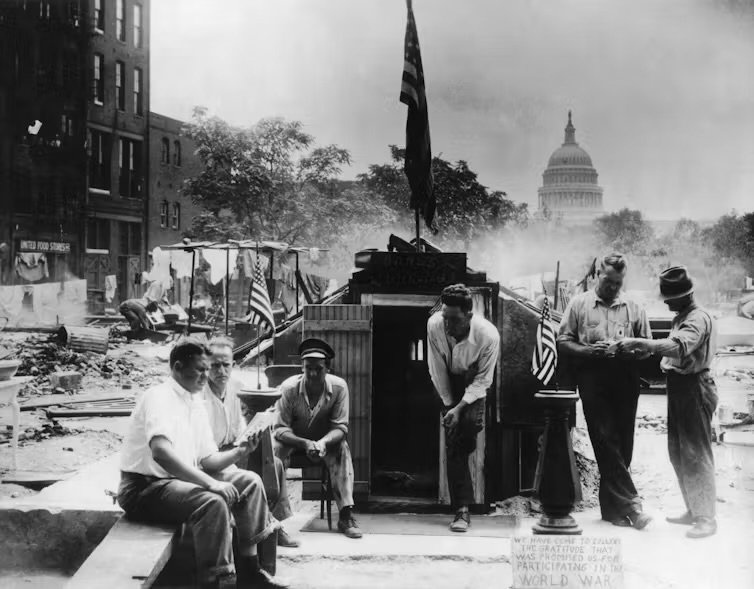
It was mid-summer in 1932 Washington DC. A giant shanty town, popularly known as a “Hooverville” had sprouted in an open area on the Anacostia Flats. Veterans from the First World War had made their way to the Capital, bringing their desperate families to persuade Congress to pay a promised bonus for military service in the Great War.

America had hit bottom by 1932, the country devastated by the 1929 Stock Market Crash that drifted into the Great Depression. Raggedly men, women, and children somehow had traveled to the city, all desperately hoping the promised bonus could be issued at once rather than 1945, the date set by the provisions of the law. These people brought little and had nowhere to go except to throw themselves on the mercy of a Democratic House, Republican Senate, and a Republican President.

Scrapped tin, packing crates, chicken wire and other material made up the shacks on the Flats, with folks making homes that were better than nothing. The Hoover administration was not happy a bit with these scruffy people descending on Washington and opposed paying the bonus (dollar amount depending on service records) as it would unbalance the national budget. The “Bonus Marchers” as they were called, roamed around the city, many in bare feet, speaking to reporters while filmed by newsreel companies such as Pathe’ News, and Hearst Metrotone News.

Finally on June 15, 1932 the House approved paying the bonus, but the bill had to find approval in the Senate. Two days later a Republican led Senate rejected the bill, dashing the hopes of destitute veterans.

After the vote Senators exited the Capitol through the underground rail system safely avoiding the stunned marchers outside.

By July 28 President Hoover had had enough of the vagabonds. He ordered General Douglas McArthur to use his troops to expel the marchers from the Flats. At the end of that meeting the President cautioned the General to avoid violence at all costs.

McArthur directed his men, including two young Majors, Dwight Eisenhower and George Patton, to fix bayonets and follow dispatched tanks into the shanty town. Briefing his troops George Patton instructed his men that “If you must fire do a good job — a few casualties become martyrs, a large number an object lesson. . . . When a mob starts to move keep it on the run. . . . Use a bayonet to encourage its retreat. If they are running, a few good wounds in the buttocks will encourage them. If they resist, they must be killed.”

Hmm.

Thinking along the same lines General McArthur ordered tear gas lobbed and setting fire to the rickety camp. In the melee two Bonus Marchers were killed and a 12-week old baby succumbed to tear gas.

The camp burned through the night and with it Herbert Hoover’s reputation. Four months later, In November Franklin Delano Roosevelt won the White House in an electoral landslide.

In America real change rises from us, the people, not from the White House. When citizens of this nation have had enough and demand justice, justice shall be done.

William Hushka of Chicago and Eric Carlson of Oakland, California perished in that long ago assault. Another casualty was infant Bernard Myers who lost his brief life from tear gas related complications. These citizens were indeed George Patton’s martyrs who still deserve to be remembered.

As do Renee Good and Alex Pretti of Minneapolis.

Stay the course my friends, We are The People and possess enormous power. Let us use it.

Gail Chumbley is the author of the two-part memoir “River of January,” and “River of January: Figure Eight,” co-writer of the screenplay, “Dancing On Air” based on those books. She has penned three stage plays on history topics, “Clay” on the life of Senator Henry Clay, “Wolf By The Ears” examining the beginnings of American slavery, and “Peer Review” where 47 is confronted by specters of four past presidents.
The Business of America

President Calvin Coolidge once famously proclaimed “The business of America is business,” which meant his administration would pursue a “hands off” approach toward the business sector over the interests of the American people. In office from 1923 to 1929 President Coolidge kept to his pro-business principles that, in turn charged the roar into the Roaring Twenties.

By the end of October 1929, six months into the new Hoover Administration, Coolidge’s lax policies came due dropping the Dow Jones Industrial into free fall. This financial catastrophe capped off a decade of easy money made through frenzied and unregulated trades, not only by wealthy holders, but by regular folks taking stock tips from friends or newspapers.

A large portion of these everyday newbies purchased shares “on-margin,” meaning 10% down with 90% on credit, usually borrowed from private banks. The only collateral required was the promise of certain and endless gains. And why not? The market had grown at an astounding rate from $27 billion in the mid-1920’s to $87 billion by 1929. 

Coolidge’s free-market detachment produced a carnival atmosphere with everyday people hot in the market game.

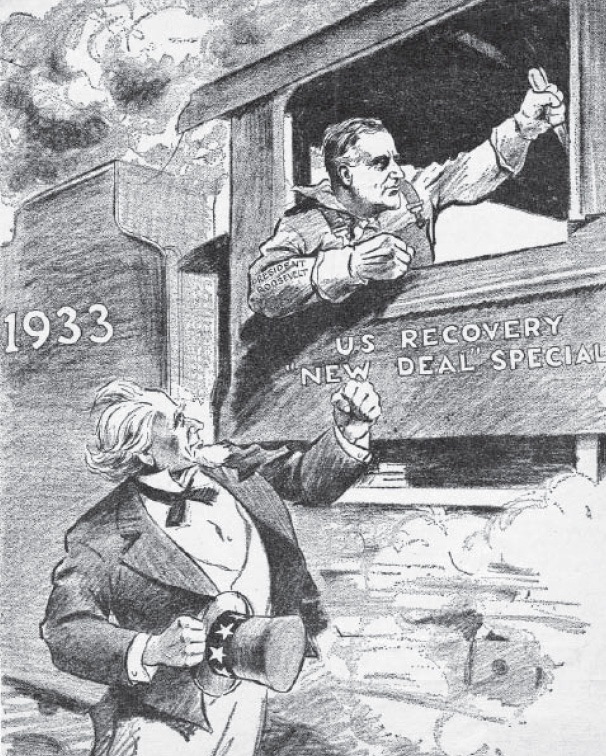
By 1932 the party was over. The now suffering nation had had enough of hands off and predatory money practices. Massive unemployment, thousands of bank failures, hunger, homelessness, and a Dust Bowl in the heartland brought America to its knees, and Democrat Franklin Delano Roosevelt to the White House.

Seeing nothing beneficial for the American people in catering only to the rich, FDR brought an end to GOP policies. His administration instead offered a New Deal for economic revival. Through a massive legislative agenda Roosevelt and Congress intended to not only meet the emergency, but restore economic growth, and eliminate the conduct that led to the Depression in the first place.

One of the most popular New Deal relief programs was the Civilian Conservation Corps. Unemployed young men were put to work throughout the nation building trails and campsites in forests like the Great Smokey Mountain National Park, and urban building projects like the River Walk in San Antonio, Texas. (Consider that idle young men in Germany at the same time donned Black and Brown Shirts and broke heads for Hitler.)

Addressing the chaotic banking system FDR proposed systematic changes. Some 6000 banks had failed between 1930 and 1933 before the new president took office. Panicked depositors waited in long lines to demand their money until banks simply ran out of cash and locked their doors. Confidence collapsed. 

In his first days Mr Roosevelt announced a Bank Holiday where banks closed for four days to stop panic withdrawals. Auditors then inspected banking institutions across the country and surprisingly many banks were deemed solvent and reopened. Not finished with banking, FDR also took to the radio to explain the banking system, and with his cheerful confidence encouraged the public to take cash out of their mattresses, coffee cans, and backyard holes and return deposits to local banks. Thousands did just that. 

In order to prevent another such economic catastrophe the Glass-Steagall Act (1933), was passed by Congress to protect the public from high risk banking practices. One piece of the law was the Federal Deposit Insurance Corporation, FDIC, which is still in effect today. Depositors had the backing of the federal government to protect their funds from any loss. Moreover the Roosevelt Administration was determined to keep people in their homes, many of whom were facing foreclosure. The Home Owners Refinancing Act provided federal assistance to those who had paid their mortgages in good faith, but now faced eviction. 

In the first hundred days of Roosevelt’s New Deal 77 laws in total were passed by Congress, all aimed at restoring the health of the country. To the majority of Americans it felt like this president truly cared about their wellbeing. Roosevelt’s ascendency to the White House, next to Abraham Lincoln’s certainly stands as the most consequential in America’s continuing experiment in self government.

On a side note Franklin Roosevelt suffered from polio and could not walk, though he believed he’d walk again. FDR never gave up. And the truth of the matter is it took a man in a wheelchair to put the United States back on its feet. Franklin Roosevelt, unlike his predecessors knew that the business of America is “We The People.”

Gail Chumbley is a history educator, author, and playwright. Her work includes River of January, River of January: Figure Eight, both available on Kindle, plays Clay on the life of Senator Henry Clay, Wolf By The Ears a study of American slavery, and Peer Review where Donald Trump meets four past presidents.

If you like, please share this on social media.