Peer Review #2

Strutting through the broad, gilded doors, bearing the black and gold insignia of his building, the President acknowledged well wishers, reporters, and staff. Happy to be back in New York, he looked forward to his familiar apartment and comfortable bed. The President felt it a hardship to live in such an old structure in Washington, though the prestige made it tolerable.

He aimed directly toward the elevator, his closest aides and Secret Service agents in tow. The Chief Executive marched into the lift, with a triumphant gait, gracing photographers with a last thumbs up, as the golden doors silently sealed.

Soon enough, the elevator car slowed to a silent halt, the opening doors revealing an opulent penthouse. His entourage emptied first into the golden rooms, Secret Service staff sweeping for any dangers that might threaten the Commander in Chief. After the officers cleared the master bedroom, the President loosened his tie, slipped off his suit jacket and kicked off his designer shoes. Exhaling onto his grand bed, a sudden movement caught his eye.  

A tall man, of regal bearing stood by the window, surveying Midtown from on high. Attired in a blue uniform, trimmed with buff lapels and cuffs, the man’s hair looked powdery white, and was bound in a queue at the nape of his neck. 

Stunned, gasping at this extraordinary vision, the President froze, too astonished and frightened to speak.

“I’m very fond of New York,” the officer began. “During the War for Independence I remained in the vicinity waiting to reclaim it from British occupiers.” He glanced at the frightened man, now burrowing under his bedclothes. “As Chief Executive, I served both terms of office here in New York.”

The President could hear his heart pounding, and idly worried about his blood pressure.

“I, too, struggled with temptation,” the officer continued. In my youth I pined for the advantages of wealth that surrounded me.” The apparition glanced at the President. “Land, military rank, social standing, . . . these were the empty ambitions I embraced as valuable.”

The President slowly began to feel his heart rate slow, the adrenaline somewhat dissipating, and found the courage to speak. “Ho, . . . how did you get in here?” 

But the soldier did not reply, turning again toward the view of Manhattan. 

“Over time, particularly once the war commenced, I discovered my assumptions slowly crumbling. The sacrifices endured by the fine men in my command taught me that there were more important ideals than fleeting treasure,” the apparition sighed, emotion emphasizing his revelation. “You must realize,” the officer turned again toward the President, eyes blazing with conviction, “all a man truly possesses is reputation. In the end, that is all that matters.” 

Dread again filled the President, clutching tightly his golden comforter, finding no comfort. He wished the specter gone, praying with all his might that a staffer would hear and rescue him.

“You must understand,” the visitor continued, “I, too, struggled to master my avarice and envy. It was through a determined practice of self-restraint, a mastering of my baser desires, that I learned to be of service to more than myself.” The soldier paused a moment, studying the frightened man grasping his bedding. “Did you know that Article Two in the Constitution was written for me?” 

Hearing this, the President forgot his fear for a moment. 

“For you?” he managed to murmur. 

“When I relinquished my command after the war, and returned to my home in Virginia, Congress judged my character upright. In truth I was weary, lonely for my family, and yearning for a peaceful life,” the General smiled sadly. “However, when I gave up power I earned honor, trust—a good name—and contentment.”

“Why are you bothering me? You should leave,” the President moaned, wishing he had flown instead to Florida. But his visitor seemed not to hear. 

“When the Constitutional Convention set to work, only one day was devoted to defining the role of president. One day,” the visitor repeated. “You see, the delegates wanted no more of arbitrary rule, believing only those of good character would occupy the office.” The apparition looked directly at the President,”

“Please go,” the President whimpered. “I’ll call my men . . .”

The General interrupted, “they are not yours, Sir. And therein lies the problem, and the purpose of my visit.” The soldier frowned deeply. “These deputies work for the American people, as do you, sir. The presidency is a position of service and trust.” He paused. “We have all noted your general deficiency in this aspect.”

“We all?” gasped the President, concerned with his pumping heart.

The General approached the vast bed, the President shrinking deeper with each step. “The President is entrusted with formidable powers, that must not be corrupted. In this you have fallen short.”

“As I am remembered in the annals of America for quiet dignity and fidelity to country, you will only be recalled as a cynical moneychanger who profited from foreigners and plutocrats.”

A knock at the bedroom door startled the cocooned President, breaking the spell. His elaborate, golden bedroom was empty.

Gail Chumbley is the author of the two-part memoir, “River of January,” and “River of January: Figure Eight.” Both are available on Kindle or in hardcopy at http://www.river-of-january.com.

gailchumbley@gmail.com


Peer Review #1

Marines manned numerous doorways along the wide hallway, as clusters of tourists wandered through colorful rooms. Upstairs the President listened to the public commotion with satisfaction, not for the house, not for the job, which, in truth, had become tiresome, but for the knowledge he could drop down and set all their bourgeois hearts aflutter. 

After a moment, he made his decision, slipping down an interior stair case, stepping into the Blue Room.

As his hands automatically fluffed his hair, the President sidled up beside a class of wiggly school children snapping cell phone pictures.

“And where are you from?,” the president teased with pleasure, anticipating an excited response. He half closed his eyes, and paused, waiting for the gratifying answer.

But he heard nothing.

Bemused, the President opened one eye, then the other. The chatty children paid him no mind, in fact were moving away, following their guide into the hallway.

“Wait,” he found himself calling. “It’s me, your President. I’m here.”

He repeated, “The President of the United States.”

But the children didn’t hear. He remained alone in the Blue Room, his hair acceptably coiffed.

No further tourists entered, though dozens drifted past the doorway. He didn’t understand and he thought very hard, seeking a rational explanation.

It was at that moment that he heard a voice, quite close, and quite annoyed. 

“Am I to understand you are a New Yorker?” 

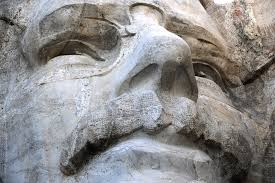
The President wheeled around toward the sound. Before him, no more than an arm’s length away stood a mustachioed gentleman, wearing pinz nez spectacles, sporting a shiny top hat. The man’s eyes blazed behind the thick round lenses, and the astonished President detected a trickle of cold sweat trace down the back of his thick neck.

“I say, are you, or are you not, a New Yorker?” The stern man spoke in a nasally, patrician voice.

“Ahh. How did you get in here,” the President stammered. “Where is my secret service protection?”

“Supercilious pup,” the man in the top hat snapped. “They tell me that YOU are from New York, and are president! A common side show huckster, President.”

The President, though alarmed, replied reflexively, “I’m in real estate. I . . .made my fortune in New York real estate.” Only the muffled din of passing tourists kept the President from panic.

“Real Estate!” The man in spectacles scornfully shouted. “I’d say you are just another scoundrel from the wealthy criminal class. In New York, swindlers like you are a dime a dozen. I made a career of exposing rascals like you.” 

The man, attired in a three-piece suit, a watch fob draping his ample waist, bore a deep scowl. “And you found your way into this office of trust. Intolerable.”

Though bewildered, the President, unaccustomed to such personal insults, felt his pique rising. “I was elected President by the largest margin in American Hist . . .”

“Poppycock,” the specter interrupted. “It is my understanding the decision rested upon a mere tilt in the Electoral system, and that outsiders interfered to make certain of your victory.” 

The strange visitor moved closer. “I’d say that you are a compromised pawn of foreign meddlers, and give not one damn for the American people.”

At this point the President had heard enough, and attempted to move his legs. He wanted very much to escape the Blue Room, but his feet remained rooted. 

“I have important things to do, you need to go,” the President’s voice trembled, trying to sound more confident than he felt.

The apparition narrowed his intense eyes, and took another step toward the unnerved President. 

“I claim more authority to this revered House and Office than your mercenary greed could ever comprehend. You belong with Tweed, Plunkitt, Fisk, Conkling, and the rest of New York’s good-for-nothings. Dishonor has followed you to the Presidency, what, with your womanizing, graft, and unsavory business connections.” The fierce apparition fixed an intense, menacing gaze. “You do not belong here, nor your parade of lackeys and opportunists.

The buzz of foot traffic grew louder, and when the President again glanced toward his unwelcome visitor, he found him gone, the Blue Room empty.

Gail Chumbley is the author of the two-volume memoir, “River of January” and “River of January: Figure Eight,” both available on Kindle.

Hard copies are available at http://www.river-of-january.com