A Surreal Landscape

In a scene from Hitchcock’s The Birds locals are gathered in a cafe eating and chatting. An attractive blonde is on the telephone explaining that children at the local school were dive-bombed by attacking crows. An elderly lady in a beret and smoking cigarettes lectures the other diners that crows don’t behave in such an aggressive manner and that there has to be another explanation. The woman identifies herself as an ornithologist and holds forth explaining crows and even seagulls do not do such things. Immediately after her expert testimony all hell breaks loose outside the cafe window, with masses of birds swooping down on passersby. The scene is chaotic and bloody leaving no doubt these attacking birds are in fact lethal. As the nightmare scene ebbs, the camera catches the bird expert, her head bowed in grief and bewilderment, stunned everything she knew and believed no longer applied to any bird in her understanding.

That woman resembles this lifetime American history educator. I’m a fairly decent generalist in subjects ranging from PreColumbian America through today, give or take minutia. But I too, am stunned by the surreal landscape of what I believed about democracy has been easily undone by a vulgar man-child and a compromised and opportunistic Republican Party.

It feels like all my understandings of my country no longer apply. The epic and fraught-filled struggle of forging the Constitution, the furnace of Civil War, the reforms of the Progressive Age, the promise of the New Deal, and Great Society are gone, rapidly destroyed by sinister design. A totalitarian despot has seduced a once noble political party rendering the valiant patriotism of those whom came before moot. Simply writing this lament is difficult, as all I once believed and explored is no longer valid.

An online troll explained it as “no one cares about that anymore.”

That means the principled determination of General Washington to serve our nation doesn’t matter. The misguided genocide of the Five Civilized Tribes upon the Trail of Tears doesn’t matter. With nearly 700,000 deaths, the crucible of Civil War no longer matters. Those brave GI’s on Omaha Beach, (including my own grandfather) and at the Battle of The Bulge no longer matters. Those brave students who occupied lunch counter stools in the face of racial violence did so for nothing. Those boys who perished in the Vietnam War are irrelevant. In point of fact no veteran matters anymore.

American history and all the sacrifice of our forefathers and mothers doesn’t count.

That 47 can fly in a foreign “gift” aircraft with a classified budget is a good thing to do with our tax money. That he remodels a room in the White House in a golden gilt is a good thing. Who really cares if former medicaid recipients suffer.

Suck it up buttercup, these are the new rules of Trump’s America.

That he has done away with investments in the Arts and Humanities is a positive. That he has placed incompetent sycophants from Fox News in high Federal positions is good. Forget he stole top secret intelligence documents. The country elected him anyway. That he has drastically shifted the tax burden onto the middle class and off of the super wealthy is how God wants it, just ask today’s Christians.

That old white men rape girls is a good thing. 

The GOP bows at his feet and gleefully ratifies every stab-wound of domestic legislation is now to be celebrated, so pop a cork. In fact destroying America for profit is now simply wholesome and righteous. 

America’s heroes, like Sergeant Alvin York in the Argonne Forest, or Colonel Joshua Lawrence Chamberlain at Gettysburg endured their generations difficulties so that Trump can plow up Mrs Kennedy’s rose garden for a putting green. Suffragette Alice Paul who went on a hunger strike and endured the torture of forced feeding did so that the current president can manipulate votes is just fine. The murders of JFK, Dr King, Harvey Milk, or the murder of Minnesota State Senator Melissa Hortman is merely a part of the 24/7 news cycle.

Indeed nothing of our past story matters because Mr 47 has disqualified all of it to make money, and more money because that’s all that matters today. Plus of course he is a convicted felon and is terrified of going to jail where he belongs.

So when you see this disoriented American History educator with her forehead in her hand, much like the bird expert in the movie, please understand the gravitational pull of her entire life’s work is today rendered null and void. 

Gail Chumbley is the author of the two-part memoir “River of January,” and “River of January: Figure Eight,” co-writer of the screenplay, “Dancing On Air” based on those books. She has penned three stage plays on history topics, “Clay” on the life of Senator Henry Clay, “Wolf By The Ears” examining the beginnings of American slavery, and “Peer Review” where 47 is confronted by specters of four past presidents.
The Business of America

President Calvin Coolidge once famously proclaimed “The business of America is business,” which meant his administration would pursue a “hands off” approach toward the business sector over the interests of the American people. In office from 1923 to 1929 President Coolidge kept to his pro-business principles that, in turn charged the roar into the Roaring Twenties.

By the end of October 1929, six months into the new Hoover Administration, Coolidge’s lax policies came due dropping the Dow Jones Industrial into free fall. This financial catastrophe capped off a decade of easy money made through frenzied and unregulated trades, not only by wealthy holders, but by regular folks taking stock tips from friends or newspapers.

A large portion of these everyday newbies purchased shares “on-margin,” meaning 10% down with 90% on credit, usually borrowed from private banks. The only collateral required was the promise of certain and endless gains. And why not? The market had grown at an astounding rate from $27 billion in the mid-1920’s to $87 billion by 1929. 

Coolidge’s free-market detachment produced a carnival atmosphere with everyday people hot in the market game.

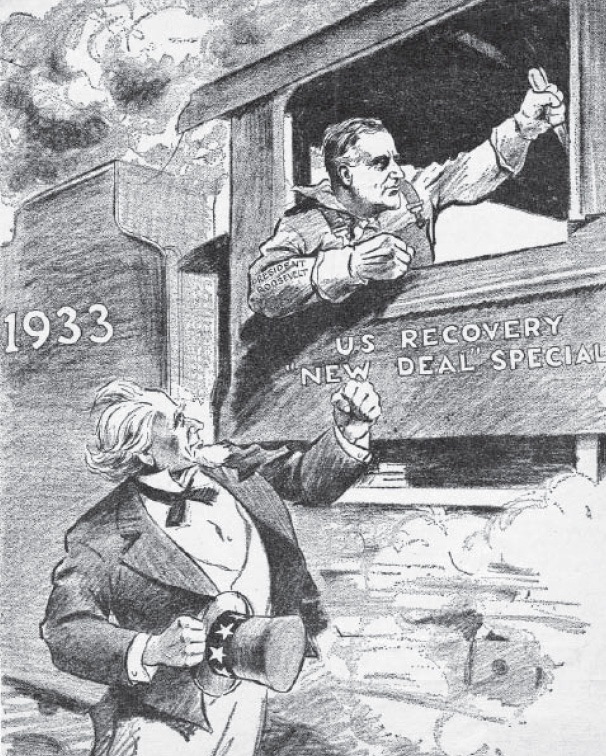
By 1932 the party was over. The now suffering nation had had enough of hands off and predatory money practices. Massive unemployment, thousands of bank failures, hunger, homelessness, and a Dust Bowl in the heartland brought America to its knees, and Democrat Franklin Delano Roosevelt to the White House.

Seeing nothing beneficial for the American people in catering only to the rich, FDR brought an end to GOP policies. His administration instead offered a New Deal for economic revival. Through a massive legislative agenda Roosevelt and Congress intended to not only meet the emergency, but restore economic growth, and eliminate the conduct that led to the Depression in the first place.

One of the most popular New Deal relief programs was the Civilian Conservation Corps. Unemployed young men were put to work throughout the nation building trails and campsites in forests like the Great Smokey Mountain National Park, and urban building projects like the River Walk in San Antonio, Texas. (Consider that idle young men in Germany at the same time donned Black and Brown Shirts and broke heads for Hitler.)

Addressing the chaotic banking system FDR proposed systematic changes. Some 6000 banks had failed between 1930 and 1933 before the new president took office. Panicked depositors waited in long lines to demand their money until banks simply ran out of cash and locked their doors. Confidence collapsed. 

In his first days Mr Roosevelt announced a Bank Holiday where banks closed for four days to stop panic withdrawals. Auditors then inspected banking institutions across the country and surprisingly many banks were deemed solvent and reopened. Not finished with banking, FDR also took to the radio to explain the banking system, and with his cheerful confidence encouraged the public to take cash out of their mattresses, coffee cans, and backyard holes and return deposits to local banks. Thousands did just that. 

In order to prevent another such economic catastrophe the Glass-Steagall Act (1933), was passed by Congress to protect the public from high risk banking practices. One piece of the law was the Federal Deposit Insurance Corporation, FDIC, which is still in effect today. Depositors had the backing of the federal government to protect their funds from any loss. Moreover the Roosevelt Administration was determined to keep people in their homes, many of whom were facing foreclosure. The Home Owners Refinancing Act provided federal assistance to those who had paid their mortgages in good faith, but now faced eviction. 

In the first hundred days of Roosevelt’s New Deal 77 laws in total were passed by Congress, all aimed at restoring the health of the country. To the majority of Americans it felt like this president truly cared about their wellbeing. Roosevelt’s ascendency to the White House, next to Abraham Lincoln’s certainly stands as the most consequential in America’s continuing experiment in self government.

On a side note Franklin Roosevelt suffered from polio and could not walk, though he believed he’d walk again. FDR never gave up. And the truth of the matter is it took a man in a wheelchair to put the United States back on its feet. Franklin Roosevelt, unlike his predecessors knew that the business of America is “We The People.”

Gail Chumbley is a history educator, author, and playwright. Her work includes River of January, River of January: Figure Eight, both available on Kindle, plays Clay on the life of Senator Henry Clay, Wolf By The Ears a study of American slavery, and Peer Review where Donald Trump meets four past presidents.

If you like, please share this on social media.

Never Forget

Martin Niemoller

First they came for the socialists, and I did not speak out—because I was not a socialist.

Then they came for the trade unionists, and I did not speak out—because I was not a trade unionist.

Then they came for the Jews, and I did not speak out—because I was not a Jew.

Then they came for me—and there was no one left to speak for me.

—Martin Niemöller

German pastor and critic of Hitler and a concentration camp survivor.

A Good Deal

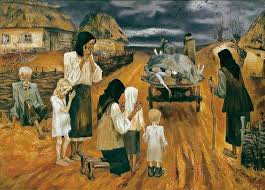
A painting by Valeriy Franchuk, “Harvest of famine” (2000)

A Reblog.

NBC news recently ran a piece on Trump meeting with Ukrainian President Volodymir Zelenskyy. In a video clip Mr. Trump announced that he had spoken with Zelenskyy about opening talks with Vladimir Putin to end the conflict between the two countries. Trump stated to the cameras that Russian President Vladimir Putin would give Ukraine a “good deal.”

Mr. Trump does not know nor does he care about Ukrainian history. If he did, the president would understand that negotiating with the Russian leader is unthinkable, a non-starter. To understand why is to look not only into Ukraine’s recent past but back into the 1930’s.

Putin’s first attempted assassination targeted Ukrainian President Viktor Yushchenko. In 2004 Yushchenko narrowly escaped death after surviving dioxin poisoning, a combination of toxic chemicals which left him weakened and permanently disfigured.

Putin, as a former KGB operative is a master of murder, and why the International Criminal Court has an arrest warrant for him.

An impulsive hustler by nature Trump shows little interest in the crimes of Vladimir Putin. After the recent meeting in Alaska, Trump again called on Zelenskyy to make a deal with Putin. That the Russian has targeted Zelenskyy in numerous assassination attempts on multiple occasions, including three failed hits in one week is of no consequence.

However this narrative reaches back further to the early Twentieth Century, when another strongman, Josef Stalin rose to power.

Following the 1924 death of Bolshevik leader Vladimir Lenin, Stalin coldly and efficiently murdered his own rivals consolidating his power as an absolute despot.

Launching his Five Year Plan, Stalin’s vision for economic prosperity, he ordered collectivization of Ukrainian farms, seizing land and harvests for Russia’s consumption. Calling farmers Kulaks, a pejorative name, Stalin justified his actions by fabricating enemies, complete with mass arrests, show trials, executions, and deporting thousands to Siberia. In that period alone thousands of Ukrainians perished in freezing rail cars, or worked to death in frigid Siberian work camps.

The total number of transportation deaths remains unknown.

However transport was not the worst weapon employed by Stalin. Ukrainian Communist party workers not only stole seasonal harvests but also the seed for future planting.

A genocide followed.

From 1930 through 1933 millions of Ukrainians starved to death or resorted to cannibalism due to Stalin’s disastrous Five Year Plan. Production dropped under the forced collective effort, and the Communist leader had to find scapegoats for the disaster, so he pinned blame on the farmers. Kulaks were dying in massive numbers on purpose to undermine the Kremin’s economic plan.

Stalin insisted he was the victim of treachery.

Called the Holodomor, (death by hunger) as it is remembered, cost the lives of somewhere between 3.5 to 5 million Ukrainians. Adding that number to those deported to Siberian gulags it is safe to say that the Ukrainian people suffered a monstrous horror.

Ukrainian memories and justifiable outrage remain vivid.

As for that ‘good deal’ with Vladimir Putin, President Zelenskyy is not interested. The Ukrainian President has no faith in Russian promises, and is not impressed by Mr. Trump and his previous effort to shake Zelenskyy down for corrupt political ends.

Today thousands more Ukrainian soldiers and civilians have lost their lives fighting this Putin-engineered war, but with national memory to guide them Ukrainians will not back down. Ever.

Independence from Russian oppression is relatively new and very fragile, and that nation will never surrender on Trump’s assurances of a ‘good deal.’ The people of that battered nation know better.

So should we.

This is the web site of the Ukrainian Embassy in DC if you’d like to make a contribution.

https://www.ukrainehouse.us/

Gail Chumbley is a history educator and writer.

Behind the Smiles

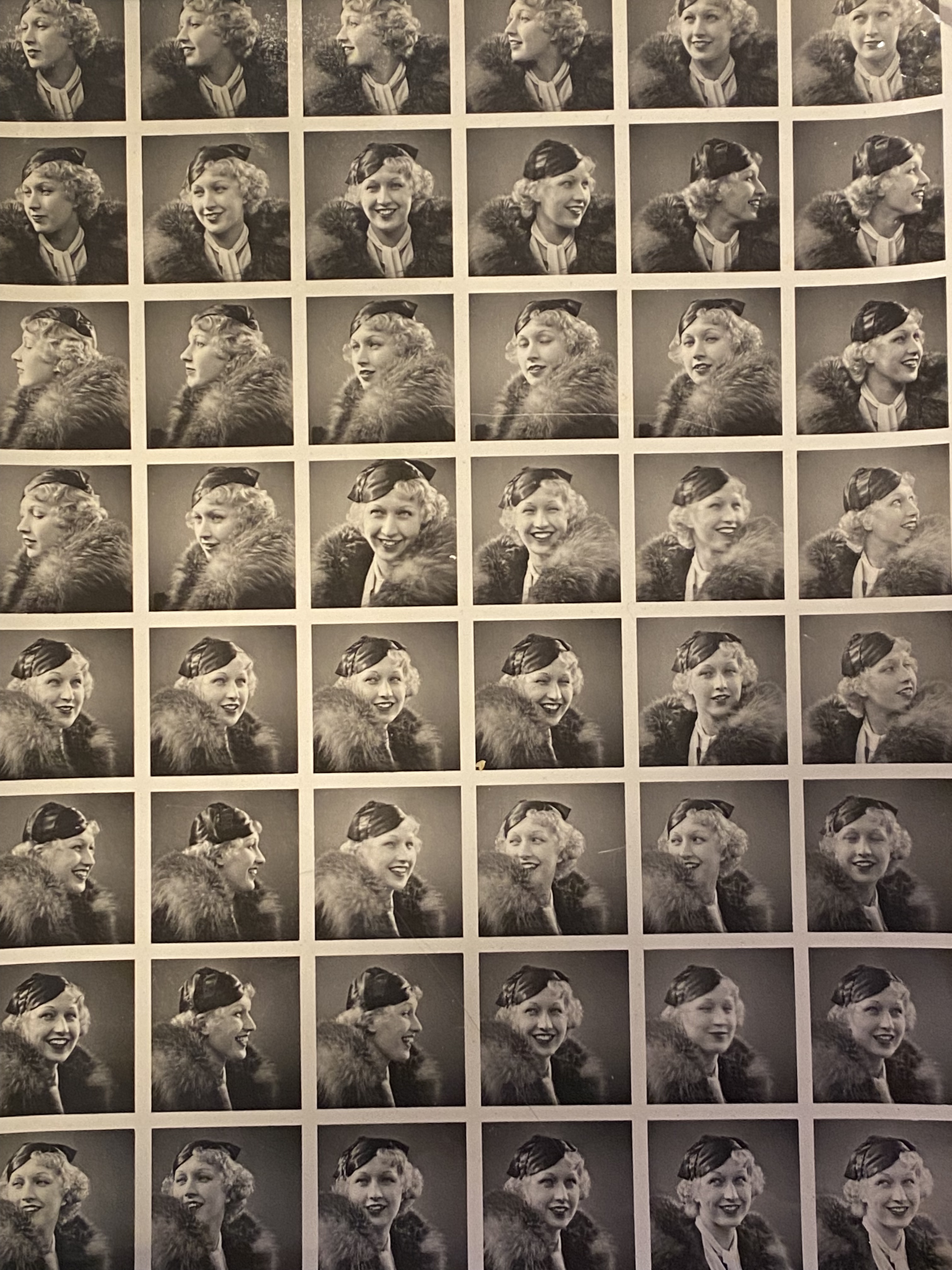
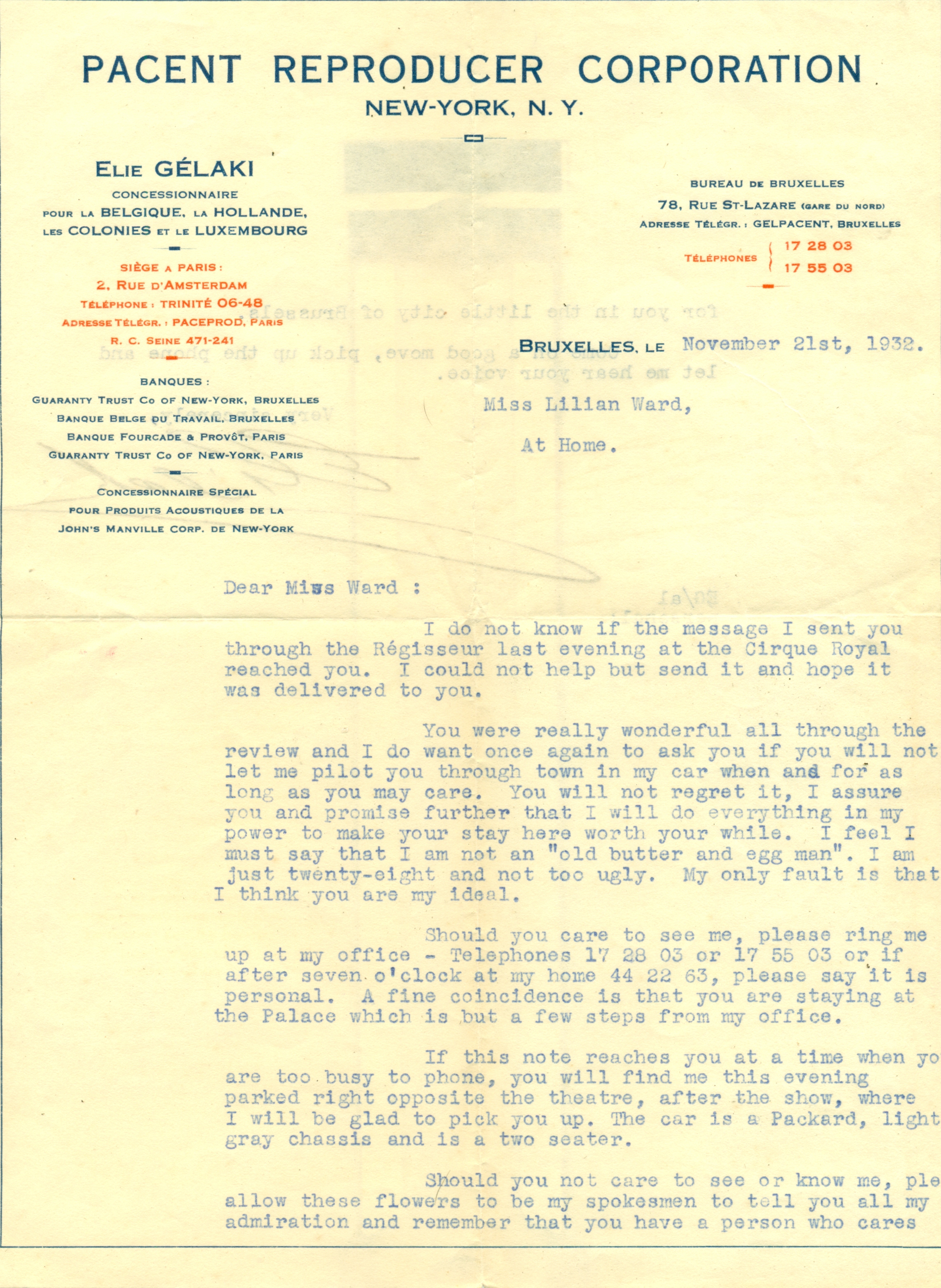
This, of course, is Ann Frank. She sat for this photo montage in Brussels, Belgium, probably just before the war. The studio’s name was Polyphoto International and it was owned by a gentleman named Elie Gelaki.

Six years earlier Elie had established another studio across the Atlantic, in New York City, and evidence indicates he aimed to do the same across Canada, and Japan. Whether those offices actually opened is hard to determine, especially in Japan as war with China had erupted. However, the New York studio did open for business and Elie got to work.

The subject of this session was the reason Elie had traveled to New York. Her name was Helen Thompson and she was a professional dancer. Though at first he had mistaken her name, Elie fell in love with the Helen, eventually following her to New York, seeking marriage. But the wedding never came about.

The 1930’s was a perilous time, especially for people like Ann Frank and Elie Gelaki, both Jewish, living their lives under the growing shadow of Nazism. And though Helen never married the Belgian she worried about his fate as the European war blitzed to life, and of course she knew nothing of Ann Frank until later. You see Helen was my mother-in-law, and though we never met, my husband told me she occasionally shared her anxiety regarding Elie’s fate.

It is evident that behind the smiles, and the momentary pleasure of picture taking, an epic story of three individuals played out in a dramatic chronicle of the 20th Century.

For more of this story read “River of January,” and River of January: Figure Eight” both available on Kindle.

Chumbley has also penned a feature film script based on the books titled, “Dancing On Air,” and in addition two plays on American history topics-“Clay,” and “Wolf By The Ears.”

gailchumbley@gmail.com

Reading Tea Leaves

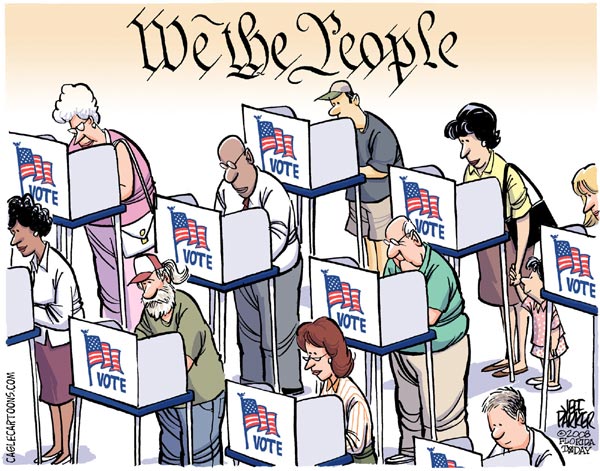
Elections belong to the people. It’s their decision.

Abraham Lincoln

From 1790 to now, American midterm elections have functioned as an effective gauge of public opinion. 

Despite southern secession, and the subsequent war of rebellion, President Lincoln viewed national elections as the indispensable foundation of a free government. There were dissenting voices calling for cancellation of the 1862 midterms due to the war, but Lincoln did not hold to that. 

After two years in office, Lincoln needed to know where he stood with the people. The Republican Party kept majorities in Congress, but a significant shift among unhappy voters surfaced. 

Democrats (those still in the Union) picked up 27 seats in the House. Though the Senate did remain in Republican hands, Lincoln understood the first two years of war had cost him plenty. Bloody defeats on the field of battle at Bull Run, the Peninsular Campaign, plus the massive casualties at Antietam had cost his administration.

In the Twentieth Century, the bi-election in 1934 delivered a powerful message of support to Franklin Roosevelt and his administration. Not only did the public approve of his New Deal, they added nine more members to the House majority, and an additional nine to the Senate. Clearly Roosevelt’s economic measures had grown in popularity across the stricken nation. Conversely, by 1938, Democrats lost 72 House seats with 81 gains for the GOP.  FDR took those results to heart changing course on some of his policies.

Harry Truman, FDR’s successor inherited a more divided America. The Democrats had enjoyed nearly fourteen years in power, but Truman’s presidency faced a shifting change. In the midterm election of 1946 the GOP secured majorities in both the House and the Senate. Fifty-five seats changed hands in the lower chamber, and seated twelve more in the Senate. The public did not view Harry Truman in the same light as his predecessor.

There are other illustrative bi-elections to examine. For example, 1982, where the Democrats picked up 26 seats in the House, and seven in the Senate after two years of the Reagan Administration. And in 1994 Newt Gingrich’s “Contract With America,” where the GOP picked up 54 House seats, and eights seats in the Senate. With that majority, Republicans worked to undermine the Clinton Administration. 

The midterms do act as a barometer of America’s political winds. A great deal is to be learned by analyzing voter turnout and the winners and losers. Political Parties can find where they stand with the people, and adjust accordingly.

In that light this last 2022 midterm spoke volumes as well. In a most unlikely scenario, where inflation and high gas prices, plus low poll numbers for our sitting president, the public rejected the GOP’s crazy MAGA’s. Yes a hand full of seats did shift the House, but barely. The former guy has clearly worn out his welcome, and voters have had enough of that sideshow. 

That he and his followers are oblivious to the temperament of the people makes no difference. The numbers don’t lie.

If this half-dozen, or so reelected extremists believe they have a mandate from the American people they are seriously mistaken. For next the two years the country will be forced to watch the same tiresome, noisy political antics they rejected at the polls.

You all are going to overplay your hands, and sink your party.

Don’t believe me? Just ask Newt Gingrich. He’s out of office and has time for your call.

Gail Chumbley is the author of the two-part memoir “River of January,” and “River of January: Figure Eight.” Chumbley has also penned two historical plays, “Clay” on the life of statesman, Henry Clay, and “Wolf By The Ears,” an exploration of racism and slavery in America.

Earned Wall Space

Poking around the basement in my mom’s house I unearthed a framed black and white portrait of Franklin Delano Roosevelt. The picture had been in a stack with other effects from one set of grandparents or the other. Certain this pic would probably end up in a dumpster, I packed it in my suitcase and brought it home. Our 32nd President is on display among other WWII pieces I’ve collected over the years.

What was it about Roosevelt and his times, that earned him premier wall space during the Depression and war years? Today the idea of commemorating a political leader with a  wall display seems odd and quaint.

So again, why did my grandparents include FDR in their home decor?

Admiration may be one reason. FDR appeared bigger than life. The man seemed to have it all: looks, money, and a pedigree that stemmed back to the early Dutch in America. His distant cousin, who also acted as his uncle-in-law, Theodore Roosevelt, still loomed large in American memory. That Franklin Roosevelt wished to carry on the tradition, especially in a time of economic collapse felt assuring.

The laissez faire policies of previous Republican administrations made for widespread fraud, especially on Wall Street. The 1920’s had been a heady time of speculation on the Dow, with banks making reckless loans on high risk investments. When the frenzy crashed and burned in October of 1929, the sitting Republican President, Herbert Hoover, suffered all the blame.

That fact raises another strength of President Roosevelt. The public trusted him. While autocracies generated “cults of personality,” Stalin, Mussolini, and Hitler, this candidate earned his office promising America a “New Deal.” He assured the country that they had not failed, the system had forsaken them, and as their new President he meant to correct those abuses.

The choice to hang Roosevelt’s portrait came from genuine respect, not fear or blind partisanship. The people elected FDR because he meant to be of use to all the American people.

This President brought energy and purpose to the Executive Branch reaching Americans personally in their daily lives. New Deal legislation quickly translated into action with legions of new programs all designed to get folks working again. The public felt a connection to the White House that perhaps hadn’t existed before that time. Mail arrived in daily landslides, mirroring FDR’s earlier political victory. Most letters requested a “hand up,” not a hand out, and that any financial help would be repaid to the government. R.E.P.A.I.D!

FDR brought electricity to rural America, lighting the night and powering radios that broadcast his Fireside Chats. Bridges, schools, and other large engineering projects connected the nation as never before. It’s a sure thing your town or city still bears an imprint of FDR’s time in office.

So it is with respect and gratitude that I have placed Franklin Delano Roosevelt on my living room wall. He set the bar for what a Chief Executive ought to be.

And after all, it’s a family tradition.

Gail Chumbley is the author of the two-part memoir, “River of January,” and “River of January: Figure Eight.” Both titles are available on Kindle. Chumbley has also authored three historical plays: “Clay” on the life of Senator Henry Clay, and “Wolf By The Ears,” concerning the evolution of racism and slavery in America, and Peer Review, where four long ago presidents speak with 47.

gailchumbley@gmail.com

The Long Haul

After the 1929 Market Crash the world fell into regional, nearly feudal isolation, and international trade quickly dried up. America, too, focused inward largely due to the nation’s earlier participation in the Great War in Europe.

Across the Pacific the Japanese Empire aimed to take advantage of global disinterest promoting its own national interests. Sold to other Asian countries as the “Co-prosperity Sphere,” hyper-nationalistic Japan intended to expand across the region, especially toward vulnerable, resource rich China.

Great Britain as well, struggled alone in a financial malaise, as did the French across the channel; both nations saddled with debt to American banks from the previous war. Germany, the defeated nation struggled with their own war debt demanded by the British and French.

The shroud of economic depression hung like a millstone over Europe and the rest of the world.

As the financial, and political fallout grew wildly unstable, regimes hunkered down and hoped for better times. However the climate instead became chaotic, bringing anti-democratic demagogues to power.

The Italians were first, producing a Fascist strongman, Benito Mussolini. El Duce, as he was known suppressed political diversity, harnessed economic efficiency, and soon, like the Japanese, pursued colonial inroads into Libya, and later the conquest of Ethiopia.

Germany soon flirted with its own style of fascism, with a meaner, violent credo. In a reaction to impossible debts, and national pride, Adolf Hitler, a feckless dreamer, stood on beer hall tables, and passionately spoke of national betrayal. Hitler revealed his malicious intentions by blaming Bolsheviks, Capitalists, and Jews for the hated Armistice of 1918, and war debt owed to the Allies.

Yet America, unlike the rest of the world, clung with all their might to the national system of Constitutional norms. At the same time Germany elected Hitler in 1932, the U.S. found their champion in Franklin Roosevelt. 

A popular Roosevelt Coalition steered the country through those hard years holding America together. FDR’s New Deal and Fireside Chats broadcasts kept at bay the fears of a nation. That’s not to say there weren’t kooks, to borrow Lindsay Graham’s phrase, but Americans faced the long haul together, believing better days had to be ahead.

The current President is no Franklin Roosevelt. And his autocratic tendencies, strongly echo those in the 1930’s.

In Project 2025 Trump aims to raise tariffs, shut down borders, all done to economically and politically isolate America. Using the same playbook of past despots specific groups are targeted as the problem. The guilty include immigrants, the LGBTQ community, liberals, educators, women, and the rule of law all in the crosshairs. All done to divert and distract while he lines his pockets.

And his tactics, so far have succeeded making half of the electorate real mean.

So, here is the question. Can America survive?

Can Americans remain bound to the framework of our 238 year old republic as it did in the Great Depression? Or will this nation forsake our financial, social, and political traditions and turn to petty retribution and scapegoating?

Will we, as a nation withdraw from the world and exchange our democracy for a strong man who insists he has all the answers?

The signs are clear. When this national crisis has passed will there be enough of us left who stood resolute for our democracy? That is the question of this historic moment. 

Gail Chumbley is a writer and history educator.