Confessions Of An Aging Teenybopper

images

Culling through pictures, playbills, luggage tags and every sort of memento in the Chumbley archive, I discovered some odd newspaper clippings. This small sheaf of articles stood out because they had no bearing on show business, airplanes, or any other achievement of my principle characters in “River of January”. The collection, clipped together was titled, “Love and Marriage.” “Love and Marriage?” Helen was a career girl, a professional! Yet she had carefully cut them out of the paper, and valued the advice enough to keep them for over seventy odd years.

Helen was, in reality, a romantic girl, a girl who dreamed of an ideal ‘happily ever after.’
Like me.
Yes, I am a closet romantic. Despite all the years spent teaching wars, treaties,and politics, I still hold on to my teenage heart.
The boy pictured in this essay is Mark Lindsay of Paul Revere and the Raiders. The band wasn’t my favorite by any means, but he was so cute. His smile on a show, “Where the Action Is,” cut me to the core. I was infatuated, as were most seventh grade girls in America.
My hair hung straight, fortunate at a time of when straight hair was the thing, wore A-line dresses called Tent dresses, and cute little round toed pumps with crazy designed stockings. Preferred lipstick came from Yardley, an English brand, or for us poor girls, Avon. The color was frosted white, or subtly pink.
And I liked boys. Boys were the ideal “them,” the unfathomable other, the male prepubescence sirens that dominated my thoughts, and permeated all conversations with my girlfriends.
Just the opening bar to the Beatles, “Night Before,” sent me into a tail spin. Paul wanted me to love him. Sigh. And the Young Rascals asked, “How Can I be Sure?” And that tore me up. My heart and mind was an explosive combination of fantasy, adrenaline, hormones, and electric guitar riffs.
It’s still a jumble in my mind, those long ago days. But I think that is somehow the right way to remember. There was a war, (in Vietnam), riots, (in Watts), and students rising up across college campuses with an unrest detectable in my seventh grade classroom.
Most of the upheaval I processed in terms of cute boys. There, I admit it. But that was certainly a long time ago, and today those glamorized notions have been replaced with a deeper understanding of the historic record, and a trail of broken relationships. And maturity.
It hasn’t been seventy years of saving the “Love and Marriage” columns, but young girls and romantic idealism remains a constant. Younger girls are more transparent, expressing their romantic enthusiasm, but we older girls haven’t forgotten.
Just check out my playlist on itunes.
Liberty Tree

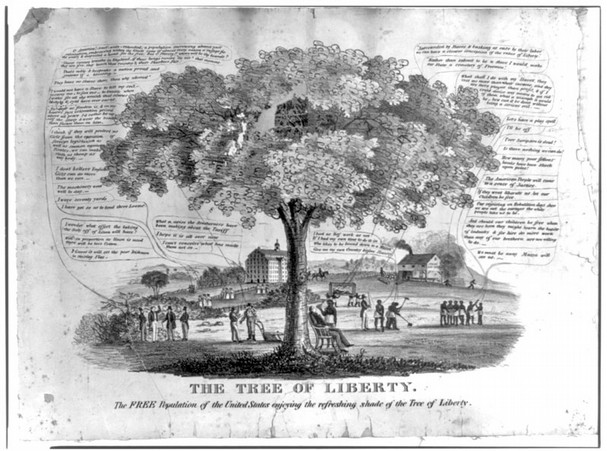
ImageOne symbol, endless interpretations. That is the age old condition of American Freedom. It is a messy affair with so many choosing to see their personal freedom as finite property. If another individual, or group realizes a gain, others record a loss.

If the Liberty Tree (above) represents that nebulous idea of freedom, the metaphor is easier to see. Made up of mostly white males, working class boys, the Sons of Liberty were the foot soldiers in the struggle for freedom. Those young men had access to guard the grounds around the trunk, and decide who could approach the tree.

Then came Scott V. Sanford, 1857 and the court ruled that slaves were slaves and absolutely prohibited  from the grounds where freedom stood.

The Fourteenth Amendment, known as the “Second Bill of Rights” guaranteed equal protection under the law to ALL Americans. Theoretically everyone was now protected under that mighty elm.

In Plessy V. Ferguson, 1896, Black Americans were allowed to peek at the tree, but only from far outside the vicinity, away from whites. If blacks felt inferior from the “Separate, but Equal” decision, that was their own problem. (Read the decision, it really says that)

Women too, steadily circled the grounds of the green–their collective eyes determined to examine the quality of the wood. Soldiers such as Elizabeth Cady Stanton, Dorothea Dix and others demanded the promise of American self-agency. Then came World War One, and women would wait no longer. Under the duo leadership of moderate Carrie Chapman Catt, and radical Alice Paul, the Nineteenth Amendment was ratified and women joined the male-dominated electoral process. These girls advanced toward their prize, though not yet able to explore the texture of the trunk.

Of course, through those many years, male interest in women’s reproduction remained paramount. “Coveture,” was a legal principle–women as property, covered by their men’s standing. Women only experienced that tree in a token sense, with permission from their father or spouse. Those brave enough to challenge the status quo, those who spoke out on reproductive rights, or even voting rights found themselves in jail. Take a look at the lives of Susan B. Anthony and Margaret Sanger. Those two women dared to touch the tree and were caught, shamed, and punished.

Roe V Wade, 1973 changed the subjugation of women for ever. In addition to the introduction of birth control pills, the girls not only circled the trunk, but were finally climbing the branches! Women could wait to start families. They could pursue education, fly airplanes, trek to the North Pole. The view from the tree top was fabulous.

But the powers of inertia, the sense of lost freedom pervaded the ranks of those who believed they were losing in this zero-sum game. Their freedom was diminished by that gained for Black Americans and women. The pull came, the courts listened, and the ropes went up again around the trunk.

In light of recent Court decisions, women are again relegated to the curb around the green. They can see the tree, but others who tout their stronger claim to freedom guard the grass. The personal proclivities of some trump the claim to self agency of others. Margaret Sanger, Mrs. Stanton, Frederick Douglass, for that matter, and Alice Paul would not be too happy with the backward turn in women’s standing concerning their autonomy. (Plus the hacking away at the Civil Rights Act of 1965)

That historic tree must spread its roots and grow to remain healthy. The reach of its branches are limitless, and no one loses freedom by sharing it’s blessings with all born to its legacy.

Happy Fourth of July.


Sharing Stories

Image


We spent Saturday and Sunday under a white tent at our local mountain golf course. The setting was an annual Art & Wine Festival and many attendees came by to talk about and purchase River of January.

Now this community, at first glance, seems sparse and hidden among the trees and peaks. But promote a fun public event, sell some food and drink, cooperative weather of blue alpine skies, and the crowds materialize. I recognized more people–more than I ever believed I knew here, swapping a story or two and catching up from last time we spoke. Some who passed by shared epic stories of their own about their family members or friends from the past. So many of us have memories that need only a spark to reignite.

It occurs to me that meaningful bonds are forged by shared experiences. One fellow who came by our display has become a real ally in promotion of “River.” We first met him when we moved up from the city in 2007 when we knew no one. My husband and I agreed to host a party for this gentleman at our new cabin, as he was running for public office. Now, between his earlier political campaign and my book, we are friends, we share a past.

Another passerby was a woman I worked with in education, and she was great. She stood under the tent and just beamed at me, repeating, “I’m so proud of you. So proud.” We indeed go way back, fighting the good fight for eradicating ignorance among the young. There is no need to explain, or promote, or sell her on anything, we know each other. She and I are on the same team.

Clearly a shared past binds people together, without the fuss of selling oneself. Sharing a previous experience gives us all a basis to reconnect in a real way. That is why I think family is great. That history is deep and transcends words or behaviors–the family unit goes way back. No explanations, no rationalizing, diapers have been changed here.

America was founded on a shared story. Colonies, Revolution, Constitution, Slavery, Civil War, etc. . . Actually in Lincoln’s first inaugural he appealed to Southerners to recall that shared history with the Union. “Mystic chords of memory,” were the words the new president selected. And perhaps that is the central issue that divides Americans as I write this blog. We struggle to find a common narrative of who we are. Which story is the common connection that brings the American public together? Is it next week on the Fourth? Does that holiday mean the same thing to each American? Or has a common past become too remote and too brittle to bind Americans together as a people?

My book “River” is an attempt to remember. The work is a celebration of Helen and Chum extraordinary story. Even my own family keeps a narrative of who we are which comes up regularly when we gather. I believe we are strengthened and revitalized as individuals when we find our place among others–with family, with friends, and as citizens.

It’s the common stories that gifts to us our perspective, proportion, and place.

Read River of January.


Sailing to Rio

Sailing to Rio

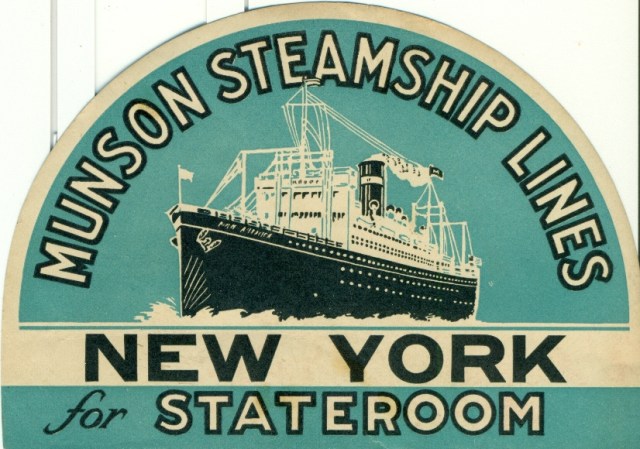
First Chum, then Helen traveled to South America via the Munson Line. A couple of names come to mind, “The Western World,” and the “American Legion.” “River of January” carries the reader back to an earlier glamorous, and wondrous world.

Then There was This One

Standing outside, rain or shine, hot or cold, fire drills were a pain. They interrupted the flow of the lesson, the morning, the afternoon, the day. I especially hated that obnoxious buzz alerting all to evacuate when testing was underway.

But, there was this game we played while getting soaked, or freezing, or scrumming together to shoot the breeze. I called it the ABC Game, and here is how it played out. Someone would pick a category, say World War Two, or Harry Potter and we would take turns filling in the next word.  A is for Azkaban, for example. And it was not only fun, but kept the kids together and occupied till the all-clear bell back to class.

So for your reading enjoyment, and to hopefully sell some books, I shall play the ABC’s of River of January.  Ahem, here goes.

A-Aviation

B-Buenos Aires

C-Chum

D-Don Dean Club

E-Mr. Evans

F-France

G-Grant Garrett

H-Helen or Hollywood

I-Ile de France

J-Jans & Whalen

K-Mr. Koserin

L-Lartique Agency

M-Mistinguett

N-“Night Flight”

O-Ovation

P-Pan American or Palladium

Q-Queen Mary

R-Rio de Janeiro

S-Surratt

T-Thompson

U-ungent pots

V-“Voila Paris”

W-Harold Whalen

X-who knows, xylophone

Y-yawl?

Z-zeitgeist?

Order River of January today.


Increasing Value


I like speaking before crowds. The opportunity to tell stories and explain ideas was how I made my living for thirty odd years in the classroom.

Today, the breadth of my public speaking concerns discussing my book, River of January.

Before each talk my husband and I set up artifacts from the lives of my protagonists, Helen and Chum. For example I have this great picture of Helen in a chorus line dated around 1932, probably in Vienna or perhaps Brussels. There’s another of Chum posing in front of a biplane, a dashing smile exuding pure joy.

Listeners seem to enjoy poking around the display of mementos, especially after I present the slideshow describing a lot of the back story to the book.

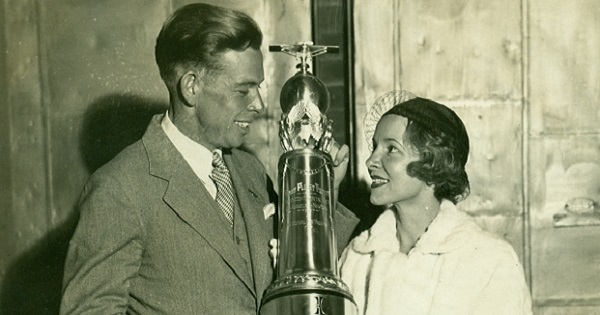
Watching faces in the audience is something I particularly enjoy. On the table we also feature a vintage aviation trophy–tarnished, old and rather forgettable. Attendees often bypass this object until I describe the air race the object commemorates. Faces literally shift, expressions of nonchalance becomes enchanted with wonder. This trophy is clearly viewed with new eyes.

That’s the part I love the most. Inspiring a sense of wonder in a tired world weighted with cynicism.

helenhayes600w

Mont Chumbley receiving trophy for first place in the Darkness Derby.

Actress Helen Hayes hands over the prize publicizing her new movie, “Night Flight.”

Capitol Theater, New York, October, 1933

A Mouse In My House

Image

I could hear a mouse under the bed. Crisp little maneuvers, poking around the books and pictures stored down there. Now, I am not afraid of mice, that’s more of a snake issue, but still, this little varmint rooting around wasn’t exactly relaxing.

I woke my husband, and he didn’t complain or resent my waking him so late. He doesn’t like home invasions any more than I do. Instead he hopped up and found a mouse trap on the porch, slapped peanut butter on the trip latch, then just as promptly hopped back into bed and fell asleep.

Now, sleep wasn’t so easy for this girl–conking out after such a creepy discovery. I rolled to my side listening as that little critter resumed his inventory of my stuff.  My stomach tensed some, waiting for the steel of death to suddenly snap. It might as well have been a grenade with the pin pulled out. I simply couldn’t  twiddle my thumbs waiting for that deadly crack.

That huge comfortable couch in the living room soon beckoned to me. I grabbed my pillow and extra blanket, bedding down away from that condemned rodent. And though my eyes were closed, my mind remained wide open, still anticipating that sudden snap. Extra pillows seemed fitting, and I piled on those that were in reach. While fussing around, trying to get comfortable, I heard that final smack, and thought that maybe sleep could now finally find me.

My mind wandered, just drifting here, floating there, eventually focusing on my second installment of River of January, The Figure Eight.” I’m a little stuck in 1938–big things happened all at once and I need to get a grip on my approach. Helen was stuck in New York at that moment and Chum was flying around the Midwest. She needed to do something besides nothing, so I researched a little of what was happening on the stage. Well, I found some memorable plays, movies and concerts while she was waiting for him. And those events were the destination of my sleepy thoughts.

Bam, right between the eyes–the thesis of my entire work hit me. It was me doing the hopping now, and I leaped off the couch, fired up my laptop and pounded away. Holy smoke-a-roonies! I thought inspiration came while trying to think, not while trying sleep. And I loved the direction my absent thoughts took me. But, alas, no . . . I am not spilling the beans here on that midnight epiphany. For that readers must wait for the second book. 

For now remember River of January is for sale. (click the title, it takes you right to the webpage)

I owe that dead little vermin so much!

Good Times Bad Times


Image


This is not a blog about Led Zeppelin. I have shamelessly used this title and image to get your attention. I am sort of sorry, but not really.

This blog however does concern the song title, “Good Times, Bad Times.”

At a book publishing seminar I attended a while back the speaker warned that marketing books was much more difficult than writing books. I didn’t believe her, or more accurately I couldn’t allow myself to believe her. At the time I was slinging rubbish into my manuscript and worse, knew my style was bad.

A couple of years later here we are–River of January is complete and I am finding that wise facilitator’s words haunting me. I think we are doing everything right, talking about the work whenever and wherever I can find a platform. Book stores, libraries, service clubs, book clubs, pushing the story on friends–you get the picture, Those who have read River, for the most part, ooze with enthusiasm and push me to complete part 2, The Figure Eight. And I am trying to get back into that writing zone, communing with Helen and Chum, by studying their mementos, listening to Chum’s taped interviews, and brushing up on the historic background of their lives. But there is this big problem in my attitude toward the second manuscript . . . plunging into the marketing angle again, when I have only sold around two hundred books with the first one.

My husband is a good cheerleader, claiming that everything with the book is good, and that we will meet our goals. We will sell books, and the public will respond in a positive manner. I think he might be right, the whole package is gorgeous: cover, interior design, pictures, font, paper color and yes, even the style and especially the story.

So Good Times must certainly follow this funk in the process of publication, and leave behind the episodes of Bad Times.

So once again consider River of January. It’s a pretty good read, even if I say so myself.

Eyes of the Beholder

Image

Is he trying to hold her hand? I have stared, examined, and analyzed this snapshot a zillion times and wonder what Grant is thinking about Helen.

Pictured above was the Vaudeville team of Garrett & Thompson–a team of hoofers out of Los Angeles touring Depresson-era America. Cracking jokes, singing, and of course blending in Helen’s ballet talent, the two traveled from here to there earning scarce cash to get by.

River of January  is not a romance novel (not that there is anything wrong with those). However the story does include the twenty-something search for love, finding flirtations along the path to adulthood. Grant Garrett became Helen’s first passion–the team leader, writer, and choreographer. She was very young, just eighteen, when she fell under the spell of her partner.

Since the publication of the book, I’ve asked readers their views on this chapter, on Grant Garrett. One young lady admitted she had a “crush” on Grant. A man-friend dismissed the dancer as a “cad.” Many others simply want to know what became of this debonaire song and dance man. (I smile and reply “Book Two).

His letters reveal much on his growing ardor concerning Helen. He fell hard for her and desperately wanted to make her his wife. But that never happened. What does that say about Helen? What does that reveal about the smitten suitor? Was it love? Was it for the moment? Was he actually a cad?

That is the beauty of releasing a book. It immediately becomes the property of the reader, and in more ways than a purchase. All whose eyes rake the pages decide for themselves the quality and nature of the characters, and their intentions.

As for me, I too have a crush on Grant. His letters entertained me all through the research for this creative nonfiction work. A handsome face, and razor sharp sense of humor, and an eagerness for success are hard for this writer to resist.

Now for my pitch: If you have read River, please comment on the smooth operator pictured above. I’d love, LOVE, to hear your opinions on his character.