Living Life Forward

It was the night of February 9, 1964, a Sunday, when my older brother and I had to make a crucial decision.  We were both over stimulated, frantic, not one of our four feet remaining long on the floor. The house vibrated with our excitement and the weight of our impossible dilemma. For starters our birthday was the following day–the 10th, (though we’re not twins–he’s a year older). Still, that pre-birthday fuse had already ignited and by the 9th the two of us were banking off the walls.

The quandary we faced that Sunday night was whether to watch “Davy Crockett at the Alamo,” starring Fess Parker on Disney (The Alamo!), or the Beatles on Ed Sullivan. This was that first historic Beatles broadcast, live on American television, and we agonized between the two choices.

In 1964 there were no video players, no DVD players, no home computers, or dvr’s, in fact televisions were the size of Volkswagen’s and transmitted in glorious, flickering black and white. This difficult decision counted because there was no rewind, there were no do-overs. One gain meant one loss.

We liked Davy Crockett an awful lot.  We had watched all the previous episodes, and Davy biting the dust in San Antonio was the much anticipated grand finale. But, oh, the Beatles! And the adoration was real, palpable, an injection of adrenaline without the needle. We worshiped at the warmth of our bedroom radios, perpetually tuned in to our local AM radio station. Reverent silence accompanied replays of “She Loves You,” and “I Want To Hold Your Hand.”

What could two grade schoolers, sick with anticipation do with such a weighty conundrum?  It was 1964 and we had to choose.

Before the proliferation of electronic media, this little girl of the 1960’s viewed momentous events as they beamed across the screen. MLK’s elocution at the Lincoln Memorial, President Kennedy’s inaugural address, his assassination, and the escalating war in Southeast Asia–all experienced as reported at that moment.

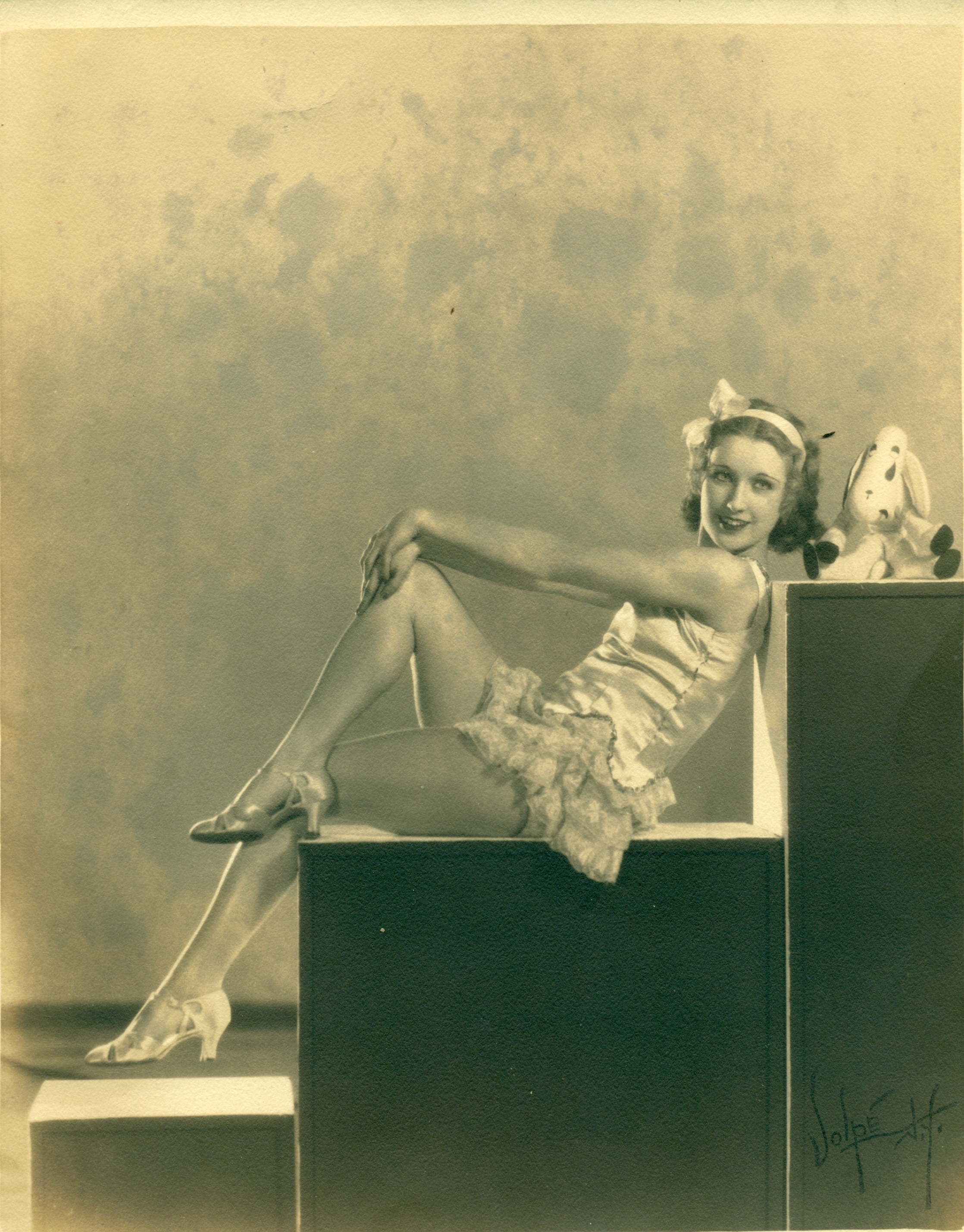
In an earlier era, when Chum flew in his air race, and Helen danced in Rio at the Copacabana, there were no camcorders or Iphones. His signature landing and Helen’s near disastrous opening night grew silent as the applause subsided, then faded in time. Much like my brother and myself in 1964, they lived life forward, one opportunity at a time.

Silent photos and written records are all that remain verifying Chum’s aerial dash through darkened skies, and Helen’s energetic dance routines. They lived life forward, embracing events as they unfolded–experienced once, then gone. I would love to see footage of Chum’s Waco airplane lifting off at dusk, or watch Helen spring across the stage. But those wishes are pipe dreams, never to happen. No vintage film or recording, (except one I found by accident) exist in the historic record. The best I can do for myself, and for readers, is try to recreate the magic of the first time around in the pages of my River of January.

Oh, by the way, I’ve never seen “Davy Crockett at the Alamo.”
ImageGail Chumbley is the author of the memoir, River of January. Also available on Kindle.
Sharing Our Truth

Image

I retired from teaching last May after more years in the classroom than I care to admit.  No longer constrained by rules, rules, and more rules, I began friend-ing my former students on Facebook.  What once was ethically frowned upon, is now my link to my past career.  That being established, I have enjoyed viewing the posts the kids have put up since graduating high school.  In something akin to an educational diaspora, these 18 year- old’s are encountering their first experiences away from home.  Of course that includes washing one’s own laundry, filling up on starchy food, and getting out of bed for class without mom.

The pictures are charming.  Girls, arm in arm, who only a month ago were strangers, now glow, linked together in this new adventure as best friends.  The boys seem less inclined to pose.  Instead they splay across the floor of a dorm room, stuffing pizza and chips into their smiling mouths.

Still the experiences behind those photos may be the most profound in life.  Whether the setting is a dorm, or an apartment, or a cave, the ritual remains the same.

I remember best, parked on the bathroom floor in my dorm room, talking earnestly and laughing many late nights.  In my new family of girls, we revealed our essence to one another, creating a link that I cannot replicate today with new acquaintances.  Established when I was naively open, without those worldly defenses I have perfected over time, those friendships have endured.  Fertilized only with an occasional Christmas card, or a stray email–when we get together, we pick right up where we left off.

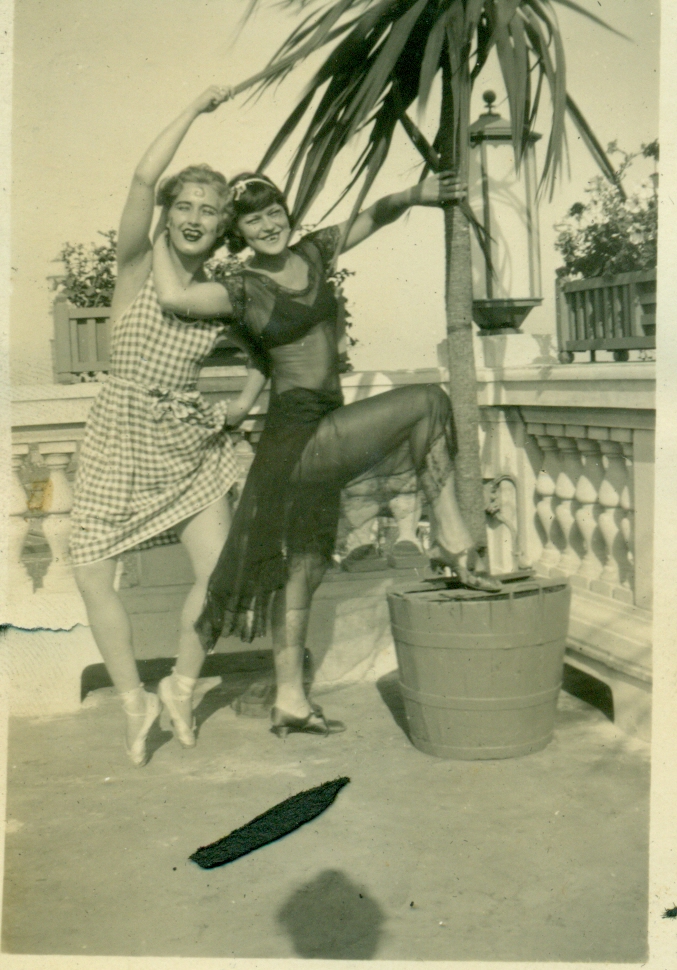
Helen, with no opportunity for college, shared a similar bonding experience with her “new” friends touring Europe.  As discussed in my book, River of January, she danced in a ballet company called, “The American Beauties,” who together performed first in Paris, and traveled as far as Algiers from 1932 to 1933.  In fact, the girl and her fellow dancers patched together their own version of a Christmas celebration at a hotel in Islamic North Africa.  She too, relished the late night yakking sessions, the joy of carrying out pranks, such as the night a group of them short-sheeted the bed of two other, unsuspecting dancers.  The picture above is a charming example of Helen purely celebrating life.

Later, these women remained some of the best friends Helen ever had.  Traveling to her home in Miami from Los Angeles or New York, the old girls sat around Helen’s little kitchen table, enjoying drinks, reminiscing and laughing.  For a short moment, seated at that tiny white table, they again were the same young dancers who had reveled in an extraordinary and memorable learning experience of their own.

Smoke Gets in Your Eyes

th

She is bent over a small Mercury outboard, hoisting the little motor in and out of the water. Her hair is wrapped in a kerchief, much as it had been when she wired mine sweepers at the Bremerton shipyards during the war. Ailene has a cigarette in her pressed lips, Humphrey Bogart style. Her black and white knit shirt has a small pocket on the left sleeve, over her bicep, and tucked inside is a pack of cigarettes–her brand, Kent. At the end of her day on the lake, my grandmother regularly downed a couple of high balls of Canadian Club, on the rocks.

My life with my grandmother has aided tremendously with the writing of River of January.  and the sequel, The Figure Eight. She, like Helen and Chum held lifetime memberships in the “Greatest Generation,” so her attitudes, word choices, and music preferences shape my thinking while I write.  Sadly she died in January, 1990, of lung cancer no less, taking a piece of me with her.

As for smoking and drinking, Chum appears as one of the few alum from that era who tended to nurse a beer, rather than chug, and chewed his cigar more than drawing a lung full. Helen, however, much like my grandmother, relished her bourbon every evening, garnished by a lit Chesterfield, and proceeded to enjoy a whale of a good evening.

Smoking and drinking blended into American culture in the 20th Century, unlike the prior or later era’s that demonized the practices. As I researched River, sifting through voluminous piles of documents, I encountered alcohol and tobacco ads placed next to those for baby formula and Ivory Soap, among other consumer goods. Liquor ads filled theater playbills on both sides of the Atlantic, nearly always featuring a shiny, sleek bottle bearing some stylish label. The message rang clear, drinking and smoking represented the height of sophistication, glamor, and sex appeal. Both my grandmother and Helen’s mementos, verified the truth that the party never stopped.

Casablanca, the celebrated 1942 film has struck me as the epitome of romantic culture in the late 30’s on into the war years. The gowns, the cosmopolitan style of understated and clipped dialog, and a perennial sense of righteous duty embraces that era. Americans lived hard and played hard, performing extraordinary feats while hungover at the least, or still intoxicated. These remarkable Americans handled drill presses, explosives, welding equipment, and other heavy industrial machinery, not to forget the operating end of an M1 rifle in a fox hole.

Out dancing, working a graveyard shift, partying, or fighting–all done with a cigarette resting, smoldering on virtuous, patriotic lips.

Gail Chumbley is the author of River of January, a memoir. Also available on Kindle.

Tell Us About Yourself

There is a living Hell known as the first teacher work day of a school year.  Teachers all gather in the cafeteria, drink coffee, chatter, have some laughs, that is, until the principal calls us to order.  I scan down the agenda, and invariably about three items in, it reads, Introduction of new staff members.  Each new, poor soul, who only knows the administrator that hired them, hears the words, “Stand up and tell us something about yourself.”  The responses can be pretty routine.  “Just got married, I’m new to the area, I’m a graduate of _________ University, (fill in), and so on . . .  I feel confident that this ritual is fairly standard across the business world, and any other kind of office setting, and is just as mortifying.

I, myself have endured that terrifying moment, having to publicly sum up my existence before a crowd of strangers.  The people around actually do look friendly, and try to make the humiliation a little lighter.  But the trick of the exercise is grappling for the words that provide some plausible description of my identity.  Without exception I blurt out some lame particulars, turn red, and sit down.  There I relive the trauma, echoing the dumb things I said over and over in my head.

The core substance of what makes up an identity is far more nebulous.  Describing characters in my book, River of January, has challenged me to present these people with more than a limited, predictable persona.  For example, Helen, the main protagonist is deceptively easy to classify as a blond beauty.  However, limiting her traits to one or two superficial qualities misleads the reader in underestimating her strengths.

If Miss Thompson stood up and introduced herself she would have much to tell.

In 1932 Helen auditioned in New York for a classical ballet troupe scheduled to travel Europe for three months.  The ballet mistress who conducted the audition was a notable Italian/American dancer by the name of Maria Gambarelli.  Miss Gambarelli had studied under legendary ballerina, Anna Pavlova, and became a famous artistic figure in her own right. 

As fun, lighthearted, adventurous, and easy going as Helen was, she was also a disciplined, inspired, and talented ballerina, too.  Gambarelli noted Helen’s professional skill and serious work ethic, adding the girl quickly to the company.  Incidentally the final twelve dancers selected  became known as, “The American Beauties,” who demonstrated to Europeans, in the following months, the grace and excellence of classical dance in America. 

Helen could have shared that little story about herself.