An America To Believe In

Religion in politics presumes all citizens essentially hold to the same beliefs. This premise also insists that religious conformity assures civic virtue and good order. However, in practice theocracies actually run counter to effective government, because invoking God in public debate stymies any exchange of thoughts. Without a “free market of ideas,” our society cannot advance, condemning the nation to decline, (See Middle Ages).   

The Constitution’s framers did not lightly pen any Article, Section, or Clause without study or debate, and that especially includes the later admission of the Bill of Rights. James Madison, in particular, examined other government systems, from the Greek City States through the Age of Reason. What Madison discovered was politics combined with religion inevitably sows public conflict; damaging both political and religious institutions. Madison’s purposeful language in drafting the First Amendment, (free exercise and establishment clauses) signaled that the United States would not repeat those fruitless mistakes. 

Lessons existed in America’s past, as well. In Colonial New England Puritan dissenters, such as Roger Williams, and Anne Hutchinson publicly rejected mandatory church compliance. Williams, later exiled to Rhode Island, defended his religious principles writing,

Enforced uniformity confounds civil and religious liberty and denies the principles of Christianity and civility. No man shall be required to worship or maintain a worship against his will.

As the first Catholic-Presidential candidate, John F Kennedy later echoed the same idea stating,

. . .it is apparently necessary for me to state once again not what kind of church I believe in — for that should be important only to me — but what kind of America I believe in.

And that was the point. American citizens must choose to worship freely, or not. That is the essence of American liberty. Law cannot dictate conscience, as our individual thoughts are as unique as our finger prints.

Despite the secular legacy of American law, religious prerequisites still surface from one era to another. In the earliest years of the Republic a fervor of evangelism blazed hot, recognized today as the Second Great Awakening. Beginning around 1800, and lasting until the Civil War, endless, exhausting revivals criss-crossed the country.

Choosing a faith among many began early and today is an American tradition.

Loosely paralleling “The Age of (Andrew) Jackson,” politics followed a similar evangelicalism, giving every person a choice in both their faith and their vote. As Americans migrated west voting rights followed, extending to the lower classes. Increasing numbers of farmers and tradesmen could cast their ballots and follow their understanding of Jesus with the same passion. 

Another unexpected outcome of the Second Great Awakening came in the form of countless spinoffs. Rural isolation cultivated a veritable Garden of Eden in new Protestant sects. For example William Miller of upstate New York forecasted the return of Christ as urgently imminent. He, and his followers believed Jesus would reappear sometime between 1843-1844. After the dates passed with no rapture, the church regrouped becoming today’s Seventh Day Adventists.

Methodists dispatched “circuit riders” into America’s interior. Men like Peter Cartwright, the epitome of a frontier “stump speaker,” could preach the Word of God, while beating the hell out of any heckler. 

Presbyterians split a couple of times before the Civil War. First, regarding whether or not untrained missionaries could lead revivals, or only seminary trained ministers. This controversy tore believers apart.

The schism for Presbyterians and other denominations sprouted from the controversy over slavery. North of the Mason-Dixon Line believers felt their duty was to take action and cleanse America of this national sin. Southerners, however countered that God made no mistakes, and it was God who appointed masters, and placed the slaves beneath them. Rather a handy absolution, that. It took a war to change the politics of slavery, but churches first led the way.

Perhaps the best advice on separation of church and state came from Justice William O Douglas in the court’s ruling, Engel V Vitale, 1962.

“once government finances a religious exercise it inserts a divisive influence into our communities.”

Dictating conscience is a fools errand, and a liberated conscience is the essential foundation of America.

Oh, and Christian Nationalism is neither Christian nor national. Quite to the contrary, that brand of absolutism does not promote public virtue, nor good order, but does lead to national decline, (see Holy Roman Empire)

Gail Chumbley is a history educator, blogger, and author of the two-part memoir, “River of January,” and “River of January: Figure Eight. Both titles are available on Kindle. Chumbley has authored three stage plays, “Clay,” “Peer Review”, and Wolf ByTheEars.” examining America’s past and present.

You’ve Been Played

Strains between North and South had reached critical mass by November, 1860. Escalating tensions burst with the election of America’s first Republican President, Abraham Lincoln of Illinois. The South Carolina legislature reacted by voting their state out of the Union on December 20th, a mere month later. By Spring 1861, the Confederate States of America consolidated, and on April 9th cannons fired upon a Union fort in Charleston Harbor. So began a bloody fraternal war. 

A longstanding question is how in the world did Planters, a small slice of the southern population, convince a mass of their social inferiors to risk life and limb, defending their aristocracy? The answer is rather simple, and lamentable. Folks from the lower rungs lived by the social rules fixed by the wealthy elite. The Planter Class established the rituals of polite society, and every white man below the Mason-Dixon hoped to someday to join their ranks (acquiring land and slaves).

The lower classes defended a minority they ached to join.

A small middle class of land holding farmers, and city professionals, also labored to reach the same social summit. In other words, acquiring the trappings of wealth, punched one’s ticket to ride.

Beneath this merchant-landholding tier massed poor whites. These desperate souls were left to precariously scratch out some kind existence as itinerant tenants. Contempt for this hardscrabble class is still evident through pejoratives that are still in use. Belittling terms like crackers, trash, hillbillies, and rednecks linger on in our lexicon.    

The Old South, in general, also distrusted the outside world. Foreigners, Yankees, Catholics, Jews, and immigrants, meaning anyone who might challenge rigorous, aristocratic formalities. The consequences for this delicate arrangement were profound. As the North industrialized, innovated, and modernized, Southern society languished, governed by reactionaries, more interested in public manners and bloodlines.

Outraged and insulted by Yankee ways, the wealthy roused the lower classes to defend Southern traditions, while in reality, barring any real opportunity of upward mobility.

This dynamic remains modern American politics. The GOP, in our time, is requiring the same fidelity. Party leadership honestly does not wish to serve you. All candidates want is your money and your vote to protect their interests, (especially the guy at the top). These characters are happy to rile voters through exhibitionism, and scapegoating whatever grievance you wish, especially piling it on minorities, the poor and the dispossessed.

But remember this, the traffic is one way only, and you are serve them, not the other way around. Keep delivering cash and power to the top, and nothing changes.

In short, you’ve been played by your chosen betters.

Gail Chumbley is the author of the two-part memoir, “River of January,” and “River of January: Figure Eight.” Both are available on Kindle.

gailchumbley@gmail.com

Humiliated, Angry, and Hurt

After losing reelection, he left Washington early. Humiliated, angry, and hurt, John Adams boarded a morning coach leaving the Capitol.

The prevailing issue in the campaign of 1800 concerned France, and that nation’s ongoing, and bloody revolution. Moreover, the French had declared war on England, and both belligerents  meddled in American domestic politics to turn public opinion.

As President, Federalist John Adams, had skillfully steered America clear of the European conflict, avoiding the danger of being ensnared between the two superpowers. Proud of his diplomatic accomplishments, Adams still brooded, unhappy with his lack of support from the country. His detractors belittled him, disparaging Adams as a pale substitute to the legendary George Washington.

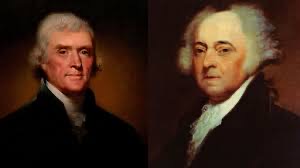
His political challenger in 1800? The clever and calculating Thomas Jefferson. 

An outspoken critic of the Adams Administration, Jefferson had been hurling plenty of invective toward the sitting President. What had once been a warm friendship between the two men quickly soured. Petulant and  thin-skinned, Adams had lashed out by pushing laws that restricted the free press and cracked down on immigration. Outraged by these policies, Jefferson, and his growing cadre of supporters, challenged the clear violations of the Constitution. 

In only the nation’s third presidential election the moment appeared volatile and uncertain. On one side was the defensive and testy incumbent, and on the other, a political foe intent on replacing him.  

Adding to the turbulence, a political wildcard entered the fray; New Yorker, Aaron Burr.

Burr, like Jefferson, had opposed unpopular and heavy handed Federalist policies, and Jefferson knew the ticket needed an electoral-rich northern state for strength. As party leader, Jefferson assumed Burr understood his lesser place, and only when the electors met did he learned just how wrong he had been. 

In the final tally, poor John Adams not only lost the election, but came in a distant third behind both challengers. Thomas Jefferson garnered 73 Electoral votes, followed by Burr with 73 of his own. Adams came in last with 65. (That tie is another story.)

Humiliated, Adams left Washington DC in a huff, but made no move to challenge the outcome. And though the former President did not greet the President-Elect, and pointedly skipped the inauguration, John Adams did not put his interests above the nation’s. 

He conceded in silence because he valued our country over his own interests. 

There is no precedent for false assertions from the clear loser in 2020.

Gail Chumbley is the author of the two-part memoir, “River of January,” and “River of January: Figure Eight.” Both titles available on Kindle, or at http://www.river-of-january.com.

gailchumbley@gmail.com

Heartfelt Objections

We couldn’t find a seat on the Washington Metro. In truth, we couldn’t see the Metro station, just a mass of humanity.

This gathering challenged the notion of enormous. The moment was historic.

Dumb luck came to our aid. A city bus hissed to a stop at the curb, and my friend and I hopped aboard, joined by a couple hundred of our new best friends. The atmosphere crackled with joy, solidarity and diesel fumes. I nearly busted out with “99 Bottles of Beer on the Wall.”

The driver seemed to catch our enthusiasm and peppered us with questions about the Women’s March. What time, where, how long would it last? She smiled realizing her shift would end before the speakers began, and I still wonder if she made it.

Nearly five hundred thousand of us convened on the National Mall, and expressed our heart-felt objections concerning the newly elected president. We marched as one.

By the way, no one violently attacked the halls of government. Though, if memory serves, I did flip off the Trump Hotel.

In October, 1969, 250,000 opponents of the Vietnam War descended upon Washington DC. In an event called Moratorium Day no one violently attacked the halls of government.

In the swelter of a 1963 Washington summer, Dr King convened the “Poor People’s” March on Washington. 250,000 Americans petitioned their government for a voting rights bill. No one even considered attacking the halls of government.

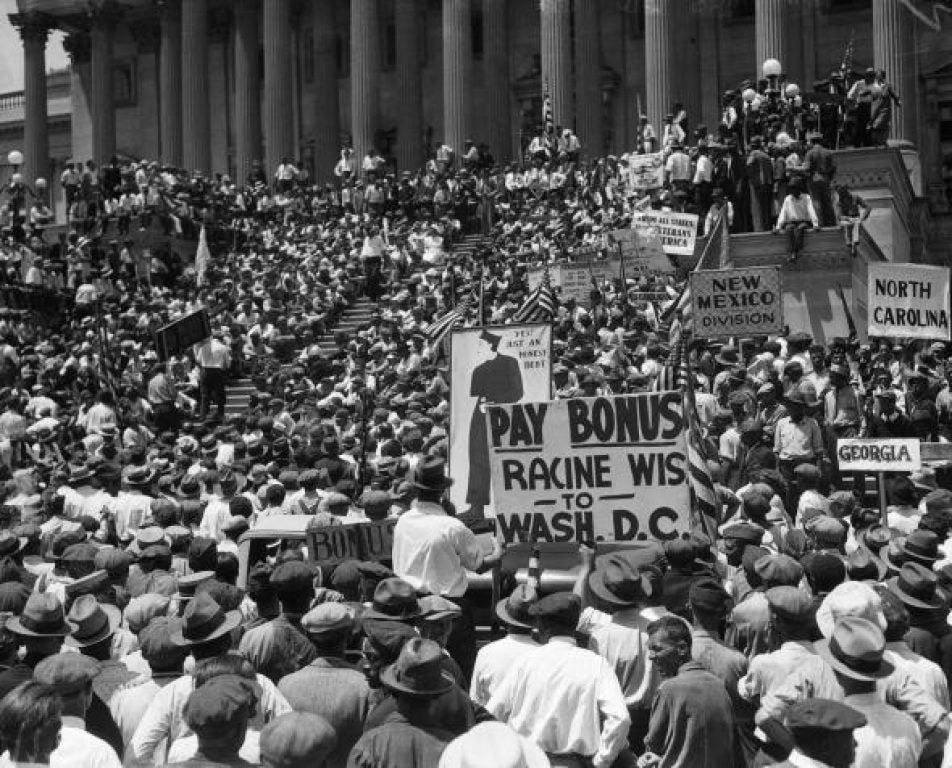
In the Spring and Summer of 1932 during the depth of the Great Depression, somewhere around 20,000 desperate men, some with their families in tow, marched on Washington DC as part of the Depression-era Bonus Army. For their trouble the marchers were attacked by Douglas McArthur, and an army detachment, who instead, burned out the shanties of the desperate. Again, no one attacked the halls of government.

On March 3, 1913, the day before the inauguration of Woodrow Wilson, nearly 10,000 women paraded down Pennsylvania Avenue promoting women’s suffrage. Though they were attacked by angry men along the route, not one woman attacked the halls of government.

Nearly 10,000 American’s joined Jacob Coxey’s Army in May of 1894. An extended economic depression caused mass unemployment, and the “Army,” demanded a public works bill to create jobs. Though the marchers reached the Capitol, and Coxey, himself leaped up the stairs to read his public works bill, the police opened up some heads, and the crowd dissolved. No one entered the Capitol.

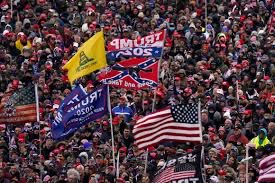
Public protest is as American as baseball. The difference lies in our use of free speech. On January 6, 2021 a mindless, misguided, and dangerous mob hijacked the right to assemble, instead escalating into a violent attack on our center of government. There is no middle ground; this was an attempted coup to seize power.

We were correct in 2017, as were those in 1894, 1932, 1963, and 1968. Marchers were seeking “the blessings of liberty” within the rule of law. None of us ignored nor defiled the spirit of protest.

And that sense of heart-felt objection, to that president proved accurate.

Gail Chumbley is the author of the two-part memoir, “River of January,” and “River of January: Figure Eight.” Both titles available on Kindle.

gailchumbley@gmail.com
Breaking Point

The American system of government requires reasonable, motivated legislators. And no, there is nothing quick about lawmaking. That a Congressman or Senator will get all they want is another no. The legislative process requires willingness, study, and compromise. It is little wonder citizens become frustrated with the pace, but that is American lawmaking. And despite the drawbacks, our frame of government is the best that exists in the world. Period.

When factions choose violence, know this, insurrection is no solution. Never has been. Acts of brutality, in fact, mangle the fabric of our society. The Far Right, along with their gutless congressional enablers will, sooner or later, reap the consequences of their lawless behavior.

As Tom Petty aptly titled the mindset, these are Rebels Without a Clue.

South Carolina Congressman Preston Brooks, in 1856, felt much the same. This impetuous “gentleman” possessed a velcro sensibility to perceived slights, and could lash out unexpectedly. Raised in the Southern canon of the code duello, Brooks believed physical retribution a mandatory response in defense of reputation and honor. Years earlier young Brooks had traveled to Washington DC in order to challenged another he believed had insulted his father, Whitfield Brooks. For this impulsive action young Preston hobbled on a cane, limping for the rest of his short life.

Hate was in the very air of Capitol Hill during the 1856 session of Congress. The “irrepressible conflict,” of slavery, weighed as heavily as the damasked draperies in the US Capitol.

The question at that moment concerned the extension of slavery into expanding territories. One law after another had either permitted, or limited the peculiar institution onto the western prairies. This was also when Brooks arrived to take his new seat in the House of Representatives.

The admission of Kansas cut from Nebraska Territory drove the headlines of that moment. Would the Nebraska Territory split into two new states, one free, and one slave? The decision weighed heavily, challenging the delicate equilibrium in the Senate.

Into this tinderbox stepped Senator Charles Sumner of Massachusetts, and his powerful speech that gripped not only Congress but the whole, volatile nation. Titled “The Crime Against Kansas,” this fiery abolitionist and orator cursed the institution of slavery belittling southern defenders as enamored with the “harlot slavery.”

That oratory lit the spark igniting Congressman Preston Brooks.

Following Senator Sumner’s two-day denunciation, the chamber quieted, and members wandered in and out, chatting or working at their fixed desks. Charles Sumner himself, was seated on the Senate floor, focusing on the papers before him. That was the moment Representative Brooks sidled up behind the preoccupied lawmaker.

Brooks made some remarks at the Senator’s desk, then lifted his cane and came down hard on Sumner’s head. Over and over the enraged South Carolinian beat his quarry, Sumner struggled, trapped halfway between his chair and bolted-down desk. Finally the cane cracked, and Brooks strolled out of the Senate Chamber.

Sumner lay groaning on the Senate floor, a bloody mess.

In the days following, Preston Brooks was both reviled and feted by enemies and compatriots. As a point of order, the young Congressman resigned his seat and left for home.

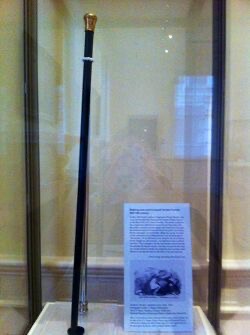
Gifts of canes were sent to this Southern hero who had taught those Yankees the physical price of loose talk.

This episode accomplished nothing of substance. A mini Civil War exploded on the Kansas Prairie, and Brooks died from some ailment. And Charles Sumner? He survived the assault, later to lead a Jehovah-like revenge on the Reconstructed South.

Why does this matter? How does this concern today? Because America is a nation of laws, the same slow, thoughtful process designed by the Framers. When agitators choose the path of violence, the recoil whipsaws uncontrollably. The Sumner Brooks episode provided a prelude to Civil War. Lasting stability rests on methodical lawmaking through thought, analysis, and compromise.

Take it from me, the past does portend the future.

Gail Chumbley is the author of the two-part memoir, River of January and River of January: Figure Eight. Both titles are available on Kindle. Chumbley is also the author of two plays, “Clay” on the life of Henry Clay, and “Wolf By The Ears,” exploring the beginnings of American racism and slavery.

gailchumbley@gmail.com

This Is Why We Teach

Hi Mrs. Chumbley! This may be very random, but very much needed to be said. I’m reading a book right now about how school systems often fail black girls. One of the examples was when teachers will allow Black girls to not work up to the highest standard because of biases that the teacher may have.

I remember when I was in APUSH in your class and it was one of the hardest things I have ever done in my life. I cried almost every day. I had been homeschool and then went to a charter school. I had never experienced a class as challenging as APUSH. I LOVED the class and what we were learning, but I just felt like the class wasn’t for me. I remember coming to you in tears because I needed you to sign a release form for me to move out of the class at semester and you said something to me that I carry to this day. You said, “Gabie, you are an AP kid, and don’t let anyone else tell you otherwise. You can do this and I’m going to help you.”

You did not fail me Mrs. Chumbly. Now, 8 years later, I am a teacher am applying to grad schools so that I can get my secondary social studies endorsement because it was in those classes that my life was changed. Thank you so much for believing in my and pushing me to the highest standard. I really do not think I would be where I am today if you would not have 💙💙

Rope of Sand

The creed of States’ Rights is all smoke and mirrors; a cover for the selfish interests of local napoleons, and the politicians they bankroll. When claimed as the only answer to the country’s problems, beware, States’ Rights never solved a thing.

Not in America.

Ours is a one of a kind, federal system of concurrent powers. Centralized authority layers and folds, meshing with state and local governments.This dynamic has functioned for over two hundred years and the bonds are subtle and sometimes conflicting. The most lethal confrontation between state and federal powers clashed in the Civil War, 1861-65. But that particular catastrophe was certainly not the first.

During the Revolution, state delegations, in an attempt to unify the embattled nation, drafted a national blueprint called the Articles of Confederation. Attending representatives squabbled endlessly to defend their own local interests, rejecting any language that bound state autonomy. So jealous were the original Thirteen of one another, political leaders dragged ratification out, while barely a step ahead of pursuing Redcoats. The Continental Congress dashed across Pennsylvania, into Maryland, and back, still resistant to real, national authority.

John Dickinson of Delaware, drafted some elements into this fledgling plan, but his model wasn’t helpful. General Washington still had to beg Congress for recruits and soldier pay, and Congress, in turn, had to beg States to fill those needs. One bright note is Congress did agree to dispatch diplomats, like Franklin and Adams, who continued the begging game across the Atlantic.

Meanwhile States such as New Jersey, and Pennsylvania, happily traded with coin-rich Brits, filling their personal coffers, while ignoring the needs of the war effort. The prospects of an American victory grew grim, as each state dug in, defending their own turf. In fact, the Confederation Congress was so toothless, the document itself failed ratification until a month before Yorktown.

Historians often use the term “rope of sand,” to describe the deficiencies and impotence of this early attempt at self governance. Lacking any real prestige, inevitable bloodshed quickly ensued among these thirteen quarreling kingdoms. Navigation rights, interstate trade, and clashes over currency, nearly ended the budding union. At that critical moment Alexander Hamilton and James Madison jointly called for a new convention to “revise” the Articles. Both men, in reality, intended to dump them for a different, stronger plan. Recently retired George Washington agreed with both men, and chaired this new convention, assembling in Philadelphia the summer of 1787, and a determined Constitutional Convention worked hard to remedy many of the new nation’s ills.

This lesson from the past remains relevant. My state, for example could never bear the seasonal costs of road construction, nor of fire fighting. The former administration’s Covid-19 policies have proven, again the futility, and folly of every state scrambling for themselves.

The events of January 6, 2021, and now with the Texas legislature attacking both voting rights, and a woman’s right to choose, similar concerns arise. Is American law no more than a vulnerable rope of sand in the hands of the states?

Fellow Americans, do not buy into the so called advantages of States’ Rights. Hidden interests cloaked in virtuous words distract us from national needs, while the favored few push their political agendas. It’s not an overstatement to say States’ Rights again threatens the good order the Framers labored to establish.

Gail Chumbley is the author of the two-part memoir, “River of January,” and “River of January: Figure Eight.” Both titles available on Kindle or at http://www.river-of-january.com.

gailchumbley@gmail.com

Marking Time

2020.

Are the awful events of these last twelve months a once-off, bad patch of misfortune? Or is there a deeper explanation for the emergence of Trump, Covid, economic disaster, and civil unrest?

American History is steeped in a collection of pivotal moments, episodes that molded the nation’s continuing path. Can the events of 1776 stand alone as a turning point, or of 1865? 

A long metaphoric chain links one scenario to the next, marked by momentary decisions, government policies, or beliefs, that surface at one point in time, and voila, America’s story fleshes out to the future.

Add chance circumstances to the narrative and predictability flies out the window. 

Does 2020 stand alone as a singular event, or an inevitable outcome seeded somewhere in the past? Surely the march of history can be much like a chicken-egg proposition.

Mention 1776 and thoughts gravitate to the Continental Congress, the Declaration of Independence, and the emergence of General George Washington. But that struggle for freedom actually began at the end of the French and Indian War. 

As for 1865, when the guns silenced at Appomattox Courthouse, Robert E Lee’s surrender affirmed America as a nation-state. But thirty years earlier, President Andrew Jackson’s administration had sparked the eventual war over the issue of slavery. Thinly disguised as the doctrine of states’ rights, the intractable argument of slavery festered. The “Peculiar Institution” is, was, and always be the cause of that bloodbath. In point of fact the fury of one man, John C Calhoun, South Carolina Senator, and former vice president, lit the fuse of war thirty years before Fort Sumpter.

As to the folly of Trumpism, arguably the roots are deeply burrowed in America’s collective past. Author, and historian Bruce Catton, wrote about a “rowdyism” embedded in the American psyche. Though Catton used that term in the context of the Civil War, his sentiment still resonates in the 21st Century, i.e., Proud Boys, and the like. 

Closer to today, the Cold War seems to have honed much of the Far Right’s paranoia. The John Birch Society, for example, organized in the late 1950’s escalating anti-Communist agitation. Senator Joe McCarthy rode to fame on that same pall of fear, (with Roy Cohen at his elbow) only to fail when he went too far.

But the presidential election of 1964 seems to mark the most distinct shift toward the defiant opposition that fuels Trump-land.

Vietnam, in 1964 had not blown up yet. JFK had been murdered the previous fall, and his Vice President, turned successor, Lyndon Johnson was the choice of a grieving Democratic Party. The GOP fielded four major candidates in the primaries: three moderates and the ultra conservative, Barry Goldwater of Arizona. Senator Goldwater gained the nomination that summer with help from two men, conservative writer Richard Viguerie and actor Ronald Reagan.

Viguerie broke political ground through his use of direct mailing, and target advertising (what today is right wing news outlets). Reagan, once a New Deal Democrat, crossed the political divide and denounced big government in “The Speech,” delivered on behalf of Senator Goldwater. These two men believed Conservatism, and Laissez Faire Capitalism had been wrongly cast aside for liberal (lower d) democratic causes. 

Their efforts struck a cord with legions of white Americans who felt the same resentment. The Liberal Media and Big Government from the Roosevelt years were Socialistic and anti-capitalistic. No urban problem, or racial strife or poverty appeared in their culdesacs or country clubs. And taxes to support Federal programs squandered and wasted personal wealth.

So many other issues shaped the modern New Right. Communism, the Cold War, Civil Rights, Vietnam, and progressive politics alienated the wealthy class. 

But here’s the rub. Ultra conservative ideology is unworkable, an ideal that awards only a small, exclusive few, (today’s 1%). So 2020, and 2016 both have roots running deep in the core of the American experience. 

2020 isn’t about this moment, not really.  

Gail Chumbley is the author of “River of January,” and “River of January: Figure Eight,” a two-part memoir available at http://www.river-of-january.com and on Kindle. Also the stage plays, “Clay,” and “Wolf By The Ears” (the second in progress.)

gailchumbley@gmail.com

The Clarity of Desperation

With only days until Christmas 1776, General Washington watched the snow fall and the ice thicken as his suffering army melted away. Earlier that year, in July, that same Army had been humiliated by the Red Coats, chased off Long Island, pursued through Manhattan, barely escaping across the Hudson River into New Jersey. 

The General had been flanked by overwhelming British forces and his inexperienced Patriot army simply panicked and ran. Furious at their conduct Washington threatened to lead another assault himself, however, cooler heads prevailed as his staff convinced him otherwise. 

Amongst King George’s red coated regulars were legions of Hessians, hired guns from the German kingdom of Hesse-Cassel. Their presence on the field infuriated the Americans, as if the King couldn’t bother to keep the conflict British. These mercenaries were especially brutal, taking a psychological toll on Washington’s volunteer army by making use of flashing, saber-like bayonets. 

But Washington had a few cards of his own to play. Contemplating retreat while still on Long Island General Washington had ordered Colonel John Glover, a New England mariner, to collect enough vessels to ferry his surviving soldiers west to Manhattan, then over the Hudson into New Jersey. With campfires blazing to fool the redcoats, Washington successfully evacuated his army waiting to board for the last boat.

The inexperienced American army was preserved.

Still, demoralized, and outgunned, the Continental Army appeared defeated and despondent. The general consensus among all was the war was hopeless, a lost cause, the Patriots esprit de corps vanished. 

By winter, Washington’s command appeared to be unraveling. Inadequate food, too few supplies, and support sapped the army’s endurance. Worse the Brits, flush with currency, settled into cozy New York accommodations and enjoyed the hospitality of the city’s loyalists community. 

With circumstances conspiring against him-the weather, scarcity of supplies, and outgunned by enemy Hessians, Washington had to act as he faced a critical moment. Writing to his cousin, Lund, the General poured out his anguish. 

. . .your immagination can scarce extend to a situation more distressing than mine—Our only dependance now, is upon the Speedy Inlistment of a New Army; if this fails us, I think the game will be pretty well up . . .

Out of desperation Washington confessed what he termed as the “clarity of despair.” He had to act.

First Washington sent for an operative who sold provisions to the nearby Hessians. This Patriot spy came into camp and apprised Washington on the disposition of King George’s contracted killers billeted in nearby Trenton. These Germans were settled in for a Christmas celebration, assured that the Americans were all but defeated. 

In his second order, Washington commanded Colonel John Glover, once again, to requisition every boat the yankee seafarer could find. Between the intelligence report and vessels secured, his men were mobilized for a surprise Christmas morning assault on Trenton. 

Once again, Glover pulled off a miracle amphibious operation. And once again, General Washington was the last man on the last boat. In two files the suffering Continental Army marched, braving more than just the weather.

His forces arrived by first light. 

The unsuspecting Hessians were throughly routed in the surprise assault, that in the end provided the Patriot cause with a desperately needed victory.

The revolutionary cause again breathed life. 

So as you enjoy the warmth of the season, remember those who struggled before that the people could have a new nation. On Christmas in 1776 Washington’s army marched through the inky, icy cold, hungry, fretting for their families, yet committed to the long game of founding a nation. 

We have done this before. Much like General Washington our desperation makes our choices clear. Recent scholarship estimates that during the Revolutionary War only 1/4 of the American population supported independence. There are more of us holding to Constitutional norms today. Stay the course this moment isn’t the last.

Merry Christmas.

Gail Chumbley is the author of the two-part memoir, “River of January,” and “River of January: Figure Eight.” Both titles available on Kindle. Gail has recently completed a stage play, Clay, on the life of Henry Clay, Peer Review, where four former presidents meet 47, and Wolf By The Ears, an examination of the events leading to chattel slavery.