Give And Take

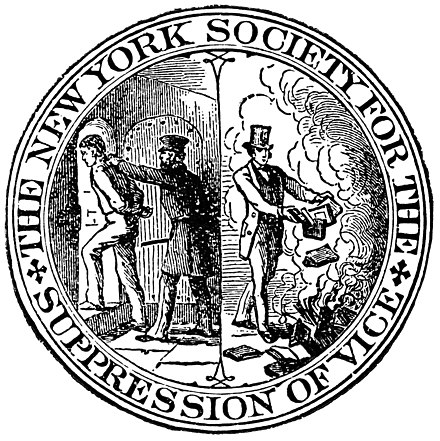
“I should say that the majority of women (happily for society) are not troubled by sexual feelings of any kind,” wrote William Acton in an 1857 medical tract. Some fifteen years later Acton’s evidence-free assumption was echoed by Postal Inspector Anthony Comstock, the founder of The New York Society for the Suppression of Vice. Comstock’s organization had been formed to monitor and enforce morality in public behavior, emphasizing in particular, the conduct of women. Any discourse on women’s sexual behavior, according to Comstock was “obscene, indecent, lewd, and immoral,” period. (Chauvinism appears to be timeless). Galvanized by his puritanical convictions, Mr. Comstock set about cleansing the moral conduct of the people of New York. (Note the Society’s Seal, above, depicts book burning, as a legitimate means to his ends.)

Finding momentum statewide, Comstock took his crusade to Washington DC, where he convinced the US Postmaster General to battle unacceptable behaviors on a national scale. Soon Congress complied with passage of the Comstock Act in 1873. This law declared that any correspondence touching on women’s birth control, contraception, and abortion were prohibited from the US mail.

Among Comstock’s many opponents, and there were more than a few, reformer and free-thinker, Ezra Heywood defied the law, publishing articles and books supporting women’s rights, and defending female sexual freedom. Mr. Heywood most notorious work, Cupid’s Yoke, insisted marriage an act of equality and balance between a man and a woman, quickly attracting government attention, when he was promptly arrested for his writings. In court, Heywood continued to argue that women were capable of controlling their own lives, and bodies, insisting the Comstock Act was destroying the liberty of conscience. Further, Heywood insisted women ought, and must have a voice in determining the size of their own families. Apparently just expressing such thoughts was enough to prove obscenity, and Heywood headed to jail for his persistence.

In the early 20th Century another movement targeted morals, this time in the film industry. Postmaster General, Will Hays, threatened Hollywood studios either to establish standards in motion picture content or the government would do the job. Known as the Hays Code, the studios prohibited profanity, nudity, violent sexuality, race mixing, and lustful kisses on the screen. In an interesting side note the film that sparked the controversy was 1934’s release of Tarzan. Maureen O’Sullivan’s Jane swimming naked alongside Johnny Weissmuller’s Tarzan sparked the scandal. Twenty Yale students, for example, stepped in front of a theater screen to halt the movie in New Haven, Connecticut.

Mr. Hay’s code remained in effect from 1934 until 1968, when the Supreme Court ruled films are art, and thus protected by the First Amendment. In place of the code, the Motion Pictures Association instead instituted the rating system we are accustomed to today. 

The specter of the Comstock Law, and the Hays Code still casts a long shadow over American culture. Instead of concentrating on public policy, and other issues; power grids, global warming, gun violence, and infrastructure, (plus many more) politicians push their private notions of morality upon the rest of us.

Women’s sexuality and healthcare are not obscene matters, nor are they open for public debate. A fixture of the 19th, and early 20th centuries was the norm known as coveture. By definition coveture meant the husband acted for his wife in all areas of life. She could not vote, nor own property in her own right, and her children belonged to her husband. She belonged to her husband. No wonder Mr. Comstock and Mr. Hays found such success in their efforts.

Those artifacts of another less enlightened age are over. Exploiting the pendulum of political opportunity, giving and taking rights from women, will no longer wash. The overturning of Roe, the war on medical aid in pregnancy, the patchwork of state reproduction laws, (14 states ban abortions from the moment of fertilization*) implies something deeply sinister. Women cannot be trusted to think for themselves, possess no self-agency like minors, or the severely mentally ill.

Absurd.

Attempting to regulate 50.4%** of the US population, (there are 100 women to every 97 men) has caused irreparable political harm to those behind today’s archaic, and reactionary movement.

See you all at the polls.

*Axios, Dec. 15, 2023

**www.census.gov

Gail Chumbley is the author of the two-part memoir, “River of January,” and “River of January:Figure Eight.” Chumbley has penned three stage plays, “Clay” about Statesman Henry Clay, “Wolf By The Ears,” an exploration of slavery and racism, and “Peer Review,” on Presidential character.

The only thing new in the world is the history you don’t know. Harry Truman
A Bright Side

Donald Trump, without a doubt has answered the centuries old question of the worst president in American history. His standing as the biggest moron lends Harding, Buchanan, Pierce, and other lackluster presidents a step up from the cellar. 

Is there a bright side to the bedlam unleashed by 45’s insanity? I believe so. Americans have witnessed how not to preside over our democracy in real time. Now that’s a powerful civics lesson. 

Once misunderstood, most American’s were reminded how the Electoral College functions—a big deal demonstrating how a candidate can win the Electoral College, but not the popular vote. From irregularities identified in the 2016 race, shocked citizens across the country wonder if this election procedure has a purpose in the 21st Century. 

The legal tradition of checks and balances took a rough bruising with Congressmen and Senators scurrying to the Oval Office to kiss the ring of their messiah. Two clearly illegal actions by the President; pressing Volodymyr Zelensky of Ukraine to open an inquiry on Hunter Biden, and Trump would offer an invitation to Washington.The second came after the January 6th insurrection using violence to disrupt the ceremonial certification of Electoral College. The House impeached both times, and the Senate refused to convict. The moral of that story? The Executive Branch went rogue and the upper chamber of the Legislative Branch failed in their duty. However, both branches somehow remained intact and horrified voters learned what they didn’t want. 

That elections and voting truly matter may be the most profound lesson of the Trump years. The right to vote is power, and denying citizens of that power became the GOP’s endgame. Even now, the far right longs to deprive many of us, especially minorities from exercising that power. The lawsuits are still flying to undermine our most sacred right under the law.

Another teachable moment touched on the Supreme Court. The 2020 death of Ruth Bader Ginsburg, and the retirement of Anthony Kennedy in 2018 shed light on manipulating the Judiciary. Senate Majority Leader, Mitch McConnell lobbed the first volley through the customary practice of filling Supreme Court vacancies. Before 2016 the sitting president had the privilege to put forth judicial nominees. That had been a long tradition. But the sitting President happened to be Barack Obama. So of course McConnell blew that up. Obama’s choice for the court was Merrick Garland, and McConnell would not hear of it.

Following the 2016 election that tradition resumed. Trump put forth Amy Coney Barrett, and later Brett Kavanaugh. Both lied in hearings to the Senate Judiciary Committee, Barrett testified she would allow Roe to remain, and Kavanaugh was a reputed date raper. The clause allowing lifetime terms for judges added gravity to Trump and McConnell’s shenanigans. 

Perhaps the Trump fiasco holds a silver lining. Americans have become more aware of the workings of our democracy, what functions under the hood, so to speak. Perhaps democracy is indeed fragile, but our near collapse into tyranny has forced us all to wake up and pay attention.

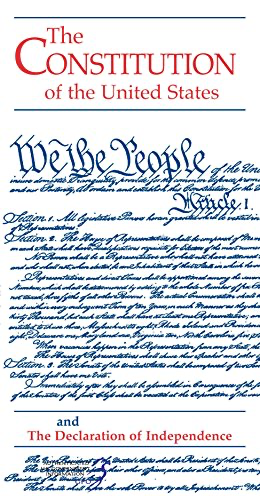
PS contact your Representative in Congress. Request a hand pamphlet of the Constitution like the one above. They have them in their DC office or their home office. We’ll show ’em.

Gail Chumbley is the author of the two-part memoir River of January, and River of January: Figure Eight. Chumbley has written two plays, Clay about 19th Century Statesman Henry Clay, and Wolf By The Ears exploring the genesis of racism and slavery in America.


The only thing new in the world is the history you don’t know

Harry Truman

Peer Review #1

Marines manned numerous doorways along the wide hallway, as clusters of tourists wandered through colorful rooms. Upstairs the President listened to the public commotion with satisfaction, not for the house, not for the job, which, in truth, had become tiresome, but for the knowledge he could drop down and set all their bourgeois hearts aflutter. 

After a moment, he made his decision, slipping down an interior stair case, stepping into the Blue Room.

As his hands automatically fluffed his hair, the President sidled up beside a class of wiggly school children snapping cell phone pictures.

“And where are you from?,” the president teased with pleasure, anticipating an excited response. He half closed his eyes, and paused, waiting for the gratifying answer.

But he heard nothing.

Bemused, the President opened one eye, then the other. The chatty children paid him no mind, in fact were moving away, following their guide into the hallway.

“Wait,” he found himself calling. “It’s me, your President. I’m here.”

He repeated, “The President of the United States.”

But the children didn’t hear. He remained alone in the Blue Room, his hair acceptably coiffed.

No further tourists entered, though dozens drifted past the doorway. He didn’t understand and he thought very hard, seeking a rational explanation.

It was at that moment that he heard a voice, quite close, and quite annoyed. 

“Am I to understand you are a New Yorker?” 

The President wheeled around toward the sound. Before him, no more than an arm’s length away stood a mustachioed gentleman, wearing pinz nez spectacles, sporting a shiny top hat. The man’s eyes blazed behind the thick round lenses, and the astonished President detected a trickle of cold sweat trace down the back of his thick neck.

“I say, are you, or are you not, a New Yorker?” The stern man spoke in a nasally, patrician voice.

“Ahh. How did you get in here,” the President stammered. “Where is my secret service protection?”

“Supercilious pup,” the man in the top hat snapped. “They tell me that YOU are from New York, and are president! A common side show huckster, President.”

The President, though alarmed, replied reflexively, “I’m in real estate. I . . .made my fortune in New York real estate.” Only the muffled din of passing tourists kept the President from panic.

“Real Estate!” The man in spectacles scornfully shouted. “I’d say you are just another scoundrel from the wealthy criminal class. In New York, swindlers like you are a dime a dozen. I made a career of exposing rascals like you.” 

The man, attired in a three-piece suit, a watch fob draping his ample waist, bore a deep scowl. “And you found your way into this office of trust. Intolerable.”

Though bewildered, the President, unaccustomed to such personal insults, felt his pique rising. “I was elected President by the largest margin in American Hist . . .”

“Poppycock,” the specter interrupted. “It is my understanding the decision rested upon a mere tilt in the Electoral system, and that outsiders interfered to make certain of your victory.” 

The strange visitor moved closer. “I’d say that you are a compromised pawn of foreign meddlers, and give not one damn for the American people.”

At this point the President had heard enough, and attempted to move his legs. He wanted very much to escape the Blue Room, but his feet remained rooted. 

“I have important things to do, you need to go,” the President’s voice trembled, trying to sound more confident than he felt.

The apparition narrowed his intense eyes, and took another step toward the unnerved President. 

“I claim more authority to this revered House and Office than your mercenary greed could ever comprehend. You belong with Tweed, Plunkitt, Fisk, Conkling, and the rest of New York’s good-for-nothings. Dishonor has followed you to the Presidency, what, with your womanizing, graft, and unsavory business connections.” The fierce apparition fixed an intense, menacing gaze. “You do not belong here, nor your parade of lackeys and opportunists.

The buzz of foot traffic grew louder, and when the President again glanced toward his unwelcome visitor, he found him gone, the Blue Room empty.

Gail Chumbley is the author of the two-volume memoir, “River of January” and “River of January: Figure Eight,” both available on Kindle.

Hard copies are available at http://www.river-of-january.com