Custodians of Now

Gratitude underpins America’s oldest quasi-secular holiday,Thanksgiving. In the 21st Century it is rather easy to scoff at a quaint observance that predates the founding of the country, and today’s America is a bit too cynical, busy, and self involved for meaningful reflection.

Separatists in 1621 Plymouth had risked all to worship freely in the New World. Suffering starvation and disease, the Mayflower survivors managed a successful harvest with the essential aid of local Natives. In an outpouring of gratitude the newcomers organized a potluck of sorts, and invited their benefactors to pause, count their blessings, savoring both the moment and the food.

General Washington announced a day of Thanksgiving after the fortuitous American victory over the British at Saratoga, and again after the Constitutional Convention in 1787. Moments of mutual gratitude implied a common bond, and an acknowledgment of common sacrifice. 

Later, in 1863, America, once again, faced a crisis of unity.

A grisly Civil War had raged for two years, when emboldened Confederate forces crossed north into Pennsylvania. Soldiers of the Blue and the Gray clashed at the crossroads town of Gettysburg. After a three-day struggle, the tide shifted in favor of the Union, and soon after Confederate troops retreated back into Virginia.

In the aftermath, President Lincoln delivered his Gettysburg Address, and shortly after called for a national day of Thanksgiving. Lincoln set aside Thursday, November 26th for the observance, calling for contemplation and gratitude. Later, in the aftermath of the Pearl Harbor attack, President Franklin Roosevelt signed into law a permanent observance of Thanksgiving to the fourth Thursday of November. 

Aside from roasted turkey, televised parades, football, relatives, and tryptophan-induced naps, this day is meant for reflection; a national respite from other distractions. As Americans we remember those who struggled through their American moment, and refresh our personal obligation to our communities, and to our nation. 

Whatever spirit guides our personal devotion, on this day we place ourselves second to something much greater-the United States of America. We recommit to our highest aspirations as a fortunate and free people; a people who respect what came before, and resolve to protect our democracy for the future.

This Thursday remember we are the custodians of now, and unity is not easy with such diverse and noisy citizens. Still the responsibility remains, carried forward from earlier generations. We Americans have an obligation to nurture solidarity over discord, amity over selfishness. 

All Americans can resolve to preserve this hard-won gift of democracy to those not yet born.   

Gail Chumbley is the author of the two-part memoir, “River of January,” and “River of January: Figure Eight.” Both titles are available on Kindle. She has also completed the play, “Wolf By The Ears,” a historic look on the advent of American Slavery.

gailchumbley@gmail.com

Insulting The Past

The first time a parent challenged my teaching in history class, took place my first year. The topic concerned the creation of the Constitution, and the era of the Early Republic. I introduced the three branches, and separation of powers, census, representation, and that type of basic information. Definitely the bare bones of Civics.

During that lesson I explained how Electors were determined, and role the Electoral College played in choosing the president. End of lesson. The following day the topic moved to ratification and the addition of the Bill of Rights. From out of nowhere a hand shot up, and an upset student blurted, “My dad says you’re a liar!”

Yep, a liar. 

That was my baptism into the sliding scale of historic facts, and that initial chill of suppression stopped me in my tracks. Following that episode, censorship never strayed far from my thoughts. It was the beginning of a caution that lasted the whole of my career.

Fast forward 30 years in history education, when a similar event repeated.

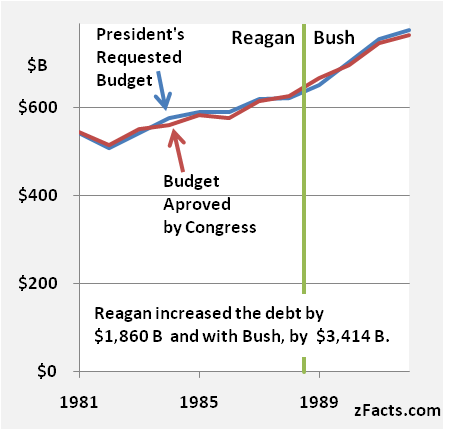
The topic this time concerned the Reagan Revolution, and the events surrounding those years. 

Students learned about the Evil Empire, “Mr. Gorbachev, Tear Down This Wall,” Perestroika, Glasnost, Reaganomics, Laffer Curve, Trickle Down, etc . . .

Foreign policy topics covered Central America and the Middle East, particularly Nicaragua and Iran. Reagan officials were selling weapons to America’s enemy Iran, using the funds to put down a Marxist insurgency in Nicaragua. A privatized foreign policy if you will.

The calls came the following day. “How could I teach such nonsense in a public school! My student came home and shared her notes, textbook and graphs. This is not right, Ronald Reagan is the beloved champion of conservatism!”

The principal called me in and wanted to know what caused the dust-up. Flustered, I didn’t know where to start. Quickly I explained the general outline of the unit, and, well, he didn’t have the time to listen to the details. And he shouldn’t have. He hired me to do that job.

The episode sort of blew over, though that parent did call me at home a number of times over that summer. Weird behavior for sure, like the dad couldn’t let it go. 

For me the matter became philosophical; either educators prepare kids for the path, or parents attempt to manipulate that path for their kids.

Touchy parents revising America’s story to force their current politics on schools does nothing less than highjack education. Talented people leave the classroom endangering the US’s most essential institution. Worse, the exertions and sacrifice of those who came before, are papered over to suit today’s furor.

America’s lifeblood is our shared story, it’s what defines us as a distinct people. We must understand those central principles from our past to move forward as a healthy nation.

To those students whose parents challenged the historic record, it’s unfortunate they cannot let go just a little, and trust public education. This is our kids birthright.

And know this-I wasn’t lying.

Gail Chumbley is the author of the two-part memoir, “River of January,” and “River of January: Figure Eight.” Both titles are available on Kindle. Chumbley has also written three stage plays, “Clay,” regarding the life of Senator Henry Clay, “Wolf By The Ears,” an exploration into American slavery, and Peer Review where 47 meets four earlier presidents.

The Forgotten Cause

In 1938, old men aided by young volunteers shuffled off of trains and cars arriving from both sides of the Mason-Dixon Line. For the most part these gents were in their early 90’s, and looked forward to reminiscing, comradeship, and scheduled ceremonies.

Organizers had planned three full days of tours, music, and ceremony, complete with a flyover and fireworks. The Battle of Gettysburg’s 75th commemoration had begun.

There had been an earlier anniversary event, in 1913, but this time visitors knew this gathering would be the last. Those in attendance understood, as did the elderly guests of honor, that those who hadn’t fallen on that Pennsylvania battlefield in 1863, would soon join the brethren who had. 

After this commemoration, the narrative would pass from eye witness accounts into America’s collective memory.  

No longer wielding rifles, many maneuvered the grounds pushed about in wheel chairs, walkers, and canes. Old men brandished ear trumpets to catch the orations of the many visiting dignitaries. The men listened as President Franklin Roosevelt delivered remarks dedicating the Eternal Light Memorial, located near the “Bloody Angle.” Battlefield tours transported veterans, and well-wishers from Cemetery Hill, to Seminary Ridge, Little Round Top, the Devils Den, and finally the exposed fields of Picketts Charge.

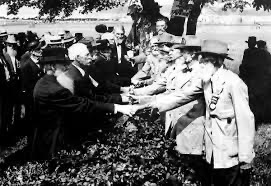
There, at the stone fence, gray old men in blue, and others in gray and butternut, shook hands in reconciliation.

Ironically, left uninvited were the scores of African Americans who had harbored such hope for new lives after emancipation and the war’s end. Unfortunately, the era of Reconstruction left little to show for racial progress or Civil Rights. Instead Freedmen found a new enslavement, recognizable in every aspect, but iron chains.

Forty Acres and a Mule had never materialized, as promised by victorious Union commanders. Now relegated to tenant farming, Freedmen struggled in the same conditions as before, but now as sharecroppers. Stuck in a never-ending cycle of poverty, black farmers found insufficient harvests debited into the next season, and then the next, in an endless cycle of debt.

The Supreme Court’s 1896 ruling in Plessy V Ferguson legalized segregation by insisting any negative correlation attached to feelings of inferiority lived only in the minds of Blacks. Separate water fountains, parks, transportation, and schools worked just fine for the elderly veterans from the North and South.

The moral force of the Civil War had died as thoroughly as the nearly 7 million who had perished upon the scattered battlefields of that bloody conflict. Those veterans who reunited in 1938 Pennsylvania found white identity and brotherhood far outweighed any new birth of freedom envisioned by President Lincoln 75 years earlier.

The current occupant of the White House has made it his mission to once again assert white supremacy in an effort to rewrite American history. His feelings had been hurt by our first black President and now he seeks revenge. Of course this foolish attempt will fail, as is his custom in all things, because we know the truth of equality and this time will never forget.

Gail Chumbley is the author of the two-part memoir “River of January,” and “River of January: Figure Eight.” Both titles available on Kindle. Ms Chumbley recently completed her second stage play, “Wolf By The Ears.”

gailchumbley@gmail.com

The More They Stay The Same

This poem surfaced after the end of the Civil War. The sentiment speaks for itself. Despite the passage of time, America is again dealing with those who still cling to grievances held for nearly a century and a half.

(*Note The Freedman’s Bureau was a government agency that aided newly freed people of color. **Pardons were granted to those who swore an oath of loyalty to the Union after the war.)

The past is rather instructive, as we find ourselves still dealing with the same raw hate.

Play the link at the bottom of this post, and follow along with the words.

O I’m a good old rebel,
Now that’s just what I am.
For this “fair land of freedom”
I do not care a damn.
I’m glad I fit against it,
I only wish we’d won,
And I don’t want no pardon
For anything I done.

I hates the Constitution,
This great republic too,
I hates the Freedmans’ Buro,
In uniforms of blue.
I hates the nasty eagle,
With all his braggs and fuss,
The lyin’ thievin’ Yankees,
I hates ’em wuss and wuss.

I hates the Yankees nation
And everything they do,
I hates the Declaration,
Of Independence, too.
I hates the glorious Union-
‘Tis dripping with our blood-
I hates their striped banner,
I fit it all I could

I rode with Robert E. Lee,
For three year near about,
Got wounded in four places
And starved at Point Lookout
I caught the rheumatism
A campin’ in the snow,
But I killed a chance o’Yankees
I’d like to kill some mo’.

Three hundred thousand Yankees
Is still in Southern dust,
We got three hundred thousand
Before they conquered us.
They died of Southern fever
And Southern steel and shot,
I wish they was three million
Instead of what we got.

I can’t take up my musket
And fight ’em now no more,
But I ain’t going to love ’em,
Now that is sarten sure,
And I don’t want no pardon
For what I was and am.
I won’t be reconstructed,
And I don’t care a damn.

Gail Chumbley is the author of the two-part memoir, “River of January,” and “River of January: Figure Eight.” Both titles are available on Kindle. Gail also has penned “Wolf By The Ears,” a play in two acts.

gailchumbley@gmail.com

Distraction By Design

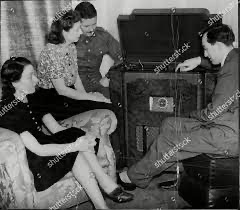
On October 30, 1938, radio listeners tuned into Mercury Theater on the Air, a CBS radio program.  The broadcast, scripted and narrated by actor Orson Welles, dramatically detailed a moment by moment invasion of Earth by Martians. To the folks who tuned in late to the program the events were construed as real, that indeed the planet had been attacked, followed with authentic panic erupting onto American streets.

Welles, and Mercury Theater producers intended the script to sound like breaking news, and real it had been received. Bedlam broke out, threaded through with stories of injury, and of suicides. The whole episode left Welles and his producers with a lot of explaining to do.

The following day, CBS Radio and young Welles, (23 at the time) made an on-air apology for the chaos. Eventually the story died down, relegated to an interesting moment of Depression-era America.

Much like October, 1938, mass hysteria has again let-loose upon the country. Only this time the  alarm, and distraction is by design, jolting anew on a 24-hour news cycle. Cannibals, sex trafficking politicians, lizard people among royal families of Europe, and poisonous contrails find gullible believers who hang on every fearful word. 

And the heaviest assault is lobbed directly at main stream media.

How? Don’t believe any of what you see and hear, unless endorsed by the Right-wing echo chamber. In a real world of Covid, climate change, and other pressing issues, the blaring noise of the propaganda machine has sabotaged progress creating more avoidable problems.

Unlike Orson Welles, the profitable rot pumped continually through cable, books and the internet is disseminated without a self conscience blush, let alone any apologies for damages done and lives lost. American consumption of news has degraded far below any sort of accuracy or structured analysis.

Sadly, a large segment of society cannot separate the wheat from the chaff. Consider those who died consuming ivermectin, hydroxychloroquine, and even bleach. Misinformation and fear is lethal.

As the unvaccinated “do their own research,” and die, the insanity refuels every second across media platforms. Makes one long again for a time when truth and responsibility mattered, and mass-hysteria with all its dangers was to be avoided. 

Gail Chumbley is the author of the two-part memoir, “River of January,” and “River of January: Figure Eight.” Both titles are available on Kindle. In addition Gail has also penned two stage plays, “Clay” on the life of Senator Henry Clay, and “Wolf By The Ears,” examining the normalization of racism in America.

gailchumbley@gmail.com

If you liked this, share.

Don’t Sit Down

In the political world there are two definitions for the term filibuster. The most common understanding concerns talking bills to death in the Senate, and the other is an unsanctioned invasion of a country to take it over. What both meanings share is a determination to wear out the opposition until the matter is settled. A siege of sorts—never giving up.

Famous uses of the filibuster include Andrew Jackson’s 1818 foray into Spanish Florida. Playing a little loose with his orders, Jackson entered the poorly defended territory, claiming to hunt down runaway slaves, and thump the Seminoles who provided sanctuary.

This extra legal foray caused an international incident. An American general, invading a weaker  target, under questionable authority. In the end, this filibuster paid off. Washington informed Madrid they supported Jackson’s invasion and the US took control of the peninsula from Spain. Done and done. 

The moral to this filibuster story is—never blink, never give up, never excuse.

In 1957, and in 1964, Southern Democrats, made use of the filibuster to talk Civil Rights legislation to death. In the ’57 debate South Carolina Senator, Strom Thurmond nattered on for 24 hours, and 18 minutes, still a standing record. And again in 1964, with Senator Robert C. Byrd of West Virginia, who droned on for 14 hours and 13 minutes. Despite obstructionist resolve, both bills did squeak through with assistance of compromising northern Republicans.

What America is facing at his very moment is a Trump-style filibuster, containing both meanings. His insufferable, boorish delaying tactics, unblinking lies, and frivolous lawsuits have characterized this nincompoop’s newest version. He is certain he can hold out against America.

And I am tired— we all are tired, sometimes to the point of despair. But, friends this struggle against malignant arrogance, greed, and hate is a filibuster we cannot lose. Not only for a place called America, but for the enlightened spirit of our country. Our legal traditions must be protected from this fallible, flawed, would-be autocrat.

Trump has filibustered his whole life for something he’s never found nor earned—blind adoration. And that doesn’t meet our traditions or expectations for elected leaders. They work for us. In a real sense our country has suffered an unauthorized invasion of our government, a hostile take over, and the man’s filibuster continues, unabated.

Poet, Langston Hughes speaks to our moment in a portion of his 1922 poem, Mother To Son.

“So boy, don’t you turn back;
Don’t you sit down on the steps, 
’Cause you finds it’s kinder hard;
Don’t you fall now— 

And Hughes is right. We can not fall. We must stay vigilant and wait this immediate threat out.

Gail Chumbley is the author of the two-part memoir, “River of January,” and “River of January: Figure Eight.”

gailchumbley@chumbleg

Cannon of Extremism

I often exit the FaceBook expressway because of the absurd misuse of the American past. And it’s not just history. Politics have abscessed into a free for all, and scientific/medical reality into FaceBook insanity. This verbal dysentery is loaded into into a cannon of extremism, where the unschooled righteously blast irrational conclusions. 

Case in point, an old friend of my husband’s posted, “Those who would give up liberty for security deserve neither.” It’s Benjamin Franklin’s sentiment, but incomplete. Franklin wrote, “Those who would give up essential Liberty, to purchase a little temporary safety, deserve neither liberty nor safety.” 

The quote is from a 1775 letter written by Dr. Franklin on behalf of the Pennsylvania Assembly. He addressed this (very long) correspondence to the Deputy Governor at the time, Robert Hunter Morris. Governor Morris had irritated the Assembly by demanding new militia for protecting western land from the Shawnee and Delaware Natives who, according to rumor were attacking settlers. To keep this episode simple, Morris wanted the lands of wealthy landowners protected, but the rest of the colony to cover the costs. Exempt were the Proprietary landowners who were earning rents from settlers, with a kickback percentage figured in for the deputy governor.

Franklin essentially called Morris out for an egregious conflict of interest, and the Assembly wasn’t financing graft. This was, by the way, four months after Lexington and Concord, and relations between colonials and redcoats tense.

What this misquoted post implied on FaceBook, defended refusing the Covid vaccine. So apparently it’s virtuous somehow to be a cyber Paul Revere spouting Franklin, calling for vaccine resistance in a pandemic. 

The irony of playing fast and loose with the past, is presuming Dr. Franklin would agree with this nonsense. Every founder did what they did for the gravest of reasons; not some oppositional hype to reject public health interests, in bumper-sticker brevity. 

The irony of the post lay with the man. By faith, Franklin counted himself a Deist–that God was the creator of a precise universe; to discover that precision is to find God. In pursuit of those truths, Franklin took on the life of an empirical, data-driven scientist. (Remember his kite-electricity experiment?)

“God Helps Those Who Help Themselves,” is another quote that ought to be repeated on FaceBook and everywhere else. When his child, Francis Folger Franklin died of small pox at age four, Dr. Franklin made an enlightened decision—he inoculated himself and his family from that deadly disease. And an inoculation was no easy nor guaranteed procedure. But as a man of science, he had the sense to take a reasonable path.

Remembering Dr. Franklin means to further our understanding of this moment in time, and follow his example of open minded curiosity, and trust in empirical solutions. Today, that task has been muddied by the misguided, destabilizing all that is good in our America.

Franklin worked hard to make the United States an opened-minded conduit of democracy, not of electronically delivered bedlam.

As Dr. Franklin reminded us, (And I mean us) “Avoid extremes; forbear resenting injuries so much as you think they deserve.” And this gem, “Never go to excess, but let moderation be your guide.”

Gail Chumbley is the author of the two-part memoir, “River of January,” and “River of January: Figure Eight.” Both titles are available on Kindle.

gailchumbley@gmail.com

A Dreamer

You may say I’m a dreamer, but I’m not the only one, I hope someday you’ll join us, and the world will live as one.

John Lennon

A professor of History and Government, President Woodrow Wilson fervently believed America could fulfill its promise as the world’s beacon of democracy, a “City Upon a Hill.” After WWI, this President aimed to reform old monarchial Europe, and lead the world to a new, enlightened destiny. But perhaps his ambitions were too lofty to be realized in a cynical world of power and greed.

Participants convened at the Bourbon Palace of Versailles on June 28th, 1919 to design a new future for . . . really the entire world. Wilson attended in person, which for an American President was a first. He posed, all smiles with the French president, Georges Clemenceau, the English Prime Minister, David Lloyd George, and Italy’s, Vittorio Orlando.

Considering the devastation from the recent war, these leaders had their work cut out for them.

After the Armistice had been signed the previous year, Wilson prepared for his journey by completing a new framework to rebuild a better world. Titled the Fourteen Point Plan, the President outlined a path to enduring peace. The intent was clear: Freedom for all. Free trade, self-government, transparency in treaties, a reduction in weaponry, and most importantly, an international peace-keeping body, The League of Nations. This proposed League had been crafted to resolve international conflicts through open diplomacy. For Wilson, mechanized warfare had proven pointless, so much so, that modern warfare had become a zero sum game.

Naturally many attendees were self-appointed representatives from oppressed ethnic groups around the globe. All had gathered to endorse the American President’s call for free governments, freely chosen.

The Chinese, for example, lobbied for colonial possessions formally held by Germany be returned. China was ignored. Young Ho Chi Minh, a student in Paris, attempted to see President Wilson to discuss the liberation of his home, French Indochina, (Vietnam). But Ho never got trough the gilt doors of Versailles.

The multitudes under British colonial rule, clamored for freedom, as well. Egyptian, East Indian, and Muslim peoples embraced Wilson’s vision of self determination. Zionists, Palestinians, even the Sinn Fein in Ireland looked for release from British subjugation.

Returning home to the White House, the President received a cable that his deputy remaining at Versailles, a Colonel Edward House, had agreed, in Wilson’s absence, to drop the League provision. Wilson flipped his wig and back he sailed, to resurrect his League as a non-negotiable part of the final agreement.

And though the League of Nations was indeed established, the US never joined. After all the horse-trading with his counterparts in Paris, Wilson could not convinced Republican Senators to ratify his treaty. Stunned, the President took his crusade to the American people, via a whistle stop tour. Exhausted by exertion and poor health, Wilson finally collapsed, followed quickly by a massive stroke.

Without the United States participation the League invariably failed. And a broken Woodrow Wilson died shortly after leaving office.

Perhaps President Wilson was foolish to think old world autocrats would give up any power and authority to colonial possessions. Clemenceau and others had viewed him as hopelessly naive. And maybe Wilson’s critics were correct. The man had a stubborn, self-righteous streak, that ultimately was his undoing.

Open government, free elections, and international commitment to fair play. Was Wilson merely a dreamer?

Gail Chumbley is the author of the two-part memoir, “River of January,” and “River of January: Figure Eight.” Both titles are available on Kindle.

gailchumbley@gmail.com


Armageddon

Univac

Remember that episode on Star Trek, “A Taste of Armageddon?” The crew of the Enterprise encounter two planets at war, waged virtually by computer. Simulated clashes determine, by mutual treaty, real fatalities in execution chambers.

That one aired in 1967. 

Technical advancements, devices to improve life, can make tasks so much easier; and these same advancements can just as easily evolve into weapons of destruction. Glidden’s barbed wire made for cheap fencing for farmers. Carnegie’s steel provided the ribs for building upward in cities, and outward on rail tracks. Rockefeller’s oil meant cheap kerosene for lamps to light up the dark. However, these same improvements found new uses when converted to weaponry:concertina wire draped across trenches, heavy armaments, explosives, and gasoline powered vehicles. World War One demonstrated both the might, and bloody futility of modern, industrialized warfare.

The nature of Twentieth Century warfare had literally been forged from 19th Century industry, which in turn gave rise to an assembly line of annihilation.  

How does weaponized technology apply to now? 

The world depends on computers. From Univac, to Commodore 64, to the MacBook, we rely on computers much as we rely on air. The benefits of cyber technology keep us linked together through social media, and new apps that innovate daily. But the dark side of this ever-evolving technology, poses significant danger, and has been weaponized effectively to undermine the stability of America.

As I write, misinformation, via the internet, has contributed to the deaths of nearly one million Americans, and climbing. Troll farms in Russia ruthlessly still hack away, under the guidance of former KGB agent, Vladimir Putin. Russian meddling in our 2016 presidential election, spewed misleading propaganda enough to tip the scales in the outcome. Though developed through advanced mathematics, and supported by other hard sciences, cyber criminals have succeeded in convincing some Americans not to believe in scientific facts. What an irony.

Our enemies have found their way in, a means to weaken and destroy the country from the inside. Through misinformation campaigns and network infiltration, criminals shut down Colonial Pipeline last May, and universities, government agencies, infrastructure systems, and businesses who are under constant threat of being held hostage–paying millions in ransom to rescue their business organizations.

The indispensable nature of computers, like this one in my lap, is a useful, vital tool. But like the technical innovations of the 20th Century, these advances foreshadow danger; cyber space as deadly as a machine gun, and as real as poison gas. Factor in nations around the globe still vying to destabilize America—especially chief competitors, Russia, and the China. 

Nothing has changed since 1914, aside from more sophisticated weaponry. Fifty-four years after Star Trek aired “Armageddon,” computer-generated death is as real as the death toll in the trenches. Threatening fingers typing the right strokes on a keyboard produces chaos and harm from those who wish us ill.