Tell Us About Yourself

There is a living Hell known as the first teacher work day of a school year.  Teachers all gather in the cafeteria, drink coffee, chatter, have some laughs, that is, until the principal calls us to order.  I scan down the agenda, and invariably about three items in, it reads, Introduction of new staff members.  Each new, poor soul, who only knows the administrator that hired them, hears the words, “Stand up and tell us something about yourself.”  The responses can be pretty routine.  “Just got married, I’m new to the area, I’m a graduate of _________ University, (fill in), and so on . . .  I feel confident that this ritual is fairly standard across the business world, and any other kind of office setting, and is just as mortifying.

I, myself have endured that terrifying moment, having to publicly sum up my existence before a crowd of strangers.  The people around actually do look friendly, and try to make the humiliation a little lighter.  But the trick of the exercise is grappling for the words that provide some plausible description of my identity.  Without exception I blurt out some lame particulars, turn red, and sit down.  There I relive the trauma, echoing the dumb things I said over and over in my head.

The core substance of what makes up an identity is far more nebulous.  Describing characters in my book, River of January, has challenged me to present these people with more than a limited, predictable persona.  For example, Helen, the main protagonist is deceptively easy to classify as a blond beauty.  However, limiting her traits to one or two superficial qualities misleads the reader in underestimating her strengths.

If Miss Thompson stood up and introduced herself she would have much to tell.

In 1932 Helen auditioned in New York for a classical ballet troupe scheduled to travel Europe for three months.  The ballet mistress who conducted the audition was a notable Italian/American dancer by the name of Maria Gambarelli.  Miss Gambarelli had studied under legendary ballerina, Anna Pavlova, and became a famous artistic figure in her own right. 

As fun, lighthearted, adventurous, and easy going as Helen was, she was also a disciplined, inspired, and talented ballerina, too.  Gambarelli noted Helen’s professional skill and serious work ethic, adding the girl quickly to the company.  Incidentally the final twelve dancers selected  became known as, “The American Beauties,” who demonstrated to Europeans, in the following months, the grace and excellence of classical dance in America. 

Helen could have shared that little story about herself.
 

Tragedy Under the Radar

A student, Joe, sauntered into my classroom, smacked his books down on his desk, wheeled around and headed back toward the door.  Before he crossed the door frame, he looked at me as an afterthought, mentioning, “A plane crashed into the World Trade Center when I left my house.”  Taking my cue from his demeanor, I casually replied, “Oh, a small plane?  Pilot error?”

“Dunno,” was the boy’s articulate farewell.

With his heads-up as a cue, I turned on the news to find out more on what I thought was a small tragedy.  Horribly, the television flashed on at the same time the second jet hit the second tower.  And if you are of an age to be aware, that nightmare attack triggered a shower of consequences all Americans continue to debate.  The Iraqi invasion, the Afghan invasion, prisoner abuse, civilian murders, airport security measures, the death of Bin Laden, and now the arguments over Syrian intervention.

Another kind of tragedy, private tragedy, is a central theme in my book, River of January.”  Silently, out of the sight of others, consequences tentacled out into the future from a series of tragedies beginning around 1900.  The losses of a lone, little girl shaped the lives of others until, well, now. 

That little girl, who readers meet as an adult in the book, suffered the tragedy of her mother’s early death, her father, no more than a stranger living in Kentucky, and later, her husband’s sudden death in Queens, New York in 1925.  From her tragedies, the now, grown woman believed that those she loved, she lost.  And that core belief held dire consequences for her two children, particularly the youngest daughter.

This sad life, heavy with suffering from crushing, dramatic losses, bore strange fruit in the woman’s inability allow her children their own lives.  Her youngest daughter was not permitted any self-agency in her profession or any personal life.  As a mother, the lost little girl demanded to be the center of her children’s world, and she was the gate-keeper of their lives.  She couldn’t comprehend sharing her family with outsiders, especially the young man who came to marry the youngest.

A tragedy under the radar. 

Amelia Earhart?

Image

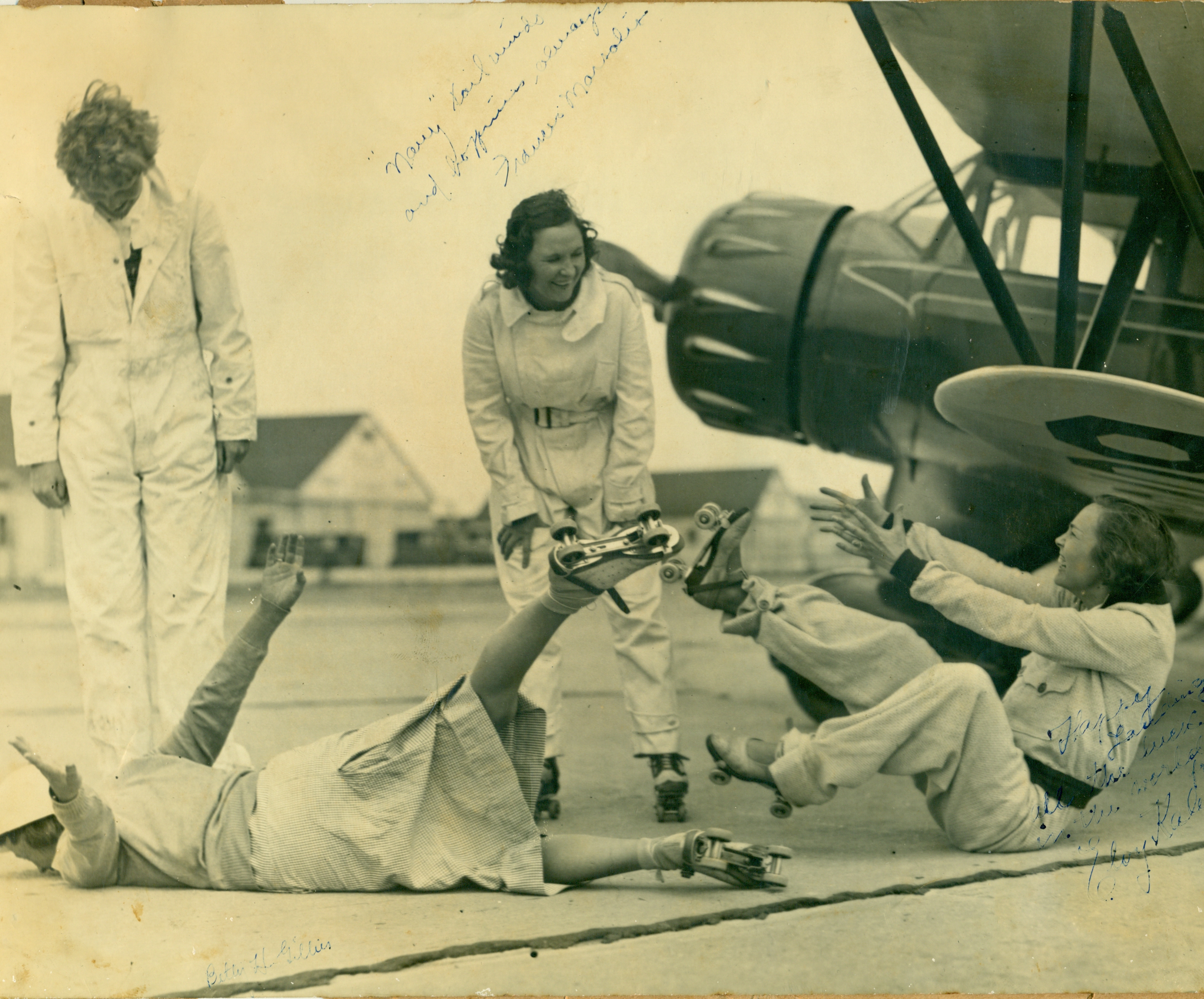
Piecing this story together didn’t come easily.  Though I have had the benefit of volumes of letters, telegrams, and pictures, among other sources, I still have struggled to get the story right.  The picture posted today provides an example of the most exciting finds I’ve made, but still shrouded with some doubt.

The girl in the center, in front of the Waco airplane, is Francis Marsalis Harrell.  From Chum’s thick scrapbook and an interview I conducted with him, I know her to have been his girlfriend.  They dated for a about a year after he left the Navy, and I believe he cared deeply for this young lady.  What brought me to that conclusion was piecework and conjecture.  First, during my interview sessions with Chum he lightly mentioned that his girlfriend used to time his trips into Manhattan from Long Island, but only when he drove female flight students into the city.  Second, when he looked through his ancient scrapbook, coming across her picture, he had to get up and walk around on his old legs, getting water from the kitchen and using the bathroom, before we could begin taping again.  I remember that clearly.

While researching my book, River of January, I gained a brief education in early aviation history.  I learned that there was a group of women who closely gathered in a league known as the “Ninety-Nines.”  This association of female aviators was a tight-knit assemblage, drawn together to survive in the male dominated world of flight.  These women resolutely broke ground for future generations of women to find their place in the cockpit.   These girls were enthusiastic and fearless pioneers.

Returning to the picture again, I found that three of these women pilots, all horsing around on roller-skates signed the photo.  Francis signed it “To Navy,” her pet name for Chum. The girl on her belly and the other one on her rear end are Betty Gilles and Elvy Kalep, other Ninety-Niners.  So the question for me has been, who is the fourth girl wearing her mechanic’s togs?

One morning, staring at this picture for the millionth time, the scales fell from my eyes and I saw Amelia Earhart.  You might see her clearly too and wonder how I missed the obvious, or think I’m nuts for believing it’s her.  So I ask myself, “Is the time right?  Is the place right? Are there other pictures from this publicity shot?”

The answers are all yeses.

This picture came from a google search of Elvy Kalep.

In the effort to reconstruct the past there exists uncertainty and conjecture.  However, thank goodness, also there exists logic and probability.

Boy, this has been fun.

Gail Chumbley is the author of the memoir, River of January. Also available on Kindle

Horizons

I was waiting for a flight to Portland yesterday, at the airport.  Watching my surroundings at the gate, I began to muse about the flight aspect of my book, River of January.  In the narrative, Chum left the Navy in 1933 finding there were only a handful of disparate companies that handled air cargo.  These businesses had  tried their hand at passenger travel in the 20’s, but costly overhead expenses put an end to that option.

Then Congress stepped in, underwriting airmail flights, and consolidating routes, that ended in the creation of the Federal Aviation Administration by the late 1950’s.  Travel after that boost, was best characterized by glamor and style.  People enjoyed spacious seating, formal dining on small white tablecloths, glass plates and silverware.  The food was fresh and hot–served by attentive stewardesses.

Now, I watch an over sized middle aged biker, sporting a wormy little ponytail pounding a pinball machine in an alcove.  He is clad in a loose, black t-shirt with the sleeves cut off, and his jeans riding on his butt crack.  Another woman is chattering loudly on her cell phone with great enthusiasm.  She’s clearly an open, affable lady.  Most of the other few folks booked on this flight are eating cold food, purchased from overpriced vendors dotted beyond the security gate.  The area feels more like a bus depot.

Then abruptly, out of the floor to ceiling windows, a small canary yellow biplane soars across the glass, piloted by a loan aviator.

It’s nice to know that for some, like Mont Chumbley, the wonder of flight has remained timeless.

Driving the Frontage Road

Now, I know the story that I am writing.  I know it so intimately, that the original manuscript, weak as it read, neared 600 pages.  I then faced a Solomon-like decision to divide my baby in two.  And as difficult as that dissection felt, I soon recognized the virtue of that decision.  Simply stated, concentrating on one volume at a time made editing so much easier, first for me, then for my editor.  But now I am looking at the same task for volume two.

Again, I know the plot of this narrative, I know where the story ends.  But writing each sentence, crafting each paragraph, delineating each chapter is tremendously challenging.  The true events placed into the manuscript need special attention to convey the fresh, authentic feel of each episode.  Re-writing volume two, which is essential, feels like starting over.  Volume one reads easily, like the speeding down an interstate, while volume two reads more like detours onto a bumpy frontage road.

I read a portion of the manuscript, attempt to perk up the conversations, then I reread it again, to liven the descriptive language.  “Was,” as a verb lays flat.  I think I hate “was.”  I need to percolate more active language.  “She was frightened,” hardly raises an eyebrow.  “Curled into a shadowed corner, the desperate child’s fingers nearly scratched through the drywall,” says fear a reader can feel.

The scenario for me is to write, re-read, write again, re-read, write again, give up, come back, re-read . . . repeat.

So I know where I will end the trip, but these detours, by-passes, and frontage road slow downs are tough to weather.  I have to use my meandering method until it reads just right.  That means re-writing each sentence in River, until a shape emerges that does the story justice.

But I Had Other Plans!

I clearly remember the day my husband told me he had throat cancer.  The news was so impossible to believe that I honestly wanted to reply, “No, Chad, you don’t, we don’t have time for cancer.”  I tend to resist any emergency that I can’t package up and manage, or eliminate by a force of will.

As he stood in the kitchen, his hands resting on the sides of the sink, tears filled his eyes.  I read in those tears that he had given up and accepted his medical condition, and that made me mad.  We weren’t going to lay down and admit that the big scary C-word would take center stage in our lives.  It wasn’t convenient–medical procedures would be scheduled when I had to work, or had other commitments to fulfill.

I couldn’t see past the treatments, the financial burden, or the fear a cancer diagnosis leaves in its wake.  We had much better things to do with our time, like going to our cabin, feeding the deer, hiking.  Cancer would interfere with our plans.

Elizabeth Kubler-Ross developed a model for accepting the unacceptable, in her five stages of grief.  1. Denial. (I resemble that remark) 2. Anger (Oh, yeah) 3. Bargaining (Huh?) 4. Depression (Medication for that) 5. Acceptance (Huh? Never!)

I am still pissed off that cancer darkened our door, and forced me to do things I hated doing.  Cancer compelled me to walk through my daily life frightened to my core.  Cancer physically shaped my husband into a skeletal invalid, restrained in a hospital bed, generally incoherent, bathed by CNA’s barely out of high school, and cancer made me a slave to beeping monitors and physicians who had no reassurances.

I never passed phase two in the Kubler-Ross schematic, however, somehow I converted that raw pain into a readable narrative that restored my sanity.

Blind Dates

If I were to pick up the thread that eventually led to River of January and retrace the steps, the book actually began with a blind date.

A good friend of mine, a fellow teacher, introduced me to my husband.  She was originally from Miami and had moved west to get away from the crime and congestion.  My husband-to-be had followed them out on a visit and it was during that visit that we got together.

He came to my house with stories of his parents and their adventures.  Mostly he talked of his father, Mont Chumbley and “Chum’s” exploits in flight.  From his wallet my gentleman caller produced a couple of pictures proving his claims.  Next he told of his mother and her career as a dancer before and during WWII.   He knew less of her story, but shared it with the same enthusiasm as Chum’s.  My beau was careful to add that his father was still alive and that I would enjoy meeting him. (And that part was true, I did meet him and was charmed.)

Each time we met, following that first date, he brought more and more mementos to show me.  Photo stills of a handsome man posing proudly before his airplane, and of a girl with smoky mascara-smudged eyes, smoking a cigarette.  I grew increasingly curious with each new find.

Eventually, we married and his father, Chum, died.  By that time I had a large closet filled to capacity with his family mementos.  All of those letters, pictures, playbills, air show programs, were saved, in my opinion, for a reason, and perhaps that was to piece them all together into a book.

My husband courted me, a history teacher with historic materials, and sifting through those stacks made the decision to write obvious.  The responsibility fell to me and hopefully I have done their fascinating lives justice.

You Had to be There

Through the writing process I had to learn to stop telling the story, and instead visually show each episode.  Describing, over telling, took a bit of time to incorporate into my writing.  Most of the works I’ve read over the years are telling by nature–straight non-fiction books, biographies, historical narratives and other factual stories of that nature. 

When making the change-over to creative non-fiction, description grew vital to relating an interesting and readable story.  In my head I started to imagine myself in the room, or within earshot of my characters.  That necessity required placing myself in rooms, houses, city streets, restaurants, and theaters I’ve passed through over time.  I visually remembered all sorts of tables, different kinds of flooring, from wood to tile, stage lighting to low lit lounges, to living room lamps, to garish lit repair shops.  My own images revived of my grandparents homes, apartments, and automobiles– my own romantic memories of brief visits to the tropics, and finally falling back on my training in American History.  I couldn’t seem to make anything up, the backdrop had to be real to me. 

I suppose I am re-inventing the wheel in this blog entry.  Or I’m admitting my limits as a writer.  George Lucas sure came up with that Death Star, Gene Roddenberry created Mr. Spock, JK Rowling evolved port keys and apparating.  Not me.  I have no talent to generate believable fantasy.  But that’s okay.  It’s been kind of cool to visit my grandmother’s tiny kitchen, and wearing ballet slippers again.  I hope that this authenticity comes through my writing in River of January.


Waiting is the Hardest Part

My son forwarded a Huffington Post story featuring the rejections endured by prominent authors.  I know that he meant it as a kindness, that everybody struggles in the book business.  Still, despite his good intentions, the story brought me down.  The business end of publishing always leaves me with a chill.

Writing, though sometimes a struggle, has been an affirming experience for me, delving into a story of risk and adventure.  I’ve been in the cockpit in an air race, suffered through butterflies waiting to go on stage in Paris, London, and Buenos Aires.  Now that the story is with the editor, I have to face the next battle–getting noticed by a publisher.  That arena is about money, markets, and deal-making.  And though I understand there are other options for getting River of January out there, those alternative routes are just as mystifying.

For any of us trying to get a manuscript before the public, we have to find some confidence to persevere through this difficult effort.  While the book moves its way through the process of finding interest, I need to cope with my uncertainty.  I can only fall back on believing in this project, that this story is unique, and powerful, and worthy of attention.  Tom Petty had it right–the waiting is the hardest part.

“Clubbing vs. Hitting the Bars”

A noteworthy feature emerged researching my book, River of January.  Helen and Chum’s mementos, particularly the photos, depict style and class–a sense of decorum and politeness that seems as faded as the old pictures.  I can’t help but wonder what happened to end the sense of self control and refinement in our social interactions.  And the sad conclusion points the damning finger at my generation.   We Boomers ushered in a coarsening of manners.

I won’t go into the brutality of the Vietnam experience, or the duplicity of Nixon’s Watergate escapades, but the era not only shaped my generation, but beat the hell out of us in the process.  Contrary didn’t cover my resistance to conventional expectations during my formative years.  If something was only done one way, I found another means.  I can’t help but remember the old bumper sticker that read, Question Authority.

At twenty, Helen wore fitted suits, wool or linen, silk stockings, fashionable hats, netting on the front, and stylish heels.  When she went on a rare date, (between her protective mother and working, her nights were busy,) the girl enjoyed going out clubbing.  Her drink was bourbon, and she smoked cigarettes from a silver case.  Her music was glamorous jazz, and her dances consisted of prescribed steps, face to face, and romantic.

I wore jeans.  I wore sweaters from thrift stores, or flannel shirts from my dad’s closet.  I liked Red Wing logging boots, and drank beer.  I loved Bobby Kennedy and the Beatles. The lead guitar, especially in the magic hands of Hendrix, to me was the summit of music.  And I hated conformity.

At the movies, my world changed when I witnessed a man cut in half in a scene from Catch 22.  Our evenings out consisted of beer at the drive-in, and dancing at country-rock taverns.  We hit the bars.  We closed the bars down.  Vonnegut was the visionary, and Lennon McCartney supplied the soundtrack. 

I believe that the youth movement made the effort to right wrongs in America, but Helen and Chum’s time actually accomplished more, enduring economic depression and defeating Fascism.  All the while looking and sounding, and behaving with grace.