Angels

Image

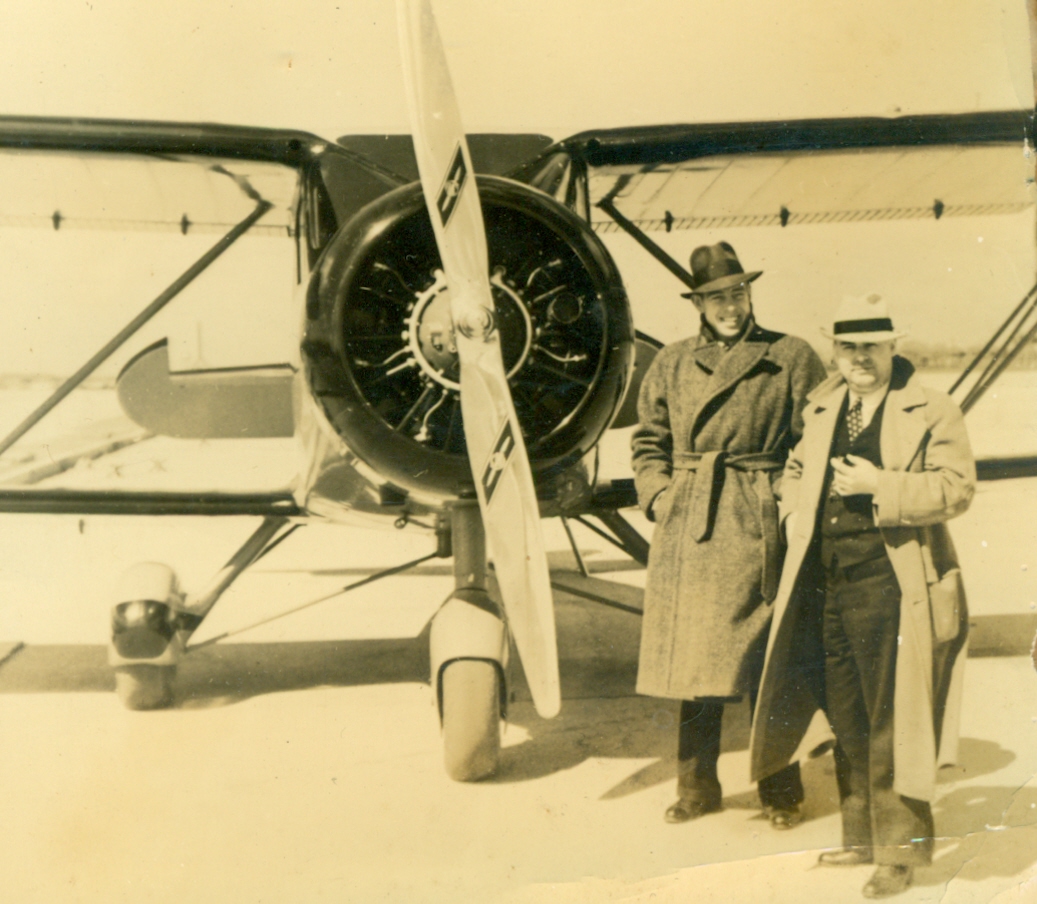
Today is Chum’s turn.  He’s the smiling, handsome fellow.  The man he is standing with is Howard Ailor, the New York distributor for Waco Aircraft Company, out of Troy, Ohio.  I chose to post this picture because of Ailor’s important role in young Mont’s start.

Some believe we all have angels who arrive when we need them, and set us in our life’s direction.  Howard Ailor was just such a man for Chum.

Following Chum’s discharge from the Navy in 1933, little opportunity–actually no opportunity beckoned in Depression-era New York City.  Enter Howard Ailor.  After making the rounds of all the existing air carriers in the city, Chum paid his last call out at Roosevelt Field, on Long Island.  A smiling, all-knowing, Ailor took one look at the young pilot and told him he’d have to make his own luck.  America was fresh out.

Crazy at it may seem, Howard convinced Chum to buy his own plane, start his own business, and for good measure moved stuff around in the Waco office, so the young man could have office space, too.  And that act of kindness made all the difference in Mont Chumbley’s life.

When I was a kid we played “Blind Man’s Bluff,” a game that began by spinning the person who was “IT.”  Blindfolded, the kid had to find everyone scattered around without looking.  In that same vein, Chum couldn’t see.  He was blinded by his uncertainty, a devastated economy, and no network of friends.  Howard Ailor stopped the spinning and sent the young man into the right direction.

Plastics

One-Word-Plastics

In Mike Nichols classic, The Graduate, Dustin Hoffman’s character is the guest of honor at his own graduation party.  Shaking hands, thanking well-wishers, one attendee herds him outside and says, “One word.  Plastics.”  There is no context or warning for the advice, and the exchange is well timed–very funny.

Turns out that the recommendation from the film was sage advice.

My husband was diagnosed with throat cancer back in the spring of 2010.  Following seven weeks of daily radiation, and powerful opiates, combined with a freighter load of other drugs, his colon ruptured by August.  Simultaneous to the colon perforation, chaos erupted as well.  The next twelve fateful hours involved a life-flight trip on a helicopter over the mountains, life and death surgery, followed by eight harrowing days in the hospital ICU.  In summary his recovery took better than three years, as he was literally coming back from the dead.

My husband’s body, initially ravaged by potent cancer drugs now pulsed lethal septic contamination . . . his mortality dangerously uncertain.

In a miniscule corner room, a broad aluminum apparatus, looking a bit like a spinning skeletal umbrella dropped from the ceiling. Numerous hooks dangled from this suspended fixture, but apparently not enough to treat his severe condition.  Hatstand-style steel poles were wheeled in, circling the raised, mechanical bed.  Every hook bore multicolored plastic bags, upside down, metering in good stuff while other plastic tubes, secreted beneath, drained out the bad stuff. The overall impression of the set up reminded me of an underwater documentary, featuring clouds of transparent jellyfish, crisscrossing uncountable tendrils. Easily fifty miles of plastic tubing splayed from above, inserted into all of his orifices-all of them.

When the medical staff ran out of natural holes, they manufactured more conduits using hypodermic needles. Blue and green plastic portals were punched into his wrists and upper arms. Threaded in were additional plastic tubes that pumped fluids, battling to purge his body of poison.

The liquids pushing through those tubes, out paced the liquids draining out, leaving his body strangely distorted.  Bloated, his eyes had swollen shut and his nose stretched broadly across his cheeks–fingers like frankfurters. As he hovered between life and death, his distended condition revealed the herculean battle against toxins within.

What my eyes could see in that little cubicle, my mind failed to process. This ordeal–his grim condition, the possibility of his death, the suddenness of the disaster became more that I could grasp.

I stopped eating, struggled to find sleep, and wandered through my days in a daze. The plastic lattice work draped over that distorted stranger removed any conscious balance of a normal life. When living in my own skin reached critical mass I realized my sanity had reached a breaking point. There was no solace to be found, no help, nothing but a mental abyss–and that couldn’t continue. I had a husband and family who needed me.

So I began writing my first memoir, River of January. I had idly contemplated starting this project for many years, telling myself that someday I’d commit the story of Helen and Chum to paper. Now, living in the middle of a nightmare, writing became a necessity, and the book began to take shape. And as dreadful as those early drafts were, I kept at it, white knuckling each word, sentence and paragraph. Somehow, in that silent struggle, I eventually began to recognize my face in the mirror again. I felt a little hungry and started to eat real food now and then.

Since that horrible episode in 2010, I can announce that he lived. I can also attest to the restorative powers of writing. (Therapeutic magic as far as I’m concerned).

But that creepy ‘suit’ portrayed in “The Graduate” offered up a great career tip. I think owning some hot plastic stocks might have covered the medical bills accrued from his difficult, extended stay. Hospitals go through plastic products like nothing I’ve ever witnessed. I can still see those icicle-like plastic bags and webs of tubes dangling in every direction from the ceiling, weaved across and under his bloated torso. A synthetic product that aided in saving a life.

Correction–saving two lives and creating a memoir.
 

Out of Bounds

Image

This beautiful girl is the subject of my new book, River of January.  Her name was Helen Thompson, and as is evident in the photo, she was a beauty.  As a little girl, Helen began dance lessons, specializing in ballet.  Her repertoire expanded over time, training professionally in tap, with acrobatic, and gymnastic embellishments.  

When she became the breadwinner, following her father’s death, her professional career grew to include performing on three continents with a stint in Hollywood.  The stage became her home, and she knew her business.  Helen was an artist and her canvas was the beauty expressed under the spotlights.  From what I have gathered in my research, she still respected auditions, and took no job for granted. 

However, it was off the stage that Helen faced her limits.

Some of her shortcomings were honest, for example she never learned to cook.  But many of her limits were imposed by others, especially her mother who wanted to keep her daughter dependent and needy, convincing the girl that she would never succeed at marriage, or any pursuit other than dancing.

If I had been told that I would write a book in three years, I would have answered, “A huh, on my voyage to Mars with Elvis.”  But unlike Helen, my family and friends could say nothing but wonderful, supportive things, encouraging me to spread my horizons. 

While her support system failed her for selfish agendas, mine has believed in my abilities outside of my career as a history instructor.

Helen was bound by her mother, while my dear one’s have kindly set no boundaries.

Folding Fitted Sheets


Folding fitted sheets is a pain.  Sometimes I can match those rounded corners fairly well and the rest of the sheet folds up reasonably.  Other wash days those stupid bottom sheets just bundle impossibly.  More than once I’ve settled for winding that cotton mess into a roll and stuffing it in the closet. 

I have spent over three years sweating over my manuscript, River of January, endeavoring to get the book right.   The first draft back in May of 2010 was, well, horrible.  I am aware that a few copies of that version are floating around, and the knowledge of those drafts out there makes me want to reach for a bag to put over my head. 

However, over time, with the help of some very nice and patient people–my family, friends and legions of my students who listened, helped my style improve. 

It will never be perfect.  The book will probably end up with some goofs that no one picks up on, until it is printed.  But I cannot rewrite forever, fit those corners to perfection.  The process has to move forward.

Hit Replay

Oddly, my brain is adept at remembering shards of events and conversations from years ago.  At least I think that I remember them.  But in the summer of 2011 my old high school gang descended for an old girls weekend at my mountain house. 

While the pushing sixty gal-pals became comfortable on the deck, catching up, laughing, and telling stories about each other from the old days, I grew uncomfortable.  What struck me from this swapping of anecdotes, was my memory maybe wasn’t so accurate.  Perhaps our shared events not exactly the way I remembered them.  So to use a Carrie Bradshaw moment, “What makes up our past as friends?” 

Is it my friend, Mary’s construction of events?  Is it Jamie’s, Ona’s or Heidi’s?  Now we delve into the metaphysical–what is and what was real?

Perhaps the writing process allows our memories to shape themselves to reflect our own temperaments,  our own psychic fingerprints, experiences processed through individual channels.  So if I don’t remember life events the same as my old friends, siblings or my spouse, I don’t think anyone is keeping score.

I’ll tell my stories the way I remember them.  Even if I’m wrong.

I Choose Door Number Three

I know the story that I wish to tell.  All of the story, leaving nothing out.  However, over the course of the writing process, the manuscript has grown to well over 350 pages.  I cannot hope to publish such a large tome as a first time writer.  The dilemma has, at times, left me down and hopeless.

Again, communicating my anxiety has been a source of great solace and solution.  Friends and family can sure help–and sometimes from people I’ve never met. 

The River of January, at this moment is undeniably too long.  So, after much anguish and talk, and a new writing friend’s kind ear, the editing scissors came out.  I have lopped off the first 50 pages for use perhaps, later, in another work.  Also eliminated was the story, in the story, examining the evolution of the book.  The files are available, and the content unharmed.  Certainly the length has finally become reasonable. 

This time, compromise seems to have moved the project ahead.  And though I tend to over tell the story, that perhaps isn’t necessary, at least not today.  I could have chosen to hold my ground, only removed the personal narrative, or take the third route.

As repeated on the old game show, “Let’s Make a Deal,”  I choose door number three.  I need to go forward.

Between Risk and Control

In my book River of January, a main figure, “Chum” Chumbley challenged the Navy’s flight school, with no assurances he would make the cut.  The regimen was designed for failure, single elimination, so the Navy could function under severe budget cuts.  Chum didn’t bother himself with the odds of survival, he simply had nothing to lose.

Once in flight school, not all was wonderful.  As a lowly Seaman Recruit it seemed everybody in his midst told him what to do.  As happy as he was to have reached the door to his highest ambition, stepping through cost him personal autonomy.  That is life in the military service.

Sitting down three years ago to begin this book, I, too, experienced a liberation, transferring this story from my thoughts through my fingers, to the keyboard.  However, though most friends and family have supported me, read the manuscript, listened to my doubts, some haven’t been so kind.  I’ve been told that I can’t write worth a damn, and that my inattention to sentence mechanics render the book unreadable.  Maybe so.  But I have plowed on, seeking help, and trying to gain control over those pesky nods to standard English.

He wanted to fly, I want to tell his story.  Who would have believed taking risks could open up a whole new set of restrictions? 

How Much is Too Much

In my first draft of River of January, I spent a lot of time explaining or telling about the historical backdrop of the book.  It was easy to do because I have been an American History teacher for thirty three years.  I felt I couldn’t tell enough about the impact of World War One on Americans, or how greed brought about the Crash of 1929.  It was boring.  One deadly, long, dreadful lecture.

Fast forward three years.  Since those early efforts the blah-blah factor has been chopped back significantly.  Still some nod to the era is needed to demonstrate how significant the achievements of Chum and Helen actually were.  For example, Chum burned to join the Navy in 1927, but he had no support from his extended family.  If I hadn’t explained the prejudices of the time, his difficulties enlisting would make no sense.

It was a tough pill to swallow when I realized my audience didn’t need to know everything I know.  Even more so, all that detail becomes tedious, I can hear a reader complain, –enough crap, get on with the story!  So I did.  But, without the historical background some of the episodes would be incomplete.  And some of the details are fascinating.

What I did on my Summer Vacation

There was an old bit performed by Cheech and Chong on one of their first albums.  Tommy Chong, as a student, has to stand up in class and read his essay titled, “What I did on my Summer Vacation.”  Clearing his throat he begins by reading the title in a monotone voice.  Moving on he continues with . . . “I got up.”

Of course the delivery is perfect and the bit is very funny.  Attempting to write a serious piece and have it sound like, “I got up,” is another matter.  Not close to funny, some days at the computer keyboard would better be spent beating my head against a brick wall.  There is no inspiration, the words are simply not available on the shelves in my brain.  Creating a narrative becomes an effort to squeeze blood out of a turnip.  

When caught in that frustrating frame of mind, I usually still try to soldier on, dragging something from my fingers.  It is either guilt or masochism that keeps me at my lap top.  I cannot verify that that type of fruitless diligence actually helps my writing.

But I do have a couple of strategies that help me out of a writing funk. First, I read the tract to someone else, (a patient someone else).  My son, David, has been a fortuitous find because he is an active listener and is brutally honest with his critiques.  His participation has been generous and has helped so much.  Another trick is just talking to someone else who is involved in the creative process.  A childhood friend of mine is a painter.  We have shared conversations about seeking truth in our respective projects.  She has been a wonderful sounding board, and says the conversations help her too.

So in the end, I can beat a dead horse, or wait for it to come back alive.  But the best option for me is to use a couple lifelines of selected family and friends.