A Meeting

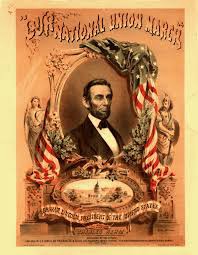
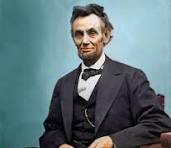
The following is an excerpt from “Peer Review” a play. The setting is a home in Gettysburg Pennsylvania. The 47th president meets the 16th.

THE TALL MAN

We have all noticed your obsession with political enemies. Mr. Nixon has kept a

particularly close watch on this activity.

DJT

Nixon’s dead, and I don’t care. Look if people aren’t nice to me I’m not nice back. They

all think they’re so much smarter than me. Obama, the Clinton’s, that Puerto Rican chick

from New York. All jerks.

THE TALL MAN

Ha. The Army of the Potomac had generals who thought the same of me. (Pauses)That

reminds me of a time when a client came to my Springfield law office and hired me for a

patent case. The fellow paid a retainer, and I began research on the legal particulars.

Oddly enough I never heard another word about it. Later the newspaper said the trial had

been moved to Cincinnati, Ohio.

DJT crosses his arms pouting. The Tall Man

merely smiles.

THE TALL MAN

Well sir, I made the journey by train to attend that proceeding. To my surprise a new lead

attorney sat at the courtroom table, and pointedly ignored me. Later I learned he had

dismissed me as a long-lanked creature in a dirty coat. Of course my feelings were more

than a little wounded. However I remained in Cincinnati and observed the court

proceedings. There is always something to learn. That attorney, Edwin Stanton, made a

fine job of it, and I later made him my Secretary of War.

DJT

What the hell is wrong with you! All you dead guys are morons. Made him a Cabinet

Secretary. I would have made up a name, you know, like Pocahontas or Shifty Schiff and

never stopped hounding him. I’da ruined the guy.

THE TALL MAN

And that would have proven a mistake. Secretary Stanton proved a wise choice for his

management of the Union Army. Besides, in the words of Mr. Lyndon Johnson, again, it

is “Better to have your enemies inside the tent pissing out, than outside the tent pissing

in.”

The Tall Man laughs and slaps his leg.

THE TALL MAN

Stanton merited the post, as did most members of my cabinet, Seward at State, Chase at

Treasury, Blair as Postmaster General. They had been my competitors for the presidency,

and I appointed these men knowing full well they resented my election.

DJT

You’re crazy. I wouldn’t have let them in the White House. I’m still gonna get even with

the scumbags who stood in my way, DeSantis and Nikki Haley. May not be today, but I

will destroy them. I never forget.

THE TALL MAN

I required sound advice in a difficult time, and that these men were the best, except for

Simon Cameron. There was a scandal and he was undone. Deceivers like Cameron and

Floyd undo themselves. You could learn from their errors.

The Tall Man looks again at his writing, as DJT

speaks.

DJT

Who needs a cabinet anyway. Fill it with dopes who will do as I say. I’m in charge now.

THE TALL MAN

Americans are a free thinking people. Never will they all revere you as does a minority at

this particular moment. You, me, all of us have but a brief time in office. The American

people possess a truth beyond momentary and shifting opinions. Beyond a name on a

map America embraces noble ideals and accomplishes great things.

DJT

Just what I thought, a Rino. You liberals are what’s wrong with America.

THE TALL MAN

Ha. You foolish man. The whole idea of America is Liberal. This nation is the product of

the best political thinking of the 18th Century. It is the sovereignty of the people!

The Tall Man taps the pen on the desk top.

Mr. Madison crafted the Constitution and his Bill of Rights upon the rights of free people.

DJT

America doesn’t care about that anymore. Times have changed. I have changed it. They

want a strong man who gets shit done. Blacks, women, immigrants put back in their

place.

THE TALL MAN

You are mistaken. Only the people are the rightful masters . . .

Gail Chumbley is the author of the two-part memoir “River of January,” and “River of January: Figure Eight,” co-writer of the screenplay, “Dancing On Air” based own those books. She has penned three stage plays on history topics, “Clay” on the life of Senator Henry Clay, “Wolf By The Ears” examining the beginnings of American slavery, and “Peer Review” where 47 is confronted by specters of four past presidents.
A Surreal Landscape

In a scene from Hitchcock’s The Birds locals are gathered in a cafe eating and chatting. An attractive blonde is on the telephone explaining that children at the local school were dive-bombed by attacking crows. An elderly lady in a beret and smoking cigarettes lectures the other diners that crows don’t behave in such an aggressive manner and that there has to be another explanation. The woman identifies herself as an ornithologist and holds forth explaining crows and even seagulls do not do such things. Immediately after her expert testimony all hell breaks loose outside the cafe window, with masses of birds swooping down on passersby. The scene is chaotic and bloody leaving no doubt these attacking birds are in fact lethal. As the nightmare scene ebbs, the camera catches the bird expert, her head bowed in grief and bewilderment, stunned everything she knew and believed no longer applied to any bird in her understanding.

That woman resembles this lifetime American history educator. I’m a fairly decent generalist in subjects ranging from PreColumbian America through today, give or take minutia. But I too, am stunned by the surreal landscape of what I believed about democracy has been easily undone by a vulgar man-child and a compromised and opportunistic Republican Party.

It feels like all my understandings of my country no longer apply. The epic and fraught-filled struggle of forging the Constitution, the furnace of Civil War, the reforms of the Progressive Age, the promise of the New Deal, and Great Society are gone, rapidly destroyed by sinister design. A totalitarian despot has seduced a once noble political party rendering the valiant patriotism of those whom came before moot. Simply writing this lament is difficult, as all I once believed and explored is no longer valid.

An online troll explained it as “no one cares about that anymore.”

That means the principled determination of General Washington to serve our nation doesn’t matter. The misguided genocide of the Five Civilized Tribes upon the Trail of Tears doesn’t matter. With nearly 700,000 deaths, the crucible of Civil War no longer matters. Those brave GI’s on Omaha Beach, (including my own grandfather) and at the Battle of The Bulge no longer matters. Those brave students who occupied lunch counter stools in the face of racial violence did so for nothing. Those boys who perished in the Vietnam War are irrelevant. In point of fact no veteran matters anymore.

American history and all the sacrifice of our forefathers and mothers doesn’t count.

That 47 can fly in a foreign “gift” aircraft with a classified budget is a good thing to do with our tax money. That he remodels a room in the White House in a golden gilt is a good thing. Who really cares if former medicaid recipients suffer.

Suck it up buttercup, these are the new rules of Trump’s America.

That he has done away with investments in the Arts and Humanities is a positive. That he has placed incompetent sycophants from Fox News in high Federal positions is good. Forget he stole top secret intelligence documents. The country elected him anyway. That he has drastically shifted the tax burden onto the middle class and off of the super wealthy is how God wants it, just ask today’s Christians.

That old white men rape girls is a good thing. 

The GOP bows at his feet and gleefully ratifies every stab-wound of domestic legislation is now to be celebrated, so pop a cork. In fact destroying America for profit is now simply wholesome and righteous. 

America’s heroes, like Sergeant Alvin York in the Argonne Forest, or Colonel Joshua Lawrence Chamberlain at Gettysburg endured their generations difficulties so that Trump can plow up Mrs Kennedy’s rose garden for a putting green. Suffragette Alice Paul who went on a hunger strike and endured the torture of forced feeding did so that the current president can manipulate votes is just fine. The murders of JFK, Dr King, Harvey Milk, or the murder of Minnesota State Senator Melissa Hortman is merely a part of the 24/7 news cycle.

Indeed nothing of our past story matters because Mr 47 has disqualified all of it to make money, and more money because that’s all that matters today. Plus of course he is a convicted felon and is terrified of going to jail where he belongs.

So when you see this disoriented American History educator with her forehead in her hand, much like the bird expert in the movie, please understand the gravitational pull of her entire life’s work is today rendered null and void. 

Gail Chumbley is the author of the two-part memoir “River of January,” and “River of January: Figure Eight,” co-writer of the screenplay, “Dancing On Air” based on those books. She has penned three stage plays on history topics, “Clay” on the life of Senator Henry Clay, “Wolf By The Ears” examining the beginnings of American slavery, and “Peer Review” where 47 is confronted by specters of four past presidents.

Memory

I am loath to close. We are not enemies, but friends. We must not be enemies. Though passion may have strained it must not break our bonds of affection. The mystic chords of memory, stretching from every battlefield and patriot grave to every living heart and hearthstone all over this broad land, will yet swell the chorus of the Union, when again touched, as surely they will be, by the better angels of our nature.

A Lincoln, March 1861

Great Things

My America is a place of perpetual greatness, not this dark moment of greed and misconduct. G.C.

Remarks at Gettysburg, 1889

“In great deeds something abides. On great fields something stays.

Forms change and pass; bodies disappear, but spirits linger, to

consecrate ground for the vision-place of souls. And reverent men and

women from afar, and generations that know us not and that we know

not of, heart-drawn to see where and by whom great things were

suffered and done for them, shall come to this deathless field to

ponder and dream; And lo! the shadow of a mighty presence shall

wrap them in its bosom, and the power of the vision pass into their

souls.”

Joshua Lawrence Chamberlain

Gail Chumbley is the author of the two-part memoir River Of January and River Of January: Figure Eight. Chumbley has authored three historical plays, Clay about Senator Henry Clay, Wolf By The Ears, an examination of American slavery, and Peer Review, where 47 meets presidents from the past. Additionally, Chumbley has co-authored Dancing On Air, a screenplay depicting the true adventures of an aviator and showgirl.

An SOS

I sent this letter to my Senators. Feel free to use it how you can.

Dear Senator,

I am reaching out to share my growing dread with this current administration. Arbitrary cuts to government programs, gestapo-like assaults upon peaceable communities and the shrinking of America’s international role is chilling.

As a career history educator I know these actions are decidedly harmful to all of us and that he is attempting to gut the rule of law. It’s as if the United States is drifting into a new Dark Ages and few are standing up for tenets of the Constitution, a hard-won, and hard-defended blueprint of government.

Please restrain yourself from the temptation of pursuing unfettered power, and apply the oh-so-needed brakes on this administration; we are counting on you to hold him to account.

I am a child of the Cold War era and recall the fear of air raid sirens and Soviet attack. But today I am more afraid. What is good about the United States is bad to this administration, and quickly ransacked out of existence, criminals are pardoned, and the guilty go free.

This damage does not fully rest on the White House, he could not carry out his pillaging without the silence of Congress. I implore you to have courage and stand up to this feeding frenzy and let us go back to being America, which still is “the world’s last best hope.”

Gail Chumbley

SLC 

The Business of America

President Calvin Coolidge once famously proclaimed “The business of America is business,” which meant his administration would pursue a “hands off” approach toward the business sector over the interests of the American people. In office from 1923 to 1929 President Coolidge kept to his pro-business principles that, in turn charged the roar into the Roaring Twenties.

By the end of October 1929, six months into the new Hoover Administration, Coolidge’s lax policies came due dropping the Dow Jones Industrial into free fall. This financial catastrophe capped off a decade of easy money made through frenzied and unregulated trades, not only by wealthy holders, but by regular folks taking stock tips from friends or newspapers.

A large portion of these everyday newbies purchased shares “on-margin,” meaning 10% down with 90% on credit, usually borrowed from private banks. The only collateral required was the promise of certain and endless gains. And why not? The market had grown at an astounding rate from $27 billion in the mid-1920’s to $87 billion by 1929. 

Coolidge’s free-market detachment produced a carnival atmosphere with everyday people hot in the market game.

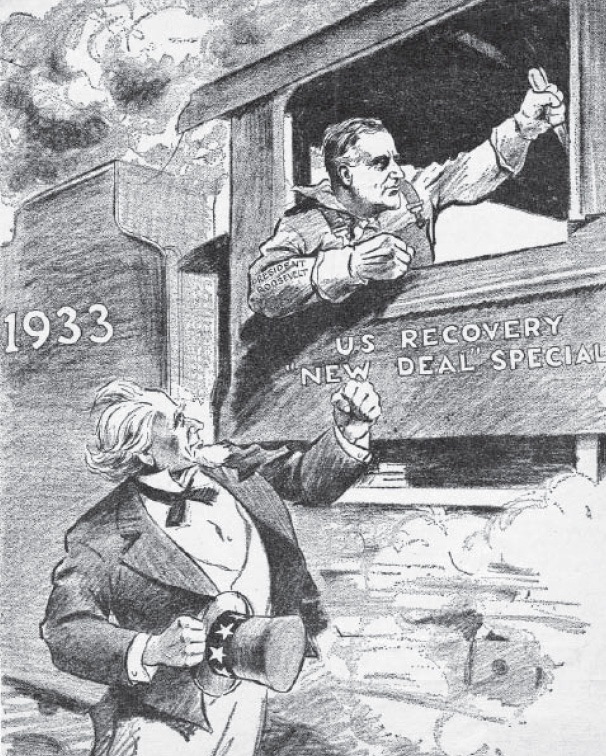
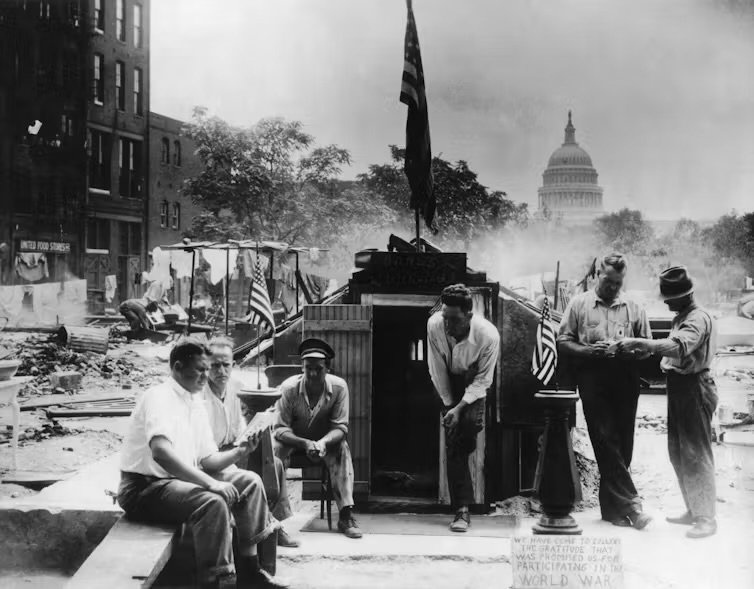
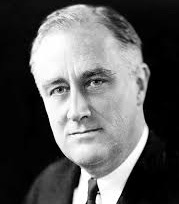
By 1932 the party was over. The now suffering nation had had enough of hands off and predatory money practices. Massive unemployment, thousands of bank failures, hunger, homelessness, and a Dust Bowl in the heartland brought America to its knees, and Democrat Franklin Delano Roosevelt to the White House.

Seeing nothing beneficial for the American people in catering only to the rich, FDR brought an end to GOP policies. His administration instead offered a New Deal for economic revival. Through a massive legislative agenda Roosevelt and Congress intended to not only meet the emergency, but restore economic growth, and eliminate the conduct that led to the Depression in the first place.

One of the most popular New Deal relief programs was the Civilian Conservation Corps. Unemployed young men were put to work throughout the nation building trails and campsites in forests like the Great Smokey Mountain National Park, and urban building projects like the River Walk in San Antonio, Texas. (Consider that idle young men in Germany at the same time donned Black and Brown Shirts and broke heads for Hitler.)

Addressing the chaotic banking system FDR proposed systematic changes. Some 6000 banks had failed between 1930 and 1933 before the new president took office. Panicked depositors waited in long lines to demand their money until banks simply ran out of cash and locked their doors. Confidence collapsed. 

In his first days Mr Roosevelt announced a Bank Holiday where banks closed for four days to stop panic withdrawals. Auditors then inspected banking institutions across the country and surprisingly many banks were deemed solvent and reopened. Not finished with banking, FDR also took to the radio to explain the banking system, and with his cheerful confidence encouraged the public to take cash out of their mattresses, coffee cans, and backyard holes and return deposits to local banks. Thousands did just that. 

In order to prevent another such economic catastrophe the Glass-Steagall Act (1933), was passed by Congress to protect the public from high risk banking practices. One piece of the law was the Federal Deposit Insurance Corporation, FDIC, which is still in effect today. Depositors had the backing of the federal government to protect their funds from any loss. Moreover the Roosevelt Administration was determined to keep people in their homes, many of whom were facing foreclosure. The Home Owners Refinancing Act provided federal assistance to those who had paid their mortgages in good faith, but now faced eviction. 

In the first hundred days of Roosevelt’s New Deal 77 laws in total were passed by Congress, all aimed at restoring the health of the country. To the majority of Americans it felt like this president truly cared about their wellbeing. Roosevelt’s ascendency to the White House, next to Abraham Lincoln’s certainly stands as the most consequential in America’s continuing experiment in self government.

On a side note Franklin Roosevelt suffered from polio and could not walk, though he believed he’d walk again. FDR never gave up. And the truth of the matter is it took a man in a wheelchair to put the United States back on its feet. Franklin Roosevelt, unlike his predecessors knew that the business of America is “We The People.”

Gail Chumbley is a history educator, author, and playwright. Her work includes River of January, River of January: Figure Eight, both available on Kindle, plays Clay on the life of Senator Henry Clay, Wolf By The Ears a study of American slavery, and Peer Review where Donald Trump meets four past presidents.

If you like, please share this on social media.

An Open Letter To NBC

NBC News is my media outlet of choice. Integrity and journalistic excellence has made for my confidence in the network. Adding Rona McDaniel as a consultant runs counter to the very qualities that built the network.

By allowing a documented source of misinformation (lies) as a consultant, NBC legitimizes that position as valid. 

It is not.

Lincoln would not treat with the Confederates, nor FDR with Hitler. Do not permit Ms McDaniel a seat of legitimacy in a world dependent on facts.

I would encourage your anchor line-up to a work stoppage, and  I will change the channel.

Post script-This goes for DJT as well. During the campaign you covered him easily 3:1 over the VicePresident. Give us all a rest. Don’t sell out our democracy for ratings.

Gail Chumbley, Idaho

Symmetry

This reactionary-looking gent is Marylander Roger Brooks Taney, an Andrew Jackson appointee to the Supreme Court. History remembers Justice Taney as the author of the Court’s most infamous ruling in Scott V Sandford (1857).  

Before his rise to the Court, Taney had made no secret of his opinion on slavery and citizenship, insisting that blacks in the country had no rights white men were bound to respect. A free black had requested documents for overseas travel that Roger Taney, as then US Attorney General, rejected. Taney declared his view that blacks were not citizens, and never would be. Travel documents for this man of color were denied.

Another important element in this story concerns the Missouri Compromise of 1820. Settled eight years prior to the election of Andrew Jackson, this legislation directed that, with the exception of the new state itself, slavery would be forbidden westward along Missouri’s southern border. Most Americans hoped that this Compromise Line would endure forever, clearly delineating for posterity new slave states from free.

By the time the Scott case wound its way to the highest court, violence and bloodshed had erupted on those very western lands, on the Kansas prairie. Emigrants raced from both northern and southern states, dead set to vote upon the status of slavery in the new state’s pending constitution. A volatile mix of invading, pro-slave Missouri Ruffians assaulted Free-State Jayhawkers near Lawrence, sparking deadly violence across the region. Unrepentant slaveholders demanded their 5th Amendment property rights (meaning slaves) be allowed any place slaveholders settled. At the same time, equally fervent opponents contended the “peculiar institution” would remain only where it existed, never to pollute new territories, or America’s future.

Justice Taney, as Chief Justice, took umbrage at these incessant attacks, and at those Northern rabble rousers who would not obey the law. When the Dred Scott case entered deliberations it appears Taney intended to settle the question for all time, silencing forever those interfering, and self-righteous Yankees. When the Court finally issued its ruling in 1857, Justice Taney’s opinion rang out with certainty, and finality.

Taney wrote

I Despite Dred Scott once residing in free territory with his master, he was still a slave.

II As a slave, Dred Scott was not a citizen and had no standing in court.

With those two main points established, Taney could have ended his decree, but the Chief Justice had some personal venom to add.

III Congress had exceeded its authority in legislating the Missouri Compromise in 1820, and the 1820 law was unconstitutional. 

IV Movable property, (slaves) could not be restricted by boundary lines or by popular vote. Property was protected by law.

Believing he had settled the dispute, Justice Taney had, in fact, only stoked a more massive inferno.

Indeed the Civil War exploded within four years of Taney’s ruling, and blazed for four bloody years. In the aftermath, an interesting turn of symmetry, the Fourteenth Amendment was submitted for adoption, flipping all of Taney’s arguments, provision by provision. 

I By virtue of birth in the United States, one was a citizen. 

II As a citizen a person was due all rights and immunities, with equal protection under the law. 

This amendment reads as if the Scott Decision acted as a template for reversal.

Fast forward to 2008. 

President-Elect, Barack Obama, in a conscious effort to mirror the sequence of fellow Illinoisan, Abraham Lincoln’s inaugural, deliberately followed the 1861 Lincoln festivities. The Obamas rode the same train route as had the Lincoln’s, breakfasted on the same meal inauguration day, and when the moment came for the swearing in, President Obama chose the same Bible as touched by Abraham Lincoln’s right hand in 1861.

In this last twist of symmetry that Bible belonged to Justice Roger B Taney, the man who decreed blacks were not citizens and never would be. A very satisfying turn, indeed.

Gail Chumbley is the author of the two-part memoir, “River of January,” and “River of January: Figure Eight.” Both are available on Kindle. Chumbley has also penned three stage plays, “Clay,” “Wolf By The Ears,” and “Peer Review.” She has cowritten “Dancing On Air,” a film script.

gailchumbley@ymail.com

Stay The Course

1864 was an election year, and an apprehensive President Lincoln believed he faced certain defeat. Despite victories at Gettysburg and Vicksburg the endless lists of casualties had left Northern families weary of war. Two years prior the Democrats gained 27 seats in the House, as critics bashed emancipation and the draft riots in New York. As the President privately despaired, “The bottom is out of the tub.” 

Lincoln’s greatest frustration centered on finding a general who could and would defeat General Robert E. Lee and his Army of Northern Virginia. A series of Union generals, all lackluster, had failed the President repeatedly. Irvin McDowell’s troops ran at Bull Run, Ambrose Burnside presided over a bloodbath at Fredericksburg, and “Fighting Joe Hooker” was roundly flanked at Chancellorsville. But the most troublesome of this difficult brood was General George Brinton McClellan.

On paper General McClellan had all the attributes of a winner. Studious, McClellan graduated 2nd in his class at West Point, joined the Army Corps of Engineers, and served in the Mexican War. Following a brief stint in the private sector McClellan returned to service when the war thundered to life at Ft. Sumter. Following a couple of minor victories in western Virginia, President Lincoln brought McClellan to the Capitol appointing him commander of the Army of the Potomac.

In Washington McClellan did whip his army into fine condition, and his men loved him in return. The difficulty the President faced was that McClellan would not fight. Over many months, with growing frustration at the army’s inaction, Lincoln stooped to sarcasm, composing a request to borrow McClellan’s army to go south, since the General wasn’t using them. McClellan returned the rancor referring to Lincoln as a “well meaning baboon,” and rudely rebuffing the President when Lincoln paid a house call. 

Other McClellan gems include:

“By some strange operation of magic I seem to have become the power of the land.”

“Who would have thought, when we were married, that I should so soon be called upon to save my country?” (To his wife.)

and, reminiscent of a current blowhard candidate,

“I can do it all.”

During the greatest national emergency since the Revolutionary War, Mr. Lincoln, with so many other demands, had to cope with a difficult, obstinate officer. As the nation watched, the President could not get the man to budge. In one instance McClellan, in Virginia, argued he couldn’t move his forces as the horses were fatigued. Lincoln asked what could the horses have done to be fatigued?

McClellan needed to be replaced, but Lincoln hesitated to do so. Considering the love the Army of the Potomac held for “Little Mac” may have stayed the President’s hand. And there were no other officers suitable to replace him. 

Later, after the Battle of Antietam in 1862, Lincoln fired the reluctant warrior after he permitted General Lee and his army to slip away.

As for the election of 1864, the President fully understood he was growing quite unpopular. He had spoken with General Grant on how to tie up the war before inauguration day when he would surely have to leave the White House. In an unexpected twist of irony Northern Democrats convening in Chicago, nominated their candidate to challenge Mr. Lincoln. They chose George Brinton McClellan.

Defeating the rebels grew even more urgent if that imperative was possible, for McClellan made clear his intention to negotiate a peace with slavery intact. 

It is difficult to imagine the President’s anguish in such an impossible situation.

So it is a remarkable thing that Abraham Lincoln emerged from the contest victorious. Severe Northern opinion hadn’t softened, the press relentlessly criticized Lincoln’s war policies, so how did this miracle happen?

Credit the Army of the Potomac.

Though the men did admire their former commander, they knew President Lincoln remained committed to the cause they shared: freedom and Union. Oceans of blood had been spilled, uncountable hardships endured, and still Union forces and the President stayed the course. These comrades-in-arms kept the faith with their president, in a war for America’s future. 

Lincoln had their backs, and these men fully understood their duty.

Today, as America approaches the election of 2024 Americans of good will must also vote for the President who solidly supports their interests. Mr. Biden’s successes include The American Rescue Plan, a stimulus bill, Build Back Better, an infrastructure spending act, and a bill lowering drug costs, such as capping insulin for diabetics, demonstrates Biden’s priorities. Like 1864, the opposition party has nothing to offer but a self-deluded windbag who has proven himself more ineffectual, and delusional than General McClellan, who at least had a real resume. Nonsense is nonsense.

An advocate for all we hold dear, voters must remain as faithful to our ideals as Joe Biden, our Chief Executive. Today the task of preserving America is as crucial as the crucible of the Civil War

We have an obligation to defend our national laws, and the ideals that shaped them. Americans, yet unborn are counting on us.

Gail Chumbley is the author of the two-part memoir River of January, and River of January: Figure Eight, both available on Kindle. Chumbley has also authored “Clay,” and “Wolf By The Ears,” two historically-set plays.