
That’s All

Colonel Clark used to bring his young son down to the dojo where my brothers participated in judo lessons. Judo had been my grandfather’s idea and he faithfully chauffeured the boys, and I sometimes came along too.

My Grandpa Ray always sat with Colonel Clark, if the old gent happened to be present. That meant I sat with Colonel Clark too. The two old men would talk and talk, seated next to one another, though their eyes remained fixed on their boys on the mats. They never seemed to look each other, but remained absorbed in their conversation.

My own distracted attention span only caught snippets of the murmuring discussion. “MacArthur, Wainwright, and Bataan,”  came up in their exchanges And despite my youth, I understood something grave, something momentous lay behind the back and forth of these two men.

Later my older brother filled in the substance of what I reluctantly overheard.

Colonel Clark had been left on the Bataan Peninsula with around 12,000 American soldiers when General Douglas MacArthur evacuated the Philippines in 1942. Under the new command of General Jonathan Wainwright the Americans surrendered to superior Japanese force, among them young Clark. The Japanese summarily ordered this defeated army to march some sixty miles through the dense, humid and scorching jungle. The purpose of the Bataan Death March was cruel attrition; death by exposure, heat exhaustion, dehydration, and starvation. American numbers dwindled. When a captive stumbled, or fainted from heat stroke, or dehydration, the penalty was an immediate beheading. Young Clark bore witness to this historic moment of living hell, and he clearly never separated himself from that ordeal.

Bataan had fused forever into his being.

And that that same ordinary old gent who chatted quietly with my grandfather had a young son was a miracle. In light of his wartime ordeal, Clark should never have survived much less sired a child.

The valiant are everywhere. 

For example there was George, the high school janitor.

For many years this little old fellow cleaned the litter-strewn halls where I taught American history. Equipped with two hearing aids, this diminutive man pushed an immense dust mop, wider than he was tall.

To a passing eye George moved about nearly invisible. Just a friendly, gentle, and harmless grandfather.

As I pontificated about D-Day, Tarawa, and the Bulge to sleepy Juniors, a foot or so of mop often slid and stopped by the open classroom door.  Silent, George hid as I blathered on about the Second World War. A short time later I learned this quiet 80-something had once handled a M-1 Garand, shivering aboard one of those heaving and crashing Higgins boats, churning  toward destiny on Omaha Beach. George had been in that first wave in June, 1944. 

Humbled to learn our little janitor was a living, breathing hero, I became the student. “So George, what do you remember most about that morning?” 

The old warrior rasped in a high, faded voice, “It was awful early, and the water was awful cold.”

So understated.

Another veteran crossed my path at the high school by the name of Roy Cortes. His son, our school Resource Officer brought Roy by to visit with my students. And another narrative of a remarkable life unfolded.

As a teenager Roy was hired by FDR’s Civilian Conservation Corps. In the forests of Idaho Roy Cortes fought fires, built campsites and lookout towers for the US Forest Service. But in late December, 194, after Pearl Harbor, Roy headed straight to the recruiting office, and was sworn into the US Army.

Roy, too, had ferried over from Southampton England, the afternoon of that bloody June day.

“What do you remember most about the invasion, Sir?” a student asked.

The affable elder smiled slightly, then a cloud passed over his expression. “I lost everyone in my outfit. I was real scared. Then I had orders to regroup with other survivors on the beach. You see, that was bad because I’m Mexican-American, and my first platoon got used to me, and the bullying had stopped. Now I had to start all over with the slurs.”

“For days, as we moved inland, these fellas giving me the business. One time this guy says, ‘Mexicans can’t shoot.’ I said that I could. So he said, ‘Ok Manuel, Jose, or whatever your name is. Show me you can shoot.”

“See those birds on that tree branch up ahead? The guy pointed. Shoot one of those.’ I lifted up my rifle and aimed at the branch and pulled the trigger.”

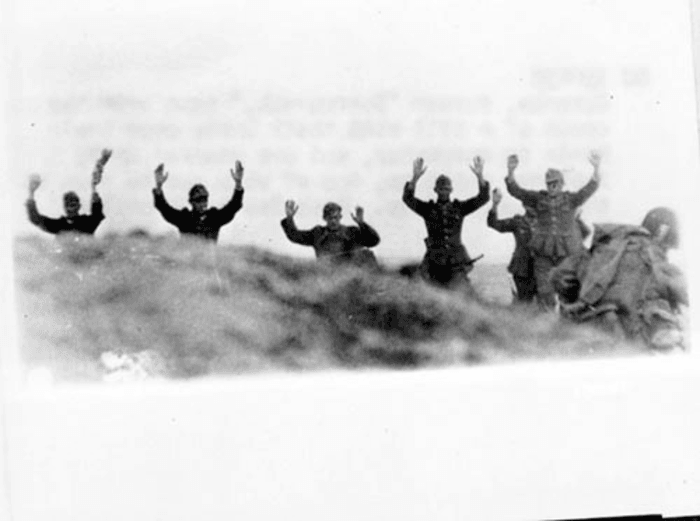
At that Roy again begins chuckling. “I missed the branch, the birds all flew away, and twelve Germans came out of a grove with their hands up.”

Astounded, no one spoke. Then a huge wave of warm laughter filled the classroom. Roy simply smiled and shrugged.

Colonel Clark, George the Janitor, and Roy Cortes. They were just kids whose lives became defined in ways we civilians can never fathom. They were scared, and hot, and cold, and hungry, and suffering, and ultimately lucky enough to come home to America.

They married, raised families, and move on with life.

That’s All.

Gail Chumbley is the author of the two-part memoir “River of January,” and “River of January: Figure Eight,” co-writer of the screenplay, “Dancing On Air” based on those books. She has penned three stage plays on history topics, “Clay” on the life of Senator Henry Clay, “Wolf By The Ears” examining the beginnings of American slavery, and “Peer Review” where 47 is confronted by specters of four past presidents.
La De Da De Dee

The following is an excerpt from the play, Wolf By The Ears, an examination of slavery in America.

The stage plunges in darkness, as The Beat Goes On by Sonny & Cher begins. From offstage The Statue announces,


THE STATUE
That first federal fugitive law just happened to parallel an invention that made cotton pay. Meet Mr. Eli Whitney, a Connecticut Yankee living in Savannah, Georgia.


The song grows quieter. In the darkness, a voice calls out,

WHITE MAN #6
This ought to work, Mistress. No more bottle neck, no more idle hands. You ought to double or triple short staple production with this device.


The stage lights rise on a young white man seated at a desk. He is bent over drawing with a protractor and straight edge. He examines a cotton boll, then lifts the diagram and studies it closely. The Statue remains downstage left. Whitney turns toward him and the audience, then speaks.


WHITE MAN #6
One of my primary objects is to form the tools so the tools themselves shall fashion the work, moving every part of its mechanism.
(He turns the drawing to the audience.)


It’s in this barrel, you see, fitted with small hooks. The teeth catch the lint, and casts off the husk. Short staple cotton could flourish with this.
(As Whitney studies his drawing, again, the Statue approaches. Whitney addresses The Statue proudly explaining)


I design machines, but came here to Georgia knowing nothing of cotton production. You see I am a Yale man, Connecticut born.


THE STATUE
No shit.


(Whitney lifts the drawing and the boll.)
WHITE MAN #6

This combing engine could turn a handsome profit, not only for Mistress Greene but for me. Where is the mischief in that?
(Whitney shrugs and sits again looking at his drawing.)


THE STATUE
An explosion in human suffering, is all. Your profit, their sweat and blood.


The light drops on Whitney, and the sound of cicadas trill. In the semi-light whispering, soft conversation, and light laughter emanate from the stage.The Statue appears on stage, standing next to a seated black woman. A clear spot reveals another woman, white, seated next to her. The women wear dust ruffle caps, and 18th Century dresses. Both are mending and knitting seated side by side. After a moment a separate spot finds The Statue aiding a black man in breeches, a white shirt, and red scarf. The black man leans on a cane. The two men watch the women a long moment then the Statue and speaks.

THE STATUE

This is Mount Vernon, Virginia, in 1790.


BLACK MAN #2
That, . .
(He gestures with his cane.)
.is Ann Dandridge and the Mistress. They often mend, knit and keep busy. No field work for Miss Ann, no sir. Spends her days spinning, weaving, and other such tasks.
The women continue their work.


BLACK MAN #2

(continues)
Mistress brought Ann, and near a hundred others after she married the General and came to Mt. Vernon. All of us know about Ann. The way folks prattle, I expect all of Fairfax County knows about Ann. But news like that doesn’t raise an eyebrow. Old John Dandridge fathered them both, the Mistress Martha Washington and Miss Ann. The Mistress keeps her younger sister close.
The spot dims on Ann Dandridge. Lee leans heavily on his cane, and The Statue helps him onto a bench.


BLACK MAN #2
Though the Mistress kept Ann close, she couldn’t stop her son, Jacky Custis, from forcing himself on Ann. A baby boy followed, after wayward Jacky took his pleasure. Ann, by blood, gave birth to her nephew’s son, and Mistress Washington, a mixed race nephew who also was her grandson. Chew on that a minute.


THE STATUE
(Yells.)
That enough mischief for you, Mr. Whitney?
The Statue and Lee watch the women a long moment, as the spot dims on them. the black man again addresses The Statue.


BLACK MAN
I came to serve the General, both me and my brother Frank, when I was near-grown, but still very much a boy. William Lee is my name, and I have served General Washington over thirty years. By his side through the war against ol’ King George.


THE STATUE
You fought alongside General Washington? Did you go willingly?


BLACK MAN #2
I did. A lot of soldiers of color, in the Revolution. Black, Native, and even women.

THE STATUE
My war too. I mean, the women are nurses, mostly. Jesus, I said my war.


BLACK MAN #2
The General somehow kept the army together. Blizzards, starvation, little ammunition, wretches barely recognizable as men. Got to hand it to the General. Wouldn’t allow no pillaging, though men were feeding on boot leather.
(He pauses.)


Knew all the General’s staff. General Greene, Knox, young Lafayette, fiery Anthony Wayne. Loyal, all of them, not one a turncoat. Well, except General Arnold. Nearly broke Master George’s heart. Mine too, if the truth be told.


Lee grips his cane, and The Statue helps him up.
He freed me right off when the war ended. If shared hardships make for family, then the General and I were family.
(He pauses.)


Wrote him I was coming. To New York. That was where they swore him in, the General. New President then. Told me no, that I was too busted up.
(Taps his knees lightly with the cane.)


Now these are no good. Just couldn’t get around. So Master George is President and. . .I stay here, making shoes. People wear Miss Ann’s stockings, and my shoes.


The spotlight remains fixed as The Statue helps Lee rise, limping with his cane into the darkness, exiting.

Gail Chumbley is the author of the two-part memoir “River of January,” and “River of January: Figure Eight,” co-writer of the screenplay, “Dancing On Air” based on those books. She has penned three stage plays on history topics, “Clay” on the life of Senator Henry Clay, “Wolf By The Ears” examining the beginnings of American slavery, and “Peer Review” where 47 is confronted by specters of four past presidents.

A Meeting

The following is an excerpt from “Peer Review” a play. The setting is a home in Gettysburg Pennsylvania. The 47th president meets the 16th.

THE TALL MAN

We have all noticed your obsession with political enemies. Mr. Nixon has kept a

particularly close watch on this activity.

DJT

Nixon’s dead, and I don’t care. Look if people aren’t nice to me I’m not nice back. They

all think they’re so much smarter than me. Obama, the Clinton’s, that Puerto Rican chick

from New York. All jerks.

THE TALL MAN

Ha. The Army of the Potomac had generals who thought the same of me. (Pauses)That

reminds me of a time when a client came to my Springfield law office and hired me for a

patent case. The fellow paid a retainer, and I began research on the legal particulars.

Oddly enough I never heard another word about it. Later the newspaper said the trial had

been moved to Cincinnati, Ohio.

DJT crosses his arms pouting. The Tall Man

merely smiles.

THE TALL MAN

Well sir, I made the journey by train to attend that proceeding. To my surprise a new lead

attorney sat at the courtroom table, and pointedly ignored me. Later I learned he had

dismissed me as a long-lanked creature in a dirty coat. Of course my feelings were more

than a little wounded. However I remained in Cincinnati and observed the court

proceedings. There is always something to learn. That attorney, Edwin Stanton, made a

fine job of it, and I later made him my Secretary of War.

DJT

What the hell is wrong with you! All you dead guys are morons. Made him a Cabinet

Secretary. I would have made up a name, you know, like Pocahontas or Shifty Schiff and

never stopped hounding him. I’da ruined the guy.

THE TALL MAN

And that would have proven a mistake. Secretary Stanton proved a wise choice for his

management of the Union Army. Besides, in the words of Mr. Lyndon Johnson, again, it

is “Better to have your enemies inside the tent pissing out, than outside the tent pissing

in.”

The Tall Man laughs and slaps his leg.

THE TALL MAN

Stanton merited the post, as did most members of my cabinet, Seward at State, Chase at

Treasury, Blair as Postmaster General. They had been my competitors for the presidency,

and I appointed these men knowing full well they resented my election.

DJT

You’re crazy. I wouldn’t have let them in the White House. I’m still gonna get even with

the scumbags who stood in my way, DeSantis and Nikki Haley. May not be today, but I

will destroy them. I never forget.

THE TALL MAN

I required sound advice in a difficult time, and that these men were the best, except for

Simon Cameron. There was a scandal and he was undone. Deceivers like Cameron and

Floyd undo themselves. You could learn from their errors.

The Tall Man looks again at his writing, as DJT

speaks.

DJT

Who needs a cabinet anyway. Fill it with dopes who will do as I say. I’m in charge now.

THE TALL MAN

Americans are a free thinking people. Never will they all revere you as does a minority at

this particular moment. You, me, all of us have but a brief time in office. The American

people possess a truth beyond momentary and shifting opinions. Beyond a name on a

map America embraces noble ideals and accomplishes great things.

DJT

Just what I thought, a Rino. You liberals are what’s wrong with America.

THE TALL MAN

Ha. You foolish man. The whole idea of America is Liberal. This nation is the product of

the best political thinking of the 18th Century. It is the sovereignty of the people!

The Tall Man taps the pen on the desk top.

Mr. Madison crafted the Constitution and his Bill of Rights upon the rights of free people.

DJT

America doesn’t care about that anymore. Times have changed. I have changed it. They

want a strong man who gets shit done. Blacks, women, immigrants put back in their

place.

THE TALL MAN

You are mistaken. Only the people are the rightful masters . . .

Gail Chumbley is the author of the two-part memoir “River of January,” and “River of January: Figure Eight,” co-writer of the screenplay, “Dancing On Air” based own those books. She has penned three stage plays on history topics, “Clay” on the life of Senator Henry Clay, “Wolf By The Ears” examining the beginnings of American slavery, and “Peer Review” where 47 is confronted by specters of four past presidents.