La De Da De Dee

The following is an excerpt from the play, Wolf By The Ears, an examination of slavery in America.

The stage plunges in darkness, as The Beat Goes On by Sonny & Cher begins. From offstage The Statue announces,


THE STATUE
That first federal fugitive law just happened to parallel an invention that made cotton pay. Meet Mr. Eli Whitney, a Connecticut Yankee living in Savannah, Georgia.


The song grows quieter. In the darkness, a voice calls out,

WHITE MAN #6
This ought to work, Mistress. No more bottle neck, no more idle hands. You ought to double or triple short staple production with this device.


The stage lights rise on a young white man seated at a desk. He is bent over drawing with a protractor and straight edge. He examines a cotton boll, then lifts the diagram and studies it closely. The Statue remains downstage left. Whitney turns toward him and the audience, then speaks.


WHITE MAN #6
One of my primary objects is to form the tools so the tools themselves shall fashion the work, moving every part of its mechanism.
(He turns the drawing to the audience.)


It’s in this barrel, you see, fitted with small hooks. The teeth catch the lint, and casts off the husk. Short staple cotton could flourish with this.
(As Whitney studies his drawing, again, the Statue approaches. Whitney addresses The Statue proudly explaining)


I design machines, but came here to Georgia knowing nothing of cotton production. You see I am a Yale man, Connecticut born.


THE STATUE
No shit.


(Whitney lifts the drawing and the boll.)
WHITE MAN #6

This combing engine could turn a handsome profit, not only for Mistress Greene but for me. Where is the mischief in that?
(Whitney shrugs and sits again looking at his drawing.)


THE STATUE
An explosion in human suffering, is all. Your profit, their sweat and blood.


The light drops on Whitney, and the sound of cicadas trill. In the semi-light whispering, soft conversation, and light laughter emanate from the stage.The Statue appears on stage, standing next to a seated black woman. A clear spot reveals another woman, white, seated next to her. The women wear dust ruffle caps, and 18th Century dresses. Both are mending and knitting seated side by side. After a moment a separate spot finds The Statue aiding a black man in breeches, a white shirt, and red scarf. The black man leans on a cane. The two men watch the women a long moment then the Statue and speaks.

THE STATUE

This is Mount Vernon, Virginia, in 1790.


BLACK MAN #2
That, . .
(He gestures with his cane.)
.is Ann Dandridge and the Mistress. They often mend, knit and keep busy. No field work for Miss Ann, no sir. Spends her days spinning, weaving, and other such tasks.
The women continue their work.


BLACK MAN #2

(continues)
Mistress brought Ann, and near a hundred others after she married the General and came to Mt. Vernon. All of us know about Ann. The way folks prattle, I expect all of Fairfax County knows about Ann. But news like that doesn’t raise an eyebrow. Old John Dandridge fathered them both, the Mistress Martha Washington and Miss Ann. The Mistress keeps her younger sister close.
The spot dims on Ann Dandridge. Lee leans heavily on his cane, and The Statue helps him onto a bench.


BLACK MAN #2
Though the Mistress kept Ann close, she couldn’t stop her son, Jacky Custis, from forcing himself on Ann. A baby boy followed, after wayward Jacky took his pleasure. Ann, by blood, gave birth to her nephew’s son, and Mistress Washington, a mixed race nephew who also was her grandson. Chew on that a minute.


THE STATUE
(Yells.)
That enough mischief for you, Mr. Whitney?
The Statue and Lee watch the women a long moment, as the spot dims on them. the black man again addresses The Statue.


BLACK MAN
I came to serve the General, both me and my brother Frank, when I was near-grown, but still very much a boy. William Lee is my name, and I have served General Washington over thirty years. By his side through the war against ol’ King George.


THE STATUE
You fought alongside General Washington? Did you go willingly?


BLACK MAN #2
I did. A lot of soldiers of color, in the Revolution. Black, Native, and even women.

THE STATUE
My war too. I mean, the women are nurses, mostly. Jesus, I said my war.


BLACK MAN #2
The General somehow kept the army together. Blizzards, starvation, little ammunition, wretches barely recognizable as men. Got to hand it to the General. Wouldn’t allow no pillaging, though men were feeding on boot leather.
(He pauses.)


Knew all the General’s staff. General Greene, Knox, young Lafayette, fiery Anthony Wayne. Loyal, all of them, not one a turncoat. Well, except General Arnold. Nearly broke Master George’s heart. Mine too, if the truth be told.


Lee grips his cane, and The Statue helps him up.
He freed me right off when the war ended. If shared hardships make for family, then the General and I were family.
(He pauses.)


Wrote him I was coming. To New York. That was where they swore him in, the General. New President then. Told me no, that I was too busted up.
(Taps his knees lightly with the cane.)


Now these are no good. Just couldn’t get around. So Master George is President and. . .I stay here, making shoes. People wear Miss Ann’s stockings, and my shoes.


The spotlight remains fixed as The Statue helps Lee rise, limping with his cane into the darkness, exiting.

Gail Chumbley is the author of the two-part memoir “River of January,” and “River of January: Figure Eight,” co-writer of the screenplay, “Dancing On Air” based on those books. She has penned three stage plays on history topics, “Clay” on the life of Senator Henry Clay, “Wolf By The Ears” examining the beginnings of American slavery, and “Peer Review” where 47 is confronted by specters of four past presidents.
Like Mice

The winter weather lay heavy upon the freezing soldiers on a kind of night even the smallest creature burrowed under, seeking warmth. But for General Washington the driving wind and snow presented a rare strategic opportunity.

Dividing his poorly clad troops into two wings, General Washington planned a pincer attack against German mercenary forces holding the town of Trenton, in New Jersey. This operation, set for Christmas night, 1776, aimed to alarm the British Crown, and to assure Americans that  the war for independence was by no means over. Not only the cold played ally to Washington’s attack, it was also Christmas night, usually a time of respite from hostilities.

As a one-time Colonel in the French and Indian War, Washington had learned a thing or two about guerrilla warfare from Native Americans. The attack on Trenton became the fruit of that learning curve.

While his army floated silently over the Delaware River, boatsmen poled into the freezing water, pushing ice floes left and right to reach the far bank. At dawn, through purple and gray skies his forces approached mercenary-held Trenton, opening musket fire upon dozing sentries, and unprepared Hessian soldiers.

In roughly an hour and a half General Washington and his Continental Army prevailed.

The Battle of Trenton did not defeat the King’s men by any means, no diplomats sat around a table in negotiations. Still Washington and his army proved controlling the place and time of engagement proved the key to defeating their Red-coated oppressors.

Whether he realized it or not, General Washington had effectively made use of what is called a Fabian strategy.

Quintus Fabius Maximus a 3rd Century Roman General lent his name, Fabian, to a military tactic of ceding space for time. Fabius made use of his philosophy to wear down invading Carthaginians in the Second Punic War. Fabius picked away at the enemy through hit and run tactics, avoiding direct battle, opting instead to wear down the invaders. Though not popular among Roman leadership Fabius’ approach proved effective in destroying the Carthaginian army under Hannibal, leader of Carthage.

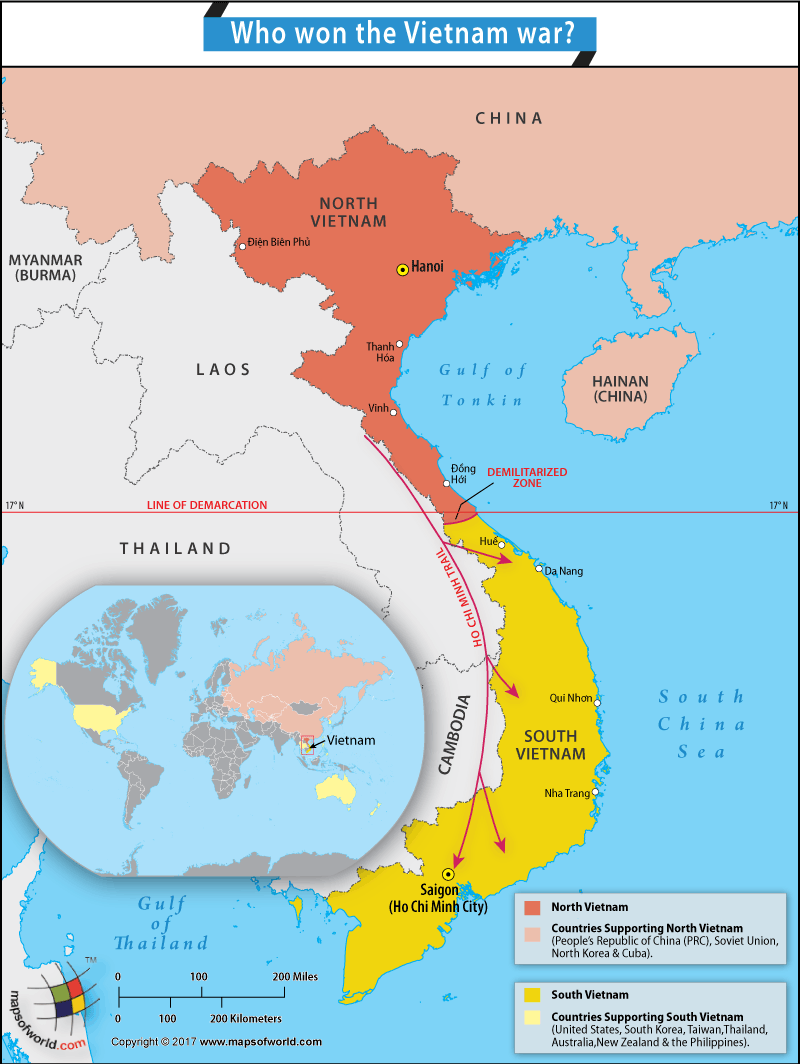
Another example of a Fabian policy concerns Vietnam.

The French occupied Vietnam around 1858 ostensibly to protect Catholic missionaries in the region. Over time France began solidifying its colonial control laying claim to the land and its resources. Soon the French extended authority over adjacent Laos and Cambodia. The entire area was named French Indochina, where the French government held sway until 1940, when France surrendered and was occupied by the Nazi’s. With approval from the Reichstag Japanese forces invaded Vietnam and remained until 1945 and the end of the war.

After the war France insisted they could take Vietnam back as a colony, and for a number of reasons the western allies agreed.

However, no one consulted the Vietnamese people, and they had other ideas. General Nguyen Giap and his Vietminh, later Vietcong forces stood with revolutionary leader, Ho Chi Minh. Together they implemented a guerrilla strategy to defeat the returning French. Similar to General Washington’s America, the Vietnamese simply wished to be liberated from foreign occupation. Thus commenced a long, drawn-out resistance, that by 1954 ended in defeat for the French. Near the city of Dien Bien Phu, in the northern part of the country, the exhausted colonial occupiers surrendered. 

(In a side note, General Giap’s forces hauled heavy artillery by hand, up steep embankments without the French military detecting their movements. Giap then summarily blew the French out of the valley).

The United States, now neck-deep in Cold War politics raised the alarm. No longer viewed as  freedom fighters, Giap, Ho Chi Minh and the Vietminh army became America’s enemy. The US Government was certain Vietnam was controlled by Communist China, and that could not go unchallenged.

In a hastily arranged conference in Geneva Switzerland, Vietnam was formally divided at the 17th parallel. Pro-Western people gained the South, while Pro-nationalists took the North. In reality the boundary meant nothing. Operatives from the North easily infiltrated the South by way of the Ho Chi Minh Trail, while American presidents passed the buck on military action until 1965. It was then that Lyndon Johnson deployed American Marines, and Americanized the conflict in Southeast Asia.

Thousands of America’s sons shipped over to Vietnam but the numbers did not seem to move the needle in terms of surrender. Military leaders and politicians claimed we were changing the hearts and minds of the Vietnamese people. Then came the Tet Offensive in January, 1968 exposing the Pentagon’s wishful thinking about ending the war. From the DMZ (demilitarized zone) southward to the Mekong Delta, Vietcong (Vietnamese Communists) fighters appeared out of the oppressive mist attacking American installations all at once. Hearts and minds had not been changed, the proof coming to living room televisions via news networks across the United States. 

Americans had been misled and were sacrificing our sons and our money for a lie.

Lyndon Johnson had believed he could ratchet up the pressure on North Vietnam, until finally Ho would acquiesce. That didn’t happen. Even after the death of Ho Chi Minh the North kept pounding away at American personnel especially at night, or in the deep darkness of the elephant grass. Our country has assumed the role of the British in the Revolution; high casualties, extensive supply lines, and millions of dollars.

(In a side note, at peace talks held in Paris, North Vietnamese delegates stalled meaningful  sessions for a year, by arguing about the shape and size of the negotiating table. You see, every day Northern delegates dragged their feet in Paris, the war grew more unpopular stateside. Fabius would have recognized the ploy).

To wrap this object lesson up, Mr Trump is now stuck in the Strait of Hormuz. He can throw around his John Wayne banter, and puff his baggy chest, but the dude has stepped on a giant rake. Like GW Bush in Iraq and Afghanistan, this mess with Iran will not end well for America. Trump is a bumbling aggressor detached from any understanding of military precedence, the country of Iran, nor its government or people.

He has inadvertently bestowed a great gift upon the Iranians. Tehran holds the moral high ground, and a home court advantage, controlling both the time and space. Once again the US has long supply lines expending American blood and treasure. In fact Trump is talking boots on the ground and reactivating the draft.

In his 1989 book From Beirut to Jerusalem, Tom Friedman shares a conversation he had with a Lebanese national. In essence Friedman was told that Americans fight like elephants and that is effective fighting other elephants. But in the Middle East (and every other country touched by colonialism) people fight like mice, much like Quintus Fabius Maximus. 

A cautionary tale to be sure.

Gail Chumbley is the author of the two-part memoir “River of January,” and “River of January: Figure Eight,” co-writer of the screenplay, “Dancing On Air” based on those books. She has penned three stage plays on history topics, “Clay” on the life of Senator Henry Clay, “Wolf By The Ears” examining the beginnings of American slavery, and “Peer Review” where 47 is confronted by specters of four past presidents.

A Fabricated War

It was early August in 1964 when two American ships cruised into the Tonkin Gulf near the coastline of North Vietnam. The long narrow country facing the South China Sea had been divided following World War Two as had Germany and Korea. The demilitarized zone bisecting Vietnam lay somewhere near 17th parallel with the French controlling the South and Nationalist Chinese in the North.

From 1946 until 1954 the French and the Northern army, the Vietminh, jockeyed to unify the country, culminating with the Battle of Dien Bien Phu where the French got their clocks cleaned and arbitration in Geneva formalized the 17th parallel boundary. The US took an active interest in the fate of Vietnam because this was the Cold War Era. It was as if a global chess match shaped foreign policy with Soviet and Chinese Communism, and western democracies calculating strategic moves. As the preeminent post war power, the United States took the forefront in limiting Communist aggression, first in Korea, and then Vietnam.

By 1964 President Lyndon Johnson set his sites on Vietnam to limit the threat of Communist influence. To the President this was a backward country and people, and an overwhelming American force would easily conclude any resistance from Vietnamese Communists. After all how could people in black pajamas defeat the greatest nation in the world? President Johnson only needed a pretense, or provocation to commit American forces south of the demilitarized zone.

And that provocation cruised into the Gulf of Tonkin in early August of 1964. First the US destroyer, Maddox followed by another destroyer, the Turner Joy reported receiving fire from North Vietnamese forces. The ‘Gulf of Tonkin Incident’ as it became known resulted with President Johnson deploying Marines to Vietnam in March of 1965.

And that my friends was how the United States blundered into a land war in Southeast Asia.

Unknown to Johnson or his Warhawk cabinet was the character of their foe. Ho Chi Minh had been a Vietnamese Nationalist from his earliest days. Educated in France, Ho Chi Minh, as a student, bought a suit in Paris and made his way to the Hall Of Mirrors in Versailles. World War One had ended and he had hoped to plead Vietnam’s desire for relief from French Colonial occupation to President Wilson. But of course racism prohibited his entrance and embittered, Ho bided his time returning to Vietnam in 1941. He and his Vietminh worked with the Americans fighting Japan believing independence would come at the hands of the United States.

That didn’t happen.

Over time Ho Chi Minh became the indispensable man in freeing Vietnam. A George Washington if you will, of the Vietnamese people. President Johnson ought to have understood that.

But no.

The American land war escalated and the bombing raids under “Operation Rolling Thunder” and Nixon’s “December Bombing” did nothing to bring the North Vietnamese to heel.

From President’s Johnson to Nixon to Gerald Ford the conflict dragged on until in 1973 all American forces came home. Over 58 thousand Americans died in Vietnam and the truth was the provocation that sparked the war never happened. The Gulf of Tonkin Incident. For real. The so-called incident had been fabricated.

Now we again are under the knuckle of a completely vacuous man who believes he can bomb a nation and culture centuries old. Ramping up force garners nothing from a proud people, in this case the Persians, to quit. Like the deadbeat he is, Trump believes he can wear down the Iranians like a window installer he’s refused to pay. But he doesn’t know who he is dealing with, and he can’t sue or counter sue or in anyway wait out Iran until they tire and give up. That will never happen, like it never happened in Vietnam.

A greedy, hateful, racist goomba from Queens cannot win this fabricated war. Reality doesn’t work like that.

Gail Chumbley is the author of the two-part memoir “River of January,” and “River of January: Figure Eight,” co-writer of the screenplay, “Dancing On Air” based on those books. She has penned three stage plays on history topics, “Clay” on the life of Senator Henry Clay, “Wolf By The Ears” examining the beginnings of American slavery, and “Peer Review” where 47 is confronted by specters of four past presidents.