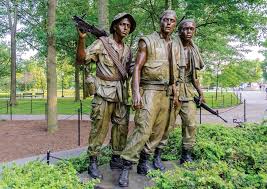
The following is an excerpt from the play, Wolf By The Ears, an examination of slavery in America.
The stage plunges in darkness, as The Beat Goes On by Sonny & Cher begins. From offstage The Statue announces,
THE STATUE
That first federal fugitive law just happened to parallel an invention that made cotton pay. Meet Mr. Eli Whitney, a Connecticut Yankee living in Savannah, Georgia.
The song grows quieter. In the darkness, a voice calls out,
WHITE MAN #6
This ought to work, Mistress. No more bottle neck, no more idle hands. You ought to double or triple short staple production with this device.
The stage lights rise on a young white man seated at a desk. He is bent over drawing with a protractor and straight edge. He examines a cotton boll, then lifts the diagram and studies it closely. The Statue remains downstage left. Whitney turns toward him and the audience, then speaks.
WHITE MAN #6
One of my primary objects is to form the tools so the tools themselves shall fashion the work, moving every part of its mechanism.
(He turns the drawing to the audience.)
It’s in this barrel, you see, fitted with small hooks. The teeth catch the lint, and casts off the husk. Short staple cotton could flourish with this.
(As Whitney studies his drawing, again, the Statue approaches. Whitney addresses The Statue proudly explaining)
I design machines, but came here to Georgia knowing nothing of cotton production. You see I am a Yale man, Connecticut born.
THE STATUE
No shit.
(Whitney lifts the drawing and the boll.)
WHITE MAN #6
This combing engine could turn a handsome profit, not only for Mistress Greene but for me. Where is the mischief in that?
(Whitney shrugs and sits again looking at his drawing.)
THE STATUE
An explosion in human suffering, is all. Your profit, their sweat and blood.
The light drops on Whitney, and the sound of cicadas trill. In the semi-light whispering, soft conversation, and light laughter emanate from the stage.The Statue appears on stage, standing next to a seated black woman. A clear spot reveals another woman, white, seated next to her. The women wear dust ruffle caps, and 18th Century dresses. Both are mending and knitting seated side by side. After a moment a separate spot finds The Statue aiding a black man in breeches, a white shirt, and red scarf. The black man leans on a cane. The two men watch the women a long moment then the Statue and speaks.
THE STATUE
This is Mount Vernon, Virginia, in 1790.
BLACK MAN #2
That, . .
(He gestures with his cane.)
.is Ann Dandridge and the Mistress. They often mend, knit and keep busy. No field work for Miss Ann, no sir. Spends her days spinning, weaving, and other such tasks.
The women continue their work.
BLACK MAN #2
(continues)
Mistress brought Ann, and near a hundred others after she married the General and came to Mt. Vernon. All of us know about Ann. The way folks prattle, I expect all of Fairfax County knows about Ann. But news like that doesn’t raise an eyebrow. Old John Dandridge fathered them both, the Mistress Martha Washington and Miss Ann. The Mistress keeps her younger sister close.
The spot dims on Ann Dandridge. Lee leans heavily on his cane, and The Statue helps him onto a bench.
BLACK MAN #2
Though the Mistress kept Ann close, she couldn’t stop her son, Jacky Custis, from forcing himself on Ann. A baby boy followed, after wayward Jacky took his pleasure. Ann, by blood, gave birth to her nephew’s son, and Mistress Washington, a mixed race nephew who also was her grandson. Chew on that a minute.
THE STATUE
(Yells.)
That enough mischief for you, Mr. Whitney?
The Statue and Lee watch the women a long moment, as the spot dims on them. the black man again addresses The Statue.
BLACK MAN
I came to serve the General, both me and my brother Frank, when I was near-grown, but still very much a boy. William Lee is my name, and I have served General Washington over thirty years. By his side through the war against ol’ King George.
THE STATUE
You fought alongside General Washington? Did you go willingly?
BLACK MAN #2
I did. A lot of soldiers of color, in the Revolution. Black, Native, and even women.
THE STATUE
My war too. I mean, the women are nurses, mostly. Jesus, I said my war.
BLACK MAN #2
The General somehow kept the army together. Blizzards, starvation, little ammunition, wretches barely recognizable as men. Got to hand it to the General. Wouldn’t allow no pillaging, though men were feeding on boot leather.
(He pauses.)
Knew all the General’s staff. General Greene, Knox, young Lafayette, fiery Anthony Wayne. Loyal, all of them, not one a turncoat. Well, except General Arnold. Nearly broke Master George’s heart. Mine too, if the truth be told.
Lee grips his cane, and The Statue helps him up.
He freed me right off when the war ended. If shared hardships make for family, then the General and I were family.
(He pauses.)
Wrote him I was coming. To New York. That was where they swore him in, the General. New President then. Told me no, that I was too busted up.
(Taps his knees lightly with the cane.)
Now these are no good. Just couldn’t get around. So Master George is President and. . .I stay here, making shoes. People wear Miss Ann’s stockings, and my shoes.
The spotlight remains fixed as The Statue helps Lee rise, limping with his cane into the darkness, exiting.
Gail Chumbley is the author of the two-part memoir “River of January,” and “River of January: Figure Eight,” co-writer of the screenplay, “Dancing On Air” based on those books. She has penned three stage plays on history topics, “Clay” on the life of Senator Henry Clay, “Wolf By The Ears” examining the beginnings of American slavery, and “Peer Review” where 47 is confronted by specters of four past presidents.

