The Art of Conversation

Dinner ended and post meal-conversations bloomed.  Fueled with Chardonnay and various reds, the noise level ratchets as each diner shares new and old stories.  Beneath the warm exchanges and laughter at the adult table, small children dart about in pursuits below the tabletop, beyond the focus of their parents and grandparents.

One little girl stands out from the chaos.  Her hair is dark brown, cut pixie short, delicate little freckles scatter across her tiny nose, and lovely dark eyes, one lighter than the other, blended in with small pools of olive green.  Her monolog never stops.  “I don’t really like red licorice,” she tells me.  “My daddy used to bring us M&M’s and gum from his work.  But he was gone to meetings for months and months.”  All the while she speaks, her little hands deftly handle a small video game that detonates hens into minute, cracked eggs at the bottom of the screen.

“Do you remember how you came back after sneaking out with your friends that night, and I was waiting for you?” laughs one grandmother to the little girl’s father.  Everyone seated at the table chuckles.  But the delicate child pays no attention to the merriment above her.

Her voice–a timbre of little tinkling bells, shows me her journal.  It’s a rectangular tome, and I can see that she has written on the empty pages since I sent it to her for her birthday in June.  Producing a pencil the size of a bread stick, the seven-year-old opens to a new page.  “My Papa in Idaho gave this to me for my birthday,” she explains.  I can see her spiky printing where she has carefully kept the dates for each entry.  I point out to her where I dedicated the book to her, inside the front cover.  At that little disclosure, she looks up curiously into my face, pulled momentarily from her private world.  This little Ramona-look-alike appraises me thoughtfully for the first time, and I can sense the girl may have found a spot in her life where I just might possibly fit.

More amiable laughter spills over the long plate and platter strewn table.  Little O turns quickly back to her journal and scribbles a secret message about her day.

I hope she mentioned me.
Signs

It’s Saturday and I have an update from my last post. 

My husband, his brother and sister placed Chum’s ashes on Helen’s grave

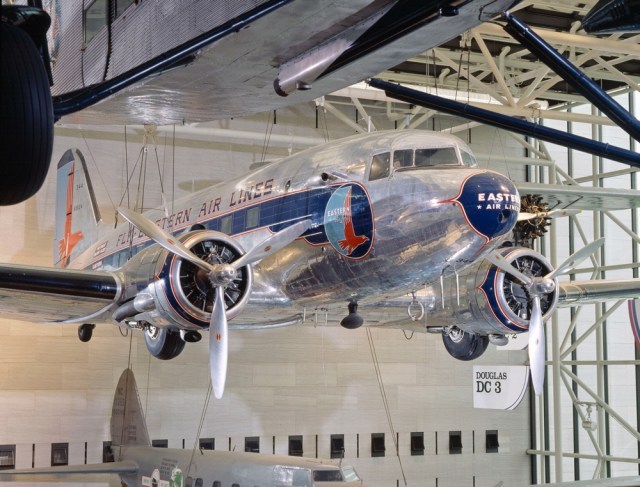
in a Miami cemetery.  While they were pouring his remains a DC 3, exactly like the one in the previous

piece flew overhead.  You can’t make this stuff up. 


The Great Silver Fleet

The Great Silver Fleet

This photo is a DC3, part of Eastern Airlines “Great Silver Fleet” of passenger liners. The plane is on display in the Air and Space Museum at the Smithsonian. We had suspected that Chum had flown this aircraft, but weren’t quite certain. Finally, I had the chance to look over his logbooks and matched the tail number to this plane. Chum captained this particular aircraft in February, 1946, six months after the war ended. If you find yourself on the National Mall, you can duck into the Air and Space, where you’ll find this beauty still on exhibit.

Sharing Our Truth

Image

I retired from teaching last May after more years in the classroom than I care to admit.  No longer constrained by rules, rules, and more rules, I began friend-ing my former students on Facebook.  What once was ethically frowned upon, is now my link to my past career.  That being established, I have enjoyed viewing the posts the kids have put up since graduating high school.  In something akin to an educational diaspora, these 18 year- old’s are encountering their first experiences away from home.  Of course that includes washing one’s own laundry, filling up on starchy food, and getting out of bed for class without mom.

The pictures are charming.  Girls, arm in arm, who only a month ago were strangers, now glow, linked together in this new adventure as best friends.  The boys seem less inclined to pose.  Instead they splay across the floor of a dorm room, stuffing pizza and chips into their smiling mouths.

Still the experiences behind those photos may be the most profound in life.  Whether the setting is a dorm, or an apartment, or a cave, the ritual remains the same.

I remember best, parked on the bathroom floor in my dorm room, talking earnestly and laughing many late nights.  In my new family of girls, we revealed our essence to one another, creating a link that I cannot replicate today with new acquaintances.  Established when I was naively open, without those worldly defenses I have perfected over time, those friendships have endured.  Fertilized only with an occasional Christmas card, or a stray email–when we get together, we pick right up where we left off.

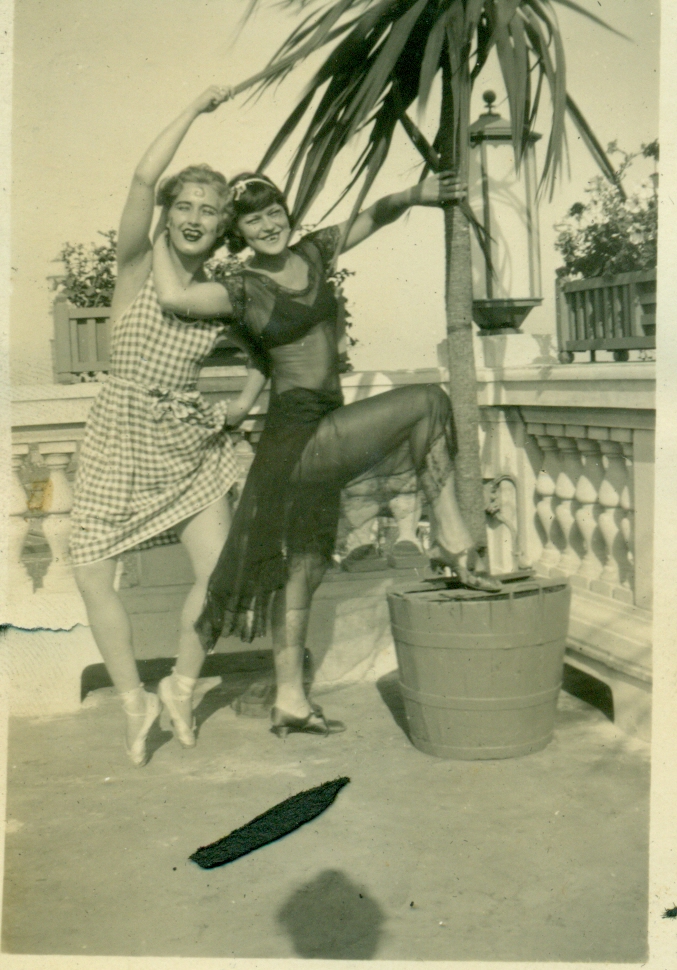
Helen, with no opportunity for college, shared a similar bonding experience with her “new” friends touring Europe.  As discussed in my book, River of January, she danced in a ballet company called, “The American Beauties,” who together performed first in Paris, and traveled as far as Algiers from 1932 to 1933.  In fact, the girl and her fellow dancers patched together their own version of a Christmas celebration at a hotel in Islamic North Africa.  She too, relished the late night yakking sessions, the joy of carrying out pranks, such as the night a group of them short-sheeted the bed of two other, unsuspecting dancers.  The picture above is a charming example of Helen purely celebrating life.

Later, these women remained some of the best friends Helen ever had.  Traveling to her home in Miami from Los Angeles or New York, the old girls sat around Helen’s little kitchen table, enjoying drinks, reminiscing and laughing.  For a short moment, seated at that tiny white table, they again were the same young dancers who had reveled in an extraordinary and memorable learning experience of their own.

Smoke Gets in Your Eyes

th

She is bent over a small Mercury outboard, hoisting the little motor in and out of the water. Her hair is wrapped in a kerchief, much as it had been when she wired mine sweepers at the Bremerton shipyards during the war. Ailene has a cigarette in her pressed lips, Humphrey Bogart style. Her black and white knit shirt has a small pocket on the left sleeve, over her bicep, and tucked inside is a pack of cigarettes–her brand, Kent. At the end of her day on the lake, my grandmother regularly downed a couple of high balls of Canadian Club, on the rocks.

My life with my grandmother has aided tremendously with the writing of River of January.  and the sequel, The Figure Eight. She, like Helen and Chum held lifetime memberships in the “Greatest Generation,” so her attitudes, word choices, and music preferences shape my thinking while I write.  Sadly she died in January, 1990, of lung cancer no less, taking a piece of me with her.

As for smoking and drinking, Chum appears as one of the few alum from that era who tended to nurse a beer, rather than chug, and chewed his cigar more than drawing a lung full. Helen, however, much like my grandmother, relished her bourbon every evening, garnished by a lit Chesterfield, and proceeded to enjoy a whale of a good evening.

Smoking and drinking blended into American culture in the 20th Century, unlike the prior or later era’s that demonized the practices. As I researched River, sifting through voluminous piles of documents, I encountered alcohol and tobacco ads placed next to those for baby formula and Ivory Soap, among other consumer goods. Liquor ads filled theater playbills on both sides of the Atlantic, nearly always featuring a shiny, sleek bottle bearing some stylish label. The message rang clear, drinking and smoking represented the height of sophistication, glamor, and sex appeal. Both my grandmother and Helen’s mementos, verified the truth that the party never stopped.

Casablanca, the celebrated 1942 film has struck me as the epitome of romantic culture in the late 30’s on into the war years. The gowns, the cosmopolitan style of understated and clipped dialog, and a perennial sense of righteous duty embraces that era. Americans lived hard and played hard, performing extraordinary feats while hungover at the least, or still intoxicated. These remarkable Americans handled drill presses, explosives, welding equipment, and other heavy industrial machinery, not to forget the operating end of an M1 rifle in a fox hole.

Out dancing, working a graveyard shift, partying, or fighting–all done with a cigarette resting, smoldering on virtuous, patriotic lips.

Gail Chumbley is the author of River of January, a memoir. Also available on Kindle.