
Riverside, 1973

Before the 1974 Expo in my hometown of Spokane, Washington, the city’s downtown area was divided by social class. Riverside Avenue ran east to west, crossed by an arterial called Division, that ran north to south. That intersection literally cut the area in half. West of Division the downtown looked like the shopping scene in “A Christmas Story.” Magical tableaus filled each department store window, creating an elegant still-life to allure shoppers. To the east of Division sat run down bars, a rescue mission, and adult-only theaters dotting the grim sidewalks of despair. Consumerism connected both worlds.

In my senior year of high school, I worked at an ice cream shop situated smack dab on the dividing line. Attempting to capture the “good old days” ragtime music looped endlessly in the shop, and we all wore white dresses, and plastic skimmer hats. The clientele largely represented the reality of Riverside. Affluent shoppers, and business owners rolled in for lunch during the day, and the dispossessed wandered in at night.

The lunch rush is where the shop made money, and all waitresses were on the floor. Each day I left my high school around 11:00am arriving about 30 minutes before the onslaught. By noon we rushed table to table, chatting with the regulars, and earning pretty healthy tips.

Weekends were different, unpredictable, and the Saturday night shift catered to a different world. After dark, homeless men asked for water, while others scrounged up change to buy a cup of soup. Heartbreaking.

A late spring night in particular, stands out in my memory.  Warm, with a light breeze, the shop felt like summer, leaving me restless, and anxious for graduation. The glass door facing Riverside opened, and a clutch of young women poured in, chatting and giggling like school girls. Sex workers all.

Preparing for their night, these girls crowded around the ice cream freezer, more like teenagers than high risk ladies of the night. The group was close, sharing a camaraderie that spoke of strong ties. 

In the middle of the party towered a long, bronze, African-American woman. God, she was gorgeous, honestly runway material. Fascinated I watched her among her peers, laughing with the rest, while she gracefully perused the glass covered ice cream selections. 

Honestly, this beauty could out Grace Jones, Grace Jones. 

The starkness of her night’s work vaguely crossed my mind, but I was in the moment. Oblivious, unapologetic, she and her friends had no shit’s to give.

Weeks later I graduated, and at the end of summer headed off to college. The memory of that  lithe beauty and her friends faded. The following summer, when I returned to Spokane, the face of downtown had been completely transformed. The railroad tracks, the bums, the skin flicks, and the girls had all vanished. The exciting facelift for Expo ‘74 displaced the rundown skid row of my childhood.

It’s now that I’m retired that that ice creamery, and the beautiful girl again live in my memory. I know now that I had choices, I had support, and a college education. But those residents of east Riverside, those belles of the street? It is impossible to know how life played out for them. Surely these people of the night were displaced, migrating where rail tracks, and sex workers could ply their trade, out of site, and away from the gentry. 

I hope life turned out better than it probably did for these marginalized folk. But that warm spring night still holds a magical quality; one of beauty and of bleakness. A grim reality of a life I never lead.

Gail Chumbley is the author of the two-part memoir “River of January,” and “River of January: Figure Eight. She has authored two plays, “Clay,” about the life of Senator Henry Clay, and “Wolf By The Ears,” a narrative of slavery in America.

gailchumbley@gmail.com
The Clarity of Desperation

With only days until Christmas 1776, General Washington watched the snow fall and the ice thicken as his suffering army melted away. Earlier that year, in July, that same Army had been humiliated by the Red Coats, chased off Long Island, pursued through Manhattan, barely escaping across the Hudson River into New Jersey. 

The General had been flanked by overwhelming British forces and his inexperienced Patriot army simply panicked and ran. Furious at their conduct Washington threatened to lead another assault himself, however, cooler heads prevailed as his staff convinced him otherwise. 

Amongst King George’s red coated regulars were legions of Hessians, hired guns from the German kingdom of Hesse-Cassel. Their presence on the field infuriated the Americans, as if the King couldn’t bother to keep the conflict British. These mercenaries were especially brutal, taking a psychological toll on Washington’s volunteer army by making use of flashing, saber-like bayonets. 

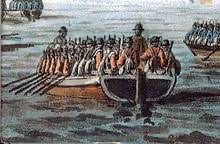
But Washington had a few cards of his own to play. Contemplating retreat while still on Long Island General Washington had ordered Colonel John Glover, a New England mariner, to collect enough vessels to ferry his surviving soldiers west to Manhattan, then over the Hudson into New Jersey. With campfires blazing to fool the redcoats, Washington successfully evacuated his army waiting to board for the last boat.

The inexperienced American army was preserved.

Still, demoralized, and outgunned, the Continental Army appeared defeated and despondent. The general consensus among all was the war was hopeless, a lost cause, the Patriots esprit de corps vanished. 

By winter, Washington’s command appeared to be unraveling. Inadequate food, too few supplies, and support sapped the army’s endurance. Worse the Brits, flush with currency, settled into cozy New York accommodations and enjoyed the hospitality of the city’s loyalists community. 

With circumstances conspiring against him-the weather, scarcity of supplies, and outgunned by enemy Hessians, Washington had to act as he faced a critical moment. Writing to his cousin, Lund, the General poured out his anguish. 

. . .your immagination can scarce extend to a situation more distressing than mine—Our only dependance now, is upon the Speedy Inlistment of a New Army; if this fails us, I think the game will be pretty well up . . .

Out of desperation Washington confessed what he termed as the “clarity of despair.” He had to act.

First Washington sent for an operative who sold provisions to the nearby Hessians. This Patriot spy came into camp and apprised Washington on the disposition of King George’s contracted killers billeted in nearby Trenton. These Germans were settled in for a Christmas celebration, assured that the Americans were all but defeated. 

In his second order, Washington commanded Colonel John Glover, once again, to requisition every boat the yankee seafarer could find. Between the intelligence report and vessels secured, his men were mobilized for a surprise Christmas morning assault on Trenton. 

Once again, Glover pulled off a miracle amphibious operation. And once again, General Washington was the last man on the last boat. In two files the suffering Continental Army marched, braving more than just the weather.

His forces arrived by first light. 

The unsuspecting Hessians were throughly routed in the surprise assault, that in the end provided the Patriot cause with a desperately needed victory.

The revolutionary cause again breathed life. 

So as you enjoy the warmth of the season, remember those who struggled before that the people could have a new nation. On Christmas in 1776 Washington’s army marched through the inky, icy cold, hungry, fretting for their families, yet committed to the long game of founding a nation. 

We have done this before. Much like General Washington our desperation makes our choices clear. Recent scholarship estimates that during the Revolutionary War only 1/4 of the American population supported independence. There are more of us holding to Constitutional norms today. Stay the course this moment isn’t the last.

Merry Christmas.

Gail Chumbley is the author of the two-part memoir, “River of January,” and “River of January: Figure Eight.” Both titles available on Kindle. Gail has recently completed a stage play, Clay, on the life of Henry Clay, Peer Review, where four former presidents meet 47, and Wolf By The Ears, an examination of the events leading to chattel slavery.