Divisions

Balkanize: Division of a place or country into several small political units, often unfriendly to one another.

America’s founders meant education to flourish, as a vital part of our country’s longevity. 

Designed to advance literacy, American public schools also curbed the rougher aspects of an expanding country. Since the earliest days of the Republic, centers of learning not only taught content, but other lessons like cooperation, and self control. Ultimately schools have instilled in all of us a shared baseline of behavior, supported by foundational facts necessary to find consensus.  

Today, technology and social media have endangered our ability to reach common ground. The distracting noise of extremists, splintering, and Balkanizing our nation threatens American institutions. Elections, government agencies, city and state government, and yes, schools are all targeted. Navigating through a culturally diverse society is inevitably stormy, and a closed American mind isn’t helpful.

Public education has traditionally been one of the ligaments that bind us all together as one people. Years ago a president encouraged us to ask “what (we) can do for (our) country,” but that’s over. Today it’s “Sorry losers and haters, but my IQ is one of the highest – and you all know it!”

Patriotism and literacy evolved together hand in hand. In 1787 Congress, under the Articles of Confederation, passed an Ordinance for settling western land. This law devised a survey system, to organize states around the Great Lakes region. This is important because sales of one plat of the survey, (you guessed it,) funded public schools. 

Thomas Jefferson affirmed the practice by insisting, ”Educate and inform the whole mass of the people… They are the only sure reliance for the preservation of our liberty.”

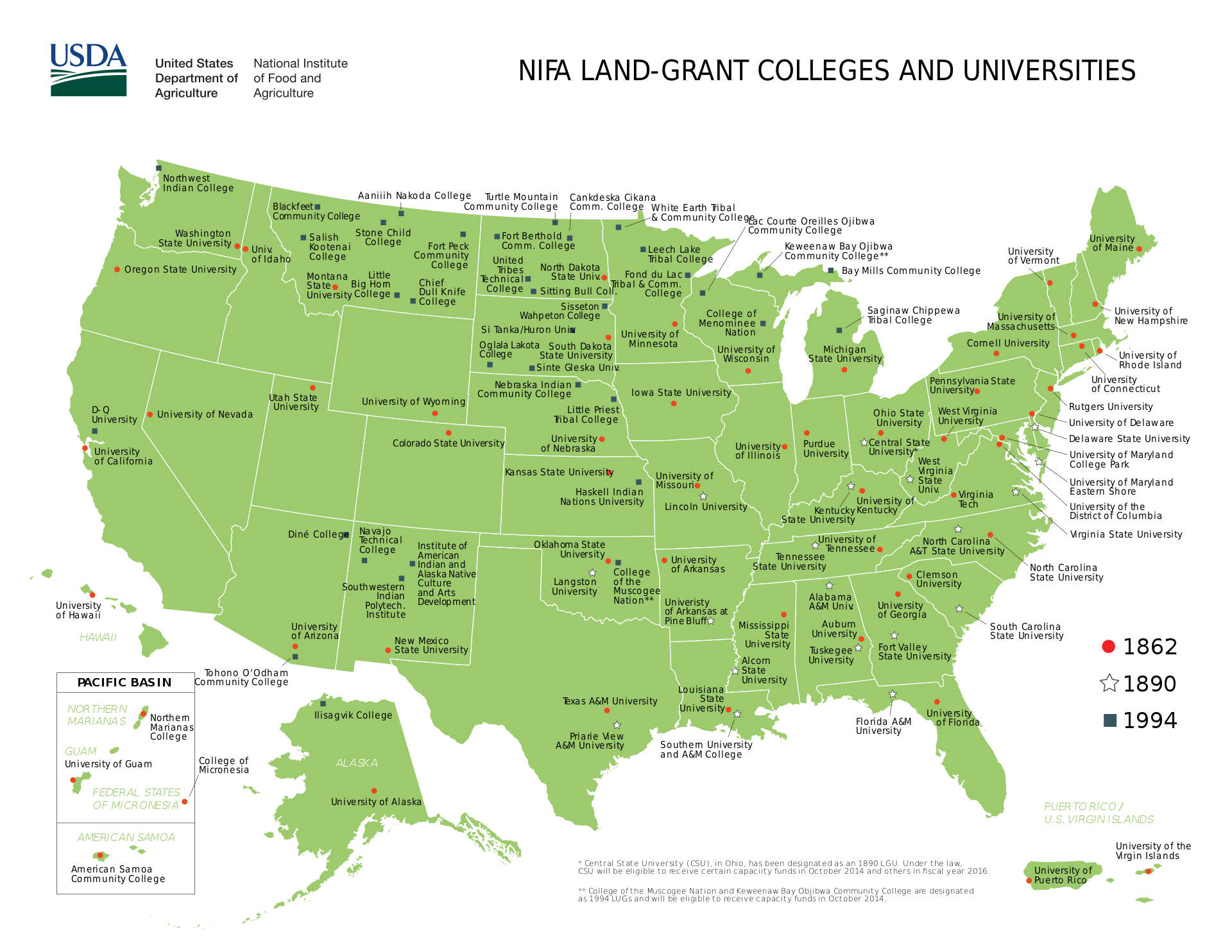
President Lincoln, a figure who deeply lamented his own lack of formal education, pushed to establish land grant universities across the growing nation. The 1862 Morrill Land Grant Act, in particular, financed colleges through Federal funding.These universities today are located in every state of the Union. 

America’s erosion of unity is tied directly to the erosion of public education. Our kids are increasingly sequestered into alternative settings; online, magnet, charter, home, and private schools. Missing is the opportunity to experience democracy at its most basic. Students grow familiar with each other, softening our own edges, renewing the energy and optimism of the nation’s promise. 

We are all taxpayers, but your local public school isn’t supposed to be Burger King, where every citizen can have it “their way.” We have a system that, regardless of money, race, ability, and social class, all have a seat at the table of democracy.

Gail Chumbley is a history instructor and author. Her two-part memoir, “River of January,” and “River of January: Figure Eight,” are available on Kindle.

gailchumbley@gmail.com
Richer Than Myth

We all closed our eyes and directed to imagine a stage play. The lights dim to darkness and the curtains open revealing a maid busy at a fireplace feather dusting the mantel.

I dutifully shut my eyes envisioning white marble and busts of philosophers as the servant did her thing.The instructor asked us to further imagine the play’s star dramatically entering from the wings. She asked what would we do as an audience? Clap of course, because the story is about to begin.

Right?

And that dear reader is the model history educators have employed for eons. America was just waiting for white folks to appear, so the story could begin. The implication is that nothing of significance had yet happened. Just the maid dusting the mantel.

To accept that John Wayne or James Arness won the west is but a myth for films and television. American history in noway resembles an episode of The Waltons. The reality of the narrative, stripping away the fiction is much richer when including the whole story.

Mining and ranching customs in America are largely of Spanish origin. Standard size horses spread northward from Mexico as escapees from Hernan Cortes and other conquistadors. The rendezvous system came to be under the French, and their Huron fur-trading partners. From totems, to kivas, to longhouses indigenous people developed distinct cultures. New World foods like corn and potatoes conquered Europe, and African exploitation introduced American traditions in music, food and language.

In short, the story of America didn’t start with Plymouth Rock, nor Jamestown. It isn’t sunbonnet madonnas, bravely trudging west, or white hatted heroes saving the day.

No clear lines separate villains from heroes. If the myth makes you feel good, watch “Lonesome Dove,” or “The Alamo.” Keep in mind both are works of fiction. If it’s accuracy you’re after, crack a history book, or catch a Ken Burns documentary.

Gail Chumbley is the author of the two-part memoir River of January, and River of January: Figure Eight. Both available on Kindle.

gailchumbley@gmail.com

Hysteria and Martyrs

I didn’t care what my students thought. Their opinions were no business of mine. That they knew how to express those ideas, using factual information, was my business.

To introduce point of view, and critical thinking a quick textbook analysis did the trick. In groups (I assigned) students researched various history texts to spot biases in the presentation of historic facts. 

Over the years, a collection of comped survey books had accumulated on my classroom shelf. I used them for my own preparation, but decided to teach the same techniques to the kids. The task was pretty simple. All groups were asked to look up the two same topics: The Salem Witch Trials of 1692, and John Brown’s Raid at Harpers Ferry in 1859. They noted the title of the text, the authors, the publication date, and any particular word choices used to explain or describe each episode.

This was the first day of school, mind you, and holy cow the results rocked these 15-year-olds orderly world.

When each group reported their conclusions, skewed viewpoints abounded. In other words the same facts drew decidedly different conclusions.

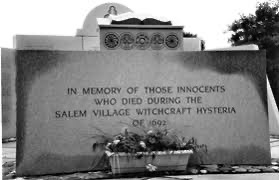
One book blamed the Witch Trials on tensions stemming from continuous Native attacks. Another blamed simmering resentment over social class, inheritance disputes, and property ownership. Moldy grain was to blame according to the Prentice Hall book. The good people living north of Boston were tripping on ergot fungus, a hallucinogen spreading on damp wheat baked into bread.

Nearly all texts made use of the terms “fear,” and “hysteria.”

The John Brown case provided even more interesting results. If the book had been published before 2001, Brown generally came off a saint. If after, the language use grew more sinister. In pre-911 America, fighting slavery had a righteous, noble language, that justified the violence. Something to the effect that, in the name of the mighty Jehovah, Brown martyred himself to strike a blow against evil. By contrast, books published after the collapse of the Twin Towers dismiss Brown’s means as unfortunate, though slavery was still bad.

By the end of this exercise students often seemed flummoxed asking “who can we believe?” 

“Yourself, of course, and your analysis skills,” I always replied.

Gail Chumbley is the author of the two-part memoir “River of January,” and “River of January: Figure Eight.” Both titles available on Kindle.

For more explanation on this lesson email at gailchumbley@gmail.com

Deathwatch

A new plan had been designed to unite political power from 13 squabbling fiefdoms, to one central government representing the people.

Statesman, James Madison fully intended his new national blueprint to quiet interstate turf wars. Until 1787 no central mediator had existed, and the constant turmoil looked to nearly finished off the fledgling nation. Madison’s remedy, his Virginia Plan would count population, and without fear or favor, allocate direct representation. However, once his proposal was disclosed to his peers, the forces of inertia nearly derailed the Constitutional Convention.

This is the short version of details:

America, though victorious over the British in the recent war, was falling apart. No money, no credit, no court system, and European enemies on a deathwatch of sorts.

Internal disputes wreaked havoc among citizens, as each former colony hustled to press state interests over national. This upheaval grew especially violent in Western Massachusetts when musket shots were exchanged in a tax uprising.

In September, 1786 only a handful of delegates reported to a Maryland convention summoned to deal with the mess. But with only a handful of states reporting, attendees couldn’t vote on any binding measure–too few were present.

Distressed by intensifying disorder, and no real authority to act, James Madison and his colleague, Alexander Hamilton agreed the time had come for a new framework of government. The two, a Virginian, and New Yorker called for another convention; one that promised to address the failing system. (See “Rope of Sand” on this blog site).

Arranged for May, 1787, in Philadelphia, Hamilton and Madison attracted participants by promising General Washington himself, would attend.  However, Washington declined at first, that is until the gunshots in Massachusetts changed his tune. He, along with fifty four other men gathered, and the process began.

In the run-up to the Philadelphia Convention, James Madison kept busy. Though this gathering had been advertised as tweaking the existing system, Madison’s plan actually abolished it, in favor of his new Virginia Plan

He and his allies clearly understood the historic risk they were taking.

In a panic, the states with fewer people balked at losing influence. A William Paterson of New Jersey, moved for recess to craft a counter plan, one that would preserve state interests against Madison’s people-based plan. 

Called the New Jersey Plan, this model would establish a one-chamber legislative branch, each state equally represented. 

Then more hell broke loose.

In another recess a middle ground was devised by Connecticut delegate, Roger Sherman. 

Called the Connecticut Compromise, or the Great Compromise, a solution emerged. Sherman brokered a lower house by representation, and the upper house of two Senators from each state. That calmed the small states, relieved they would not be diminished by population-heavy states.

There are so many more details to the development of the Constitution, but this agreement signified a start. 

That kind of goodwill and commitment to duty has sustained the United States through rough times. Granted, flaws remained regarding slavery, the slave trade, women’s rights, and Native American policy. Still, this ballast was enough to move the ship of state forward. 

Today the national GOP promotes chaos and gridlock as somehow virtuous, while our adversaries still maintain America’s deathwatch.

Perhaps 1787 produced a better caliber of political leadership, Americans who served the common good.

Gail Chumbley is the author of the two-part memoir, River of January, and River of January: Figure Eight. Both title are available on Kindle.

gailchumbley@gmail.com

An America To Believe In

Religion in politics presumes all citizens essentially hold to the same beliefs. This premise also insists that religious conformity assures civic virtue and good order. However, in practice theocracies actually run counter to effective government, because invoking God in public debate stymies any exchange of thoughts. Without a “free market of ideas,” our society cannot advance, condemning the nation to decline, (See Middle Ages).   

The Constitution’s framers did not lightly pen any Article, Section, or Clause without study or debate, and that especially includes the later admission of the Bill of Rights. James Madison, in particular, examined other government systems, from the Greek City States through the Age of Reason. What Madison discovered was politics combined with religion inevitably sows public conflict; damaging both political and religious institutions. Madison’s purposeful language in drafting the First Amendment, (free exercise and establishment clauses) signaled that the United States would not repeat those fruitless mistakes. 

Lessons existed in America’s past, as well. In Colonial New England Puritan dissenters, such as Roger Williams, and Anne Hutchinson publicly rejected mandatory church compliance. Williams, later exiled to Rhode Island, defended his religious principles writing,

Enforced uniformity confounds civil and religious liberty and denies the principles of Christianity and civility. No man shall be required to worship or maintain a worship against his will.

As the first Catholic-Presidential candidate, John F Kennedy later echoed the same idea stating,

. . .it is apparently necessary for me to state once again not what kind of church I believe in — for that should be important only to me — but what kind of America I believe in.

And that was the point. American citizens must choose to worship freely, or not. That is the essence of American liberty. Law cannot dictate conscience, as our individual thoughts are as unique as our finger prints.

Despite the secular legacy of American law, religious prerequisites still surface from one era to another. In the earliest years of the Republic a fervor of evangelism blazed hot, recognized today as the Second Great Awakening. Beginning around 1800, and lasting until the Civil War, endless, exhausting revivals criss-crossed the country.

Choosing a faith among many began early and today is an American tradition.

Loosely paralleling “The Age of (Andrew) Jackson,” politics followed a similar evangelicalism, giving every person a choice in both their faith and their vote. As Americans migrated west voting rights followed, extending to the lower classes. Increasing numbers of farmers and tradesmen could cast their ballots and follow their understanding of Jesus with the same passion. 

Another unexpected outcome of the Second Great Awakening came in the form of countless spinoffs. Rural isolation cultivated a veritable Garden of Eden in new Protestant sects. For example William Miller of upstate New York forecasted the return of Christ as urgently imminent. He, and his followers believed Jesus would reappear sometime between 1843-1844. After the dates passed with no rapture, the church regrouped becoming today’s Seventh Day Adventists.

Methodists dispatched “circuit riders” into America’s interior. Men like Peter Cartwright, the epitome of a frontier “stump speaker,” could preach the Word of God, while beating the hell out of any heckler. 

Presbyterians split a couple of times before the Civil War. First, regarding whether or not untrained missionaries could lead revivals, or only seminary trained ministers. This controversy tore believers apart.

The schism for Presbyterians and other denominations sprouted from the controversy over slavery. North of the Mason-Dixon Line believers felt their duty was to take action and cleanse America of this national sin. Southerners, however countered that God made no mistakes, and it was God who appointed masters, and placed the slaves beneath them. Rather a handy absolution, that. It took a war to change the politics of slavery, but churches first led the way.

Perhaps the best advice on separation of church and state came from Justice William O Douglas in the court’s ruling, Engel V Vitale, 1962.

“once government finances a religious exercise it inserts a divisive influence into our communities.”

Dictating conscience is a fools errand, and a liberated conscience is the essential foundation of America.

Oh, and Christian Nationalism is neither Christian nor national. Quite to the contrary, that brand of absolutism does not promote public virtue, nor good order, but does lead to national decline, (see Holy Roman Empire)

Gail Chumbley is a history educator, blogger, and author of the two-part memoir, “River of January,” and “River of January: Figure Eight. Both titles are available on Kindle. Chumbley has authored three stage plays, “Clay,” “Peer Review”, and Wolf ByTheEars.” examining America’s past and present.

Rope of Sand

The creed of States’ Rights is all smoke and mirrors; a cover for the selfish interests of local napoleons, and the politicians they bankroll. When claimed as the only answer to the country’s problems, beware, States’ Rights never solved a thing.

Not in America.

Ours is a one of a kind, federal system of concurrent powers. Centralized authority layers and folds, meshing with state and local governments.This dynamic has functioned for over two hundred years and the bonds are subtle and sometimes conflicting. The most lethal confrontation between state and federal powers clashed in the Civil War, 1861-65. But that particular catastrophe was certainly not the first.

During the Revolution, state delegations, in an attempt to unify the embattled nation, drafted a national blueprint called the Articles of Confederation. Attending representatives squabbled endlessly to defend their own local interests, rejecting any language that bound state autonomy. So jealous were the original Thirteen of one another, political leaders dragged ratification out, while barely a step ahead of pursuing Redcoats. The Continental Congress dashed across Pennsylvania, into Maryland, and back, still resistant to real, national authority.

John Dickinson of Delaware, drafted some elements into this fledgling plan, but his model wasn’t helpful. General Washington still had to beg Congress for recruits and soldier pay, and Congress, in turn, had to beg States to fill those needs. One bright note is Congress did agree to dispatch diplomats, like Franklin and Adams, who continued the begging game across the Atlantic.

Meanwhile States such as New Jersey, and Pennsylvania, happily traded with coin-rich Brits, filling their personal coffers, while ignoring the needs of the war effort. The prospects of an American victory grew grim, as each state dug in, defending their own turf. In fact, the Confederation Congress was so toothless, the document itself failed ratification until a month before Yorktown.

Historians often use the term “rope of sand,” to describe the deficiencies and impotence of this early attempt at self governance. Lacking any real prestige, inevitable bloodshed quickly ensued among these thirteen quarreling kingdoms. Navigation rights, interstate trade, and clashes over currency, nearly ended the budding union. At that critical moment Alexander Hamilton and James Madison jointly called for a new convention to “revise” the Articles. Both men, in reality, intended to dump them for a different, stronger plan. Recently retired George Washington agreed with both men, and chaired this new convention, assembling in Philadelphia the summer of 1787, and a determined Constitutional Convention worked hard to remedy many of the new nation’s ills.

This lesson from the past remains relevant. My state, for example could never bear the seasonal costs of road construction, nor of fire fighting. The former administration’s Covid-19 policies have proven, again the futility, and folly of every state scrambling for themselves.

The events of January 6, 2021, and now with the Texas legislature attacking both voting rights, and a woman’s right to choose, similar concerns arise. Is American law no more than a vulnerable rope of sand in the hands of the states?

Fellow Americans, do not buy into the so called advantages of States’ Rights. Hidden interests cloaked in virtuous words distract us from national needs, while the favored few push their political agendas. It’s not an overstatement to say States’ Rights again threatens the good order the Framers labored to establish.

Gail Chumbley is the author of the two-part memoir, “River of January,” and “River of January: Figure Eight.” Both titles available on Kindle or at http://www.river-of-january.com.

gailchumbley@gmail.com

Marking Time

2020.

Are the awful events of these last twelve months a once-off, bad patch of misfortune? Or is there a deeper explanation for the emergence of Trump, Covid, economic disaster, and civil unrest?

American History is steeped in a collection of pivotal moments, episodes that molded the nation’s continuing path. Can the events of 1776 stand alone as a turning point, or of 1865? 

A long metaphoric chain links one scenario to the next, marked by momentary decisions, government policies, or beliefs, that surface at one point in time, and voila, America’s story fleshes out to the future.

Add chance circumstances to the narrative and predictability flies out the window. 

Does 2020 stand alone as a singular event, or an inevitable outcome seeded somewhere in the past? Surely the march of history can be much like a chicken-egg proposition.

Mention 1776 and thoughts gravitate to the Continental Congress, the Declaration of Independence, and the emergence of General George Washington. But that struggle for freedom actually began at the end of the French and Indian War. 

As for 1865, when the guns silenced at Appomattox Courthouse, Robert E Lee’s surrender affirmed America as a nation-state. But thirty years earlier, President Andrew Jackson’s administration had sparked the eventual war over the issue of slavery. Thinly disguised as the doctrine of states’ rights, the intractable argument of slavery festered. The “Peculiar Institution” is, was, and always be the cause of that bloodbath. In point of fact the fury of one man, John C Calhoun, South Carolina Senator, and former vice president, lit the fuse of war thirty years before Fort Sumpter.

As to the folly of Trumpism, arguably the roots are deeply burrowed in America’s collective past. Author, and historian Bruce Catton, wrote about a “rowdyism” embedded in the American psyche. Though Catton used that term in the context of the Civil War, his sentiment still resonates in the 21st Century, i.e., Proud Boys, and the like. 

Closer to today, the Cold War seems to have honed much of the Far Right’s paranoia. The John Birch Society, for example, organized in the late 1950’s escalating anti-Communist agitation. Senator Joe McCarthy rode to fame on that same pall of fear, (with Roy Cohen at his elbow) only to fail when he went too far.

But the presidential election of 1964 seems to mark the most distinct shift toward the defiant opposition that fuels Trump-land.

Vietnam, in 1964 had not blown up yet. JFK had been murdered the previous fall, and his Vice President, turned successor, Lyndon Johnson was the choice of a grieving Democratic Party. The GOP fielded four major candidates in the primaries: three moderates and the ultra conservative, Barry Goldwater of Arizona. Senator Goldwater gained the nomination that summer with help from two men, conservative writer Richard Viguerie and actor Ronald Reagan.

Viguerie broke political ground through his use of direct mailing, and target advertising (what today is right wing news outlets). Reagan, once a New Deal Democrat, crossed the political divide and denounced big government in “The Speech,” delivered on behalf of Senator Goldwater. These two men believed Conservatism, and Laissez Faire Capitalism had been wrongly cast aside for liberal (lower d) democratic causes. 

Their efforts struck a cord with legions of white Americans who felt the same resentment. The Liberal Media and Big Government from the Roosevelt years were Socialistic and anti-capitalistic. No urban problem, or racial strife or poverty appeared in their culdesacs or country clubs. And taxes to support Federal programs squandered and wasted personal wealth.

So many other issues shaped the modern New Right. Communism, the Cold War, Civil Rights, Vietnam, and progressive politics alienated the wealthy class. 

But here’s the rub. Ultra conservative ideology is unworkable, an ideal that awards only a small, exclusive few, (today’s 1%). So 2020, and 2016 both have roots running deep in the core of the American experience. 

2020 isn’t about this moment, not really.  

Gail Chumbley is the author of “River of January,” and “River of January: Figure Eight,” a two-part memoir available at http://www.river-of-january.com and on Kindle. Also the stage plays, “Clay,” and “Wolf By The Ears” (the second in progress.)

gailchumbley@gmail.com

The Clarity of Desperation

With only days until Christmas 1776, General Washington watched the snow fall and the ice thicken as his suffering army melted away. Earlier that year, in July, that same Army had been humiliated by the Red Coats, chased off Long Island, pursued through Manhattan, barely escaping across the Hudson River into New Jersey. 

The General had been flanked by overwhelming British forces and his inexperienced Patriot army simply panicked and ran. Furious at their conduct Washington threatened to lead another assault himself, however, cooler heads prevailed as his staff convinced him otherwise. 

Amongst King George’s red coated regulars were legions of Hessians, hired guns from the German kingdom of Hesse-Cassel. Their presence on the field infuriated the Americans, as if the King couldn’t bother to keep the conflict British. These mercenaries were especially brutal, taking a psychological toll on Washington’s volunteer army by making use of flashing, saber-like bayonets. 

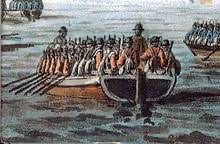
But Washington had a few cards of his own to play. Contemplating retreat while still on Long Island General Washington had ordered Colonel John Glover, a New England mariner, to collect enough vessels to ferry his surviving soldiers west to Manhattan, then over the Hudson into New Jersey. With campfires blazing to fool the redcoats, Washington successfully evacuated his army waiting to board for the last boat.

The inexperienced American army was preserved.

Still, demoralized, and outgunned, the Continental Army appeared defeated and despondent. The general consensus among all was the war was hopeless, a lost cause, the Patriots esprit de corps vanished. 

By winter, Washington’s command appeared to be unraveling. Inadequate food, too few supplies, and support sapped the army’s endurance. Worse the Brits, flush with currency, settled into cozy New York accommodations and enjoyed the hospitality of the city’s loyalists community. 

With circumstances conspiring against him-the weather, scarcity of supplies, and outgunned by enemy Hessians, Washington had to act as he faced a critical moment. Writing to his cousin, Lund, the General poured out his anguish. 

. . .your immagination can scarce extend to a situation more distressing than mine—Our only dependance now, is upon the Speedy Inlistment of a New Army; if this fails us, I think the game will be pretty well up . . .

Out of desperation Washington confessed what he termed as the “clarity of despair.” He had to act.

First Washington sent for an operative who sold provisions to the nearby Hessians. This Patriot spy came into camp and apprised Washington on the disposition of King George’s contracted killers billeted in nearby Trenton. These Germans were settled in for a Christmas celebration, assured that the Americans were all but defeated. 

In his second order, Washington commanded Colonel John Glover, once again, to requisition every boat the yankee seafarer could find. Between the intelligence report and vessels secured, his men were mobilized for a surprise Christmas morning assault on Trenton. 

Once again, Glover pulled off a miracle amphibious operation. And once again, General Washington was the last man on the last boat. In two files the suffering Continental Army marched, braving more than just the weather.

His forces arrived by first light. 

The unsuspecting Hessians were throughly routed in the surprise assault, that in the end provided the Patriot cause with a desperately needed victory.

The revolutionary cause again breathed life. 

So as you enjoy the warmth of the season, remember those who struggled before that the people could have a new nation. On Christmas in 1776 Washington’s army marched through the inky, icy cold, hungry, fretting for their families, yet committed to the long game of founding a nation. 

We have done this before. Much like General Washington our desperation makes our choices clear. Recent scholarship estimates that during the Revolutionary War only 1/4 of the American population supported independence. There are more of us holding to Constitutional norms today. Stay the course this moment isn’t the last.

Merry Christmas.

Gail Chumbley is the author of the two-part memoir, “River of January,” and “River of January: Figure Eight.” Both titles available on Kindle. Gail has recently completed a stage play, Clay, on the life of Henry Clay, Peer Review, where four former presidents meet 47, and Wolf By The Ears, an examination of the events leading to chattel slavery.

Set Their Feet On The Firm And Stable Earth

“Princes’ don’t immigrate” opined the 19th Century American magazine, Puck. The subject of the quote concerned the multitudes of immigrants flooding both American coastlines. Newcomers hailing from Asia and Southern Europe had alarmed American Nativists who considered the influx as nothing more than riffraff, and a danger to good order. Unfortunately this view of the foreign-born still endures today.

News footage over the last few years has chronicled the plight of the dispossessed amassing along southern tiers of both Europe and the US. Frequently victims of repressive governments, criminals, and crippling poverty, risk dangerous journeys, refugee camps, and even cages to escape hardships.

The earliest immigrants to American shores shared similar pressures, escaping the unacceptable familiar for an unknowable future. A brief look at the American Colonial period illustrates this enduring dynamic.

16th and 17th Century England targeted dissident groups in much the same way; exiling nonconformists, petty criminals, while others were lured by the hope of riches and a fresh start.

These emigres shared one common thread-remaining in England was not an option.

Religious challenges to the Catholic Church set in motion a veritable exodus of refugees fleeing England. As the Protestant Reformation blazed from Europe to the British Isles, the bloody transformation of the English Church began. In the 1535 English Reformation, King Henry VIII cut ties with the Vatican, naming himself as the new head of the English Church. This decision triggered a religious earthquake.

The Church still closely resembled Catholicism, and the disaffected pressed for deeper reforms, earning the title, “Puritans.” Ensuing religious struggles were long, bloody, and complicated. Ultimately the discord culminated in the violent repression of Puritans.

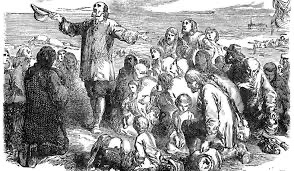
Two phases of reformed believers departed Great Britain for the New World. First was a small sect of Separatists led by William Bradford. These Protestants believed England to be damned beyond redemption. This band of the faithful washed their hands entirely of the mother country. Settling first in Holland, Bradford and other leaders solicited funding for a journey to Massachusetts Bay. Americans remember these religious refugees as Pilgrims.

Nearly a decade later another, larger faction of Puritans followed, making landfall near Boston. More a tsunami than a wave, the Great Puritan Migration, brought thousands across the Atlantic, nearly all seeking sanctuary in New England.

Lord Baltimore was granted a haven for persecuted English Catholics when that faith fell under the ever swinging pendulum of religious clashes. Maryland aimed for religious toleration and diversity, though that ideal failed in practice.

The Society of Friends, or Quakers, made up another sect hounded out of England. Britain’s enforcement of social deference, and class distinction, ran counter to this group’s simple belief in divine equality. Quakers, for example, refused to fight for the crown, nor swear oaths, or remove hats encountering their ‘betters.’ That impudence made the faith an unacceptable challenge to the status quo.

William Penn (Jr.) became a believer in Ireland, and determined the Crown’s treatment of Quakers unjust. After a series of internal struggles, King Charles II removed this group by granting Penn a large tract of land in the New World. Settling in the 1660’s, “Penn’s Woods,” or Pennsylvania settled the colony upon the egalitarian principles of Quakerism.

Scot settlers, known as Scots-Irish had resisted British hegemony for . . ., for . . ., well forever. (Think of Mel Gibson in Braveheart.) First taking refuge in Ireland, this collection of hardy individualists, made their way to America. Not the most sociable, or friendly bunch, these refugees ventured inland, settling along the length of the Appalachian Mountains. Tough and single-minded, this group transformed from British outcasts to self-reliant backcountry folk.

Virginia, the earliest chartered colony, advanced in a two-fold way; as an outpost against Spanish and French incursions, and to make money. At first a decidedly male society cultivated tobacco, rewarding adventurers and their patrons back home by generating enormous profits. Ships sailed up the James and York Rivers depositing scores of indentured servants, not only to empty debtors prisons, but to alleviate poverty and crime prevalent in English cities.

Transporting criminals across the Atlantic grew popular. The Crown issued a proprietary charter to James Oglethorpe, for Georgia. Oglethorpe, a social reformer, envisioned a haven for criminals to rehabilitate themselves, and begin anew.

All of these migrants risked dangerous Atlantic crossings for the same reason. Parliament and the Crown considered the Colonies as a giant flushing toilet. England’s solution to socially unacceptable populations, was expulsion to the New World.

Caution ought to guide current politicians eager to vilify and frame immigrants as sinister and disruptive. No one lightly pulls up roots, leaving behind all that is familiar. (Consider the human drama on April 1, 2021 where two toddlers were dropped over a border wall from the Mexican side).

Americans today view our 17th Century forebears as larger than life heroes, but their oppressors saw these same people as vermin–as dispensable troublemakers who threatened good social order. This human condition remains timeless, and loose talking politicians and opportunists must bear in mind the story of the nation they wish to govern.

*The Middle Passage was the glaring exception of those wishing to emigrate.

Gail Chumbley is the author of the two-part memoir, River of January, and River of January: Figure Eight. Both titles available on Kindle.

gailchumbley@gmail.com

Englishman’s Foot

Englishman’s Foot is a non-native plant introduced by English settlers to the New World. The plant sprouted from manure droppings from equally non-native cattle. It spread unabated throughout New England, and metaphorically named by the native people.

The story is a familiar one. Dissenters of the Church of England, disciples of reformer John Calvin, departed for Holland, washing their hands of what they viewed as English apostasy. After a time among the Dutch, these expatriates watched in horror as their children came of age in the secular world of the Continent. Alarmed, William Bradford and other Separatist leaders determined to leave Holland as well, to take their chances in the New World. 

Bradford, later explained this decision in On Plymouth Plantation, deciding it was better to lose their offspring to the tomahawk than to lose their mortal souls to God. 

You know the next part of this story. 

Pilgrims, The Mayflower, Plymouth Rock, Samoset, Squanto, Corn, Thanksgiving, shoe buckles, etc . .

But this story concerns those already inhabiting the New World, the indigenous peoples of America. In truth, white men had been poking around the shores of early America well before the Mayflower sailed. Explorers, trappers, and fishermen had already encountered native people, trading goods, microbes, cultural practices, and language. Some indigenous folk spoke a bit of English, or the French they had acquired from couriers du bois.

In 1621, the Pokanoket peoples of the Wampanoag Confederacy observed the arrival of the Pilgrims to Massachusetts Bay. Their sachem, or leader, Massasoit, made the decision to cautiously welcome these newcomers, rather than force them back into the sea.

Dispatching the English-speaking native, Samoset, Massasoit hoped to learn the intentions of these outsiders. His own people weakened especially by small pox, and perpetual warfare, influenced his decision to feel out an alliance with these gun-toting English settlers, in particular, against the Narragansett of nearby Rhode Island. Massasoit’s peaceful reception forged an uneasy pact that helped the Separatists survive their “starving time.”

After Massasoit’s death in 1661, followed soon by his eldest son, his second son, King Philip, became the new sachem of the Wampanoag.

Philip’s time witnessed a massive expansion of British New England. Ships from East Anglia seemed to appear daily on the horizon, emptying thousands of new settlers to the Bay Colony. Plymouth Separatists welcomed the influx of these new colonists. The Massachusetts Bay Colony soon pressed hard on native lands, and it wasn’t long until Philip’s tolerance for the English reached a breaking point. By 1675, King Philip determined to take the action his father had avoided-force the English off Native land.

It was a forlorn hope, and Philip ultimately met his end at the hands of a fellow-Wampanoag, an informer. The sachem’s corpse was mutilated, his torso drawn and quartered, and his head posted on a pike in Plymouth as a warning to all others. Philip’s head remained on that pike for decades. 

In the end, and it truly was the end, Philip’s wife and son were sold into slavery in the Caribbean.

Ironically the offspring lost were in fact Wampanoag, not English. And King Philip’s War set a bloody pattern repeated frequently in the colonial period and after.

Enjoy the turkey, but remember the cost paid by the vanquished.

Gail Chumbley is the author of “River of January,” and “River of January: Figure Eight,” a two-part memoir. Both titles are available on Kindle. Chumbley additionally authored three stage plays: Clay regarding the life of statesman Henry Clay, Wolf By The Ears delving into American slavery, and Peer Review where 47 meets four previous presidents.

gailchumbley@gmail.com

En