Head and Heart

th


“Believing with you that religion is a matter which lies solely between man & his god, that he owes account to none other for his faith or his worship, that the legitimate powers of government reach actions only, and not opinions, I contemplate with sovereign reverence that act of the whole American people which declared that their legislature should make no law respecting an establishment of religion, or prohibiting the free exercise thereof, thus building a wall of separation between church and state.” Thomas Jefferson, January 1, 1802

President Jefferson did not mince his words. He drew a clear distinction between what is personal and sacred, and what remained secular and public. History had taught Jefferson that invoking the Almighty usually ended in bloody holy wars, rendering effective civil government unworkable. Of all the founders, President Jefferson grasped the importance of detaching faith from law.

If you follow my blog you already know I’m not a big fan of Jefferson. His actions, as well as his writings on race alone, provide a legacy of duplicitous thinking. For example the practice of beating young slaves daily was of no matter to the master of Monticello. But on the issue of natural rights, his Lockean take on the social contract– Jefferson’s views ring with authority.

This morning the Idaho Legislature killed a bill in committee that would “Add the Words,” (protecting the LGBT community) to the Human Rights Act in Idaho. Following three days of impassioned testimony from supporters and detractors, HB2 fell in a 13-4 vote. A significant amount of testimony came from various churches on both sides of the issue. The fearful tended toward the shrill, impassioned by their emotions. One fellow, in particular, ranted that his wife shouldn’t have to share a public bathroom with a transgender individual. He was so riled up the committee chair admonished him to control himself. His answer, “Well Praise the Lord.”

Now the Gay community in Idaho didn’t seek this fight. These folks have done their best get along in society. The term ‘closeted’ comes to mind here. The threat of eviction, job termination, and outright violence has demanded a covenant of silence. However, over time, the preponderance of social, economic, and political mistreatment has galvanized this movement for simple justice. These citizens have had enough. They ask for equal protection under the law in explicit, measurable language to deter the countless harms endured, that were so eloquently enumerated in this week’s testimony.

As a student of American History I understand this disconnect between contending factions. We are a nation founded under the tenants of the Enlightenment. Jefferson actually lifted John Locke’s language when he described ‘natural rights’ which he articulated as ‘certain unalienable rights.’ And at the same time America is one of the most religious nations in the world. Always has been. The trick is remembering to separate these two competing voices of law and of faith. Even my debate students were taught to keep God out of the tournaments. Once invoked, the open exchange of ideas is over. God has spoken.

For the longevity of the American Creed, our law makers must use their heads when shaping legislation. When kneeling to pray, worship with all of your  heart. I do.

But please leave those competing, conflicting, diverse, religious convictions at the door of the halls of law. Contending voices achieve nothing but a counter productive cacophony of discord.

And next time . . . Add the Words.

Gail Chumbley is a retired history teacher and the author of the nonfiction work, River of January

September Song

 th

This was our first book talk of the new year. We left the house around noon to travel to a small senior facility with an equally small number of residents. I held low expectations of selling any books, but hoped to brighten up the day for a few folks. We had earlier decided to focus on retirement homes because River of January touches on many events that this elderly generation finds familiar.

Finally securing a couple of extension cords my projector flickered on, illuminating an empty wall, and the power point show began. The nurses aides rolled in some residents in their wheel chairs, where they remained quietly seated for the duration. Two other people wandered in at the same time and began a turf war over the ‘good’ chair. The gentleman didn’t move, nor did he say a word, but he meant to sit in that chair. The woman who demanded that same seat kept insisting that it was HER chair. Watching the showdown, I was reminded of how ornery my kids could get, fighting over preferential seating, either in front of the television, or riding in the car. In this instance, the feisty woman prevailed, and the old guy had to settle for the love seat. Once he settled into the cushions, he promptly fell asleep–for the whole presentation.

Two other fellows seemed to enjoy the pictures and the talk. As images of Helen Hayes and Maurice Chevalier flashed on the wall, I caught both respond with slight nods and faint smiles. Another woman sitting apart, back in the corner appeared very sharp, seeming to deliberately separate herself from the her failing comrades. Perhaps I sympathized with her, hiding in that corner, when our victorious friend from the ‘chair wars’ piped up, “I saw this show on tv!”

When I attempted to engage the group with rhetorical questions, they just stared, eliciting next nothing. And in a brief moment of insight I decided that these  people had given enough in life. I was there to bless their day, perhaps make it better for that short time, than it otherwise might have been. All was as it should be, I was in the right place at the right time.

After I finished the program one of the quiet gentleman from his wheelchair tried to speak. His voice was quite weak with age and poor health. He was difficult to understand. Listening hard, reading his dry lips I made out B-24’s. “You flew B-24’s in the war?” I asked. He nodded and smiled. I took his hand, shook it and said, “Thank you sir for your service.” He whispered a couple more unintelligible words, and I smiled in return.

Time is a demon. For these people, idle hours can feel an insufferable burden. Still, sealed up inside their frail bodies exist dramatic stories, from dramatic lives already lived in full.

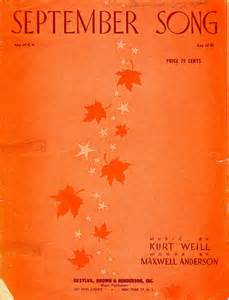
The old standard, September Song captures the beauty and melancholy of those facing a day identical to the day before, until those days run out.

Oh, it’s a long, long while from May to December
But the days grow short when you reach September
When the autumn weather turns the leaves to flame
One hasn’t got time for the waiting game

Oh, the days dwindle down to a precious few
September, November
And these few precious days I’ll spend with you
These precious days I’ll spend with you

I am looking forward to our next retirement home visit in February.

Gail Chumbley is the author of River of January. Visit the website at www.river-of-january.com

At Amazon

The Laundry Room

th

Initially this post was supposed to discuss what a slob I’ve become since I began writing. I planned on stressing how my story, told in River of January has consumed my days and has trumped any other daily concern–in particular bothering to cook meals or even getting dressed each morning. Then I happened to catch Tina Fey in an interview on Inside the Actors Studio. I like Tina Fey. She reveals her honest opinions with no airs or pretense, openly laughing at her own shortcomings. This particular episode was clearly a rerun, with James Lipton discussing and sharing a clip from her newest film “Admission,” released back in 2013.

This taped exchange between Lipton and Fey eventually transitioned from her many successes on the big and small screens to authoring her first book, Miss Bossy Pants. She confessed that the writing process was surprisingly more difficult and caused her more discomfort than any screen play. Fey shared that she found time to work on the book during breaks on 30 Rock, and in spare moments on various movie sets. While at home, her husband tended their children while she hid in her laundry room to continue her manuscript. And Fey further admitted that publishing Bossy Pants left her profoundly vulnerable and solitary. She said, and I quote, “You really put yourself out there.”

This accomplished, brilliant writer-comedian used her laundry room for writing, and felt vulnerable about her work! Now, I certainly don’t pretend that I anything near her immense talent, but I, too, wrote a lot of River of January in my laundry room! Tina Fey and I both wrote books in our laundry rooms! In my case I busted out my laptop on that cluttered floor because our washer’s timing mechanism was on the fritz. I had to keep a constant vigil so the machine would finish a full cycle. Easily I passed a good two to three hours a session, leaning against the litter box, as the churning rotation of the washer and dryer rendered that little space the best spot in the house to concentrate.

Writing a book is hard, and has frequently forced me to reassess my value as a person. I believed real writers, like Tina Fey, sat behind elegant desks; keyboards illuminated by brass halogen lamps, genteel mugs of hot tea within reach, assistants scurrying in and out of the room conveying edited sheets of type to publishers. That scenario bears no resemblance to this middle aged woman, clad in flannel shirts and sweat pants, continually switching off the pause button on a faulty washing machine.

The most reassuring part of that TV interview was how anxious Fey felt over her book’s public reception, saying something to the effect of how she girded herself for literary failure. Again, another bingo. I’d like to count my writing meltdowns, and vows to never write again, but I only have so many toes and fingers. Any remarks readers have written or spoken regarding my book, River, is indelibly carved into my psyche–forever.

So the truth remains that my writing is mine alone. The words generated, the story those words tell, are between me and my computer. Still, aside from that solitary angle, plus the risk and intimidation in publishing River, I somehow feel less alone. Oh, that washing machine is now working fine.

Gail Chumbley is the author of River of January, available on Kindle.

Visit www.river-of-january.com


The Working End of Tomorrow

815528365b25248630140a659ad44ffa


“A politician looks forward to the next election cycle, while a statesman looks forward to the next generation.” This admirable sentiment has been attributed to a number of speakers including Thomas Jefferson and the 19th Century Reverend James Freeman Clarke. But I heard the quote attached to President Gerald Ford. Whoever uttered these words has my full endorsement.

This morning began well. I awoke from a dream-filled sleep of taking roll, presenting lessons, and interacting with my students. They were all mixed up, hailing from a multitude of graduating classes, but still they were all my kids. I knew them well. In point of fact, most of my nights pass in a flowing narrative of teacher dreams, and I’ve gotten fairly used to this regular occurrence. The joke since retiring is, “I work so hard at night I should still be on the payroll.”

At any rate, after waking up, my mood remained jovial, still dialed in to happy. Tapping on my iPhone a picture appeared of a former student, now in a military uniform singing with three other soldiers. He and his brothers-in-arms were performing a rendition of the National Anthem at a public event. In another post a young lady, newly attending college revealed her fears about losing interest in reading for pleasure—a concern she happily resolved by opening a new book. Scrolling down the wall a bit, a wonderful family picture appeared of one of the kindest student’s I’ve had the pleasure to know. She posed before a Christmas tree with her three little boys, the youngest only two months old. Her husband’s caption clearly revealed his love for her and his boys. These posts are just, well, just so cool!

Not all teaching reminders and memories are as bright as those that I experienced this morning. Still, I wouldn’t have missed my time with these young people for a king’s ransom. Magic occurred in those classrooms; pure joy a guaranteed bi-product of the learning process.

I discovered over the years, that basic to the art of teaching and learning, is a faith in the future, a tangible something waiting ahead for every individual—a realized dream. All the hours of classroom preparation devoted to listening and thinking skills, observation, and problem-solving, were simply a training ground for young people to eventually find their place in the larger world.

While grappling with today’s incessant demands, it is far too easy to gloss over thoughts of the future. Caught up in the crowded moments that make up the present, many lose sight of the certainty of tomorrow. Teachers, however, are not permitted the luxury of settling in the moment. We must skip ahead of the “now,” planning and adjusting, then planning further. Intrinsic to our professional calling is the absolute assurance of a looming future, and we have to get our kids ready.

Perhaps stake holders could gain some perspective by casting aside trivial, momentary agendas—the noisy culture wars taking place across media battlegrounds, jousting in never ending finger pointing. Those distractions impede the progress available to our students, who are rapidly passing through the system. These kids are here today and gone tomorrow, quite literally.

When I assessed my students in class, I often envisioned them as adults, figuring out their individual niche. With that objective as my guide, I tried to design the best methods available to reach practical benchmarks. Even so, in the end, I had to let each class move on, a natural continuation forward to meet their futures, hopefully carrying my small contribution. An act of faith.

With our eyes vigilantly fixed on the countless tomorrows yet to come, would teachers be considered President Ford’s definition of statesmen? I’d like to think so.

Gail Chumbley is a retired educator and author of River of January. Also available on Kindle. Watch for “River of January: Figure Eight” this Fall.

The Great Silver Fleet

The Silver Fleet in a Golden Age!

gail chumbley's avatarGail Chumbley

The Great Silver Fleet

This photo is a DC3, part of Eastern Airlines “Great Silver Fleet” of passenger liners. The plane is on display in the Air and Space Museum at the Smithsonian. We had suspected that Chum had flown this aircraft, but weren’t quite certain. Finally, I had the chance to look over his logbooks and matched the tail number to this plane. Chum captained this particular aircraft in February, 1946, six months after the war ended. If you find yourself on the National Mall, you can duck into the Air and Space, where you’ll find this beauty still on exhibit.

View original post

The New Frontier

MomDad1[1]

These are my folks. Today is their 62nd anniversary, and unlike my last anniversary post, mom and dad are still alive and kicking, arguing about the same trivial nonsense in the same house where I grew up.

Example-Dad:We drove to Minnesota in ’68 in that black Chevy. It’s just before we bought the white one.

                  Mom: (condescendingly) Dave, you had sold that truck already, we drove the white one.

And so it still continues, even into their eighties. It’s that kind of banter that seems to keep them young. And it’s funny, but that is how they endure in my memory, as young parents, with small children. Though I was one of the brood of four, the two of them remain youthful, and optimistic in my mind’s eye, raising their family in the heady years of JFK’s New Frontier.

After their almost teenage marriage, Dad and Mom bought a modest house on a modest street. My dad worked shifts at Kaiser Aluminum, sweating over pots of white-hot molten ore, spewing the kind of heat that would have made Andrew Carnegie happy. If my father could snag a “double,” stay on for an extra shift to earn more cash, he would jump at the opportunity. Dad wasn’t really a workaholic, because he was foremost a family man, and played as hard as he labored. Still, at the same time he sought financial security, and knew ‘all blessings flowed’ from contract negotiations, remaining a proud member of the Steel Workers Union.

In contrast my mother preferred staying home. She still does. Her home has been, and always will be her sanctuary. She is an interesting individual. As a teacher I can state for certain, if there had been aptitude testing for school children in the 1930’s, my mother would have qualified for a gifted and talented program. No joke–if we analyzed the hours the woman has spent reading, her eyes have scanned print more than looking at my dad. Mom’s face is available in both hard cover and paperback, (no e-book format yet). I think that if she couldn’t read, my mother would wither up and blow away.

Well, after some difficulties in those early years, my older brother arrived on February 10, 1954. And they named him Dale for my mother’s uncle. The next year, I showed up on February 10, 1955. It seemed to make some sort of cutesy sense that I should be called Gail. The timing of our precisely dated births convinced my mother, and maybe even my dad, that all God’s children naturally arrived on February 10th. (You’d think birthday parties would have been easier to plan, but my mom says no).

The path they have tread through the years was not exactly paved with gold. My dad’s employer, Kaiser Aluminum semi-regularly initiated lay offs as the metals market waned. But, was he daunted? Not by a long shot–he had a trick or two up his plaid flannel sleeve. My father, at heart, was not a factory drone, he was an outdoors man, a tree expert to be precise, equipped with winches, come-alongs, Swede saws, augurs, and thermoses of bad coffee. Dad just started his own business, a tree removal and yard clean-up enterprise. And though he actually made more money than at the plant, his practical, family-man side, the side that considered his wife and children, sent him back for the medical insurance and a retirement pension.

My dad always knew how smart my mother was, and instead of feeling intimidated, he was proud. Even today the woman can clear the board on “Jeopardy,” faster than Alex Trebeck with his cheat sheet. In the early years of the 1960’s, he convinced her to challenged the Postal Civil Service Exam, which she passed in spades. Instead of resenting Mom going to work, he encouraged her natural smarts and her remarkable abilities as a positive thing.

Now my mom wasn’t as convinced. Like I said before, she liked being a haus frau. However, her talents shined from the beginning, drawing attention from the postal hierarchy, who saw her as management material. So, after the birth of my youngest brother in 1962, mom entered the workplace and blossomed, eventually becoming a supervisor and working, for the most part with air mail at the airport. She memorized every air route, every airport designation, every schedule, with few mistakes. Her memory skills are almost scary. (I don’t know why he still bothers to argue with her).

So today my young, Kennedy-era parents are celebrating their 62ned wedding anniversary. They will eat dinner at 4:00, and chat about some earlier vacation . . . perhaps the Mesa Verde, the Custer Battlefield, or the semi annual holy pilgrimage to Minnesota, the land of his people. Maybe they’ll reminisce about the time I dropped her diamond watch into the toilet, or the chronic illness that plagued my younger brother through his childhood. Maybe they’ll laugh about the sauna they built, proud to have imported the authentic stove all the way from Sweden. After waiting weeks for the package to arrive it finally came by post. Opening the box they read it was made in Bellevue, Washington, five hours away by interstate.

I think their marriage just might be a good one.

Gail Chumbley is the author of the memoir River of January.

Letters From The London Palladium, 1934

HPalladium0001

The following is an excerpt from River of January, Crossing The Atlantic

Dear Dorothy,
I am sorry to write to you in a crisis, but I have dreadful news. Please keep what I’m about to tell you a secret—not a word to my Mother or my sister, please. We’ve been fired! I know—it’s horrible. I don’t know what we’ll do. Jans says he can fix it, but I’m not so sure. I may have to come home early. I am writing to you because I can’t say a thing to my Mother—you know how she gets. But I may need a little money to get home. I do promise to pay you back when I get on my feet.
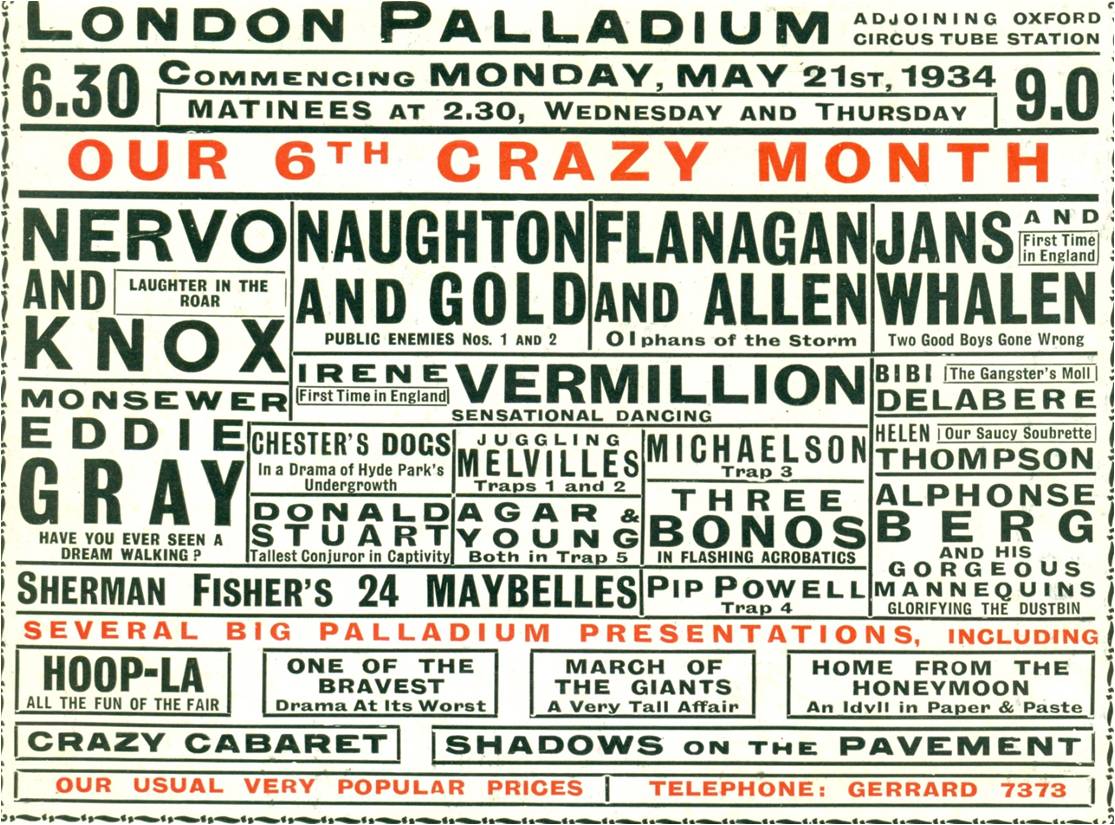
We made our first trip to the Palladium, they lettered my name on the billboard “Helen Thompson, Our Saucy Soubrette” whatever that means. I thought it was cute. Anyhow, we entered the theatre through the back entrance and met a lot of the cast. Such nice people, too. They told us that “The Crazy Show,” that’s what they call it, has been coming back to the Palladium for years. This group of comedians is known, together, as the “Crazy Gang” and made us feel very welcome. They explained that the same crowds return each season to see their old friends in the show.
We felt pretty excited opening night when Jans and Whalen took the stage after the all-cast extravaganza and began their routine. Harry Jans told the one about the soldier who had survived mustard gas and pepper spray becoming a seasoned veteran. No on laughed. The audience hated them. No one booed, and they clapped a little when Jans played and sang, “Miss Porkington Would Like Creampuffs.” Remember that silly song? Other than that polite response, not a snicker sounded in the whole house.
Then I went on stage and performed a widow comedy monologue; black gown, the whole bit, and I bombed too. With all those spotlights trained on me, if it hadn’t been for the coughing and murmuring I would have thought the theater empty. It was horrible— nauseating— I couldn’t believe how miserably we failed. WE LAID AN EGG!
After the show some of the regulars took us out for drinks. I wanted to run back to the hotel and hide. They led us to a nice pub, but I felt so shook up I could hardly light my cigarette. They explained that English audiences often don’t understand American humor. In particular, my widow act seemed more offensive than funny.
“Too many widows after the Great War,” one comedian named Eddie Gray told me. “Not funny to families with loved ones who died in the trenches.”
That never crossed my mind, Dot. It’s been almost 15 years, for goodness’ sake. So we were ready to make the changes the boys in the cast suggested. No prohibition jokes, no dead jokes, more songs, and lighter skits. When we arrived for rehearsal the next morning letters were pinned to the dressing room doors that we were to clean our things out—that the management would no longer honor our contract. By the way, the Times critics gave us a lambasting, too. I got to feel mortified all over again.
So, dear Dorothy, that is how the situation stands. Whalen won’t come out of his room. Jans is ready to murder the guy in the front office, and I may drag out my trunk and mail myself home. Just let me know if you can cover my passage. But, don’t do anything yet.
Thanks oodles and oodles and mum’s the word.
Helen

My Dear Friend Dorothy,
Salvation! We have been kept on the bill, at least for a couple of small bits. So thanks for agreeing to help me home, but Jans did take care of things. I swear, Dot, Harry Jans could coax the English rain back into the gray English clouds.
It all happened so quickly, but this is how events turned. We were shocked, and then worried, as I’m sure you could tell. Then Jans remembered that our contract explicitly stated we were to make $1000 dollars a week regardless of circumstances. He marched into the manager’s office and wouldn’t leave until he received a check for $4000 dollars, or our reinstatement to the show. The manager balked and then Jans reiterated that the contract was clear. My partner gets a little fierce when he’s riled and I think he scared the fellow. The manager said he’d discuss it with his investors.
But that’s not the best part. The whole cast refused to go on until we were back on the billing! Their leader, Teddy Knox, told the manager that one night wasn’t fair, and that until we went on again, they would wait. All of them! Bless their hearts! Guess they are crazy. Later, I caught up with Teddy Knox in the green room and told him how grateful I was. I guess I just hugged him and cried.
So all is well, and Bertha still calm. I will tell her, but will word my letter so that she doesn’t blow her stack. Thanks again, Dot. You are such a swell friend!
Helen
Dear Bert,
We have had quite a hectic week. We opened on Thursday night and were fired Friday morning. Can you believe that? But don’t panic, we’re back on the bill now. It was all a misunderstanding; apparently people in England and people in the States laugh at different things, so we changed our act a bit. Should be all right now. Jans and Whalen are keeping a close eye on me so don’t worry. I will send a money order in my next letter and hopefully more news. Don’t worry Mother. Things here are fine. Love to Eileen.
Love,
Wellen
Helen,
I don’t understand how you could take firing lightly. If there are any further problems you catch the first ship home. You tell Harry Jans that I mean it. Now take care, and make sure you keep me informed of any other issues.
Mother

Dear Mother,
I hope that you aren’t too cross with me. We won’t be gone long, and I will be home very soon. The three of us are back in the lineup. Jans and Whalen play toreadors in the opening number, and I am in a black and white feather costume complete with white boots. The outfits are very snazzy. We sing the show’s theme song, “Come Round London with Me,” then “God Save the King.” We had to rehearse them both, and the audience stands up and sings along when “God Save the King” begins. Can you believe it?
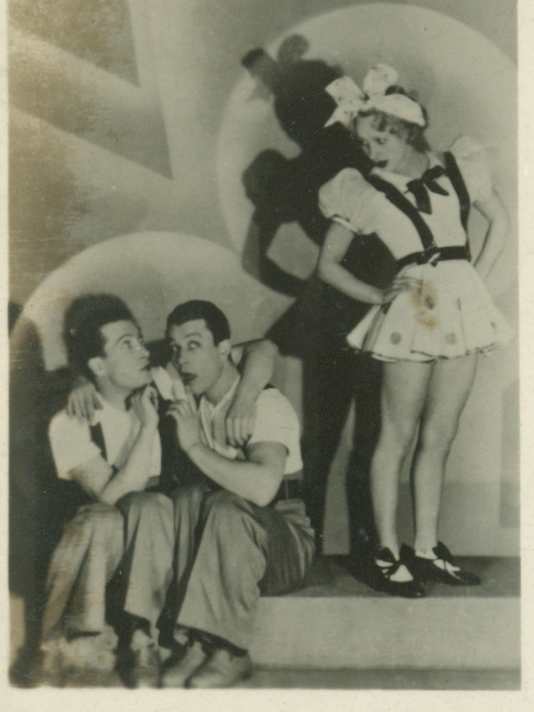
Jans and I finally are doing our own skit. I wear my tap shoes, a short flared skirt with suspenders and a huge pink bow in my hair. On cue I timidly step to center stage (everyone can hear each tap). Under the spotlight Jans, says “Did you come out to sing a song for the nice people?”
I point to my throat and croak out “l-a-r-y-n-g-i-t-i-s.”
Jans answers, “Oh, that’s a shame we all were looking forward to your number.”
I lean over and whisper into Jans’ ear. Jans then says loudly “You want to whisper the words to me, and I sing the song? Yes, yes, a grand idea! I would love to!” He announces “This song is called “Where on Earth could all the Fairies Be?”
I whisper in his ear, he sings a line, next whisper, he sings, and then Jans finishes, arms opened wide belting the out the refrain, “Where on Earth could all the Fairies Be?”
A spotlight quickly hits Jimmy Naughton, (he’s a Brit) planted up in the balcony who calls out in an effeminate voice,
“Oh, my, where aren’t they?” The lights cut to black and the crowd roars with laughter. Cute, huh?
Did you receive the money I mailed?
It won’t be long now,
Little Sister

Picture1

Cocolalla

73115959-SLD-004-0017

We had two cabins on a small lake in Northern Idaho.

Located between Lake Coeur de Alene, and the Pend Oreille, our little acre overlooked tiny Cocolalla, with large windows where we could watch the waves lap up on the beach. The original structure we astutely named the Little Cabin, later followed by the larger Big Cabin. This bigger cottage had been built with all the amenities of home; running water–hot and cold, a tub and toilet, a full kitchen, and electric heat.

Those early weekends in the Little Cabin hold many good memories. All of us crammed into that tiny wood box, the unfinished walls festooned with a lifetime of greeting cards, a big enameled wood stove, and a porcelain basin for washing dishes. Grandpa got his hands on a tall steel milk can and commandeered it for enough drinking water to get us through the weekend. As for entertainment, Grandma had an old radio that blasted the most impressive static, interspersed with Roy Orbison or Andy Williams fading in and out.

Once the Big Cabin was completed and my grandparents moved in, the smaller cabin was demoted to storage. It also housed a set of bunk beds, a fold-down couch, and one double bed; useful for my brothers who were just getting bigger. Now, in addition to greeting cards, the cabin stored every variety of water equipment. Fishing poles, life jackets, oars, and an outboard motor clamped to a metal barrel, with stacks of beach towels the size of blankets.

As I recall, a constant grit of sand coated the linoleum floor.

The property was my grandparents retirement dream, but a dream they happily shared with the rest of us. I knew, even then, that I was always welcome, always.

My grandpa was an early riser, a product of a lifetime as a mailman. He didn’t want to tiptoe around a little kid sleeping on his sofa at five in the  morning. At bedtime my grandmother and I made our way to the Little Cabin in the dark by flashlight. Under the covers of  the double bed, I would chafe my feet deep under the sheets to warm my toes. As we grew settled and peaceful she would begin to reminisce, talking to me for hours in that darkness. I learned of her life in those moments, warm in that cozy bed, listening to her voice, breathing the scent of the evergreen forest.

She told me of my biological grandfather, her first husband, who had left her bereft and penniless after my mother had been born. Despite the Depression, he liked to gamble away their money. My Grandma had to leave him and she struggled to find work as few jobs existed. Forced to farm out her daughter, my mother, in various homes, her the guilt still haunted her. Clearly it still broke Grandma’s heart that she was forced to separate from her little girl for months at a time. I could hear a wound that could never heal.

As the night grew deep, crickets and bullfrogs began to chorus. Flanked next to her, and pressed against some greeting cards, I prayed I wouldn’t spoil the magic by having to go potty. She kept, beneath the bed, a Chase and Sanborn coffee can that I hated to use. It felt cold and left rings on my little bottom. Still, considering options, the can was more appealing than a journey to the outhouse. Using that creepy outhouse in the daytime was bad enough, but at night unthinkable.

Finally poking her lightly, I would tell her. And she never hesitated. Showing no impatience at all, Grandma seemed to make my problem her own, reaching for the flashlight and finding that rusty can. She held the light on me so I could aim properly, then back into the warm bed. No recriminations.

She loved me.

I loved her.

Today my husband and I live in the woods. We don’t have a lake, but a river runs near and we can hear it on very quiet nights. I relax in my cozy bed in the darkness and listen to the crickets and bullfrogs, while breathing in a scent of pine. A sense of complete security, of love, of acceptance returns, synonymous with the love of my grandmother. She was home for me, and though gone these many years, my mountain cabin still echoes with her voice.

Gail Chumbley is the author of the two-part memoir “River of January,” and “River of January: Figure Eight.” Both are available at http://www.river-of-january.com and on Kindle.

gailchumbley@gmail.com

My Rock, My Refuge, My Library

It wasn’t yet 10:00am, but parking spaces were filling up fast. The library would open soon.

Be-bopping up the sidewalk, dressed completely in black, ear buds stuffed under his knitted cap, came the happiest Goth in high-tops. A young mother followed behind, a stack of books awkwardly balanced under one arm, and a wiggly baby in the other. The time was 9:58.

Older folks, hipsters, Lexus drivers, the tattooed poor–all queued together for their morning stop at the public library. How remarkably American.

When the doors finally did slide open, this society of seekers disappeared inside, striding with purpose to stake their domain. A no-nonsense aura filled the air as each card holder claimed their chair, booth, or computer to commence their business.

If ever there existed a reflection of perfect democracy it is America’s neighborhood library.

Visits make a lot sense. The facility is clean, climate controlled and the interior is well lit for reading and research.

More, public libraries offer a multitude of services for the community. The unemployed  gets out of the house, and can search job openings on the internet, maybe check out a DVD or two at no cost. For the housing insecure, the interior offers sanctuary, a chance to safely close one’s eyes or relax and catch up on some reading. Mothers toting little ones make use of programs such as story-time, organized games and crafts, providing a diversion from hours at home.

My own elderly parents used to check out their book limit every two weeks. The librarian knew them well, suggested titles, and bagged up their books. They, too, waited in the parking lot. When those doors glided apart, canes in hand, they hobbled inside, joining the democratic wave claiming library privileges.

It was Benjamin Franklin who modeled this fixture in America’s beginnings. Franklin knew national longevity demanded literacy, and in that spirit he established the first lending library in Colonial Philadelphia. A true visionary, Dr. Franklin set the course for public good by founding these centers of learning. If he could see what I saw in that library parking lot, Franklin would rest a gratified patriot.

Next to public schools, a library card is the ultimate equalizer–from the richest to the poorest among us. No amount of status or money can elbow us out. My access is equal to yours.

To politicians fearful of books on the shelf, you strike a blow not only against the First Amendment, but to all the connecting tissue of American society. A misguided, self-righteous streak exposes a dark agenda which should give us all pause. Attacking libraries attacks us all. 

Gail Chumbley is the author of two books, “River of January,” and “River of January: Figure Eight.” Both titles available on Kindle. Chumbley has also authored two stage plays, “Clay,” and “Wolf By The Ears.”

gailchumbley@gmail.com