Wounds

th

Rereading the original draft of my book, River of January, I reviewed the back story that propelled the book’s creation. An impossible crisis pushed me to write the work, but that narrative was cut out of the main manuscript due to length. But I still believe that the story behind the published story is important to share.

The Intensive Care Unit was the largest department on the third floor of the hospital. Reflecting back I never did figure out which direction the ward faced. Was it north toward Boise’s golden foothills or south over the blue turf of the football stadium? Someone needed to open the blinds.

The floor plan in the ward ovaled around like a carpeted arena, anchored by a nurses’ station in the infield. Three quarters of the broad ring had been segmented into tiny stalls–narrow spaces housing mechanical beds. My husband’s particular nook, squeezed into a curved corner, remained either open or sealed by simply sliding a glass door and a privacy curtain. Each morning I instinctively gauged his condition by the disposition of that entrance. Coding patients were afforded some semblance of privacy.

The sparse decor inside clearly signaled “no nonsense.” Two chairs flanked the entrance, with one small footstool. I once tried pulling out that stool to attempt a nap, but sleeping was reserved for the critical only; the nursing staff’s frenzied laps around his bed made sleep impossible.

Unconscious, bloated, with a swollen torso and bulging arms, my husband lingered on the crinkly mattress. Tubes protruded from nearly every square inch of his upper body, pumping in liquid meds and below, pumping out liquid waste material. Attached monitors loudly measured his heart and pulse rates, racketing in a relentless beeping.  I was afraid to ask the meaning of the numbers blinking on the monitor, the din adding to my fatigue. Eventually, I inquired what a normal cardio reading looked like, and the answer wasn’t reassuring. I froze in that nondescript chair, dazed, almost hypnotized, willing his numbers to improve. Still indifferent, that monitor shifted erratically, frequently setting off an alarm drawing in medical reinforcements. 

The cocktail of fluids pumped into his arms overnight had left him bloated to the point that his nose had flattened across his full, stretched cheeks. Fingers that had earlier held my hand from the stretcher now swelled to the size of cooked kielbasa—triggering thoughts of his wedding ring and his watch. My next random reflection recalled both pieces being handed to me the night before, and hopefully safe in my purse. It was a dreamy recollection. 

The worst feature of his bare torso was the ragged, opened split from his naval to his groin, sealed by a stiff grey foam substance, and a thin membrane of clear film covering the diagonal wound. I was told his body was so contaminated in septic debris that the stitches closing the incision would have healed before the toxic substances beneath had cleansed.  So this vacuum packed dressing over his wound kept the area draining and that tube, too had an attached little box, stowed under the bed that beeped and flashed. 

He looked too rubbery and inflated to be real, but with the aid of artificial ventilation forcing his breath, I could clearly hear his intake of air. 

Clinging to these subtle signs I began the litany of phone calls that had to be made to the rest of the family.  His son, my parents, his siblings . . . I hated to upset them all, but knew these relatives had to be kept in the loop. Listening quietly on the phone, my 78-year-old father finally spoke; he and my mom would pack up and come down to Boise from Spokane. I wasn’t prepared for that offer, and asked them to give me a little time. I still wasn’t convinced my husband was going to live. At that moment I had no energy for company, all my focus concentrated on watching his vital signs.

Desperation is a funny emotion. The intensity of it burns on the inside, and we fool ourselves in believing the conjured up power somehow changes reality. Maybe the instinct to inflict mental suffering on ourselves is a primal manifestation of empathy for our loved ones. He bore the physical wounds, while mine lashed and scorched my insides. Over the course of his lengthy critical care, and his slow road to recovery, I had to do something with all the bile stuffed into my psyche. Out of this pain came the healing therapy of River of January and my own recovery through writing.

Gail Chumbley is the author of the memoir River of January
 

Landmarks

 “Avalon,” is a lovely 1990 film directed by Barry Levinson.  The movie depicts the generations of the Krichinsky clan, a Polish-Jewish family that immigrated and settled in Baltimore.   In a touching scene toward the end of the film the lead character, played by Armin Mueller-Stahl shares a story with his grown grandson about a visit he took to his old neighborhood.  Describing his walk, Mueller-Stahl frets about the absence of familiar buildings.  Finally finding the childhood house of his now-deceased wife he reflects that it was a good thing (he found the house) because he thought for a moment that he “never was.”

Many places central to River of January also have passed into time.  New construction, commercial and residential, has erased much of what once solidly stood.  For Chum, the greatest eradication had to have been the airstrips and hangars of Roosevelt Field.  That particular airfield meant a lot to him as it was the site of his 1933 Air Race.  Today that area is all retail–the legendary field buried under department stores such as Coach, Anne Taylor, Sleep by Number, and the like.  On the other hand, Helen’s Whitby Hotel on West 45th Street still stands, though remodeled into privately owned condos.  I would also presume that many of the old vaudeville theaters, the Keith-Albee chain for example, are long gone.  Public entertainment halls are simply vestiges of a distant past where the girl turned herself inside-out to entertain New York audiences.  

I just returned from a visit to my old hometown.  Though elderly, my folks still live in the house of my childhood, a place I more frequently visit in my dreams.  On this actual trip we drove a little around the old neighborhood.  In the 1960’s, when I was a kid, my friends and I often walked to the grocery store, or a nearby soda shop called “Woodies.”  It had an unauthorized drawing of Woody Woodpecker on the front sign, and inside we played pinball and bought penny candy.  In later years, hard economic times hit the area and gang sign was more prevalent on old buildings than prosperous businesses within.  The grocery store closed, and shortly after Woody’s went out of business. 

But now, what a change!  A British-themed pub sits on the corner where once stood the drugstore that sold us our Marvel comic books.  Across the street a new high-end pizzeria, complete with outdoor dining, twinkling lights and live music–where in an earlier time a full service gas station checked oil, filled tanks and handed out Green Stamps.  And the old Woodies now?  It’s a hole in the ground.

My folks still reside in the old house, though they too have repainted and remodeled.  My mom took the opportunity of our visit to let me know that her beautiful re-done kitchen will be an asset when we sell the house.  All I could say was, “Where are you two going to live.”  She only smiled.

There is nothing we can do to stop time, (even Botox is no shield).  I pray that I can still recognize where I am in that part of Spokane as the months and years continue to blow by.  I want to be able to identify the place where I once was. 

The Diva?

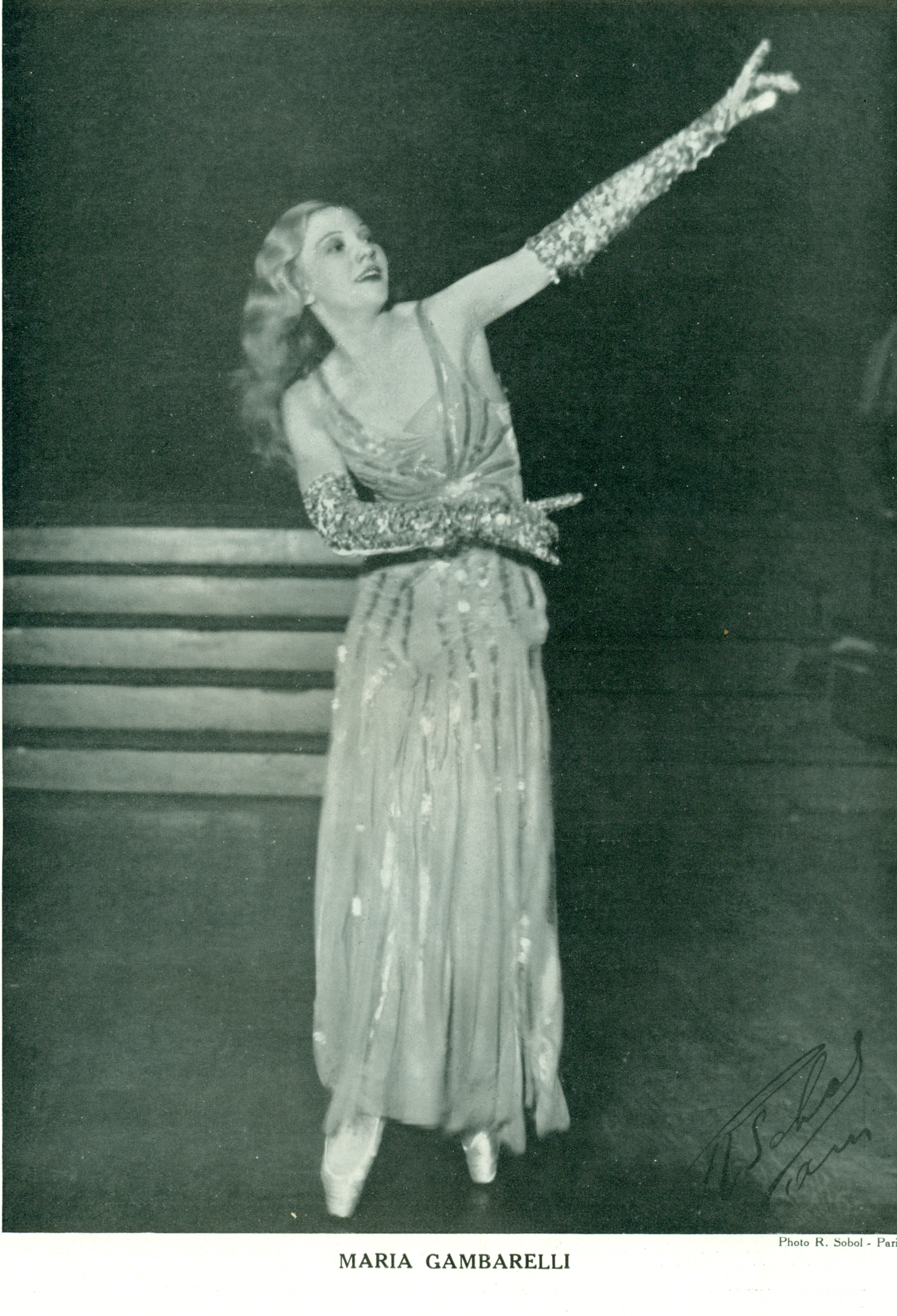
ImageAt the risk of sounding too teacher-ish, I’d like to write a bit on the woman pictured above.  However, before I discuss Maria Gambarelli, it is fitting to mention that she is just one of many interesting characters I ran across researching River of January.  It is also fair to say that Helen’s audition for Miss Gambarelli altered the course of Helen’s early career.

Born in the US to Italian parents , Miss Gambarelli began classical training at a young age.   Crossing the Atlantic she studied ballet under famed Russian dancer, Anna Pavlova.  Once back in New York, Miss Gambarelli performed with acclaim on American stages.  After an appearance on a New York radio show, Gambarelli grew to be a celebrity among audiences not interested in ballet.  In her interviews she shared stories of Italian origin, along with related folk songs.  The host, Roxy Rothafel soon made Miss Gambarelli a regular on his program, raising her profile as a dancer.

Rothafel was the man behind the construction of the Roxy Theater, which opened in New York in the late 1920’s.  Miss Gambarelli began a long term contract at the theater, performing for audiences with her company of principal ballerina’s called the Roxy-ettes.  As you may have guessed, that dance line most likely evolved into the famed Radio City Rockettes.  At least that’s the story I found.  Nailing down the past is a dicey proposition, competing with numerous other theories.  However, it does seem to flow.

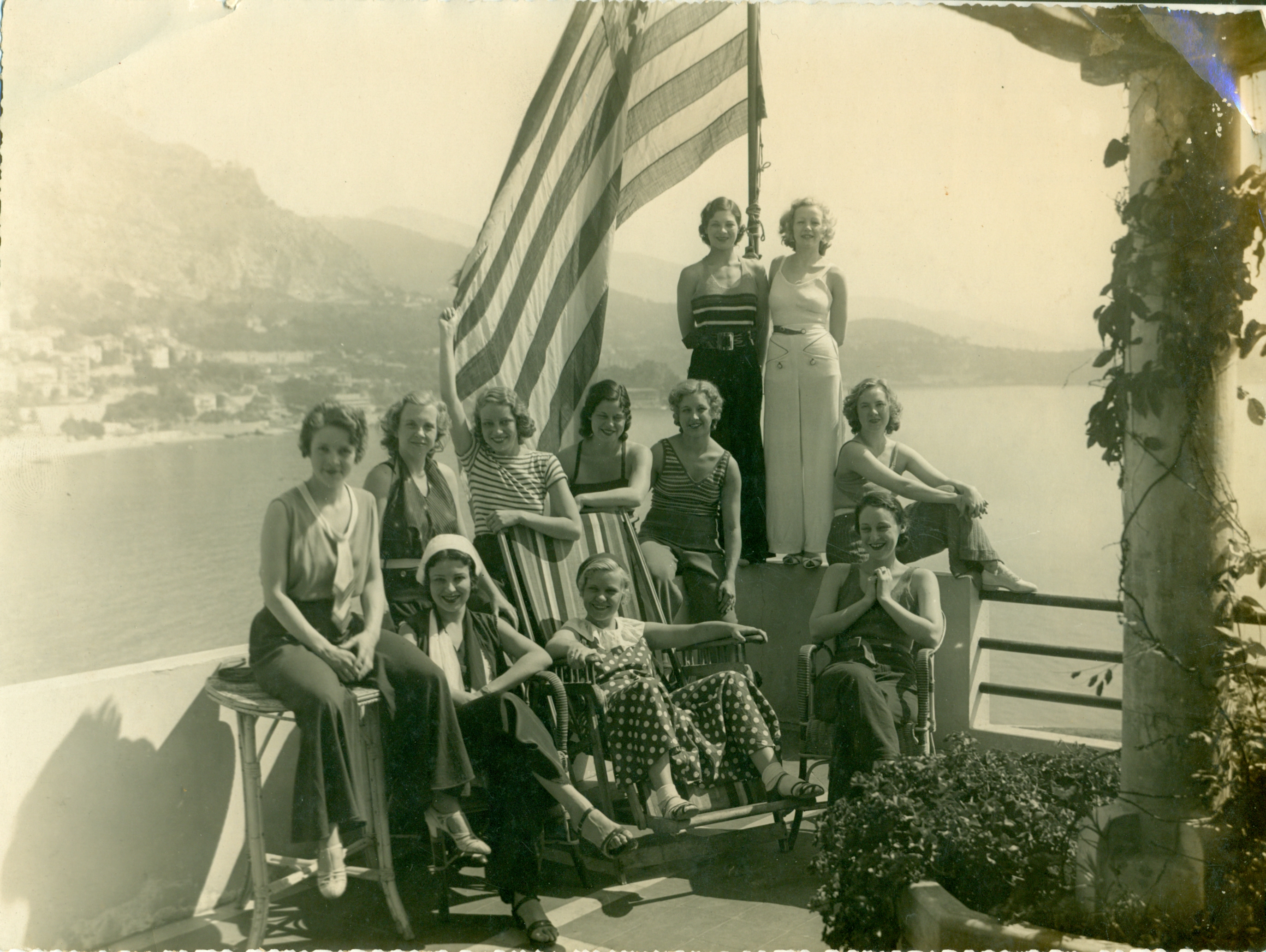
This ties into my book because Helen danced for Miss Gambarelli in 1932.  The soloist had been engaged by investors to lead a dance company on a tour of European cities.  The company titled “The American Beauties,” was slated to perform first in Paris, then to Brussels, Monte Carlo, and ending in Erba, Italy.  I found in Helen’s papers that the backers worked through the William Morris Agency in New York, in conjunction with the Lartique Agency on the Champs Elysee in Paris.

Helen successfully won a spot with the troupe, and began rehearsals with ten other girls in New York.  Then the dancers experienced a near mythical crossing on the SS Ile de France to Le Havre, and by rail to Paris–all in Miss Gambarelli care.

After the endless training, all of the traveling, all of the money spent in promotion–the tour faced failure.  After only two weeks of performing at the “Le Ambassadeurs” club in Paris, Miss Gambarelli quit the tour.  And not only did she quit, she turned around and sued Lartique for breech of contract.  Miss Gambarelli wasn’t being treated up to her expectations, nor was she allowed to maintain control over the music, or the  choreography of the production.  So she quit.

When I wrote about this episode in the book I needed to find the right word to describe Miss Gambarelli’s behavior.  I couldn’t use diva, because that’s a term that didn’t become a pejorative until today.  Prima-donna is a tough one too.  In fact spell-check doesn’t even recognized Prima-donna, let alone touch on its meaning.

But, if anyone fitted the term, it was Maria Gambarelli.

In the end the tour carried on without it’s star, and evolved over time into a broader variety program.  A new headliner re-tooled the production adding more song and dance, enjoying great success by the time Helen left for New York in 1933.

The show must go on.

On Motivation

Guilt has been an impressively persuasive source of motivation for me.  Getting ready for bed, before picking up a night read, I review what didn’t get done that day.  I quite often withhold affection for myself until my list is all checked off.  As a life long teacher, my to-do’s drive my day.  Education loves stated objectives.

In River of January I had to come to an understanding of what motivated my main characters.  Chum simply had ambitions to fly airplanes and, later, any other vehicle that propelled forward at high speeds.  Helen aimed for show business success, and her formative years pointed at nothing else but training and performance.  Somehow the two of them appeared more prompted by better internal motivations than guilt.  It seems that neither were moved by negative impulses–they didn’t waste their energy feeling inadequate.

They did struggle with personal problems–serious childhood issues each silenced the best they could.  Yet, ambition overrode, or at least, held in abeyance the guilt and doubts that had the power to paralyze their resolve.  Chum took big risks, such as the air race in 1933, and when Helen auditioned for parts she was legally too young to take.  It’s as though professional details presented no barrier to the greater prize of success.

I found, through their records, that both were methodical, committing to paper extensive to-do’s. Helen painstakingly recorded list of agents, theaters and studios along Hollywood Boulevard in 1930.  Chum kept concise records of his air routes, (weather, ground contacts, and flight anomalies) beyond the required logbook.  These people were organized!

Perhaps the moral of this brief installment is reconfiguring the daily humdrum, and not confuse vacuuming with anything near achievement.  That is what one does to have a clean floor.  Chum and Helen kept their eyes on the prize, to steal a phrase, and didn’t confuse the mundane with authentic success.

Doubting My Doubts

Its been a tough couple of days for this writer.  I am on my third editor and living on tender hooks if she is going to follow through with the job.  My history with editors has been a rough one.

The first one I paid, only to be told that I was beyond hopeless as an author.  She fired me and I was horrified and despondent.  Editor number 2 was a friend of a friend.  She didn’t charge me, because she enjoyed the process, but became quite ill and stopped responding to my calls or emails.  Now I’m on editor number 3, and readers, I hope she’s the charm.

Not all is gloom and doom, however.  The first editor was right about my writing style.  I stunk.  My style was notable for lacking style.  But did I give up?  Did I hide under the bed?  Well, yeah I did, for a couple a weeks.  It was the shame that someone saw through my facade, my pretentiousness, calling me out as a fraud.  I felt a fraud, too.  I ended up lolling around in a deep pool of pity and humiliation.  Geez, this writing business can be brutal on self worth.

Saturday I emailed #3 asking her how the edit was going.  I hadn’t heard much from her, understanding she had other projects that had to be finished.  Still, I watched my email attentively looking for any new messages.  And one day later it came.  Such a long email.  Just the sheer length of the reply kicked my nerves into overdrive, and my stomach into knots.

But I took a breath and a drink of water, then focused on her words.  She actually likes my work!  She even complimented my dialog and details.  The first editor, if she knew of that new assessment would certainly roll her eyes in disbelief.  But I’ve thought a lot about #3’s remarks and need to give myself a break.  After #1’s rejection, I dug in and rewrote, rewrote and rewrote.  #2 editor generously monitored my work, line by line, and I have nothing but warm gratitude toward her for such kind tutelage.  She revealed to me my writing voice.

#3’s concerns surround the plot line, and the sudden starts and stops with the overall book.  It appears I’ve graduated from weak sentences, now to the larger shape of the overall work.  Of course I had to beg her not to drop me, and felt a little silly and dramatic after revealing my vulnerability.  But I need a solid editor who believes in my manuscript.  I’ll do anything I need to do to get River of January to publication.

This has been nothing less than an ordeal.  Yet, I am persuaded that the story must come to life, the adventures of the central characters deserve attention.  I can’t let my doubts overwhelm me.

I need to learn to doubt my doubts.

American Bliss

Ryan sat in the back corner of my classroom, right in front of the doorway.  He may not have been fully engaged in the lesson of the day, but he never disrupted class either.  In fact the subject was race hate, the rise of Fascism, and the emergence of Adolf Hitler as fuhrer by 1933.  This particular discussion concerned, antisemitism and Hitler’s diatribe, Mein Kampf.

The young junior raptly examined a scab on his hand while his right heel bobbed up and down in nervous boredom.  “Ryan,” I directed toward him.  His hands froze, his foot paused, still.

“Yeah,” the boy replied in his perfect central London English.

“Can you tell these kids about the Irish question in England?” I flatly inquired.

“I don’t know anything about that,” Ryan answered dismissively, returning to his blood trickling fist.

I didn’t let him off easily.  “You know Ry–the Irish Republican Army, Sinn Fein?  They have targeted the British forever, because of the British occupation of their land.”

Now Ryan is clearly becoming annoyed with me, as all the kids are looking his way.  His lax teenage cover was in the process of being blown.  “Yeah.  Like, I know about it, but it doesn’t effect me here in the states.”

“Sinn Fein actually killed Prince Phillip’s brother, Louis Mountbatten with a bomb,” I add for effect.  “Londonderry is very dangerous between Protestants and Catholics.  They commit reprisals all the time over the British presence, and have forever,” I repeat.  “Right, Ryan?”

This English-American teenager has jumped to his feet, pumping his file finger accusingly at me.  “You shut up!” he yells.  “You don’t know what you’re talking about!”

At his reaction, I look at the horror-stricken faces of the other 35 kids and calmly explain, “That’s nationalism . . .blood and belonging.  Sorry Ryan, I didn’t mean to rile you up.  But, these kids have no notion of how distinct cultural groups see themselves and other outside groups.  They know nothing of the burning hatred and venom one group holds for another.”

He stood silently for a moment, then slumped back into his desk, shaking his head doubtfully.  Now I felt kind of bad for making use of his English background to make a point.  “It’s okay, Ryan thinly smiled.”

Later that year, for Christmas, he gave me a beautifully wrapped gift.  “Open it,” the boy insisted.  So I did.  Inside was a GI Joe, George Washington doll.  Complete with uniform, a pistol and, a saber.  I still laugh when I think about it.

Helen actually toured Europe during those years of upheaval between the wars.  The chill of fascism touched her life particularly in Rome and Milan.  Her friends from the dance company attempted to work in Germany, only to find their presence unwelcome, and their stay cut short.

Hitler jokes bounced from stage to stage, cast party to cast party.

A Jewish boyfriend of Helen’s worked night and day to build a photography business, driving the length and breadth of the continent to establish satellite offices.  He was first stymied in Berlin when investors “suddenly” bowed out, and unable to travel to Madrid due to the Spanish Civil War raging by 1936.

In so many modern respects, despite enormous international changes since World War Two, we Americans still manage to lack an understanding of our world neighbors.  Americans still choose to be willfully isolated–an isolation that deprives us an accurate understanding of other people and cultures.

An Anchor in a Whirlwind

Image

Helen seated below flag in stripped tank and blond hair-Monte Carlo 1932

Chum once told me that he never suffered from jet lag.  And he later flew jets.  The early flights didn’t reach ten thousand feet in altitude and the duration was relatively short.  Time zone hopping took a lot longer from the east to the west, and back again.  Flights landed before the body or even the mind was too zapped.  I asked him how he sustained himself waking up in a different place nearly every day.  He looked at me with a perplexed expression, as though he couldn’t fathom the question.  “I never had any problems,” he’d repeat.  “I never struggled to sleep, and my appetite was always good.”

Those few, still living when I began River of January told me, amused, that Chum made a habit of standing on his hands, heels against the hotel wall every morning on turnaround flights.  The man maintained his vitality with rigorous exercise, and few vices.  He knew himself well, and held his life together with discipline and purpose.

In a bit of a contrast, Helen, who also traveled a great deal, found her center in a circle of friends.  It seems her friendships melded easily and had staying power.  Despite waking up in Milan one day and Vienna the next, her fellow dancers provided a niche where she securely fit.  On the voyage to Rio, Helen made a friend of her cabin-mate and the two remained close during, and after the engagement.  Her place among others provided Helen a context in which she functioned well.

And in all her travels, she always knew her mother waited back in New York, expectant for the girl’s return.

As the scenery from the rail cars constantly shifted, the theaters and hotels changed, and managers varied, Helen never appeared to suffer from insecurity or alienation.  She didn’t waste time agonizing about her talent or if the company had a place to perform.  The girls had each other.

Despite the chaos inherent in their chosen careers, (flying and show business) plus living in the fall-out of the Great Depression and the ominous rise of fascism–the two appeared to cope with continuous change gracefully.  Young and excited, they both seemed to revel in the novelty of each new day.  The pilot found strength in the fullness of himself, and Helen among her fellow entertainers.  In a world torn by strife at home and abroad, they had little time for indecision, or hesitation.  Chum and Helen cultivated their own strong sense of certainty.  That inner strength lead to purposeful and consequential lives.

The Art of Conversation

Dinner ended and post meal-conversations bloomed.  Fueled with Chardonnay and various reds, the noise level ratchets as each diner shares new and old stories.  Beneath the warm exchanges and laughter at the adult table, small children dart about in pursuits below the tabletop, beyond the focus of their parents and grandparents.

One little girl stands out from the chaos.  Her hair is dark brown, cut pixie short, delicate little freckles scatter across her tiny nose, and lovely dark eyes, one lighter than the other, blended in with small pools of olive green.  Her monolog never stops.  “I don’t really like red licorice,” she tells me.  “My daddy used to bring us M&M’s and gum from his work.  But he was gone to meetings for months and months.”  All the while she speaks, her little hands deftly handle a small video game that detonates hens into minute, cracked eggs at the bottom of the screen.

“Do you remember how you came back after sneaking out with your friends that night, and I was waiting for you?” laughs one grandmother to the little girl’s father.  Everyone seated at the table chuckles.  But the delicate child pays no attention to the merriment above her.

Her voice–a timbre of little tinkling bells, shows me her journal.  It’s a rectangular tome, and I can see that she has written on the empty pages since I sent it to her for her birthday in June.  Producing a pencil the size of a bread stick, the seven-year-old opens to a new page.  “My Papa in Idaho gave this to me for my birthday,” she explains.  I can see her spiky printing where she has carefully kept the dates for each entry.  I point out to her where I dedicated the book to her, inside the front cover.  At that little disclosure, she looks up curiously into my face, pulled momentarily from her private world.  This little Ramona-look-alike appraises me thoughtfully for the first time, and I can sense the girl may have found a spot in her life where I just might possibly fit.

More amiable laughter spills over the long plate and platter strewn table.  Little O turns quickly back to her journal and scribbles a secret message about her day.

I hope she mentioned me.

Signs

It’s Saturday and I have an update from my last post. 

My husband, his brother and sister placed Chum’s ashes on Helen’s grave

in a Miami cemetery.  While they were pouring his remains a DC 3, exactly like the one in the previous

piece flew overhead.  You can’t make this stuff up. 


The Great Silver Fleet

The Great Silver Fleet

This photo is a DC3, part of Eastern Airlines “Great Silver Fleet” of passenger liners. The plane is on display in the Air and Space Museum at the Smithsonian. We had suspected that Chum had flown this aircraft, but weren’t quite certain. Finally, I had the chance to look over his logbooks and matched the tail number to this plane. Chum captained this particular aircraft in February, 1946, six months after the war ended. If you find yourself on the National Mall, you can duck into the Air and Space, where you’ll find this beauty still on exhibit.