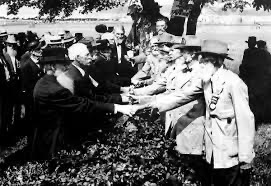
In 1938, old men aided by young volunteers shuffled off of trains and cars arriving from both sides of the Mason-Dixon Line. For the most part these gents were in their early 90’s, and looked forward to reminiscing, comradeship, and scheduled ceremonies.
Organizers had planned three full days of tours, music, and ceremony, complete with a flyover and fireworks. The Battle of Gettysburg’s 75th commemoration had begun.
There had been an earlier anniversary event, in 1913, but this time visitors knew this gathering would be the last. Those in attendance understood, as did the elderly guests of honor, that those who hadn’t fallen on that Pennsylvania battlefield in 1863, would soon join the brethren who had.
After this commemoration, the narrative would pass from eye witness accounts into America’s collective memory.
No longer wielding rifles, many maneuvered the grounds pushed about in wheel chairs, walkers, and canes. Old men brandished ear trumpets to catch the orations of the many visiting dignitaries. The men listened as President Franklin Roosevelt delivered remarks dedicating the Eternal Light Memorial, located near the “Bloody Angle.” Battlefield tours transported veterans, and well-wishers from Cemetery Hill, to Seminary Ridge, Little Round Top, the Devils Den, and finally the exposed fields of Picketts Charge.
There, at the stone fence, gray old men in blue, and others in gray and butternut, shook hands in reconciliation.
Ironically, left uninvited were the scores of African Americans who had harbored such hope for new lives after emancipation and the war’s end. Unfortunately, the era of Reconstruction left little to show for racial progress or Civil Rights. Instead Freedmen found a new enslavement, recognizable in every aspect, but iron chains.
Forty Acres and a Mule had never materialized, as promised by victorious Union commanders. Now relegated to tenant farming, Freedmen struggled in the same conditions as before, but now as sharecroppers. Stuck in a never-ending cycle of poverty, black farmers found insufficient harvests debited into the next season, and then the next, in an endless cycle of debt.
The Supreme Court’s 1896 ruling in Plessy V Ferguson legalized segregation by insisting any negative correlation attached to feelings of inferiority lived only in the minds of Blacks. Separate water fountains, parks, transportation, and schools worked just fine for the elderly veterans from the North and South.
The moral force of the Civil War had died as thoroughly as the nearly 7 million who had perished upon the scattered battlefields of that bloody conflict. Those veterans who reunited in 1938 Pennsylvania found white identity and brotherhood far outweighed any new birth of freedom envisioned by President Lincoln 75 years earlier.
The current occupant of the White House has made it his mission to once again assert white supremacy in an effort to rewrite American history. His feelings had been hurt by our first black President and now he seeks revenge. Of course this foolish attempt will fail, as is his custom in all things, because we know the truth of equality and this time will never forget.
Gail Chumbley is the author of the two-part memoir “River of January,” and “River of January: Figure Eight.” Both titles available on Kindle. Ms Chumbley recently completed her second stage play, “Wolf By The Ears.”
gailchumbley@gmail.com
 Gail Chumbley