Pickaxe To Nerve Agent

Josef Stalin was the embodiment of evil. Moreover, if one figure set the standard for Russian despots, it was Stalin. His reign of domestic brutality and foreign terror set the tone for a long, dangerous Cold War. Czarist Russia had set a particularly high bar for authoritarianism, but Uncle Joe inflicted monstrosities that would make Ivan the Terrible cringe.

After Russia withdrew from WWI, through a series of moves, the Bolsheviks, headed by Vladimir Lenin prevailed in gripping the reins of power. Through the aid of Leon Trotsky, a brilliant intellectual, and Josef Stalin a seasoned street fighter, the Bolsheviks founded a peoples state, loosely framed around the teachings of Marx.

During the next few years The US provided relief to the starving of Europe from Great Britain to Vladivostok. But aid made no difference to Lenin. In 1919 the Comintern was established in Moscow, professing the aim of Communist takeover of the world.

In 1924 Lenin died, and a fresh struggle for power ensued. When the snow storm settled Stalin was in command and Trotsky exiled.* Conditions in Stalin’s USSR flowed a crimson red. The Kremlin’s secret police cracked down on the people, through arrests, murders, and spying. By 1934 the NKVD began a purge that included the liquidation of middle class Ukrainian farmers resulting in the deaths of millions.

And those policies were domestic.

At the same time, spying took center stage in Stalin’s foreign policy. English and American assets were turned including left-leaning Americans disillusioned by the Depression, and England’s Cambridge Five, headed by Kim Philby. Philby held a high clearance in British intelligence. The use of such double agents allowed Stalin to essentially shoot fish in a barrel.

Atomic weaponry literally mushroomed on the scene, raising the stakes in East West relations. America lost it’s mind in the Red Scare, and Soviet agents burrowed deeper undercover.

That was then. But it is also now. Excluding reformer, Mikhail Gorbachev, Russian leadership emulates the tone set by Josef Stalin. Infiltrating the National Rifle Association, political misinformation, cyber hacking, and buying off scoundrels with generous loans, Vladimir Putin is an apt pupil of old Uncle Joe.

On January 6, 2021 as white supremacists broke past Capitol barriers, vandalizing and assaulting law enforcement, the winner of that moment was Vladimir Putin. Destabilizing America has been the object of the struggle since the Russian Revolution. 

Dear GOP, you are indeed Putin’s puppets.  

*Trotsky was murdered in August, 1940. An operative bludgeoned him to death outside Mexico City with a pickaxe. Putin critic, Alexei Navalny is currently in a Russian jail, weakened by a nerve agent that was meant to silence him.

Gail Chumbley is an author, and history educator. Her two-part memoir, “River of January,” and “River of January: Figure Eight,” are both available on Kindle.

gailchumbley@gmail.com

The Bloody Shirt

Principled soldiers of conscience, the victorious army knew they had served well, defending the Constitution to the last full measure.

May of 1865 witnessed Washington’s Grand Review of the Union Army. Smartly uniformed soldiers filed past crowds, in a river of Union blue. The guns had silenced a mere month earlier at Appomattox, Virginia; the Republic preserved.

A brilliant sun glinted off polished bayonets, and the parade route decorated with miles of silk banners, tattered company colors and patriotic bunting. Rejoicing greeted the passing soldiers in shouts and fluttering handkerchiefs. Flower petals rained down in a fragrant carpet of gratitude. 

The bloody war finally, truly, had ended. 

One year later, near Springfield, Illinois, a group of veterans established a fraternal association, the Grand Army of the Republic. The idea caught fire nationally as other veterans founded their own local chapters; a place men could remember, share, and grieve for lost friends. Soon these war horses got busy extending their service to those they had defended.

First, survivors lent aid to disabled fellow veterans, assistance to widows and their dependents, and orphan homes. Soon preserving battle sites added to the group’s outreach. Before long members began seeking electoral office to further serve the nation.

A story has it General Benjamin Butler, now a Congressman, grew extremely agitated while speechifying, and produced a torn, and bloody shirt he claimed came from the battlefield. Soon the practice of “waving the bloody shirt,” invoking war credentials, became customary for candidates. The saying “vote the way you shot,” launched the careers of numerous politicians. 

Presidents from Ulysses Grant, (1868-1876) through William McKinley (1896-1901) had faced the rebels on the battlefield.*

War memorials and monuments mushroomed, funded with GAR donations. Reunions, benevolent societies, veterans homes, and hospitals kept local chapters busy. In fact, much of GAR efforts were eventually assumed by the Federal Government, particularly pensions for those who had served.

Over time survivors of the Civil War dwindled in number. However, the organization soldiered on until 1956 when it finally faded. Loosely related, though more a coincidence, our last five star general was serving as president when the GAR closed its doors. President Dwight David Eisenhower, who kept a farm in Gettysburg, happened to occupy the White House.

This brotherhood, this Grand Army of the Republic, rose to defend our democracy in the mid-19th Century. This model of valor, and sacrifice shaped the character of the military for years to come. 

But one truth is quite clear, no officer ever advocated for a coup, and there was not one sucker or loser in their ranks.

In 2021 we can do no less.

*Chester Arthur served in the New York Militia, Grover Cleveland did not serve.

Gail Chumbley is a history educator, author and playwright. Her two-part memoir, “River of January,” and “River of January: Figure Eight,” are both available on Kindle.

gailchumbley@gmail.com
Divisions

Balkanize: Division of a place or country into several small political units, often unfriendly to one another.

America’s founders meant education to flourish, as a vital part of our country’s longevity. 

Designed to advance literacy, American public schools also curbed the rougher aspects of an expanding country. Since the earliest days of the Republic, centers of learning not only taught content, but other lessons like cooperation, and self control. Ultimately schools have instilled in all of us a shared baseline of behavior, supported by foundational facts necessary to find consensus.  

Today, technology and social media have endangered our ability to reach common ground. The distracting noise of extremists, splintering, and Balkanizing our nation threatens American institutions. Elections, government agencies, city and state government, and yes, schools are all targeted. Navigating through a culturally diverse society is inevitably stormy, and a closed American mind isn’t helpful.

Public education has traditionally been one of the ligaments that bind us all together as one people. Years ago a president encouraged us to ask “what (we) can do for (our) country,” but that’s over. Today it’s “Sorry losers and haters, but my IQ is one of the highest – and you all know it!”

Patriotism and literacy evolved together hand in hand. In 1787 Congress, under the Articles of Confederation, passed an Ordinance for settling western land. This law devised a survey system, to organize states around the Great Lakes region. This is important because sales of one plat of the survey, (you guessed it,) funded public schools. 

Thomas Jefferson affirmed the practice by insisting, ”Educate and inform the whole mass of the people… They are the only sure reliance for the preservation of our liberty.”

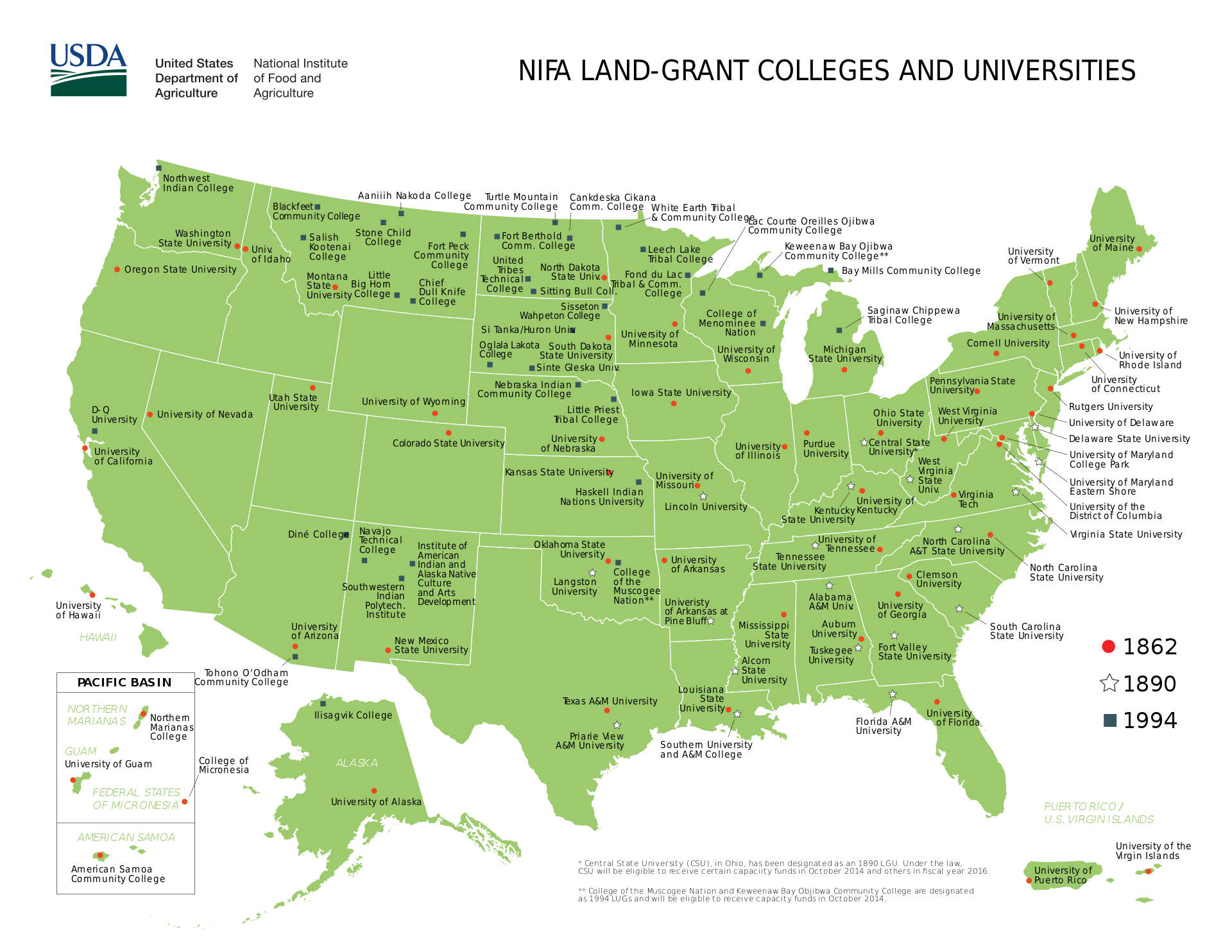
President Lincoln, a figure who deeply lamented his own lack of formal education, pushed to establish land grant universities across the growing nation. The 1862 Morrill Land Grant Act, in particular, financed colleges through Federal funding.These universities today are located in every state of the Union. 

America’s erosion of unity is tied directly to the erosion of public education. Our kids are increasingly sequestered into alternative settings; online, magnet, charter, home, and private schools. Missing is the opportunity to experience democracy at its most basic. Students grow familiar with each other, softening our own edges, renewing the energy and optimism of the nation’s promise. 

We are all taxpayers, but your local public school isn’t supposed to be Burger King, where every citizen can have it “their way.” We have a system that, regardless of money, race, ability, and social class, all have a seat at the table of democracy.

Gail Chumbley is a history instructor and author. Her two-part memoir, “River of January,” and “River of January: Figure Eight,” are available on Kindle.

gailchumbley@gmail.com

An America To Believe In

Religion in politics presumes all citizens essentially hold to the same beliefs. This premise also insists that religious conformity assures civic virtue and good order. However, in practice theocracies actually run counter to effective government, because invoking God in public debate stymies any exchange of thoughts. Without a “free market of ideas,” our society cannot advance, condemning the nation to decline, (See Middle Ages).   

The Constitution’s framers did not lightly pen any Article, Section, or Clause without study or debate, and that especially includes the later admission of the Bill of Rights. James Madison, in particular, examined other government systems, from the Greek City States through the Age of Reason. What Madison discovered was politics combined with religion inevitably sows public conflict; damaging both political and religious institutions. Madison’s purposeful language in drafting the First Amendment, (free exercise and establishment clauses) signaled that the United States would not repeat those fruitless mistakes. 

Lessons existed in America’s past, as well. In Colonial New England Puritan dissenters, such as Roger Williams, and Anne Hutchinson publicly rejected mandatory church compliance. Williams, later exiled to Rhode Island, defended his religious principles writing,

Enforced uniformity confounds civil and religious liberty and denies the principles of Christianity and civility. No man shall be required to worship or maintain a worship against his will.

As the first Catholic-Presidential candidate, John F Kennedy later echoed the same idea stating,

. . .it is apparently necessary for me to state once again not what kind of church I believe in — for that should be important only to me — but what kind of America I believe in.

And that was the point. American citizens must choose to worship freely, or not. That is the essence of American liberty. Law cannot dictate conscience, as our individual thoughts are as unique as our finger prints.

Despite the secular legacy of American law, religious prerequisites still surface from one era to another. In the earliest years of the Republic a fervor of evangelism blazed hot, recognized today as the Second Great Awakening. Beginning around 1800, and lasting until the Civil War, endless, exhausting revivals criss-crossed the country.

Choosing a faith among many began early and today is an American tradition.

Loosely paralleling “The Age of (Andrew) Jackson,” politics followed a similar evangelicalism, giving every person a choice in both their faith and their vote. As Americans migrated west voting rights followed, extending to the lower classes. Increasing numbers of farmers and tradesmen could cast their ballots and follow their understanding of Jesus with the same passion. 

Another unexpected outcome of the Second Great Awakening came in the form of countless spinoffs. Rural isolation cultivated a veritable Garden of Eden in new Protestant sects. For example William Miller of upstate New York forecasted the return of Christ as urgently imminent. He, and his followers believed Jesus would reappear sometime between 1843-1844. After the dates passed with no rapture, the church regrouped becoming today’s Seventh Day Adventists.

Methodists dispatched “circuit riders” into America’s interior. Men like Peter Cartwright, the epitome of a frontier “stump speaker,” could preach the Word of God, while beating the hell out of any heckler. 

Presbyterians split a couple of times before the Civil War. First, regarding whether or not untrained missionaries could lead revivals, or only seminary trained ministers. This controversy tore believers apart.

The schism for Presbyterians and other denominations sprouted from the controversy over slavery. North of the Mason-Dixon Line believers felt their duty was to take action and cleanse America of this national sin. Southerners, however countered that God made no mistakes, and it was God who appointed masters, and placed the slaves beneath them. Rather a handy absolution, that. It took a war to change the politics of slavery, but churches first led the way.

Perhaps the best advice on separation of church and state came from Justice William O Douglas in the court’s ruling, Engel V Vitale, 1962.

“once government finances a religious exercise it inserts a divisive influence into our communities.”

Dictating conscience is a fools errand, and a liberated conscience is the essential foundation of America.

Oh, and Christian Nationalism is neither Christian nor national. Quite to the contrary, that brand of absolutism does not promote public virtue, nor good order, but does lead to national decline, (see Holy Roman Empire)

Gail Chumbley is a history educator, blogger, and author of the two-part memoir, “River of January,” and “River of January: Figure Eight. Both titles are available on Kindle. Chumbley has authored three stage plays, “Clay,” “Peer Review”, and Wolf ByTheEars.” examining America’s past and present.

You’ve Been Played

Strains between North and South had reached critical mass by November, 1860. Escalating tensions burst with the election of America’s first Republican President, Abraham Lincoln of Illinois. The South Carolina legislature reacted by voting their state out of the Union on December 20th, a mere month later. By Spring 1861, the Confederate States of America consolidated, and on April 9th cannons fired upon a Union fort in Charleston Harbor. So began a bloody fraternal war. 

A longstanding question is how in the world did Planters, a small slice of the southern population, convince a mass of their social inferiors to risk life and limb, defending their aristocracy? The answer is rather simple, and lamentable. Folks from the lower rungs lived by the social rules fixed by the wealthy elite. The Planter Class established the rituals of polite society, and every white man below the Mason-Dixon hoped to someday to join their ranks (acquiring land and slaves).

The lower classes defended a minority they ached to join.

A small middle class of land holding farmers, and city professionals, also labored to reach the same social summit. In other words, acquiring the trappings of wealth, punched one’s ticket to ride.

Beneath this merchant-landholding tier massed poor whites. These desperate souls were left to precariously scratch out some kind existence as itinerant tenants. Contempt for this hardscrabble class is still evident through pejoratives that are still in use. Belittling terms like crackers, trash, hillbillies, and rednecks linger on in our lexicon.    

The Old South, in general, also distrusted the outside world. Foreigners, Yankees, Catholics, Jews, and immigrants, meaning anyone who might challenge rigorous, aristocratic formalities. The consequences for this delicate arrangement were profound. As the North industrialized, innovated, and modernized, Southern society languished, governed by reactionaries, more interested in public manners and bloodlines.

Outraged and insulted by Yankee ways, the wealthy roused the lower classes to defend Southern traditions, while in reality, barring any real opportunity of upward mobility.

This dynamic remains modern American politics. The GOP, in our time, is requiring the same fidelity. Party leadership honestly does not wish to serve you. All candidates want is your money and your vote to protect their interests, (especially the guy at the top). These characters are happy to rile voters through exhibitionism, and scapegoating whatever grievance you wish, especially piling it on minorities, the poor and the dispossessed.

But remember this, the traffic is one way only, and you are serve them, not the other way around. Keep delivering cash and power to the top, and nothing changes.

In short, you’ve been played by your chosen betters.

Gail Chumbley is the author of the two-part memoir, “River of January,” and “River of January: Figure Eight.” Both are available on Kindle.

gailchumbley@gmail.com
Humiliated, Angry, and Hurt

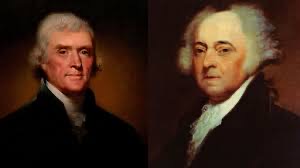
After losing reelection, he left Washington early. Humiliated, angry, and hurt, John Adams boarded a morning coach leaving the Capitol.

The prevailing issue in the campaign of 1800 concerned France, and that nation’s ongoing, and bloody revolution. Moreover, the French had declared war on England, and both belligerents  meddled in American domestic politics to turn public opinion.

As President, Federalist John Adams, had skillfully steered America clear of the European conflict, avoiding the danger of being ensnared between the two superpowers. Proud of his diplomatic accomplishments, Adams still brooded, unhappy with his lack of support from the country. His detractors belittled him, disparaging Adams as a pale substitute to the legendary George Washington.

His political challenger in 1800? The clever and calculating Thomas Jefferson. 

An outspoken critic of the Adams Administration, Jefferson had been hurling plenty of invective toward the sitting President. What had once been a warm friendship between the two men quickly soured. Petulant and  thin-skinned, Adams had lashed out by pushing laws that restricted the free press and cracked down on immigration. Outraged by these policies, Jefferson, and his growing cadre of supporters, challenged the clear violations of the Constitution. 

In only the nation’s third presidential election the moment appeared volatile and uncertain. On one side was the defensive and testy incumbent, and on the other, a political foe intent on replacing him.  

Adding to the turbulence, a political wildcard entered the fray; New Yorker, Aaron Burr.

Burr, like Jefferson, had opposed unpopular and heavy handed Federalist policies, and Jefferson knew the ticket needed an electoral-rich northern state for strength. As party leader, Jefferson assumed Burr understood his lesser place, and only when the electors met did he learned just how wrong he had been. 

In the final tally, poor John Adams not only lost the election, but came in a distant third behind both challengers. Thomas Jefferson garnered 73 Electoral votes, followed by Burr with 73 of his own. Adams came in last with 65. (That tie is another story.)

Humiliated, Adams left Washington DC in a huff, but made no move to challenge the outcome. And though the former President did not greet the President-Elect, and pointedly skipped the inauguration, John Adams did not put his interests above the nation’s. 

He conceded in silence because he valued our country over his own interests. 

There is no precedent for false assertions from the clear loser in 2020.

Gail Chumbley is the author of the two-part memoir, “River of January,” and “River of January: Figure Eight.” Both titles available on Kindle, or at http://www.river-of-january.com.

gailchumbley@gmail.com

Heartfelt Objections

We couldn’t find a seat on the Washington Metro. In truth, we couldn’t see the Metro station, just a mass of humanity.

This gathering challenged the notion of enormous. The moment was historic.

Dumb luck came to our aid. A city bus hissed to a stop at the curb, and my friend and I hopped aboard, joined by a couple hundred of our new best friends. The atmosphere crackled with joy, solidarity and diesel fumes. I nearly busted out with “99 Bottles of Beer on the Wall.”

The driver seemed to catch our enthusiasm and peppered us with questions about the Women’s March. What time, where, how long would it last? She smiled realizing her shift would end before the speakers began, and I still wonder if she made it.

Nearly five hundred thousand of us convened on the National Mall, and expressed our heart-felt objections concerning the newly elected president. We marched as one.

By the way, no one violently attacked the halls of government. Though, if memory serves, I did flip off the Trump Hotel.

In October, 1969, 250,000 opponents of the Vietnam War descended upon Washington DC. In an event called Moratorium Day no one violently attacked the halls of government.

In the swelter of a 1963 Washington summer, Dr King convened the “Poor People’s” March on Washington. 250,000 Americans petitioned their government for a voting rights bill. No one even considered attacking the halls of government.

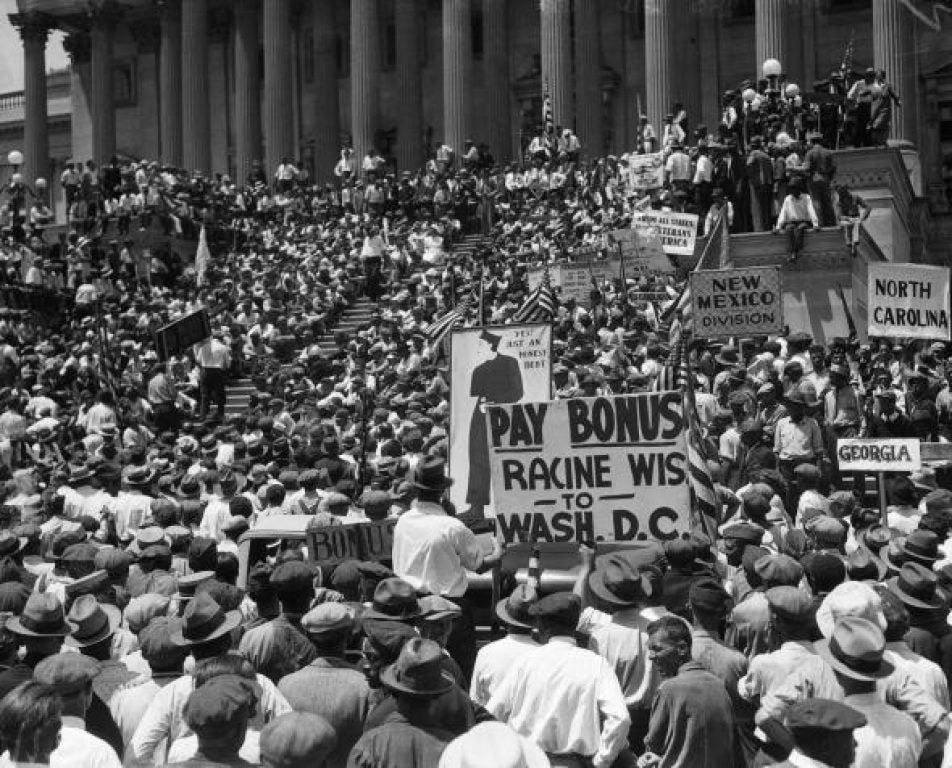
In the Spring and Summer of 1932 during the depth of the Great Depression, somewhere around 20,000 desperate men, some with their families in tow, marched on Washington DC as part of the Depression-era Bonus Army. For their trouble the marchers were attacked by Douglas McArthur, and an army detachment, who instead, burned out the shanties of the desperate. Again, no one attacked the halls of government.

On March 3, 1913, the day before the inauguration of Woodrow Wilson, nearly 10,000 women paraded down Pennsylvania Avenue promoting women’s suffrage. Though they were attacked by angry men along the route, not one woman attacked the halls of government.

Nearly 10,000 American’s joined Jacob Coxey’s Army in May of 1894. An extended economic depression caused mass unemployment, and the “Army,” demanded a public works bill to create jobs. Though the marchers reached the Capitol, and Coxey, himself leaped up the stairs to read his public works bill, the police opened up some heads, and the crowd dissolved. No one entered the Capitol.

Public protest is as American as baseball. The difference lies in our use of free speech. On January 6, 2021 a mindless, misguided, and dangerous mob hijacked the right to assemble, instead escalating into a violent attack on our center of government. There is no middle ground; this was an attempted coup to seize power.

We were correct in 2017, as were those in 1894, 1932, 1963, and 1968. Marchers were seeking “the blessings of liberty” within the rule of law. None of us ignored nor defiled the spirit of protest.

And that sense of heart-felt objection, to that president proved accurate.

Gail Chumbley is the author of the two-part memoir, “River of January,” and “River of January: Figure Eight.” Both titles available on Kindle.

gailchumbley@gmail.com
Rope of Sand

The creed of States’ Rights is all smoke and mirrors; a cover for the selfish interests of local napoleons, and the politicians they bankroll. When claimed as the only answer to the country’s problems, beware, States’ Rights never solved a thing.

Not in America.

Ours is a one of a kind, federal system of concurrent powers. Centralized authority layers and folds, meshing with state and local governments.This dynamic has functioned for over two hundred years and the bonds are subtle and sometimes conflicting. The most lethal confrontation between state and federal powers clashed in the Civil War, 1861-65. But that particular catastrophe was certainly not the first.

During the Revolution, state delegations, in an attempt to unify the embattled nation, drafted a national blueprint called the Articles of Confederation. Attending representatives squabbled endlessly to defend their own local interests, rejecting any language that bound state autonomy. So jealous were the original Thirteen of one another, political leaders dragged ratification out, while barely a step ahead of pursuing Redcoats. The Continental Congress dashed across Pennsylvania, into Maryland, and back, still resistant to real, national authority.

John Dickinson of Delaware, drafted some elements into this fledgling plan, but his model wasn’t helpful. General Washington still had to beg Congress for recruits and soldier pay, and Congress, in turn, had to beg States to fill those needs. One bright note is Congress did agree to dispatch diplomats, like Franklin and Adams, who continued the begging game across the Atlantic.

Meanwhile States such as New Jersey, and Pennsylvania, happily traded with coin-rich Brits, filling their personal coffers, while ignoring the needs of the war effort. The prospects of an American victory grew grim, as each state dug in, defending their own turf. In fact, the Confederation Congress was so toothless, the document itself failed ratification until a month before Yorktown.

Historians often use the term “rope of sand,” to describe the deficiencies and impotence of this early attempt at self governance. Lacking any real prestige, inevitable bloodshed quickly ensued among these thirteen quarreling kingdoms. Navigation rights, interstate trade, and clashes over currency, nearly ended the budding union. At that critical moment Alexander Hamilton and James Madison jointly called for a new convention to “revise” the Articles. Both men, in reality, intended to dump them for a different, stronger plan. Recently retired George Washington agreed with both men, and chaired this new convention, assembling in Philadelphia the summer of 1787, and a determined Constitutional Convention worked hard to remedy many of the new nation’s ills.

This lesson from the past remains relevant. My state, for example could never bear the seasonal costs of road construction, nor of fire fighting. The former administration’s Covid-19 policies have proven, again the futility, and folly of every state scrambling for themselves.

The events of January 6, 2021, and now with the Texas legislature attacking both voting rights, and a woman’s right to choose, similar concerns arise. Is American law no more than a vulnerable rope of sand in the hands of the states?

Fellow Americans, do not buy into the so called advantages of States’ Rights. Hidden interests cloaked in virtuous words distract us from national needs, while the favored few push their political agendas. It’s not an overstatement to say States’ Rights again threatens the good order the Framers labored to establish.

Gail Chumbley is the author of the two-part memoir, “River of January,” and “River of January: Figure Eight.” Both titles available on Kindle or at http://www.river-of-january.com.

gailchumbley@gmail.com

A Burst of Joy

He looked an awful lot like Andrew Jackson. A long, craggy, narrow face, a shock of white brushy hair, and an irascible temperament. That was my paternal grandfather, Kurtz Olson. Despite his throwback, no-nonsense, narrow persona I found him endlessly interesting and somehow quite endearing. 

The youngest of seven children to Swedish immigrants Peter and Matilda Olson, Kurtz was born in Wing River, Minnesota in 1905. Though I don’t know much about his early Minnesota upbringing, I do know that he had a mercurial temperament, no attention span, and restless feet. Grandpa frequently uprooted his family, first moving house to house, then state to state, reaching the Pacific coast.

During the worst of the Depression years Grandpa worked as a welder, and scrap metal dealer. My dad like to remind us that with so many people jobless, Kurtz had lots of work repairing and parting out junked automobiles. One of my favorite snapshots from his early years is Grandpa and another man posing with axle grease below their noses. The two were making sport of Hitler, who in the 1930’s was still viewed as an object of jest. Grandpa Kurtz is smirking, knowing he’s naughty, and thoroughly enjoying himself. 

During the Second World War, he and my grandmother moved the family to Tacoma, Washington. With the “Arsenal of Democracy” in full swing, Kurtz had plenty of metal work on the coast. After 1945, he again uprooted and moved his family to Spokane, Washington, where cheap hydro power had opened plenty of post-war employment. 

Still, Minnesota remained the holy land. Always impulsive, Grandpa would hop in his truck and make sudden pilgrimages home, blowing straight through Montana and North Dakota, usually 24 hours or so to reach the open arms of his Minnesota family.

For Kurtz it was as if traveling from Paris to Versailles, but a hell of lot further. 

Unlike my immediate family, where I was the only girl, Kurtz lived in a decidedly female home. My aunt and grandmother typically sat for hours at the kitchen table, reading the Enquirer and movie magazines while talking shit about nearly everyone else in the family. Poor old Grandpa. Those two women tied that poor man into knots, riling him up with nonsense and fantom outrage.

It wasn’t that my Grandfather was unkind by nature, but he was easy to wind up, perceiving the world in black and white, dictated by those two judges presiding at the kitchen table.

Fortunately, despite those women bad-mouthing me, my brothers and the rest of the extended family he liked me. And I liked him.

In a fleeting, incomplete memory I see him waiting under street lights at the Spokane Greyhound bus depot. We all must have been meeting a relative from Minnesota or Seattle. In a burst of joy I remember shouting “Grandpa,” as I sprinted to him, where he scooped me up into a hug. Another vivid moment I recall was his truck pulling up in front of our house, and Kurtz coming to the door wearing nothing but that smirk, and bright red long johns, with laced Red Wing boots. What a character.

Speaking in a NorthAmerican Scandinavian cadence (yah, you betcha) made some of his comments worth remembering.

“First they call it yam, and then they called it yelly, now they call it pree-serfse.”

And Kurtz always had a dog. There had been Corky, Powder and Puff, Samantha, and Cindy among many others. Samantha was an especially smart Border Collie. After finding herself thrown on the floor of Grandpa’s truck one too many times, she figured out how to brace herself on the dashboard. He would roar up to yellow traffic lights, then stand on the brakes to avoid a red light. My god it was perpetual. My guess is he needed a new clutch about every three months, casualties of his Mr Magoo style of driving. At any rate, Samantha his wise co-pilot learned to watch the traffic lights and prepare for impact. 

Pulling up to his house on some forgotten errand I saw my grandpa splitting wood in the backyard. Across the fence, next door, a neighbor dog set up a ruckus barking my way. I called out, “You be quiet over there,” to which my grandfather observed, “He doessent underschand you. It’s a Cherman Shepard.” Then he laughed, and so did I.

My children didn’t know Kurtz. And for that I’m sorry. They missed a true original. I suppose that is my job, and the job of all of us Boomers to share these kind of stories. We bridge the years between that Depression-era, World War Two generation to our Millennial children and our grandkids. They won’t know if we don’t tell the story. And since it’s December, I’ll sign off with this Kurtz Olson Christmas anecdote.

On Christmas Eve in about 1936-37, my grandpa packed up the family for an evening service at the Lutheran Church. Being good Swedes they had placed traditional candles balanced on the boughs of their live Christmas tree. Somehow in the bustle they left some candles lit. By the time they returned the house was gone replaced by a fully engulfed fire lighting up the night.

They lost everything. In an ironic twist my grandfather the welder somehow overlooked the flames of his yule-tree. That incident remained an inflection point in Olson family lore.

Now he’s long gone, as is my dad and other family members. But through the written word he remains as vivid as his humor, his voice, and his presence in my memory.

Merry Christmas. 

Gail Chumbley is the author of the two-part memoir, “River of January,” and “River of January: Figure Eight” three plays on history topics, and a screenplay based on her books.