Category Archives: Uncategorized
Bridled
A blond nurse in heavy makeup called his name, and my husband dutifully rose, glancing at me to do the same. Delaying for a moment, debating my options, I stood too.
Back in an examination room his radiation doctor, a young, attractive cowgirl, took pictures of his neck–both sides–and displayed a CT scan undeniably bearing a clear tumor profile. There was no mistake, the ENT’s diagnosis was correct–Chad had stage four tonsil cancer and surgery became paramount. This radiation doc announced that she had all ready reserved a date for his tonsillectomy.
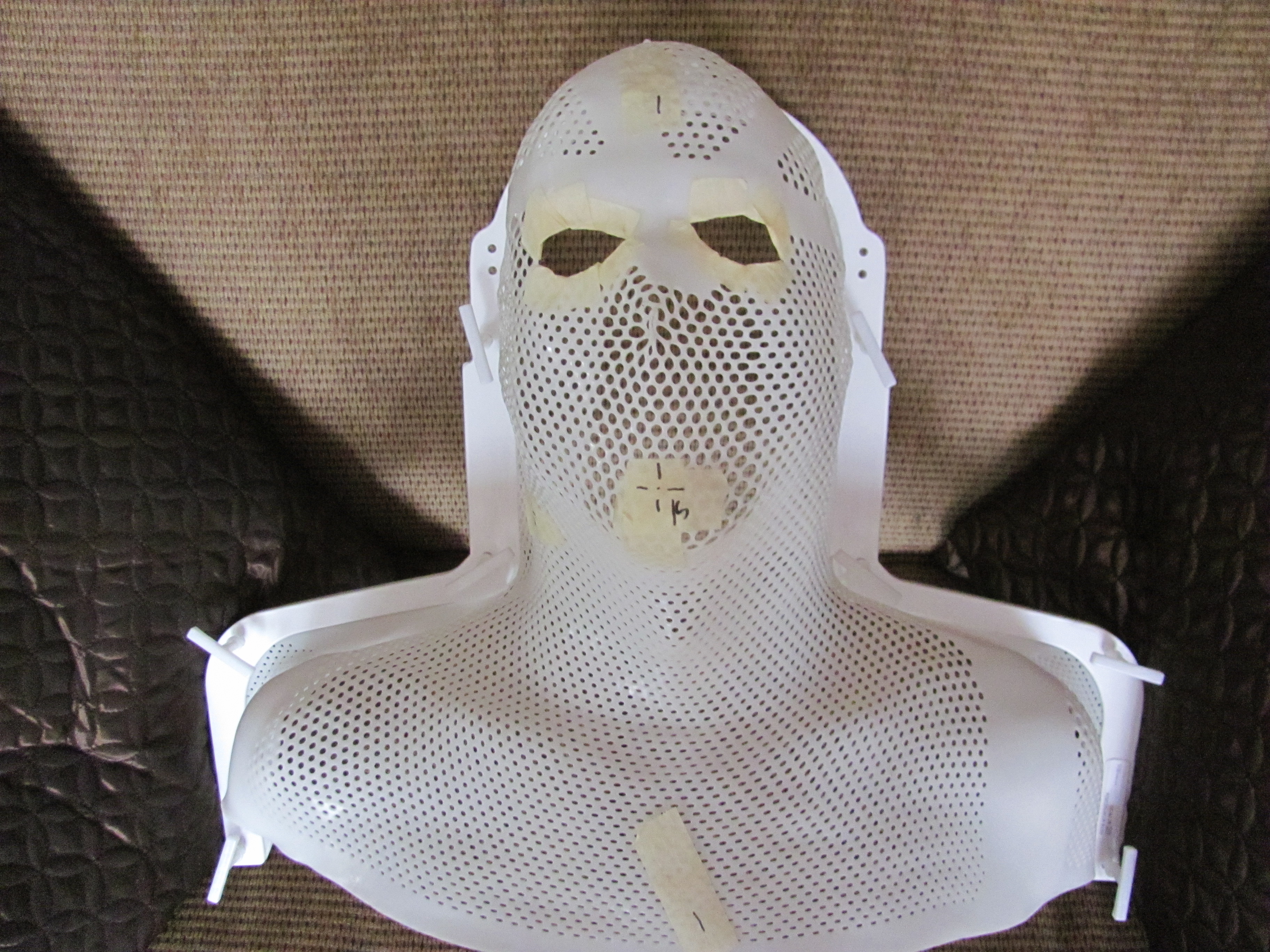
This particular oncologist was a very perky, affirming young physician. Wearing cowboy boots, and a western cut shirt featuring mother-of-pearl snap buttons, she and her assistant in smiling upbeat tones clarified what we could expect from his cancer treatment. She described a restraint mask, gesturing toward his imaged tumor, that she would construct. Using the proper measurement of his jaw line and tumor dimensions, the mask would provide marked targets for the radiation laser. Chad would have to sit for a plaster fitting soon so she could fabricate a precise mold. The radiation would blast any unchecked cancer cells the surgery didn’t remove.
Smiling with her mouth, not with her eyes, the oncologist admitted that neck-throat-esophageal cancer is the worst type on the patient. She elaborated her point explaining that the neck has no thick layers of skin or muscle to protect the esophagus from extensive damage. Elaborating, the doctor continued that as soon as the tonsils were out, Chad would undergo a minor procedure to have a feeding tube placed into his stomach for sustenance. His throat would very likely become too burned to perform a swallowing reflex.
When we arrived home I confessed to him that I didn’t think I had another crisis in me. In my previous marriage there had been nothing but catastrophe–in this marriage we had struggled with a blended family. Just the thought of another calamity paralyzed me from the inside out. I honestly wanted some way to take a pass on this new one. He just hugged me, almost in desperation, saying everything would be all right. I wasn’t assured.
When My Worst is My Best
The tumor institute quickly became far too familiar, an unsolicited home away from home. He’d press the down button on the stainless steel elevator, lowering us into that stark, beige basement–the waiting room. An ordeal. I pretended to be brave.
The smell in the unit was a combination of baby powder and rubbing alcohol, probably from the hand sanitizer dispensers positioned everywhere on those bland beige walls. Fox News blared from a 12 inch television in the corner— while stunned patients and family members stared. Health magazines and pamphlets were scattered on cookie cutter office chairs and faux-wood end tables.
We didn’t belong in this surreal place and neither of us were prepared for what was coming.
Walking phantoms, hairless and fragile, shuffled awkwardly, angular-ly across the nondescript carpet, escorted by unnaturally jolly nurses dressed in flowery scrubs.Patients ambled down one of two passages traversing this subterranean ward. A straight hall toward the right led to the radiation wing while to the left lay the chemotherapy suite.
I might have giggled when I imagined we had entered an episode of the Twilight Zone, encountering wraith-like aliens in a windowless underworld. But there was nothing humorous about this place. People lived or died here, and I somehow grasped that I couldn’t accept this room, with its contrast of sick men and women tended to by a cheer leading squad.
And that marked the beginning of my own hell–a disassociation reflex that formed to shield my mind. I couldn’t process this unexpected, horrifying reality.
For Chad, well, he was just all eyes, trying with all his might to make the hospital and his condition seem smaller, incidental, a bump in the road—but our surroundings betrayed his assurances.
Update
Hey folks,
Sorry I haven’t blogged in a few days. I actually have been involved in two-day writing seminar. Tomorrow is the big day for the next increment for River of January.
In the meantime, I need to ask something of you.
Would you please send your personal email to me at
chumbleg@aol.com
It is a way that I can keep you up-to-date on the final publication day for this epic book.
Thank You for reading along!
Gail Chumbley
chumbleg@aol.com
Take Smaller Bites
Above arid and baking Boise, we found an oasis, a cabin in the cooler mountains. Purchased three years before Chad fell ill, we were looking forward to calling the little place home after I retired. We were both thrilled with the location and he stayed most weeks while I remained in the valley. For me, the place represented my real life. It began Friday night when I drove up, and lasted till Sunday when I had to turn into a teacher again.
But this was the same time when my husband started complaining of a steady sore throat. Unable to ignore the pain, my husband’s doctor referred him to an ENT for more thorough tests. The appointment had been set nearly a month out, which left him with too much time to worry. Hurting and scared, he decided to visit a rural medical clinic near the cabin. Unable to exactly pinpoint the source of his pain, the Physicians Assistant prescribed penicillin for possible strep throat in case the infection was hiding, and that made his wait-time easier. Sometimes I thought it wasn’t in his throat at all, though it was in his head.
Despite my doubts, I made the decision to cook up a storm during the week of Spring Break at the end of March. If he fattened up a little, he’d hopefully feel better.
I think it was the night I made stuffed pork chops that my husband again complained, “I can’t open my mouth wide enough to eat.” Frustrated by his endless fretting, my sympathetic answer consisted of something like “Take smaller bites.” I didn’t think much of his squawking because he hadn’t stopped complaining in over a month. My vote went to a canker sore deep in his throat that needed to heal.
The first part of April brought the long awaited ENT appointment and he drove down to town. I was in class and didn’t hear from him at all that day. Oddly, when I pulled into the driveway after work, Chad was standing on the front porch watching me drive into the garage. Again, I passed it off as nothing. It was a nice day and he is the kind of person that is always dusting up chores to do, so I assumed that was why he was outside.
As I dumped my purse, bag and coffee cup on the table he came into the kitchen not looking any different than usual. Rinsing my cup at the sink I pleasantly asked him how his doctor’s visit had gone, and he looked at me suddenly with an intense expression reflecting shock and disbelief. “I have cancer”. At first I didn’t react, honestly not knowing what I was supposed to say or feel. I stared back, as his eyes filled with tears.
I wish he could have given me the news in smaller bites.
Resemblances
There were pieces missing in what I was watching in Florida—mysteries from an earlier time. The only observable friction I witnessed played out over an air conditioner. When Chum had built the place, he designed it so that the house angled to the southeast in order to catch the cross breezes blowing in from the Atlantic through jalousie windows. In other words, there was no central air-conditioning, just the little window swamp coolers in three rooms: the living room, Chad’s bedroom and Helen’s old room. The old man didn’t like to run these air conditioners because it cost money to pay the higher Florida Power and Light bills. The insufferable heat and humidity didn’t seem to have an effect on him at all. Every morning he donned his long green “old man” pants and a long-sleeved khaki shirt, sweating like mad, yet appeared quite comfortable. What Chum considered frugal was, in Chad’s dictionary, “cheap.”
After our marriage, my husband wanted to remain with me in Idaho. I think it was mostly because he loved me and the West, but part of me believed it probably had something to do with his mixed feelings for his father. I had a good teaching job, and my kids were established in school. Plus, I owned the house we lived in. Back in Florida, Chad had earlier lost his apartment on the 79th Street Causeway to Hurricane Andrew, and then moved home to nurse his mother through her final struggle with emphysema. Chum was there too, with his room in the basement. The two men—Chad and his father—had cared for Helen together, jockeying around her oxygen tanks and tubes, keeping her fed and clean.
My husband had wanted out of Florida for a long time, only waiting for his mother to get better, and his son to graduate from high school. It had long been his dream to live in the mountains and to visit old University of Florida friends now residing in Boise. Eventually his frail mother died, one thing led to another, and we ended up, as I already explained, meeting, and soon married.
Fifteen years later, unconscious, Chad’s life hung in the balance. His back looked arched, his swollen chest protruded upward on a raised, levered hospital bed. Monitoring over his still body, I recognized this was the spot where he would either live or die. I heard no platitudes, no assurances, saw no smiles, or affirming nods from any of the medical staff. There simply was nothing to say.
His father had all ready been gone for a few years, dying on the same kind of medical bed, but in an assisted living facility. Hospice had then kindly ministered to Chum through his last illness, and assured passing. Looking down on my husband’s ravaged body, that first trip to Miami strangely returned to my thoughts, evoking the complex bond between this father and son, who now shared a haunting resemblance.
What had drawn us to that little room with the beeps and lights was the culmination of one distressing appointment after another to a cancer treatment center in Boise. These visits invariably involved copious amounts of prescribed toxic chemicals pumped into his body on a daily basis, and razor-sharp radiation that scorched his throat. Health providers were literally killing Chad to cure him. At least that’s the way it felt.
Missing Pieces
Chad and I met in the fall of 1994. We married the following March in Key West, Florida. I met his family there— his brother, sister, and the patriarch, Mont Chumbley, or simply, as he insisted, “Chum.” Plainly, his father was a well- mannered gentleman, and I liked him at once. Chad’s father seemed so unpretentious, that being around him was easy, with conversation naturally flowing.
When my new husband led me downstairs to his father’s bedroom, the walls were festooned with scores of old-time black and white publicity photos. They all featured the same beautiful girl. It was Chad’s mother, posed in professional glossies. I was immediately taken by her siren-esque good looks. Helen, by any standard was lovely. Her flaxen curls were evenly waved, 1930’s style; her eyes smoky lidded, her lashes accented with mascara. She held a cigarette stylishly between her fingers, as a wisp of smoke, frozen by time swirled upward— a classic Hollywood beauty. The unknown stories behind these photos—stories she could no longer tell, captured my imagination. Movie glossies, ice-skating poses, and the black and whites autographed by fellow entertainers, left me sincerely curious.
Another visible change I noted on this visit was the hostility that my husband began to exhibit toward his father. Gone were all the glowing descriptions of aviation he had shared during our courtship, replaced now by caustic and resentful criticism. How odd, I thought. What did that sweet old man do to alienate his son so severely? More perplexing was the time the two of them spent working on household projects together— all completed in strained silence. If Chad turned off the water to a toilet to begin repairs, his father appeared quietly behind him. They worked without speaking.
The house, perched on the side of a sloping hill, led down to a seawall and a man-made lake called Mirror Lake. Chum had been one of the first to start construction around the water in 1953. Since then, the rest of that square block in Miami Shores had filled in with lake-front homes. A Catholic rectory sat diagonally to the right of the backyard, and rang the Doxology from the bell tower each afternoon, sending a lovely resonance of notes tumbling over the small waves.
Father and son seemed immune to that neighborhood music as they sweated and grunted over the washing machine, the dryer, leaky sinks, or other pending jobs that had waited for Chad’s arrival. All I could hear sitting in the living room was metallic clinks and exhaled profanities.
Later, when my new husband caught up with me by the lake, the first words out of his mouth were, “. . . he’s such an asshole.” Asking for an explanation, Chad only quipped, “He just is.” It left me again wondering what that harmless old man could have possibly done to earn such contempt.
This family presented real mysteries. There existed a clear disconnect between the adventurous stories of flight, and the sparks of resentment. What lay behind the glamorous cheesecake shots of Helen on the basement walls? My mind was was spinning.
Especially crazy was that no one would or in some cases, could answer my questions. I had some sleuthing ahead of me.
Tragedy Under the Radar
A student, Joe, sauntered into my classroom, smacked his books down on his desk, wheeled around and headed back toward the door. Before he crossed the door frame, he looked at me as an afterthought, mentioning, “A plane crashed into the World Trade Center when I left my house.” Taking my cue from his demeanor, I casually replied, “Oh, a small plane? Pilot error?”
“Dunno,” was the boy’s articulate farewell.
With his heads-up as a cue, I turned on the news to find out more on what I thought was a small tragedy. Horribly, the television flashed on at the same time the second jet hit the second tower. And if you are of an age to be aware, that nightmare attack triggered a shower of consequences all Americans continue to debate. The Iraqi invasion, the Afghan invasion, prisoner abuse, civilian murders, airport security measures, the death of Bin Laden, and now the arguments over Syrian intervention.
Another kind of tragedy, private tragedy, is a central theme in my book, River of January.” Silently, out of the sight of others, consequences tentacled out into the future from a series of tragedies beginning around 1900. The losses of a lone, little girl shaped the lives of others until, well, now.
That little girl, who readers meet as an adult in the book, suffered the tragedy of her mother’s early death, her father, no more than a stranger living in Kentucky, and later, her husband’s sudden death in Queens, New York in 1925. From her tragedies, the now, grown woman believed that those she loved, she lost. And that core belief held dire consequences for her two children, particularly the youngest daughter.
This sad life, heavy with suffering from crushing, dramatic losses, bore strange fruit in the woman’s inability allow her children their own lives. Her youngest daughter was not permitted any self-agency in her profession or any personal life. As a mother, the lost little girl demanded to be the center of her children’s world, and she was the gate-keeper of their lives. She couldn’t comprehend sharing her family with outsiders, especially the young man who came to marry the youngest.
A tragedy under the radar.