chumbleg.blog/2020/12/02/a-burst-of-joy/
Merry Christmas
chumbleg.blog/2020/12/02/a-burst-of-joy/
Merry Christmas
He proclaimed “it’s morning in America,” in a political commercial reassuring citizens the country’s best days still lay ahead. Responding to four gloomy years of oil shortages and the American hostage taking in Iran, the nation, in 1980, enthusiastically turned from Jimmy Carter’s malaise to genial Ronald Reagan’s magnetic smile.
Reagan had campaigned hard against what he viewed as an intrusive and bloated Federal bureaucracy. After his landslide victory in November of that year, President Reagan, repeated that theme in his inaugural address remarking, “it is no coincidence that our present troubles . . .are from . . .the growth of government.” The new president added that “government is not the solution to our problems, government is the problem.” Conservatives and Blue Dog Democrats were giddy to see federal entitlement programs cut, or at least significantly pared down.
In the spirit of shrinking domestic spending, the Reagan Administration shepherded Congressional bills to cut services to poor and disabled Americans. Federal education programs went under the ax, as well as reductions of Medicaid, and Social Security. These entitlements suffered steep cuts by restricting eligibility, and removing many from the federal rolls.
Mr. Reagan operated under the theory of “trickle down economics,” a belief that tax cuts for the rich would naturally benefit lower income brackets. New economic opportunities would emerge as reinvested wealth would find its way to employing the lower classes. Also known as “supply-side” economics, Reagan proceeded to slash not only taxes on the rich, but also loosened federal regulations on businesses, environmental protection, and opening federal lands to private interests.
As Reagan’s personal hero, Calvin Coolidge, once stated, “the business of America is business.” And this President catered to business.
However cut and slash as he might, the anticipated economic outcomes didn’t quite pan out. Though social programs saw budgets diminished, military spending at the same time spiked, diverted to high ticket stealth technology development, and the fated Strategic Defense Initiative. The rich did become richer, but no benefit managed to trickle down.
With relaxed oversight the New York Stock Exchange finally crashed in 1987 through eased SEC regulations, and a myriad of shady practices that benefitted Wall Street insiders. One of the more egregious examples of this malfeasance concerned the Savings and Loan fiasco of 1986.
And the real cost for Americans? Middle class taxes bailed out insolvent, shady S&L’s, while at the same time reduced social programs inflicted real hardship upon the least among us. Congressional passage of the Mental Health Systems Act of 1981 was one such law. This bill mirrored one implemented earlier in California when Reagan served as governor of that state. The law essentially “streeted” mental health patients residing in psychiatric hospitals across the country. That type of direct care was not within the provenance of government support.
In explanation, the Reagan Administration argued that newer and better psychotropic drugs would offset the need for in-patient treatment, and those who still needed in-patient mental health care could be looked after by local communities and families.
However, that assumption never worked out as local communities and families did not, or could, not step up.
Today we see the fallout of the Mental Health Systems Act in real time. Among the homeless are those hardest hit by financial trouble, both the mentally ill, and the dispossessed. The victims collect throughout urban areas, housed in tent encampments, huddled under bridges, seeking refuge in hospital emergency rooms, or public buildings, or sleeping in parks and alleys. Many are veterans, addicts, and untreated victims of assorted psychiatric disorders.
Left uncomfortable and angry, America doesn’t seem able to understand how this massive uptick in homeless populations exploded across the nation.
In the richest country in the world citizens seem unable and/or unwilling to demand our political leaders find solutions. No one seems keen to fight the disdain, and stigma of permitting homeless shelters anywhere, particularly near residential areas. The failure is visible in every urban area in the nation. And if there is anyone to blame for this slow-motion humanitarian disaster, look no further than the so-called “Reagan Revolution.”
The kicker is that the Reagan Administration did not save a cent despite entitlement cuts. Instead of reducing expenditures the federal deficit tripled from $930 billion in 1981 to $2.8 trillion by 1989.
So much for theories.
Gail Chumbley is the author of the two-part memoir, “River of January,” and “River of January: Figure Eight.” Both titles are available on Kindle. Chumbley also has written three historical plays: “Clay” exploring the life of Senator Henry Clay, “Wolf By The Ears” a study of American slavery and racism, and Peer Review, a fanciful piece where 47 converses with past presidents.
gailchumbley@ymail.com
chumbleg.blog/2022/05/25/the-little-things/
Reblog from May before the overturn of Roe.
#VoteBlue2022
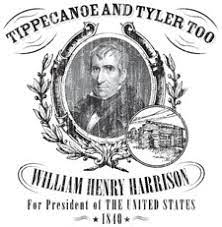
This was the situation in April, 1841. Newly inaugurated president, William Henry Harrison died after only a month in office. The 68-year-old Harrison apparently succumbed to pneumonia after delivering an exceptionally long inaugural address in foul weather. Harrison, the first Whig to win the presidency, was also the first chief executive to die in office, and the Constitutional protocol of succession had never before been exercised.
Harrison’s Vice President, John Tyler, moved quickly upon learning of the President’s demise. He located a judge to administer the oath of office, and moved into the Presidential Mansion (White House). When members of Harrison’s cabinet informed Tyler they would take care of the daily business of governing, he cooly responded that they could either cooperate, or resign.
Tyler had been an odd choice for Vice President. The Whig Party had gelled during the Jackson administration, proposing financial and internal developments over sectionalism and states rights. The Whigs further found slavery not only inconsistent with liberty, but also an obstacle to the growth of a modern economy.
Foremost among the Whigs was the Party’s greatest voice, Senator Henry Clay of Kentucky. Clay had first been a presidential candidate in 1824, and again in 1836. However, in 1840 when the Whigs met in Harrisburg, PA to nominate their candidate, Clay failed to gain the top spot, and then declined the offer of the vice-presidency. Clay later regretted his momentary pique.
Though John Tyler had been a Virginia Democrat, he had publicly broken with Andrew Jackson over Jackson’s misuse of presidential power. In particular, Tyler objected to Jackson’s threats against South Carolina in the Nullification Crisis, leading Tyler to forsake the Democrats, but not the philosophy of states’ rights, or the institution of slavery.
The Whigs decided that Tyler’s opposition to Jackson was good enough to offer him the second spot on the Whig ticket, and Tyler accepted. Then a month into his term, Harrison died, and this Southern Democrat, a wall-to-wall sectionalist assumed the presidency.
From there, Whig policies quickly unraveled.
If the Whig’s aimed to realize their platform of national economic growth, their hopes died under President Tyler’s veto pen. Predictably, the Whig cabinet soon grew frustrated, then disgusted with presidential obstruction. Members began to resign. Only Secretary of State Daniel Webster hung on, as he was in the middle of Canadian boundary discussions with the British. Then he, too, submitted his resignation. Shortly after the cabinet fled, the Whigs formally expelled Tyler from the party.
To their credit the Whig leadership didn’t excuse Tyler, or defend his contrary actions. No one said ‘let Tyler be Tyler.’ They publicly broke and denounced the President’s antics, though the cost, for the Whigs, came due ten years later when they disbanded.
Yet, the story doesn’t end with the demise of the Whigs, but begins anew with a stronger and more principled political movement. For from the ashes came the birth of the Republican Party, much like a rising phoenix.
But today that party has soured. No longer guided by principle the GOP has submerged their once decent name in the cesspool that is Trumpism.
*This post appeared in 2019. And now, in 2022, the GOP has formally forsaken all that was decent in the Republican Party. They now publicly support a coup attempt through silence and excuses, abandoning leadership of their party to propagandized fanatics.
Gail Chumbley is the author of the two-part memoir, “River of January,” and “River of January:Figure Eight,” “Clay,” a play chronicling the life of Senator Henry Clay, followed by another, “Wolf By The Ears,” a study of racism and slavery. “Peer Review” is her third work imagining 47 meeting four earlier presidents, and a screenplay, “Dancing on Air” based on her books.
gailchumbley@ymail
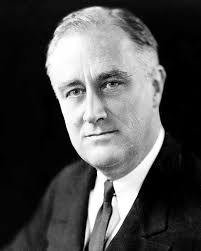
Poking around the basement in my mom’s house I unearthed a framed black and white portrait of Franklin Delano Roosevelt. The picture had been in a stack with other effects from one set of grandparents or the other. Certain this pic would probably end up in a dumpster, I packed it in my suitcase and brought it home. Our 32nd President is on display among other WWII pieces I’ve collected over the years.
What was it about Roosevelt and his times, that earned him premier wall space during the Depression and war years? Today the idea of commemorating a political leader with a wall display seems odd and quaint.
So again, why did my grandparents include FDR in their home decor?
Admiration may be one reason. FDR appeared bigger than life. The man seemed to have it all: looks, money, and a pedigree that stemmed back to the early Dutch in America. His distant cousin, who also acted as his uncle-in-law, Theodore Roosevelt, still loomed large in American memory. That Franklin Roosevelt wished to carry on the tradition, especially in a time of economic collapse felt assuring.
The laissez faire policies of previous Republican administrations made for widespread fraud, especially on Wall Street. The 1920’s had been a heady time of speculation on the Dow, with banks making reckless loans on high risk investments. When the frenzy crashed and burned in October of 1929, the sitting Republican President, Herbert Hoover, suffered all the blame.
That fact raises another strength of President Roosevelt. The public trusted him. While autocracies generated “cults of personality,” Stalin, Mussolini, and Hitler, this candidate earned his office promising America a “New Deal.” He assured the country that they had not failed, the system had forsaken them, and as their new President he meant to correct those abuses.
The choice to hang Roosevelt’s portrait came from genuine respect, not fear or blind partisanship. The people elected FDR because he meant to be of use to all the American people.
This President brought energy and purpose to the Executive Branch reaching Americans personally in their daily lives. New Deal legislation quickly translated into action with legions of new programs all designed to get folks working again. The public felt a connection to the White House that perhaps hadn’t existed before that time. Mail arrived in daily landslides, mirroring FDR’s earlier political victory. Most letters requested a “hand up,” not a hand out, and that any financial help would be repaid to the government. R.E.P.A.I.D!
FDR brought electricity to rural America, lighting the night and powering radios that broadcast his Fireside Chats. Bridges, schools, and other large engineering projects connected the nation as never before. It’s a sure thing your town or city still bears an imprint of FDR’s time in office.
So it is with respect and gratitude that I have placed Franklin Delano Roosevelt on my living room wall. He set the bar for what a Chief Executive ought to be.
And after all, it’s a family tradition.
Gail Chumbley is the author of the two-part memoir, “River of January,” and “River of January: Figure Eight.” Both titles are available on Kindle. Chumbley has also authored three historical plays: “Clay” on the life of Senator Henry Clay, and “Wolf By The Ears,” concerning the evolution of racism and slavery in America, and Peer Review, where four long ago presidents speak with 47.
gailchumbley@gmail.com
chumbleg.blog/2022/06/24/a-different-code/
#SecondClassCitizens #OverTurningRoe
In the fall of 1789 recently inaugurated President, George Washington called for a National day of Thanksgiving. Under the previous frame of government, the unworkable Articles of Confederation, such proclamations had customarily been sent to the governors of each state. However, Washington abandoned that practice. As the first US President, Washington instead issued the proclamation to the American People.
This President deliberately bypassed state governments.
The new Constitution, practically wet with ink, had been intentionally addressed to “We The People,” and Washington aimed through his administration to join every citizen, regardless of state, to the national government. This proclamation, seemingly banal, clearly signaled a dramatic reset of power in the new Republic.
Two years prior, in Philadelphia, the framers turned attention to composing a Preamble, otherwise understood as a mission statement. Preambles were not unusual, each state government began with them, but in that hot, humid chamber of Constitution Hall work commenced to define America’s mission. Gouverneur Morris, a delegate from New York, most probably authored the statement, and it was Morris who set out the language.
We the people of the United States, in order to form a more perfect union, establish justice, insure domestic tranquility, provide for the common defense, promote the general welfare, and secure the blessings of liberty to ourselves and our posterity, do ordain and establish this Constitution for the United States of America.
The heart of these guiding principles begin with the phrase “The People,” followed by the active verb, “To Form.”
The Preamble rests upon this infinitive clause, implying America is a work in constant progress. This mission is a founding legacy fixed upon enduring bedrock.
Susan B Anthony sought justice voting in the Election of 1872. Arrested for casting her ballot, Anthony faced a Federal judge, and received a verdict of guilty. The 19th Amendment, ratified nearly fifty years later extended the vote to women. Hounded by settlers from the 17th Century onward, Native Americans sought survival and the tranquility to peacefully co-exist with whites. It’s ironic that indigenous Americans were not citizens until 1924.The United States in 1860, teetered on a knife point of dissolution. President, Abraham Lincoln, could not stand by and watch democracy die under the threat of secession. Preparing for the common defense Lincoln mobilized northern forces to defend the Union. From Jane Addam’s Hull House, a Chicago settlement center for immigrants, promoting the general welfare, to Dred Scott, and Homer Plessy’s struggle to reap the blessings of liberty, each generation stood tall in their historic moments.
To honor the principles of the document, and as heirs of Constitutional law, our charge, like those before, is weightier than our private comfort. We The People have no choice but to continue Gouverneur Morris, and President Washington’s wishes To Form A More Perfect Union.
Modern America’s mini tyrants must not prevail. Make your voice heard at the ballot box on Tuesday, November 8, 2022.
Gail Chumbley is the author of the two-part memoir, “River of January,” and “River of January: Figure Eight.” Both titles are available on Kindle. Chumbley has written two historical plays, “Clay” regarding the life of Senator Henry Clay, and “Wolf By The Ears,” an exploring the roots of slavery and racism.
Nothing short of brilliant, Dale Olson could expound on almost any topic. His knowledge of sports, history, and literature rendered him as a true Renaissance man. He also loved the Simpsons.
Dale Curtis Olson joined the planet on February 10, 1954.
Born and raised in Spokane he attended public schools and graduated from Joel E. Ferris in 1972. A graduate of the University of Washington in History and Political Science, he pursued jobs that carried him around the globe. With positions from Antarctica and to Johnson Island, Dale found the world his finishing school. He did not simply tour destinations, Dale relished them, as food for his soul.
His children were his books, and those surrounded him. Still news of his grandnephews and niece arrived welcome to his home.
Throughout Dale’s long trials with illness he persevered, aided in large part by our brother David. Our gratitude is heartfelt.
Dale was predeceased by our father, David E. Olson, and survived by our mother, Rita Olson. Also his sister Gail Chumbley(Chad) of Garden Valley, Idaho, brothers Stephen (Elizabeth), and David Olson of Spokane. He is remembered by all his nieces and nephews residing from Spokane to Portland, to Salt Lake City.
We will have no service, and in lieu of flowers donations to American Battlefield Trust, https://www.battlefields.org are suggested.
Oh to live on Sugar Mountain
With the barkers and the colored balloons
You can’t be twenty on Sugar Mountain
Though you’re thank that you are leaving there too soon.
Neil Young