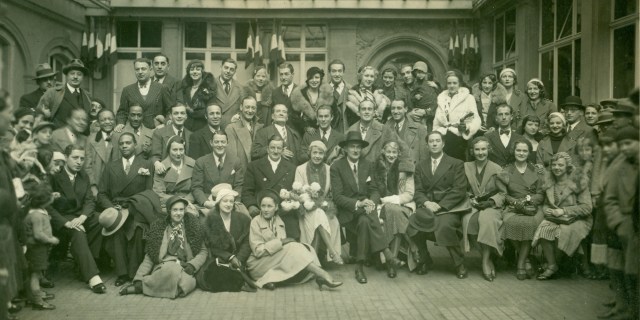
Mistinguett is front center. Helen is in the back wearing the light color fur collar. But look to the left middle.
Today’s mystery question–who are those two African-American gentlemen sitting together?
Mistinguett is front center. Helen is in the back wearing the light color fur collar. But look to the left middle.
Today’s mystery question–who are those two African-American gentlemen sitting together?

This just in. My first reviewer LIKED my book!

The book’s progress is coming along. At this writing, we are looking at the end of March for publication. Cross your fingers. There are details still dangling such as a book cover, interior design, inserting pictures and printing hard copies. I’m not sure about Kindle or Amazon ebooks, but my publisher seems to think those options are do-able.
Marketing seems to be the real work. Any of you that have published in the past are most likely aware of the immensity of the task. I would love to hear from readers of any venue, mom and pop bookstores, reading groups, service groups, or any organization that would enjoy a book talk. I am open to suggestions and compiling a list of likely outlets.
I live near Boise and can drive to most locations in the Pacific Northwest. For other locations some planning would be necessary, and books shipped ahead.
I believe in River of January. The story did not fall into my lap by accident and I have nothing but respectful awe for my protagonists, Helen and Chum. Their story deserves to be told. It must be told. They did things in their lives I’m not sure can be repeated today. In the earliest days of show business and aviation one needed heart and guts, not a masters degree. Added to the tale is the compelling story of America during 20th century, a hundred years of growth, change and world leadership.
I thank you for sticking to the blog all these months, and the kind support you have extended.
This writer is open to (nice) suggestions.

It is very easy to look out on a classroom and see average kids, gridded in average desks. The first day of school felt as if I was corralling colts to lock up in a pen. Students were all the same–feisty, noisy, exuberant, in need of order and compliance. That was the initial view from the front of the room.
Yet, over the next days, weeks and months their little eggs cracked, and conformity ceased. Each individual emerged through comments, reactions, and casual conversation. In the place of the “American Teenager,” sprouted pretty cool people. Through the course of many years I became acquainted with nationally ranked athletes, cancer survivors, opera singers, bowling proteges, dancers, and kids who’d been cast in feature films. From generic outward appearances sprang unique and captivating individuals.
What separates the ordinary from the singular? In reality is it a shortsightedness I placed upon myself at the start of the year? I saw rows and columns instead of the garden blooming before me. It fell upon the kids to show me who they were, whether in outright admission or inadvertent comments. Do we all suffer from blind first impressions?
I came to understand that my two major characters in River of January worked hard to rise from the ordinary.
For Chum, his progress was the product of driven, conscientious mastery. He flew so often, so much, that life on the ground wasn’t nearly as satisfying! In Helen’s case she not only adored dance and studied hard, but had her mother at her side pushing from childhood.
There were reverses in their efforts. Chum’s father refused to see the boy’s uniqueness, refused to recognize the son was meant for something more than steering a plow. Helen’s willful mother was a source of such external pressure it spilled over into her life off the stage.
Both figures reached enormous heights in their respective pursuits. Chum’s air race proved to the aviation world that he had indeed arrived, and Helen’s professional career took her across three continents.
The central reason I wrote this book was to share two exceptionally eventful lives. Sifting through the volumes and volumes of their records it became clear these were no ordinary people. Helen and Chum were unusually accomplished . The better I came to know them through the things they left behind, the more impressed I became. These two deserve to be remembered. They raised the bar of living life to extraordinary levels.
And I don’t want them to be forgotten.
It was the night of February 9, 1964, a Sunday, when my older brother and I had to make a crucial decision. We were both over stimulated, frantic, not one of our four feet remaining long on the floor. The house vibrated with our excitement and the weight of our impossible dilemma. For starters our birthday was the following day–the 10th, (though we’re not twins–he’s a year older). Still, that pre-birthday fuse had already ignited and by the 9th the two of us were banking off the walls.
The quandary we faced that Sunday night was whether to watch “Davy Crockett at the Alamo,” starring Fess Parker on Disney (The Alamo!), or the Beatles on Ed Sullivan. This was that first historic Beatles broadcast, live on American television, and we agonized between the two choices.
In 1964 there were no video players, no DVD players, no home computers, or dvr’s, in fact televisions were the size of Volkswagen’s and transmitted in glorious, flickering black and white. This difficult decision counted because there was no rewind, there were no do-overs. One gain meant one loss.
We liked Davy Crockett an awful lot. We had watched all the previous episodes, and Davy biting the dust in San Antonio was the much anticipated grand finale. But, oh, the Beatles! And the adoration was real, palpable, an injection of adrenaline without the needle. We worshiped at the warmth of our bedroom radios, perpetually tuned in to our local AM radio station. Reverent silence accompanied replays of “She Loves You,” and “I Want To Hold Your Hand.”
What could two grade schoolers, sick with anticipation do with such a weighty conundrum? It was 1964 and we had to choose.
Before the proliferation of electronic media, this little girl of the 1960’s viewed momentous events as they beamed across the screen. MLK’s elocution at the Lincoln Memorial, President Kennedy’s inaugural address, his assassination, and the escalating war in Southeast Asia–all experienced as reported at that moment.
In an earlier era, when Chum flew in his air race, and Helen danced in Rio at the Copacabana, there were no camcorders or Iphones. His signature landing and Helen’s near disastrous opening night grew silent as the applause subsided, then faded in time. Much like my brother and myself in 1964, they lived life forward, one opportunity at a time.
Silent photos and written records are all that remain verifying Chum’s aerial dash through darkened skies, and Helen’s energetic dance routines. They lived life forward, embracing events as they unfolded–experienced once, then gone. I would love to see footage of Chum’s Waco airplane lifting off at dusk, or watch Helen spring across the stage. But those wishes are pipe dreams, never to happen. No vintage film or recording, (except one I found by accident) exist in the historic record. The best I can do for myself, and for readers, is try to recreate the magic of the first time around in the pages of my River of January.
Oh, by the way, I’ve never seen “Davy Crockett at the Alamo.”
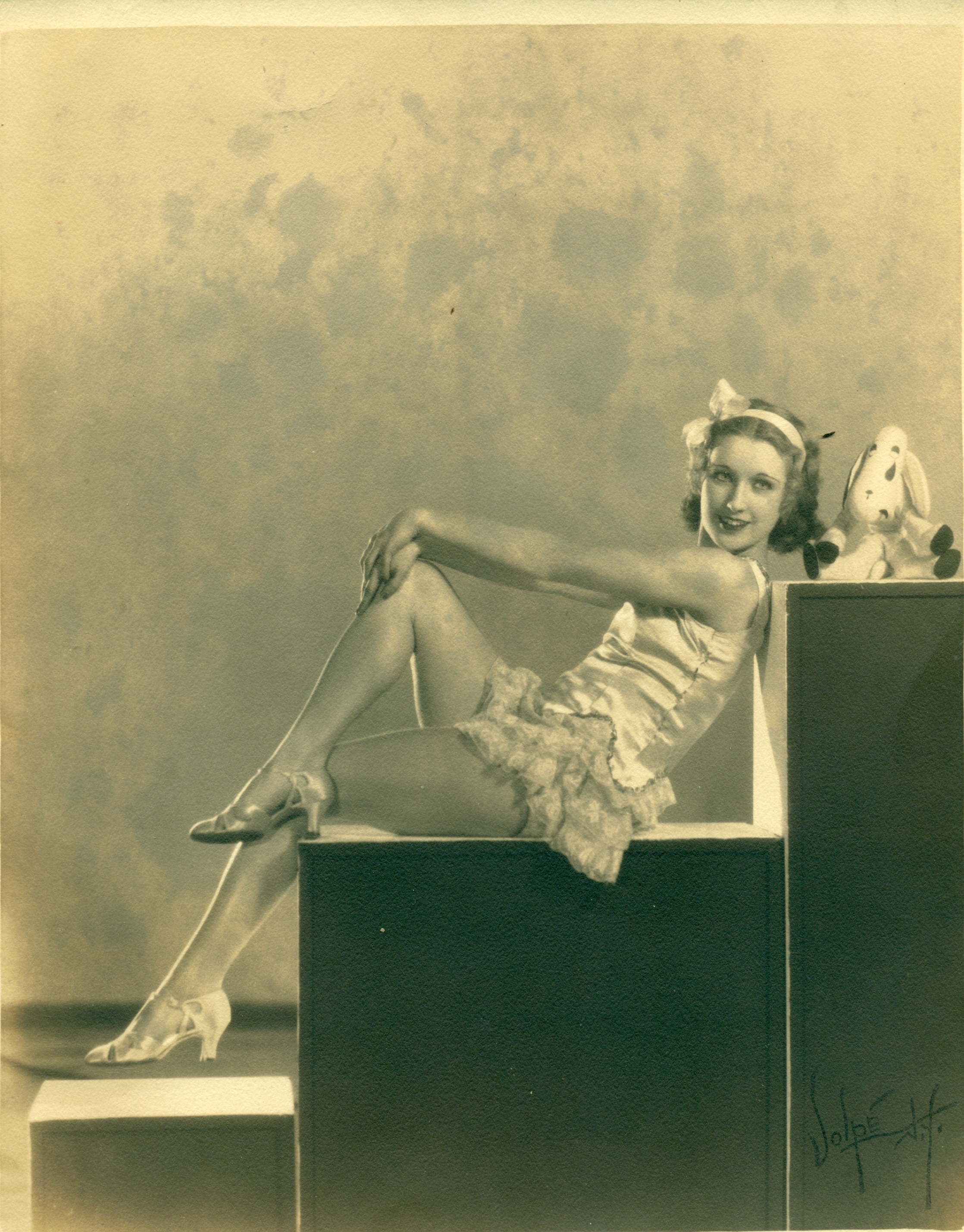 Gail Chumbley is the author of the memoir, River of January. Also available on Kindle.
I recall a quote, used everywhere it seems, that January is the Sunday month of the year. Where we live the weather becomes more gray than sunny, and the snow isn’t quite as exciting or welcome as in December. This is a tough month for disappointment, too. Shoulders girded, body braced, we of the upper latitudes plow forward to survive the dismal weeks of January. The last thing any of us need is outside disappointments or frustrations.
I was married. I was. Not the other person. And I had two little children. It was January, and he had overdrawn our bank account once again. I didn’t realize that as fast as I wrote checks for bills he went to the bank and took out the cash. Checks bounced. We had overdrafts and poverty. And my little boy had a birthday coming up, and this man, who was supposed to be a responsible father had spent all our money.
I tried to sew up a little pair of brown pants made of corduroy but they turned out to be too short. I had some remnants left and had to turn the fabric the opposite direction to lengthen and make wearable his little birthday present. That was all I had to give him that year. It was a painful and memorable January.
Much has changed since then, life is stable, the ex-husband a bad memory and that little boy is turning 30 with plenty of clothes.
I didn’t share this tale to illicit a pity-party. Part of my motivation is that it is indeed January, and my boy is indeed turning 30. The other reason is how unwelcome impediments, and other barriers crop up constantly. And they appear at the worst times, times when we feel we can’t handle another disaster. And it feels to me that the first of the year is the toughest time to cope with problems and losses.
In terms of my book title, River of January, remember the name is translated from the Portuguese Rio de Janiero. That was the place Chum met Helen, and where they subsequently fell in love. As I write, I see that the high today in Rio will be 91 degrees. I wonder, are problems easier to handle when January is a summer month?
Could I have kept my little boy in shorter pants?
Writing isn’t a skill that comes naturally to me. And I know what good writing looks like when I read it. I have had students who were naturals, fashioning well constructed sentences, laced with alluring imagery. I have friends who make words sing, in fact some have earned their living producing written words for money. Many teaching colleagues who literally drip poetry were my neighbors in nearby classrooms. Not me. Not this kid. When this story, River of January, fell into my lap I didn’t know where to turn. The idea of me writing a book was laughable, astonishing, the last thing an old girl like me would take on.
I tried to outsource the effort at first. I beat the bushes to get help from a number of people. who would essentially write it for me. You know those friends. The one’s who would love to put their lives on hold to unravel my convoluted sentences. And in fairness, some individuals actually did that for me, I am deeply grateful and indebted to them.
Still, sitting down at the keyboard, I know what it is I want to say. I know there is passion, anguish, ethereal joy. But my brain flushes, just like a toilet. The harder I push, the more words elude me. It’s as though English becomes somehow unintelligible, and foreign. I thumb through Roget’s, scan Webster’s, and finally have to walk away leaving my mental firewall to soften up.
Much later, while making my bed, eating red licorice, or watching “The Fatal Attraction of Adolf Hitler” on the Military Channel the words form in my mind, elegantly phrased. Then look out, I’ve got to jot them down before they evaporate, never to reappear.
I figure this writing business is a lot like golf, not that I play golf, mind you. But my husband does. He’ll come home from eighteen holes and it’s easy to see how his day passed. I get a tapping Fred Astair through the front door when the links played well, or he stomps in cussing, fit to be tied with frustration.
Can any of us control the flow of magic when it visits? Can any of us make magic appear at will? I can’t. That neuron synapse-ed mess I call my brain does not tolerate fools. It shuts tight when I squeeze too hard. And we have words, my brain and I, when the disconnect seals off from my head to my fingers.
To finish this bathroom-themed post, I must return to the natural. Writing isn’t easy to fake. I can push and bargain and swear, but the fluency of truth, of an honest phrase or an essential certainty is a gift of grace, not a product of stress. When I am anchored to my spirit, not my head, the magic has half a chance.
In my dating days I employed the habit of acting the way my dates expected. There I said it. I submerged my identity for a guy. Now if you are reading this post thinking “what a bimbo,” take a moment to recall your own dating history. We lose weight, we drink less, we put makeup on for an evening of television, we attempt to be funny and charming–we wear a mask. You know, the Bridget Jones school of dating.
I’m not absolute about this, but I think Helen always remained Helen in her single years. Back reading for River of January I got the sense that she didn’t play any coquettish games to land an evening out. My observation of this girl was that men saw what they wanted in her, attached their own sense of who she was. And their frustration trying to put a ring on her finger stemmed from a deep misunderstanding of Helen Thompson.
Aside from the reality that her mother called the shots in Helen’s life, three men attempted to win her heart, and take her for their own. And I suppose we could start by looking first at the last, Mont Chumbley.
The young pilot became infatuated with Helen nearly from the first time he laid eyes on her. Those spotlights hitting the stage, in hues of blue, pink, yellow, and white can intensify an already dazzling girl. Once he decided he loved her, he posted himself every night at the club until her contract ended. If any drunk (or sober) patron made advances, Chum intervened assuring her safety. And that is how he saw himself, her protector until she could leave show business. It never seemed to occur to him that she loved performing and had no intentions of giving up her art. That caused big problems later.
Her middle admirer, the boy who courted her the longest, across continents, was Elie Galeki. Now Elie was a person who lived life systematically and deliberately. He worked hard to establish his own photography business, caring for his mother and sisters in Brussels. His suits were pressed, his appointment book organized, his expectations orderly. However, with Helen he had his hands full. To is way of thinking, once he met “the one” she would naturally love him back, and they would marry. Elie, too, expected Helen would give up the stage and settle down as his dutiful wife. That wasn’t actually Helen’s style, and she knew he wasn’t the right guy.
Her earliest boyfriend, and vaudeville partner, Grant Garrett, was an entirely different sort of character. He was a comedy writer, dancer, and singer, and Helen did respond to his charms. Grant was ready with a zinger, usually targeted at Helen’s intransigent mother. He was smooth in style and rough in attitude. He liked to fight for money around bonfires in hobo camps, and he drank hard. Of all three blokes, he may have been temperamentally the best suited to Helen. He treated her as an equal, and understood her drive and ambition for the stage. She was a professional, and so was Grant. They shared their love of performing.
I don’t believe Helen submerged her personality for any of these three suitors. But Grant was the one her understood her the best. Mostly they saw what they wanted in her beauty, grace, and bubbly sense of fun. I suppose that if any of these gentlemen became frustrated with the girl, they only had their illusions to blame.
This is a clip of Bing Crosby singing the song that inspired the title of my book, River of January. Try to stay warm!

My parents kept a beige wall phone when I was growing up. The ring could wake the dead. Both sides of grandparents settled for basic black, one a desk phone the other fixed to their kitchen wall. If my paternal grandparents were expecting a long distance call we all waited in the living room, reverently, as though it was God calling. And God help you if you made any noise while my grandmother was on that phone, conversing with her relatives back in Minnesota. Those calls were an almost holy occasion.
Their phone exchange was Fairfax, ours, on the other side of town, was Keystone. My husband remembers their phone exchange began with Plaza, and his mother, Helen, growing up, used the famous prefix, Murray Hill in New York City. I think that’s the same one actress, Barbara Stanwick requests in one of her old movies.
It is my understanding that many rural Americans had a phone installed before even electricity was available in vast tracts of the country. My Minnesota relatives, for example, didn’t have an indoor toilet until the early 1960’s, yet had that telephone on a doily covered end table as early as the 1920’s. Chum recalled that their phone on the farm had a different ring for each home connected along a party line. He remembered that the different rings didn’t matter because everyone eavesdropped on everyone else.
Operators, or “hello girls,” as they were known, plugged connections on regional calls offering choices for long distance service. There was “Station to Station,” which meant you talked to anyone at the number dialed. Then came “Person to Person,” where you hailed a specific individual. I remember dialing collect calls, which were long distance too, connected through a live operator, costing my parents a bundle if they accepted. And they always accepted.
The telephone of yore was a mysterious device. The phone company, AT&T held a monopoly and innovated very slowly. I recall when the clockwise dial was replaced by gray push buttons. Then there was the desk phone offered in green and red, as well as black and beige. I vaguely remember “Ma-Bell,” as we irreverently referred to the company, marketing blue, white and pink “Princess Phones,”. Geez, how sexist.
But what telephones held then, which is gone now, was a sense of mystery. When that device rang it was a crap shoot who waited on the other end. We could only call on land lines, and if no one answered there was no evidence of our call. If that certain someone called me, and I missed it, well, I missed it. We had no call waiting, no answering machines, and certainly no ‘missed call’ record.
And long distance calls were fashionable and expensive, folks largely opting to stay in touch through less expensive letters. While Helen toured Europe from 1932-33, she had no cause to use a telephone. If Elie wrote to her and scheduled a call, she would take it at the prescribed time at her hotel. But calling her mother back in the states was never an option.
Public phones could be found on nearly every city block as I grew up. Now they are as scarce as manual typewriters. Formality, phone etiquette, the necessity of saying hello to mother’s or father’s who picked up, are all gone. I would sit in the stairway of our house for some telephone privacy, because my family was everywhere, my brothers especially snoopy and irritating. Even that modicum of supervision is gone for teenagers. They can call, text, Facetime, use Facebook, stay connected all day everyday.
Perhaps the extra effort required for telephone calls gave them a higher value. Our capacity for electronic interaction is nearly effortless today, but also somehow has cheapened a once-regarded gesture.
 Gail Chumbley