What Are You Waiting For?

I began a routine of driving home from school, entering the house, saying hello to my mother, and crawling into bed with Chad for a nap.  As he lay recovering physically, I needed to begin a recovery of my own, in my mind and spirit.  I had been diagnosed with PTSD, post traumatic stress disorder.  And I felt disordered.  I had order in my schedule, in my classroom, in the care of my husband, but my insides were wasted.  What this girl needed was an existential anchor and a path back to me.

My solution didn’t look like redemption at first.  And that statement requires some explanation.

Prior to Chad’s illness, prior to his father’s death, my husband found himself frequently back in Miami.  The reasons always concerned his father, but sometimes the trip was a medical emergency, sometimes an issue with the house.  Regardless of the errand, my husband packed up boxes and boxes of family mementos and shipped them to Idaho.  We, my daughter and I, enjoyed an archival Christmas each time the mail arrived.  By the time Chad’s father, Chum, had agreed to come west and live closer to us, half of our bedroom was furnished with plastic containers of Chumbley memorabilia.

Here I was, a basket case, and my room was jam packed with historic documents.  I am a historian with an active interest in research.  I teach advanced placement history.  I am operating under deficiencies near a nervous breakdown.  Still I couldn’t add one plus one and see the route to my recovery in front of my face.  It took a student to help me along.

When my course reached the Great Depression era, I always described Chum’s air race.  People did all sorts of activities during those years to make a little money.  I showed the kids the trophy, discussed the drama, and reveled along with my students over Chum’s daring.  In the same vein when we talked about the world’s descent into fascist hell, I shared Helen’s story of dancing across Europe with a backdrop of swastika’s and regimented Italy.  Inevitably one or another student would remark, “Sounds like a movie.”  And I would always agree.

A boy, a junior asked me why I was waiting to commit the story to book form.  My pat answer was not to offend anyone in my husband’s family.  This self-assured young man, Ethan, who thought more of my abilities than I did, looked me dead in the eye and accusingly challenged, “That’s just and excuse.  What are you really waiting for?”

At that juncture, my husband was lying prostrate in bed, a close colleague had died of a similar infection, another colleague’s husband dropped dead officiating a soccer match, and this boy wanted to know what I was waiting for.

I began River of January in May 2011.  The prose was terrible–more venting and judging than describing all the characters.  An editor fired me because the book stunk, and I continued to re-write, a friend helped me line by line, and I continued to rewrite, another editor asked if I was kidding with this book, and I continued to rewrite.

And dear readers, through all that time and uncertainty, Chad grew stronger and I gradually began to recognize myself in the mirror.

Writing has healing properties of enormous power.  I just hope River reflects the strength and the determination that restored my life.

What Is This Place?

This is another post from River of January, explaining the circumstances behind the work.  For the next few weeks I plan on blogging portions from the manuscript that were edited out.  The story behind the story simply made the book too long, but thoroughly describes the path to the book’s creation.

He had been unconscious for about seven hours when I returned to the hospital, in the early morning of a certain-to-be- hot day.  By the time the elevator opened, emptied and refilled, I had time to note the nearest fire stairs. The ICU needed an express lift.  Whispering footfalls down a sterile, light peach hall led to a set of double doors, electric, requiring all entrants to sanitize hands and don surgical masks.  Just reaching his ward required countless consuming steps.  At last, after a cursory discussion with the charge nurse, identifying myself, I was directed to a corner where my husband lay unconscious.   Pulling aside turquoise drapery, there he lay, swollen and spent, punctured with countless tubes dropping from suspended clear bags, attached into numerous portals in his arms, abdomen, and chest.  His delirium and thrashing in the night forced the graveyard shift to restrain his wrists in Velcro cuffs anchored to the bed railings.  For the moment, his body lay motionless, comatose and unaware.

             Attached to Chad’s lower torso, a catheter was inserted.  And across his grossly distended lower abdomen a small red ring of turned out flesh with an opaque bag adhered around the opening, leading to a fatter tube fitted into a lunchbox-size canister positioned under the bed. That, I was told, collected feces from his large intestine.

His colon had ruptured the day before, and emergency surgery was crucial to save his life.  Of course, the problems that brought us to this point had begun months before, on the other end of his body.  Chad had been diagnosed with stage four Tonsil Cancer the previous April.  Now an oxygen tube had been forced down that same raw throat, and something akin to a mini-power strip, called a ‘pick’ was inserted under his skin, between his heart and left collarbone.  Another panel of ports was visible in his left inside elbow— I assumed to provide additional openings for more of the countless IV bags that crisscrossed his high narrow bed in a canopy of plastic.  His arms, red and purple, gave evidence to the sub dermal pooling of blood from all the needle punctures through his paper thin skin.  Red abrasions tracked down his bicep, the front of his forearm and onto his gauze covered left hand, trapped in Velcro; there were more tubes sprouting from an IV underneath the white dressing.  

All of these lines connected to something, each anchored to a myriad of flashing, incessantly beeping monitors.  His body seemed a human casino—one where no one wins.  The multiple reading machines produced a frightening racket, betraying his dangerous condition.  Loudly, the devices declared his pulse rate, heart beats, and the level of oxygen in his blood, with monotonous and relentless bursts.  It didn’t help that the medical staff eyed those readings grimly as they routinely stopped and carefully charted the numbers.

Most vivid in my mind was the beading sweat dripping off of the harried ICU nurse, as he raced around the bed in tennis shoes, laboring to battle, and improve those noisy readings.  Somehow I want to remember him wearing a sweat band around his head, like Andre Agassi wore, but that couldn’t have been the case. We were in a hospital.  It also appeared that this nurse had no other patients that first morning, because apparently his only job was to try and keep my husband numbered among the living.

It was a disastrous ending to a horrible spring and summer.  All I had left was grim resolve— there clearly would be no quick resolution to the calamity that had befallen us.

Wounds

th

Rereading the original draft of my book, River of January, I reviewed the back story that propelled the book’s creation. An impossible crisis pushed me to write the work, but that narrative was cut out of the main manuscript due to length. But I still believe that the story behind the published story is important to share.

The Intensive Care Unit was the largest department on the third floor of the hospital. Reflecting back I never did figure out which direction the ward faced. Was it north toward Boise’s golden foothills or south over the blue turf of the football stadium? Someone needed to open the blinds.

The floor plan in the ward ovaled around like a carpeted arena, anchored by a nurses’ station in the infield. Three quarters of the broad ring had been segmented into tiny stalls–narrow spaces housing mechanical beds. My husband’s particular nook, squeezed into a curved corner, remained either open or sealed by simply sliding a glass door and a privacy curtain. Each morning I instinctively gauged his condition by the disposition of that entrance. Coding patients were afforded some semblance of privacy.

The sparse decor inside clearly signaled “no nonsense.” Two chairs flanked the entrance, with one small footstool. I once tried pulling out that stool to attempt a nap, but sleeping was reserved for the critical only; the nursing staff’s frenzied laps around his bed made sleep impossible.

Unconscious, bloated, with a swollen torso and bulging arms, my husband lingered on the crinkly mattress. Tubes protruded from nearly every square inch of his upper body, pumping in liquid meds and below, pumping out liquid waste material. Attached monitors loudly measured his heart and pulse rates, racketing in a relentless beeping.  I was afraid to ask the meaning of the numbers blinking on the monitor, the din adding to my fatigue. Eventually, I inquired what a normal cardio reading looked like, and the answer wasn’t reassuring. I froze in that nondescript chair, dazed, almost hypnotized, willing his numbers to improve. Still indifferent, that monitor shifted erratically, frequently setting off an alarm drawing in medical reinforcements. 

The cocktail of fluids pumped into his arms overnight had left him bloated to the point that his nose had flattened across his full, stretched cheeks. Fingers that had earlier held my hand from the stretcher now swelled to the size of cooked kielbasa—triggering thoughts of his wedding ring and his watch. My next random reflection recalled both pieces being handed to me the night before, and hopefully safe in my purse. It was a dreamy recollection. 

The worst feature of his bare torso was the ragged, opened split from his naval to his groin, sealed by a stiff grey foam substance, and a thin membrane of clear film covering the diagonal wound. I was told his body was so contaminated in septic debris that the stitches closing the incision would have healed before the toxic substances beneath had cleansed.  So this vacuum packed dressing over his wound kept the area draining and that tube, too had an attached little box, stowed under the bed that beeped and flashed. 

He looked too rubbery and inflated to be real, but with the aid of artificial ventilation forcing his breath, I could clearly hear his intake of air. 

Clinging to these subtle signs I began the litany of phone calls that had to be made to the rest of the family.  His son, my parents, his siblings . . . I hated to upset them all, but knew these relatives had to be kept in the loop. Listening quietly on the phone, my 78-year-old father finally spoke; he and my mom would pack up and come down to Boise from Spokane. I wasn’t prepared for that offer, and asked them to give me a little time. I still wasn’t convinced my husband was going to live. At that moment I had no energy for company, all my focus concentrated on watching his vital signs.

Desperation is a funny emotion. The intensity of it burns on the inside, and we fool ourselves in believing the conjured up power somehow changes reality. Maybe the instinct to inflict mental suffering on ourselves is a primal manifestation of empathy for our loved ones. He bore the physical wounds, while mine lashed and scorched my insides. Over the course of his lengthy critical care, and his slow road to recovery, I had to do something with all the bile stuffed into my psyche. Out of this pain came the healing therapy of River of January and my own recovery through writing.

Gail Chumbley is the author of the memoir River of January


Landmarks

 “Avalon,” is a lovely 1990 film directed by Barry Levinson.  The movie depicts the generations of the Krichinsky clan, a Polish-Jewish family that immigrated and settled in Baltimore.   In a touching scene toward the end of the film the lead character, played by Armin Mueller-Stahl shares a story with his grown grandson about a visit he took to his old neighborhood.  Describing his walk, Mueller-Stahl frets about the absence of familiar buildings.  Finally finding the childhood house of his now-deceased wife he reflects that it was a good thing (he found the house) because he thought for a moment that he “never was.”

Many places central to River of January also have passed into time.  New construction, commercial and residential, has erased much of what once solidly stood.  For Chum, the greatest eradication had to have been the airstrips and hangars of Roosevelt Field.  That particular airfield meant a lot to him as it was the site of his 1933 Air Race.  Today that area is all retail–the legendary field buried under department stores such as Coach, Anne Taylor, Sleep by Number, and the like.  On the other hand, Helen’s Whitby Hotel on West 45th Street still stands, though remodeled into privately owned condos.  I would also presume that many of the old vaudeville theaters, the Keith-Albee chain for example, are long gone.  Public entertainment halls are simply vestiges of a distant past where the girl turned herself inside-out to entertain New York audiences.  

I just returned from a visit to my old hometown.  Though elderly, my folks still live in the house of my childhood, a place I more frequently visit in my dreams.  On this actual trip we drove a little around the old neighborhood.  In the 1960’s, when I was a kid, my friends and I often walked to the grocery store, or a nearby soda shop called “Woodies.”  It had an unauthorized drawing of Woody Woodpecker on the front sign, and inside we played pinball and bought penny candy.  In later years, hard economic times hit the area and gang sign was more prevalent on old buildings than prosperous businesses within.  The grocery store closed, and shortly after Woody’s went out of business. 

But now, what a change!  A British-themed pub sits on the corner where once stood the drugstore that sold us our Marvel comic books.  Across the street a new high-end pizzeria, complete with outdoor dining, twinkling lights and live music–where in an earlier time a full service gas station checked oil, filled tanks and handed out Green Stamps.  And the old Woodies now?  It’s a hole in the ground.

My folks still reside in the old house, though they too have repainted and remodeled.  My mom took the opportunity of our visit to let me know that her beautiful re-done kitchen will be an asset when we sell the house.  All I could say was, “Where are you two going to live.”  She only smiled.

There is nothing we can do to stop time, (even Botox is no shield).  I pray that I can still recognize where I am in that part of Spokane as the months and years continue to blow by.  I want to be able to identify the place where I once was. 

On Motivation

Guilt has been an impressively persuasive source of motivation for me.  Getting ready for bed, before picking up a night read, I review what didn’t get done that day.  I quite often withhold affection for myself until my list is all checked off.  As a life long teacher, my to-do’s drive my day.  Education loves stated objectives.

In River of January I had to come to an understanding of what motivated my main characters.  Chum simply had ambitions to fly airplanes and, later, any other vehicle that propelled forward at high speeds.  Helen aimed for show business success, and her formative years pointed at nothing else but training and performance.  Somehow the two of them appeared more prompted by better internal motivations than guilt.  It seems that neither were moved by negative impulses–they didn’t waste their energy feeling inadequate.

They did struggle with personal problems–serious childhood issues each silenced the best they could.  Yet, ambition overrode, or at least, held in abeyance the guilt and doubts that had the power to paralyze their resolve.  Chum took big risks, such as the air race in 1933, and when Helen auditioned for parts she was legally too young to take.  It’s as though professional details presented no barrier to the greater prize of success.

I found, through their records, that both were methodical, committing to paper extensive to-do’s. Helen painstakingly recorded list of agents, theaters and studios along Hollywood Boulevard in 1930.  Chum kept concise records of his air routes, (weather, ground contacts, and flight anomalies) beyond the required logbook.  These people were organized!

Perhaps the moral of this brief installment is reconfiguring the daily humdrum, and not confuse vacuuming with anything near achievement.  That is what one does to have a clean floor.  Chum and Helen kept their eyes on the prize, to steal a phrase, and didn’t confuse the mundane with authentic success.

Doubting My Doubts

Its been a tough couple of days for this writer.  I am on my third editor and living on tender hooks if she is going to follow through with the job.  My history with editors has been a rough one.

The first one I paid, only to be told that I was beyond hopeless as an author.  She fired me and I was horrified and despondent.  Editor number 2 was a friend of a friend.  She didn’t charge me, because she enjoyed the process, but became quite ill and stopped responding to my calls or emails.  Now I’m on editor number 3, and readers, I hope she’s the charm.

Not all is gloom and doom, however.  The first editor was right about my writing style.  I stunk.  My style was notable for lacking style.  But did I give up?  Did I hide under the bed?  Well, yeah I did, for a couple a weeks.  It was the shame that someone saw through my facade, my pretentiousness, calling me out as a fraud.  I felt a fraud, too.  I ended up lolling around in a deep pool of pity and humiliation.  Geez, this writing business can be brutal on self worth.

Saturday I emailed #3 asking her how the edit was going.  I hadn’t heard much from her, understanding she had other projects that had to be finished.  Still, I watched my email attentively looking for any new messages.  And one day later it came.  Such a long email.  Just the sheer length of the reply kicked my nerves into overdrive, and my stomach into knots.

But I took a breath and a drink of water, then focused on her words.  She actually likes my work!  She even complimented my dialog and details.  The first editor, if she knew of that new assessment would certainly roll her eyes in disbelief.  But I’ve thought a lot about #3’s remarks and need to give myself a break.  After #1’s rejection, I dug in and rewrote, rewrote and rewrote.  #2 editor generously monitored my work, line by line, and I have nothing but warm gratitude toward her for such kind tutelage.  She revealed to me my writing voice.

#3’s concerns surround the plot line, and the sudden starts and stops with the overall book.  It appears I’ve graduated from weak sentences, now to the larger shape of the overall work.  Of course I had to beg her not to drop me, and felt a little silly and dramatic after revealing my vulnerability.  But I need a solid editor who believes in my manuscript.  I’ll do anything I need to do to get River of January to publication.

This has been nothing less than an ordeal.  Yet, I am persuaded that the story must come to life, the adventures of the central characters deserve attention.  I can’t let my doubts overwhelm me.

I need to learn to doubt my doubts.

The Great Silver Fleet

The Great Silver Fleet

This photo is a DC3, part of Eastern Airlines “Great Silver Fleet” of passenger liners. The plane is on display in the Air and Space Museum at the Smithsonian. We had suspected that Chum had flown this aircraft, but weren’t quite certain. Finally, I had the chance to look over his logbooks and matched the tail number to this plane. Chum captained this particular aircraft in February, 1946, six months after the war ended. If you find yourself on the National Mall, you can duck into the Air and Space, where you’ll find this beauty still on exhibit.

Sharing Our Truth

Image

I retired from teaching last May after more years in the classroom than I care to admit.  No longer constrained by rules, rules, and more rules, I began friend-ing my former students on Facebook.  What once was ethically frowned upon, is now my link to my past career.  That being established, I have enjoyed viewing the posts the kids have put up since graduating high school.  In something akin to an educational diaspora, these 18 year- old’s are encountering their first experiences away from home.  Of course that includes washing one’s own laundry, filling up on starchy food, and getting out of bed for class without mom.

The pictures are charming.  Girls, arm in arm, who only a month ago were strangers, now glow, linked together in this new adventure as best friends.  The boys seem less inclined to pose.  Instead they splay across the floor of a dorm room, stuffing pizza and chips into their smiling mouths.

Still the experiences behind those photos may be the most profound in life.  Whether the setting is a dorm, or an apartment, or a cave, the ritual remains the same.

I remember best, parked on the bathroom floor in my dorm room, talking earnestly and laughing many late nights.  In my new family of girls, we revealed our essence to one another, creating a link that I cannot replicate today with new acquaintances.  Established when I was naively open, without those worldly defenses I have perfected over time, those friendships have endured.  Fertilized only with an occasional Christmas card, or a stray email–when we get together, we pick right up where we left off.

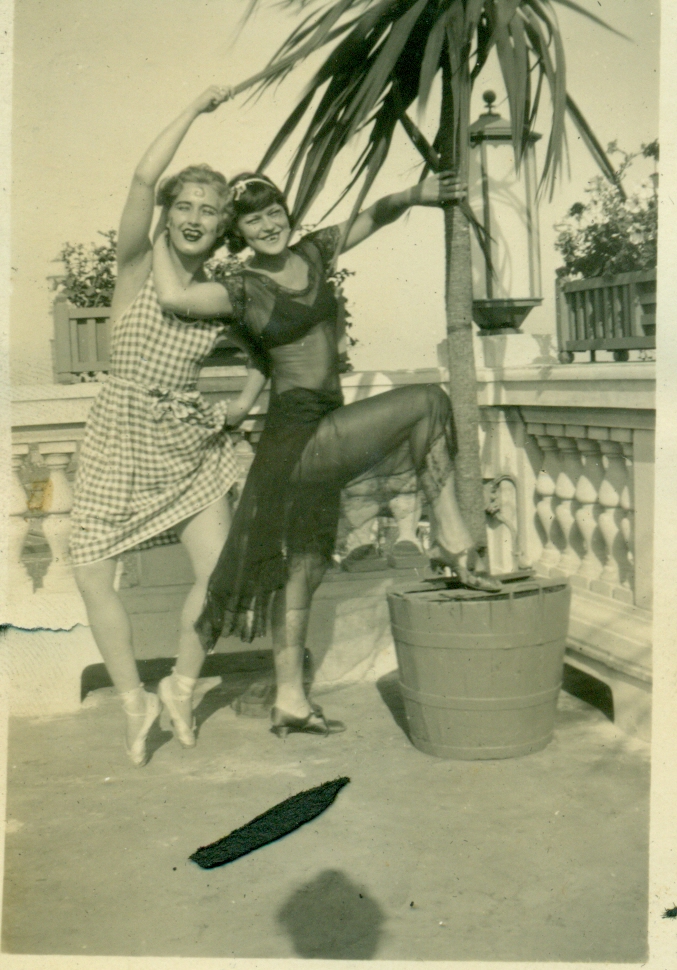
Helen, with no opportunity for college, shared a similar bonding experience with her “new” friends touring Europe.  As discussed in my book, River of January, she danced in a ballet company called, “The American Beauties,” who together performed first in Paris, and traveled as far as Algiers from 1932 to 1933.  In fact, the girl and her fellow dancers patched together their own version of a Christmas celebration at a hotel in Islamic North Africa.  She too, relished the late night yakking sessions, the joy of carrying out pranks, such as the night a group of them short-sheeted the bed of two other, unsuspecting dancers.  The picture above is a charming example of Helen purely celebrating life.

Later, these women remained some of the best friends Helen ever had.  Traveling to her home in Miami from Los Angeles or New York, the old girls sat around Helen’s little kitchen table, enjoying drinks, reminiscing and laughing.  For a short moment, seated at that tiny white table, they again were the same young dancers who had reveled in an extraordinary and memorable learning experience of their own.

Smoke Gets in Your Eyes

th

She is bent over a small Mercury outboard, hoisting the little motor in and out of the water. Her hair is wrapped in a kerchief, much as it had been when she wired mine sweepers at the Bremerton shipyards during the war. Ailene has a cigarette in her pressed lips, Humphrey Bogart style. Her black and white knit shirt has a small pocket on the left sleeve, over her bicep, and tucked inside is a pack of cigarettes–her brand, Kent. At the end of her day on the lake, my grandmother regularly downed a couple of high balls of Canadian Club, on the rocks.

My life with my grandmother has aided tremendously with the writing of River of January.  and the sequel, The Figure Eight. She, like Helen and Chum held lifetime memberships in the “Greatest Generation,” so her attitudes, word choices, and music preferences shape my thinking while I write.  Sadly she died in January, 1990, of lung cancer no less, taking a piece of me with her.

As for smoking and drinking, Chum appears as one of the few alum from that era who tended to nurse a beer, rather than chug, and chewed his cigar more than drawing a lung full. Helen, however, much like my grandmother, relished her bourbon every evening, garnished by a lit Chesterfield, and proceeded to enjoy a whale of a good evening.

Smoking and drinking blended into American culture in the 20th Century, unlike the prior or later era’s that demonized the practices. As I researched River, sifting through voluminous piles of documents, I encountered alcohol and tobacco ads placed next to those for baby formula and Ivory Soap, among other consumer goods. Liquor ads filled theater playbills on both sides of the Atlantic, nearly always featuring a shiny, sleek bottle bearing some stylish label. The message rang clear, drinking and smoking represented the height of sophistication, glamor, and sex appeal. Both my grandmother and Helen’s mementos, verified the truth that the party never stopped.

Casablanca, the celebrated 1942 film has struck me as the epitome of romantic culture in the late 30’s on into the war years. The gowns, the cosmopolitan style of understated and clipped dialog, and a perennial sense of righteous duty embraces that era. Americans lived hard and played hard, performing extraordinary feats while hungover at the least, or still intoxicated. These remarkable Americans handled drill presses, explosives, welding equipment, and other heavy industrial machinery, not to forget the operating end of an M1 rifle in a fox hole.

Out dancing, working a graveyard shift, partying, or fighting–all done with a cigarette resting, smoldering on virtuous, patriotic lips.

Gail Chumbley is the author of River of January, a memoir. Also available on Kindle.

Making Something of Nothing

I began teaching in 1979.  And if memory serves, Paul Volker headed the battered Federal Reserve, and Carter was in the White House turning off lights.  The economy had slumped badly from a combination of Vietnam deficits and the oil embargo, compliments of OPEC.  That was the year I finished college and began teaching, taking a job where I could find one.  While urban school district’s were letting folks go, I was forced to beat the bushes for a rural position.

Eventually I found a district hiring.  The town was quite remote, housing more raccoons than people.  There I taught and coached every sport available.  I didn’t have a choice, the economy was that bad.

Then came 2008–we all remember that disastrous economic mess when the whole financial sector was heading off a cliff.  That was the same time I started to consider retirement, and the prospects were certainly dim.  Due to the dire conditions of the financial sector I decided to hang in a few more years until circumstances improved.  And they did.

Persevering through through hard times is something I understand.  None of us can pause our lives and wait for better days.

It was 1933 when Chum decided to part ways with the US Navy.  The back story to his decision is drawn out fully in my book, River of January.  The short answer is ambition.  Based in Panama, where poverty ran rampant, Chum was insulated from a similar economic disaster that had befallen America.  Arriving in Depression-era New York proved a sobering and challenging experience.  Honestly, the young man’s only assets were his driving ambition, and he could fly airplanes.  As I described in the book, the country was broke.

The same could be said for Miss Helen Thompson.  In a sense the girl was luckier than Chum, (they hadn’t crossed paths yet).  Show business was and is a tough career to scratch out, and very few are lucky enough to arrive.  So she defied the odds of employment every time she auditioned.  In her letters and papers Helen is quite conscious of money and spending.  There are numerous makeshift ledgers of her expenditures throughout her papers.  But it is notable that she never mentioned the general economic disaster.  Helen accepted the terms of her time and place, and soldiered on.  Clearly her assets were drive and talent, the income came along as she persevered.

Neither Chum nor Helen, (or any of us for that matter) have control over the years we breath air.  Tapping into their personal reservoir of  inner drive, the two of them cobbled together incredible lives.  He won an air race, and met famous people, while she danced across Europe and met famous people.  I bet that was fun.  Fun in the time of scarcity.