Western Union

Western Union

My computer crashed, but I have wonderful neighbors who are IT wonders. The little gadget is now up and working. Progress on all fronts with the book. Speaking engagements are lining up and books should be done by the end of the month.
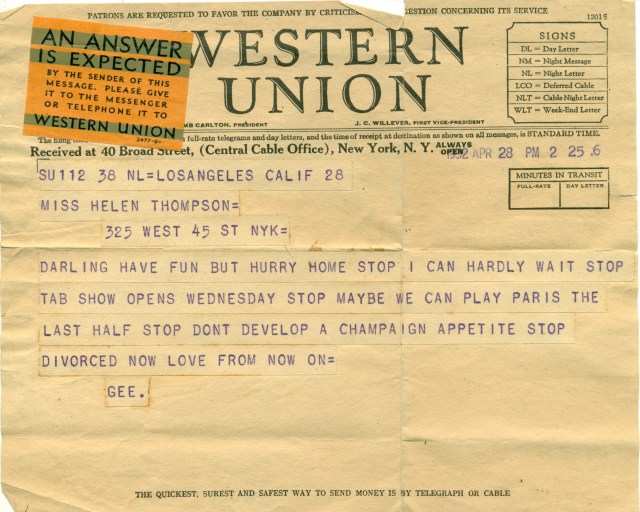
Pictured is a telegram for Helen from an admirer, before she shipped off to Europe in 1932. The story appears in the book.

Promising Start

Image

It’s Sunday, it’s raining, and my husband is watching golf. I have given myself credit for remaining conscious with so many reasons to go back to bed.

But I’m excited. The book talk on the radio yesterday came off smoothly.

Two days ago I spoke with the radio announcer on the phone filling her in a bit on the story.  Either she was in a hurry to get back on the air or simply wasn’t impressed. That was okay.  I am accustomed to impatience when I start to blather.  After all, I taught school for decades.

However, despite her indifference, I decided to bring along some photos of my protagonists, Helen and Chum.  Before we went on the air I shared them with the disc jockey.  It was awesome.  She lit up like a Christmas Tree.  “I had no idea,” came out of her mouth.  “I love this era, it was so glamorous,” she added.  I simply replied “I know.”  And the interview began.

All someone has to say is “tell me about your book,” and I am off to the races.  She grew as animated as I felt, and brought up the photos a couple of times during the interview for listeners to understand. I think that it was a promising start to my book promotion. Not that everyone will like River of January  mind you, but just a chance to explain the story, and how it evolved gave me heart.

My publisher, Yvonne Rousseau at Point Rider Publishing saw what I saw from the beginning. She has championed the book more than once when I was ready to abort the mission. Yvonne has proven very proficient at hand-holding when necessary. And her daughter, Brook Rousseau, the artist behind the cover design, has been nearly mystic in capturing the story in a bold image. I think many books will sell simply because of her exquisite design. A big thanks to Yvonne and Brooke–a true team of pros.

I suppose this promising start to River’s launch is exciting enough to keep my eyes open on this wet, gray day. In spite of listening to soft-spoken analysts murmuring boring commentary from the Cadillac World Golf Championship.

Do You Understand Now?


Image


My book, River of January is not, I repeat, not a romance novel. Does it contain a love story? Yes indeed, and a good one too.  However, the two destined to find each other, Chum and Helen, meet later in the book.

The manuscript has made a small circle of rounds, either for review or because someone felt they could help promote the work. And of all the folks who have read it, only two readers complained that the romantic part didn’t come soon enough in the story.  I have to admit that was frustrating to hear, because so much cool stuff transpires before they meet in the book.  Paris, London, Rome, Vienna, dancing, singing, and ocean liners for Helen. Tragedy, endurance, ambition, aviation, air racing, and adventure for Chum.  And all of the action is true and verifiable. What do these readers think?  Is real life no more than a love story?  Is their life no more than a love story?

I understand enough to say that these folks are looking for a marketable formula. They look for the effort to possess the elements that sell in fiction. However my work is creative nonfiction and follows no predictable pattern, just like any persons life. These two people pursued avenues that opened to them, as we all do.  It’s just that their paths included vaudeville stages, the silver screen and the golden age of aviation. Isn’t that enough?  I wrote the book to chronicle two actual lives. If the work sells on that merit, that will be wonderful. My limit is changing the story up to fit a commercial template. To even think of shuffling the events around feels sleazy and unethical.

It was my son, my sage, who reduced the conundrum down to a simple truth. He explained that once I commit the words to paper I lose control of how readers perceive them. And he is right. After the telling, the tale belongs to each individual and their unique interpretations.  And that means letting go of the outcome.

Past As Prelude

Image

I don’t remember the topic, I think it may have been health care, but a friend loudly complained, “I don’t care about the past, I care about now.”  He was annoyed with me for suggesting there was turmoil with the passage of the Social Security Act under FDR and more with Medicare under LBJ.  I have to admit that stunned me for a moment because I look behind nearly every current event that crosses the news.

As I am writing, Russian President Vladimir Putin has demanded approval to deploy troops to the Ukraine.  The demonstrators in Kiev made use of the Olympic media presence to make their move, and that was smart.  But now that the cameras have gone, Putin is laying down some payback for the distraction to his Olympics.  All done in the present tense and understandably awful.

But why?  What is the back story?  Who died and put Russia in command of the Ukraine?

Old story.  It began when a Viking named Rurik founded Kievan Rus back in the day.  And President Putin claims the same authority  for this current invasion in 2014.

I am not trying to write a report for my fifth grade teacher, but the Russians do look at that region as within their sphere of influence. And believe me, I am not an expert on that part of the world–but the impact of Russia’s past claims to the south and west doesn’t require shiny credentials to understand.

After the 1917 Revolution and the First World War, the Ukraine folded into the emerging Soviet Union, it’s boundaries fading from maps for the next seventy years.  During Marshall Stalin’s reign of terror in the 1930’s, nearly the entire middle class of Ukrainian farmers, “Kulaks,” were exterminated and the land collectivized.

Russian nationalism, it’s sense of blood and belonging, includes the southwestern region of the Ukraine. And they mean business. I remember the Ukrainian president who suffered mercury poisoning which left him alive, but quite disfigured. Though the proof is circumstantial, the likely perpetrator was the old Soviet KGB, or the agency’s non-Communist replacement. Putin was an operative at that time.

I offer very little in solutions to this aggressive action on the part of the Russian government. We in the West believe the people of the Ukraine deserve their own national integrity and future. Still the pull of history remains overwhelmingly powerful. All I can offer is an understanding of the roots to this conflict. The connection between the two republics stems from a past that is far more complicated and difficult than a headline.To assume that justice and fair play figures into this struggle for freedom is irrelevant. There has never been any such understanding between the Russians and their cousins.

A Russian scholar would certainly shed more historic light on the topic, and flesh out more details and episodes, especially concerning the Romanov Dynasty. However, this iron-clad dynamic exists between the two countries whether the western press examines the connection or not.

For the record, more remote republics are viewed in the same possessive light as the Ukraine, Chechnya for example.  If the past provides any guidance, which I believe it does, this story is nowhere near over.
Retirement

No doubt that one of the primary reasons I retired was burn out.  I had worked in secondary classrooms the length of my adult life and struggled the last couple years largely due to growing political pressure.  You see, I bought into the idea that hard work paid off and came to realize that I was dead wrong. My hard work didn’t matter. None of my colleagues hard work mattered. My student performance outcomes, though well above the national average didn’t matter.  Nothing moved policy makers except that they could hire two new teachers for the price of me, and many of my fellow staffers.

When the mortgage market imploded in 2008, Southwestern Idaho flat-lined economically.  While teachers, such as myself, fought draconian budget cuts the legislature didn’t listen. They didn’t care. The brutal impact on classroom numbers and lack of materials made no difference, their ears were closed. In fact, the Great Recession instead provided an opportunity to attack our union and kill protections such as negotiations, due process, and arbitration rights. I found that regardless of my expertise and my kids remarkable growth I was handed more students in class (220 every other day) and less time to teach (down 25% a week).

When I realized I could swing retirement I took it.

I worry about what is behind me in public classrooms.  There are enormously bright kids out there begging to be challenged.  These young people are smart, but need skills and information to develop their optimum potential.  However, as long as law makers settle for cheap, keeping salaries spartan, and classrooms packed, I cannot see America preparing for the future. The results will reflect the dismal investment.

In my state the Superintendent of Education denied that teachers were leaving education due to the perceived oppression from the legislature.  And he can tell himself and the entire House and Senate that tale.  It’s just not true. Teachers want to succeed, aspire to excellence, wish to see achievement among their students.  That is why the miserly funding and lack of support by policy makers has had such a negative impact.  No one wants to go into a job already set up to fail.

Teaching as a profession shouldn’t be done at such personal sacrifice.

English 101


Apostrophes

I worked with quite a number of English teachers during my long thirty-three year teaching career.  They, as a group of educators, contribute a great deal to the heart of a school.  Over the years it has become my opinion that the purpose of language arts is to cultivate the dreams of dreamers, the hearts of romantics, and inspire the hero in all of us.

Back during my days in high school I recall reading Romeo and Juliet as a freshman.  It surprised me that teen angst played a central role in a Shakespearean play.  I suffered deeply from those same dramatics and felt validated that I didn’t suffer alone, Shakespeare understood.  By my junior year I developed a serious crush on transcendentalist, Henry David Thoreau–that dude sought the identical truths troubling my path at the same time.  In college, Flannery O’Conner’s A Good Man is Hard to Find haunted my thoughts for many months after reading.

In light of the power of the written word, I’ve never understood an English teacher’s penchant for dissecting the writing of their students.  Correct their grammar, okay, but the voice on the paper is so personal that trimming and cobbling feels more like slashing and burning creativity.  (Math teachers really hate it when English teachers correct their grammar.  In one inservice an offending math presenter snapped back, “now for your algebra equation).  I get the part about smoothing out sentences, polishing images and descriptions, but how much is too much intimidation and infringement on the writers soul.

This blog sounds somewhat defensive, and I am aware of my sensitivity.  My book is in it’s final edits and reviewers are hopefully at work as I write, plowing their way through my manuscript.  I have refrained from asking anyone from a Language Arts background to review my work, out of fear of a big red bad grade.  Writing River of January has been such a journey, such a sacrifice of my time and heart, I don’t think I could bear to have banal technicalities flaying the story.  I’ll let my publisher/editor suffer through those arcane changes.

The truth of the matter is that I did not set out in life to be a writer.  I was a history teacher.  In my area of expertise my students excelled in expository writing . . . you remember, the old blue book essays.  The mechanics weren’t as important as voice, evidence, and argumentation.  Where my writing lacks is in the finesse of perfect structure–and that is, I am painfully aware, my weakness.

So English teachers of America–give us heart, inspire us, and let us find our voices in our writing. Besides, since the start of this project I’ve written and rewritten so much that I can see sentence structure much more clearly.  It takes hours and hours of writing to become a better writer. Put away your red pen and let the kids write amok.  As they improve, then go back and point out the rules of sentence structure.  For young learners the corrections will make so much more sense.

Gail Chumbley is author of River of January

Sad Tuesday

We had to euthanize our cat yesterday afternoon.  She was old, would have been nineteen years in March.  And despite the fact that we knew the day would arrive, no one told us it would be February 17, 2014.  I had planned to vacuum. 

It’s strange how losing such a little creature inspires such powerful pain.  She’d been around so long, losing her seemed like it would never happen.  I wasn’t prepared.

Odd how accustomed we became to her.  Though small in stature, her presence loomed large around the place. The little thing had a combination meow-plus-purr sound that I found very predictable and comforting.  Her chitter-chatter was as much a part of this cabin as the refrigerator vibrating, or the drip from the bathtub faucet.  The void of her absence today shouts in its silence.

We most likely kept her going far too long.  That was our issue.  There had been earlier brushes with momentary paralysis, glandular issues, and diabetes. Yet the old thing still used her box properly, ate and drank like a truck driver, and talked and talked, rubbing herself on every door-sill and corner in our/her house. 

That little girl surreptitiously weaseled her way so far into my heart, that my sorrow today has thrown me for a loop.  An ice-cold straight razor has cut me from my heart to my stomach, flowing loss and regret.

Writing does help. I now seize the written word as my own form of exorcism and cleansing–banishing my demons of doubt and sorrow. Yet I can still picture her, lying on a towel, looking at us while the vet injected a syringe into her leg.  Her little head lolled over, and my grief erupted.  

Driving back up to mountains we kept telling each other it was the right thing to do.


This is no Fluke

Image

I spent a couple of days with my folks in Washington State, where I grew up.  It’s always good to go, and even more imperative as they age.  However, the part I seem to forget when I visit, is that time portal called their front door.  When I step through, the world suddenly changes, and I have traveled back in time.  The atmosphere inside, at the latest, is around 1970.  That’s the truth–you can ask any of my childhood friends.  Nixon unfortunately is still in the White House, and they still speak of John F. Kennedy with reverence.

Two of my brothers came over and we settled into the family room to answer questions on Jeopardy.  My dad has his evening viewing schedule locked up.  After Final Jeopardy, he flips over to MeTV for an old rerun of MASH.  It isn’t a very humorous episode.  Hawkeye and company are falling apart, dreaming of home, away from freezing Korea.  So I attempt some lighter conversation.  But no one is listening to me, they are glued to Colonel Potter while he dreams of his childhood horse.

The spell eventually breaks and we talk a bit.  My older brother describes another rerun of the Jack Benny Show which was so funny he had to turn it off.  It was too soon after his stomach surgery and it hurt to laugh. We’re talking about Jack Benny, not How I Met Your Mother.

The next verbal  tussle involved the first episode of All In The Family that dealt with homosexuality.  My younger  brother argues that the gay guy was played by Charlton Heston, and I know he wasn’t.  So we go back and forth arguing about that.  He wants to bet five bucks.  But, I’ve got him.  I have my iPhone and internet service.  I find a clip of that particular show and he grows quiet.

I can’t really fault my family for their desire to remain in a past time.  Dad loves his Nelson Eddy movies, and figuring out the vocalists in big band pieces.  It seems that talking played a bigger role in family life and socializing in 1970. Nobody could end the verbal give and take with substantiating, electronically generated facts.

I get it.  I can see easily why I became a History instructor.  I can understand why River of January was a temptation too irresistible to let go. I came by my passion honestly.  And here, in my mountain house? I’d say it’s about 2005.  I know I’m still pissed about the invasion of Iraq, House reruns occasionally flicker from the small screen in the living room, and in a guilty pleasure my Sirius Radio station is set to “Classic Vinyl.”

What year is it at your house?

Ambition V. ADHD

Image

In this first winter of my retirement some days weigh heavier than others.  Yesterday grew so onerous for example that I cleaned out the mudroom.  Trying to sort out my yearnings I thought about how anxious I am to see this book materialize, then I wondered if it’s just cabin fever.  

I am an ambitious person.  No matter what I complete, how well projects or objectives are met, I feel unfinished.  Is this the outcome of a driven personality?  A perfectionist? Or a nut-job?  Somehow the causes seem irrelevant when the restlessness drives me to pursue housework.  

I envy those who can putter around contentedly, planting flowers, decorating walls, and in many ways living in the moment and making that moment beautiful.  I try to attend to that affective side of myself, but never out of serenity,  Guilt haunts my activities, pushing me to complete the task.  Not love, not pleasure, not contentment.  Jesus how many antidepressants can one soul swallow?

In River of January I am working with people I understand.  We are kindred spirits, Chum, Helen and I.  They too drove themselves to find success. 

I get it, he wanted to do what he wanted to do.  And the man wanted to fly airplanes.  As remote as that possibility appeared from a family farm at the foot of the Appalachians, Chum pursued that single aim for all it was worth. 

Helen, too, aimed stardom, and she trained as if she were running a marathon.  They disregarded all the powers of inertia and conformity, pushing forward even though they had no guarantees of success.

I too, have no guarantees in this book effort, but my spirit is restless and pushes on anyway.  It’s just my nature. 

This couple lived in a unique time and place.  America convulsed with growth in the early to mid Twentieth Century, and they both found opportunity in the upheaval.  I am compelled to preserve their tale, and compelled to find some success sharing it in book form.

It snowed last night.  Shoveling ought to smooth the edge off my restless fidgeting.