
We have a book cover!
We have a book cover!

I spent a couple of days with my folks in Washington State, where I grew up. It’s always good to go, and even more imperative as they age. However, the part I seem to forget when I visit, is that time portal called their front door. When I step through, the world suddenly changes, and I have traveled back in time. The atmosphere inside, at the latest, is around 1970. That’s the truth–you can ask any of my childhood friends. Nixon unfortunately is still in the White House, and they still speak of John F. Kennedy with reverence.
Two of my brothers came over and we settled into the family room to answer questions on Jeopardy. My dad has his evening viewing schedule locked up. After Final Jeopardy, he flips over to MeTV for an old rerun of MASH. It isn’t a very humorous episode. Hawkeye and company are falling apart, dreaming of home, away from freezing Korea. So I attempt some lighter conversation. But no one is listening to me, they are glued to Colonel Potter while he dreams of his childhood horse.
The spell eventually breaks and we talk a bit. My older brother describes another rerun of the Jack Benny Show which was so funny he had to turn it off. It was too soon after his stomach surgery and it hurt to laugh. We’re talking about Jack Benny, not How I Met Your Mother.
The next verbal tussle involved the first episode of All In The Family that dealt with homosexuality. My younger brother argues that the gay guy was played by Charlton Heston, and I know he wasn’t. So we go back and forth arguing about that. He wants to bet five bucks. But, I’ve got him. I have my iPhone and internet service. I find a clip of that particular show and he grows quiet.
I can’t really fault my family for their desire to remain in a past time. Dad loves his Nelson Eddy movies, and figuring out the vocalists in big band pieces. It seems that talking played a bigger role in family life and socializing in 1970. Nobody could end the verbal give and take with substantiating, electronically generated facts.
I get it. I can see easily why I became a History instructor. I can understand why River of January was a temptation too irresistible to let go. I came by my passion honestly. And here, in my mountain house? I’d say it’s about 2005. I know I’m still pissed about the invasion of Iraq, House reruns occasionally flicker from the small screen in the living room, and in a guilty pleasure my Sirius Radio station is set to “Classic Vinyl.”
What year is it at your house?
 I’m back. I’ve spent the last couple of days visiting my folks and checking out some mom and pop bookstores. It’s my hope to find some speaking opportunities to promote my forthcoming book, River of January, and perhaps sell a few.
Again, I have posted Lincoln’s picture as I did in my last post, because today is our 16th President’s 206th birthday. I like Lincoln. A lot. I am what one would call a “Lincoln-ista.” As I write, my standup cardboard Lincoln is presiding over the dining room table. It is after all his birthday!
A life lesson Mr. Lincoln seemed to apply frequently was understanding other points of view. He and his wife were both born in the border state of Kentucky. Slavery was legal in Kentucky until the Thirteenth Amendment abolished the practice. Lincoln understood the mindset of slave owners, he grew up among them. He knew the agricultural imperative of forced labor and the violent defense by planters who would lose their customary way of life. However, Lincoln disapproved of slavery. To him the issue was not only a moral one, but an economic wrong as well. He believed all men should enjoy the fruits of their own labor. Still Lincoln didn’t point fingers and shrilly condemn his Southern brethren–that would have been foolish and frankly unLincoln-like.
Lincoln tended to avoid resentments and harsh judgements. Doris Kearns Goodwin’s Team of Rival’s recounts an incident where Lincoln was to represent a railroad company in a Chicago trial. When he arrived to court, Lincoln found he had been fired and a “real lawyer,” Edwin M. Stanton was arguing for the company. Stanton made a snide comment about Lincoln’s crude and hayseed appearance within his hearing. Still, Lincoln remained in court as an observer, believing he could learn something from a Harvard trained attorney. Later, Lincoln made Stanton his Secretary of War. No offense taken, so none festered. As a member of the Cabinet, Stanton became deeply devoted to this uniquely principled president.
Now how does an examination of two qualities in President Lincoln have anything to do with my book? Well, more than you might think. Though Chum never had the stomach for unjustifiable character attacks, he didn’t waste his energy holding resentments. From my time in his company he never, ever gossiped or spoke badly of anyone that I can remember. His only remark close to snide, was the time he said Howard Hughes kept the Kleenex business booming. (Anyone who’s seen the DiCaprio movie understands). Helen however, seemed to be able to take criticism well. It was a must, a part of the business. She was a performer and required to stay sharp. From my study of her letters, Helen often attended other productions to see what she was up against as an artist. If she read poor reviews the girl took it in stride and learned. She improved her skills.
I, too would love to be free of resentments and to see the other person’s viewpoint without spite. Society is a collection of individuals with limitless opinions on limitless subjects. Believing that we are all absolutely right, and refuse to hear otherwise, does little in the way of progress. Chum didn’t let the obstacles of his time and place discourage him. Instead he was polite, courteous, and left the naysayers behind. Helen saw opportunity in adversity. She tenaciously used criticism and competition as guideposts to her success.
Not one among us have the market cornered on truth. But, as Lincoln knew, self righteous blowhards who refuse to bend, eventually break.

Leaving town and my computer behind. I’ll get back on this site next week.
The book is slowly taking shape. Early reviews surprisingly acceptable.
If you know of times and places I can present the story and book, respond on this site.
Remember Lincoln on the 12th.
Happy February.
Here, in my state a showdown is brewing between the LGBT community and legislators in the capitol.
Idaho passed a Human Rights Act a number of sessions ago believing their votes showed what good folks they were. They won’t discriminate against women, Jews, Blacks, or Japanese Americans who were interned here during WWII. There will be no genocide, no back of the bus, nor will camps hold citizens.
These largely white, male reactionaries didn’t realize they had opened a Pandora’s Box of outcomes. Where they thought they had passed an ‘everybody wins,’ warm and fuzzy law, the residents of Idaho took the lawmakers at their word.
That brings our story to today. The LGBT community has nearly begged lawmakers to ‘Add the Words’ to the previous Act. Four words to be precise. The gay community insists that Sexual Orientation and Gender Identity amend the law as it stands currently. However, lawmakers will not permit any hearing or even tolerate such an incomprehensible notion. That is this conflict in a nutshell. The majority of rural-dwelling, agrarian conservatives cannot fathom that alternative sexuality is real. Roosters like hens, steer like cows, billy’s like nanny’s. It’s very simple. For the religious right, they look to multiple translations and versions of the Bible, and Adam and Eve reads clearly.
The problem centers on real life and real people. Whether most farm animals (most) behave according to expectations, humans are something more. Sexuality isn’t a black and white issue like race relations. And the gay community is real and is suffering. Simply because those in power refuse to recognize reality–physical bashing, job and housing discrimination, bullying, it is happening. Haters know what lawmakers refuse to see. By taking no action the Idaho legislature has condoned persecution.
I am reminded of a story of Queen Victoria. It was the late 1800’s in London and Jack the Ripper was waging terror in the impoverished White Chapel neighborhood. However, the Queen refused to recognize the crimes because she did not believe prostitution was real. How could there be prostitutes murdered when the profession did not exist. End of problem.
The LGBT community is real. Even if law makers refuse to recognize the demographic, everybody else in society does. That’s why the discrimination and abuses are carried out. Legislators may not believe in alternative lifestyles, and in return we are certainly losing our belief in our legislators.
There are gay characters in my book, River of January, and though it wasn’t my business to out them, I could see they suffered. One in particular lost his career and died very young after an unhappy, unfulfilled life.
This is, in America, and in my state, the last acceptable prejudice. Those who govern the people must govern for all the people, whether or not they personally approve of alternative lifestyles. E Pluribus Unum, Out of Many Come One.

In this first winter of my retirement some days weigh heavier than others. Yesterday grew so onerous for example that I cleaned out the mudroom. Trying to sort out my yearnings I thought about how anxious I am to see this book materialize, then I wondered if it’s just cabin fever.
I am an ambitious person. No matter what I complete, how well projects or objectives are met, I feel unfinished. Is this the outcome of a driven personality? A perfectionist? Or a nut-job? Somehow the causes seem irrelevant when the restlessness drives me to pursue housework.
I envy those who can putter around contentedly, planting flowers, decorating walls, and in many ways living in the moment and making that moment beautiful. I try to attend to that affective side of myself, but never out of serenity, Guilt haunts my activities, pushing me to complete the task. Not love, not pleasure, not contentment. Jesus how many antidepressants can one soul swallow?
In River of January I am working with people I understand. We are kindred spirits, Chum, Helen and I. They too drove themselves to find success.
I get it, he wanted to do what he wanted to do. And the man wanted to fly airplanes. As remote as that possibility appeared from a family farm at the foot of the Appalachians, Chum pursued that single aim for all it was worth.
Helen, too, aimed stardom, and she trained as if she were running a marathon. They disregarded all the powers of inertia and conformity, pushing forward even though they had no guarantees of success.
I too, have no guarantees in this book effort, but my spirit is restless and pushes on anyway. It’s just my nature.
This couple lived in a unique time and place. America convulsed with growth in the early to mid Twentieth Century, and they both found opportunity in the upheaval. I am compelled to preserve their tale, and compelled to find some success sharing it in book form.
It snowed last night. Shoveling ought to smooth the edge off my restless fidgeting.
Today’s posting has nothing to do with my book. Instead I am moved to comment on today’s news.
The news of Pete Seeger’s passing is popping up everywhere on all my personal media settings. And I, as millions of others loved the music of Pete Seeger. I always have. The beauty of his voice alone, or with his group, “The Weavers” still echoes compellingly in my mind.
Yet, today, with his passing, I’m not thinking of the silenced music. As essentially American as his voice and lyrics resonated, the lessons I learned from Pete Seeger are more linked to political conviction and courage. His was the voice of the non-conformist, the social and political critic who challenged conventional beliefs.
Seeger served in uniform during World War Two. Though he was a young man when he soldiered, his participation says a great deal about the justness of America’s struggle against totalitarianism. But after the war, Seeger seems to have instantly grasped the politics of the Cold War for was it was, an excuse to stifle the voice of opposition. Seeger suffered for his convictions. When popular thought demanded unified anti-Communist behavior, Seeger did not comply. It was justice he sought, and in the days of racism and blind war mongering, Seeger would not close his eyes and pretend America practiced equality and liberty. And his beliefs landed him in political hot water.
His banjo and singing voice were his only sword and sidearm– yet still he made himself a dangerous man to an American government that demanded wall to wall consensus. This troubadour appeared to be fearless in expressing his thoughts, singing anywhere and everywhere he saw injustice.
The Vietnam War provided Seeger and a growing segment of Americans a broader platform to protest Johnson-Nixon policies in Southeast Asia.
I remember that he was to appear on “The Smothers Brothers Comedy Hour,” and sing Waist Deep in the Big Muddy, an anti-war song. Such a powerful message! The lyrics at bottom called out the man in the White House as a “big fool.” CBS pulled Seeger from the show out of fear of retribution from stock holders, sponsors and hawkish politicians. To their credit, the Smothers Brothers refused to go on until Seeger was allowed back on the show. CBS caved, Seeger appeared, the feelings of America soured more on the war, and for a wide variety of reasons America withdrew from that nightmarish miasma.
This blog is a tribute to other voices of opposition across many generations of Americans. The list is long of patriotic citizens who understood the First Amendment meant what it said. We should honor the lives of those who resisted the tyranny of a majority they believed misguided.
William Lloyd Garrison, Frederick Douglass, Sojourner Truth, Margaret Fuller, Elizabeth Cady Stanton, Helen Hunt Jackson, Homer Plessy, Jacob Riis, Henry George, Lewis Hine, “Mother” Mary Harris Jones, Ida Tarbell, Ida B. Wells, Eugene V. Debs, Alice Paul, Big Bill Haywood, Phil Ochs, Mario Savio, Cesar Chavez, Bobby Kennedy, Diane Nash, Bayard Rustin, Daniel Ellsberg, Harvey Milk, and the other thousands of names left off this list.
Hoist one tonight for Pete Seeger and the multitude of others who braved the currents of popular thought, for there is nothing more American than to question the status quo.
One question raised about River of January is,”Are my characters brushes with the famous true?” The short answer is yes. Helen dined with Maurice Chevalier, and they performed on the same stage. Chum crossed paths with Amelia Earhart regularly at Roosevelt Field. The celebrity passages are factual. I have their pictures with the famous, references from documents, and proof in aviation logbooks.
Creative non-fiction appears to be a new genre in search of defining itself. Where exactly is the line between creative and non-fiction? Though I need to tell this story, I certainly wasn’t alive at the time. Frankly who knows what the characters precisely uttered to one another at any given time. I tried to rely on personal and business letters, quoting at length when I could, to add tone, cadence and a feel for the era. I am adding a lot of pictures for readers to visually connect to the characters, and the sights they photographed on their travels. Additional color had to come from my imagination, with clues found in the archive of family memorabilia.
My personal preference in reading is non-fiction history. I have lived on a strong steady diet of biographies and general histories. Still I wonder how any scholar concludes their work without feeling uneasily incomplete. The subtleties of human interaction, the nuances of personal connection are more than left out. We simply can’t know all facets of historic lives. Our only alternative is to flesh out the tale with what we understand about the human condition. And of course every writer struggles with their own blinders, biases, and preconceived notions.
For example the age old question of General Washington’s taciturn exterior has intrigued historians for two centuries. Was he grave and somber because his teeth hurt? Possibly. Did he wish to hide his false teeth due to the fact they were unsightly, fashioned out of a number of materials–ivory to human–to wood. Are both theories wrong? Did Washington remain stoic in appearance to evoke nobility and dignity? Maybe. In fact, all of the above could pass scrutiny. Different historians have differing opinions.
I am not too troubled about shaping feelings in ways I think makes sense. I’ve fallen in love, held my own in arguments, and felt more regrets than I care to claim. That is the truth I rely upon to craft the creative element in this historical narrative.
I think all biography and history possess an element of the unknown. Whether the history is filtered through professional scholars such as Robert Remini, Doris Kearns Goodwin, or Miss Nobody Gail in her Idaho cabin, we are analyzing viable evidence to apply shape and logic to past lives.
Did Helen meet Sophie Tucker. Yes. She told us in a letter. What did she say to her? How did she act around her? I ask myself what would I have said as an American to another famous American performing in London? That’s the creative portion of this non-fiction format.
All things considered, creative non-fiction is an exciting new canvas for writing. I feel like a kid in a candy store each time I turn over another photo or letter.
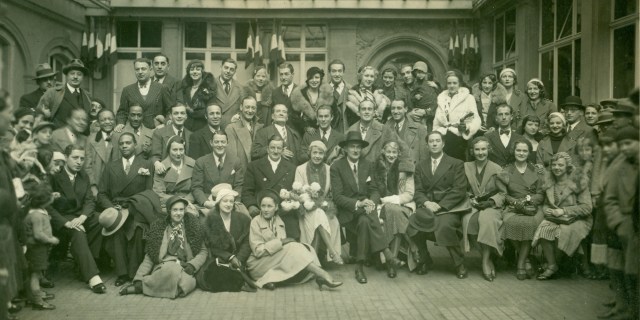
Mistinguett is front center. Helen is in the back wearing the light color fur collar. But look to the left middle.
Today’s mystery question–who are those two African-American gentlemen sitting together?

This just in. My first reviewer LIKED my book!
 Alice Paul
 Gail Chumbley