Fear and Euphoria

The doctor told us that it would be awhile before any tests were performed on my husband.  She quietly, carefully explained that she would call me if there was news of his condition.  For the moment Chad was hooked up to a drip for pain and another for fluids.  Then this quiet, unassuming doctor made it clear we were dismissed.

Stepping outside, the three of us lingered along the broad circular drive.  The night was warm, still hanging on to the day’s exceptional heat.  I remember almost laughing when I told Carlos about the art of timing.  He unwittingly had walked into a hellish ordeal that had actually barely begun.  Making our way to the public parking area, my girl suggested I sleep at her house since it was so close to the hospital, maybe a five minute drive.  We didn’t know what the night would bring and I needed to remain close.

Soon seated in Catherine’s living room, glass of wine in my hand, I suddenly felt like me.  I somehow slipped back into my personality again when I wasn’t looking.  There was no one needing my help, no one calling my name, no one griping about how awful they felt.  For the moment I was free.  So bowed down by responsibility and fear, the absence of demands jolted me back from that alien world of caretaker.  I felt nearly giddy with my momentary freedom, not willing to contemplate what was happening in that hospital room a few miles away. Bidding goodnight to room mates, new boyfriend, and my daughter, I toddled off to bed, setting my cellphone on high.

Sleep, however remained elusive, with the adrenalin of fear, then of euphoria swirling around my mind and body.  At 1:00 AM the cell phone shrilled loudly.  I fumbled around the floor next to the bed, aware that my daughter was next to me.  Flipping the phone open, I graveled out a hoarse hello.  Catherine sat up.

“Mrs. Chumbley?  I have received he results of the CT scan and it is clear that the colon has ruptured, feces is spreading through his body.  Chad is in grave condition.  He must have surgery.  You will soon receive another call from a surgeon, Dr. ???, (I honestly can’t remember his name.)  He will perform the procedure and will require your permission.

“Should I come back?”

“I don’t see anything you can do at this point. The surgeon will call for authorization and that you can do by phone.”

“Oh, okay.  Thank you.”  I hung up.

“Maybe we should go back down,” my daughter whispered in anguish.  I thought that over.

“No.  I think we will get more sleep here than in the waiting room at the hospital.”

We drifted back off to sleep.
A Handshake

Normal life attempted to intrude into our ongoing nightmare.  Our daughter had met her first serious boyfriend, and he had driven up to Boise to meet us.  Instead of finding her parents at the cabin in the woods, she tracked us down in a sterile, whispering examination room.  The poor kid she presented to us, Carlos, extended his hand to my husband, and miraculously Chad raised his own in a handshake.  (By the way that is the last thing Chad remembers today, that handshake.)

The two of them arrived at nearly the same time the ER doc returned to the room announcing that we were going on another ride downtown.  Chad’s chemo doc was on-call at the main medical center, and wanted to assess him in person.  Catherine and Carlos decided to meet us across town, and for a fourth time in one afternoon, turned evening, the two of us were loaded onto an ambulance.

Nearing the downtown medical center, the driver, a very nice young man, kept up a light banter with me.  Pulling up to a traffic light I realized we were behind my girl and her new beau.  Why, I’ll never know, my hands were shaking and I wanted to vomit, I asked the driver to give them the siren.  He complied, and we all waved ourselves silly, vehicle to vehicle.

Inside the main ER the verdict came in, Chad was to be admitted overnight for tests.  The last place either of us wished to be–a hospital–looked like home-base for us, at least for the night.  Orderlies rolled Chad into a side elevator to the fourth floor.  We followed in the public lift.  It was while looking for his room number, that I came face to face with a former student.  She was an aide on the floor.  Automatically smiling, I put my hand out to shake hers.  The girl having none of that, threw her arms around me in a big comforting hug.  That gave me no comfort, she must have known of his dire condition.

Punched up with more Dilaudid, my husband managed to talk to his Chemo doctor clearly, lying in his new surroundings.  He admitted that he hadn’t used the bathroom except to urinate for three days.  I heard her murmur, “fleet” again, quite clearly, but without enthusiasm. “Life flight for an enema,’ darkly crossed my mind.

The two kids sat down in the deep window sill of the room, all eyes, slowly acclimating from their new mutual attachment, into the reality of our medical abyss.

Finally, after passing a number of emotions across her face, the oncologist ordered a CT scan for my husband.  She then told us that it would be late before the procedure took place, and that we should go and get some rest.  Her words surprised me.  Darkness had crept in while I was distracted.  It was already ten at night when our worried little entourage was dismissed from the hospital.

The doctor promised she would call me when she knew something.

The Treeline

I still don’t recall exactly how it happened, but the decision was made to life flight Chad to Boise.  Following a 20 minute rollicking drive on dirt roads, the ambulance pulled into the helipad site where a chopper awaited.  Gently the medics pulled the stretcher out of the truck, and from there turned Chad over to the life flight paramedics.

All three, the pilot and the two flight medics exchanged a quiet conversation out of earshot, while transferring my husband onto the chopper.  Then the pilot turned toward me and asked my weight.  If I weighed more than a 110 lbs at that point I’ll eat my hat.  I was pretty skinny by then.  I must have looked it, too  because they invited me to take the co-pilot seat for the fifteen minute ride down.

The pilot then offered me a pair of headphones so that I could hear the conversations between the pilot and the medics and the pilot and the hospital.  At once the word came up front that Chad’s vitals had dropped dangerously.  The medics added that the trouble was the altitude and that they would keep me apprised.  Frozen in that seat, frozen in the heat of mid-day August, I hoped he needed nothing more than a fleet enema when we landed.

The helicopter lifted directly up and over the mountain facing the helipad.  Heavy forest quickly thinned as the terrain turned to dry, barren hills.  Les Bois, French for “the trees,” spoke somewhere in my mind, observing the distinct line of forest ending in a golden hilly desert.  While musing over the vista the pilot asked me which hospital to approach, and unable to think, I told him the wrong one.

Heading to the incorrect facility, (home of the tumor center) I could see ground crew on a painted target waving us down.  Outside the pad, another ambulance waited to drive us to the emergency entrance.  Again my mind released unsolicited thoughts–how much was this all going to cost?  I knew we were racking up giant bills, but of course had no more control over the debt than I did the cancer.

Once inside, he was pulled quickly into an examination room.  The nurse assailed him with a blizzard of questions.  “When is your birthday?  What day is this?”  Chad could answer correctly, but crumpled into severe spasms of pain in the effort.  After two injections of Dilaudud the pain stemmed enough for him to describe his symptoms.

An ER doctor breezed into the room, asking many of the same questions as the nurse, then ordered an abdominal x–ray.  He would contact Chad’s chemo doctor, in the meantime, who was on call at the main medical center downtown.

And that was when our daughter walked into the ER, towing her new boyfriend from Salt Lake City.  We were meeting him for the first time.

Breaking Inside

Happy Friday.  It looks like a snowy day is ready to break as I sit down to write.  Again this blog continues to described the back story to my first book River of January.  I did not set out to be a writer, but as many others , came to the craft from a place of difficulty.  Thanks for reading.  Hopefully, the manuscript  will become available in early 2014. . .

The man lay in bed writhing in agony.  Truly at a loss I kept repeating “what should I do, who should I call?”  Escalating the urgency of the moment, my husband leaned over the bed and vomited red Gatorade.  Or was it blood?  The contents on the rug were too similar in color to decide.  I hurriedly called the Boise tumor center for direction.  The answering triage nurse assured me that it was nothing but constipation, and that was the cause of his considerable pain.  I quickly located a feeding syringe in the kitchen and loaded it up with a liquid laxative, and we waited for the desired effect.

Chad’s body did not cooperate with the laxative, instead he was nearly screaming with pain.  My hands were splayed open and I raced around the bed fretting about what I needed to do.  He yelled “call Donny.” 

What was unusual about that idea is that Donny, our neighbor, is a retired plumber.  Unless he could use his snake and wrench, there wasn’t much our handy neighbor could do to help.  But that detail escaped me at that moment, and I did call Donny’s number.  He wasn’t there.

It was his wife who answered, and after I explained the emergency she responded, “I’m on my way.”

Rocking back and forth, Chad clearly had progressed toward delirium.  By the time the neighbor pulled into the driveway, his condition had significantly deteriorated.  She came in, took one look at him, picked up the phone and dialed 911.  “911!” Here?  In the woods?  Apparently so, because about a half hour later a huge rescue vehicle backed into the drive. 

Our little mountain home was quickly transformed into medical bedlam.  Medics stood over Chad’s bed, attaching a blood pressure cuff, poking in a line of saline into his arm, and asking him a blizzard of questions.  Other paramedics commenced to shove furniture out of the way navigating a white covered gurney into the house.  Watching the chaos I had enough presence of mind to understand my helplessness, and at that moment something broke inside of me.  It wasn’t physical like my husband’s–it was more like a last, single mooring had detached and I started to float away, still present, but at the same time unfastened from the confusion.

An Ordinary Moment

Neither one of us had asked for this nightmare.  He was chronically sick, chronically scared, in such horrible pain, over-medicated, and our lives transformed into daily endurance tests.  Chad was trying to cope with more misery than I could fathom, and I was trying to cope with him.  That insight gave me needed perspective, and helped me (at times) to function.  Above all I did love him and knew for a fact that he would care for me if our situations were reversed.

I recall remarking to a friend at the hospital that I hadn’t signed up for this.  He took on a wry expression and responded sagely, “yes, yes, you did.”  He was right, of course, I had indeed.

Trying to mimic normal to the best of his ability, Chad rallied one afternoon, and announced he was going to use a birthday gift card to buy a new golf club.  There is a beautiful, forested golf course near us, and his card was redeemable at the pro-shop.  Though I shouldn’t have let him drive, it was a short dash and we both desperately needed a respite of ordinary.  This errand meant that I had, perhaps about an hour off nursing duty, so I began to watch a saccharine-sweet movie on my laptop. It hadn’t escaped my attention that romance novels and fluffy sweet films were becoming my obsession.  My only escape from this impossible situation.  If Chad was asleep, or in this unusual case out, I plugged in some trite nonsense and buried myself in garbage. 

I was so lost in a trivial DVD that I didn’t notice the time.  Becoming aware of the extended quiet it occurred to me he should have returned home.  A little more time passed and I finally heard the car tires on the gravel.  I hit the pause on the film, embarrassed to be caught watching such nonsense, and hurried to meet him at the door.

He slowly rose out of the car and his posture and carriage looked oddly off.  His gait was peculiar as he ambled to the house, bow-legged, his chin in his chest.  Hobbling straight for his bed, he mumbled he didn’t feel well and I let that pass.  He fell into bed and instantly dropped off to sleep while I stood by and watched him.  So very strange.

Quietly returning to my insignificant movie I could hear his light snores, and I tried to underplay how weird he looked when he walked in the house.  Abruptly I heard my name . . . Gail, Gail, Gail, and I darted to his bedside.

He was twisting back and forth shouting there was something wrong inside. 

Support Our Troops?

Image

The armistice ending World War One, also known as the “Great War” was signed on this day in 1918.  The idea behind Armistice turned Veterans Day, was to remember the price paid by servicemen living and dead.  A visit to Arlington Cemetery provides a sobering, powerful lesson in the extraordinary price paid by those who gave ‘Their Last Full Measure’, to quote President Lincoln.

Row after  exact row, rank and file marble headstones arc the green, rolling acreage of Mary Custis Lee’s childhood plantation. Surveying this overwhelming vista, proof of the price paid by those in arms raises a difficult, perhaps unanswerable question. How can Americans best provide solace, comfort and justice for our fighting men and women?

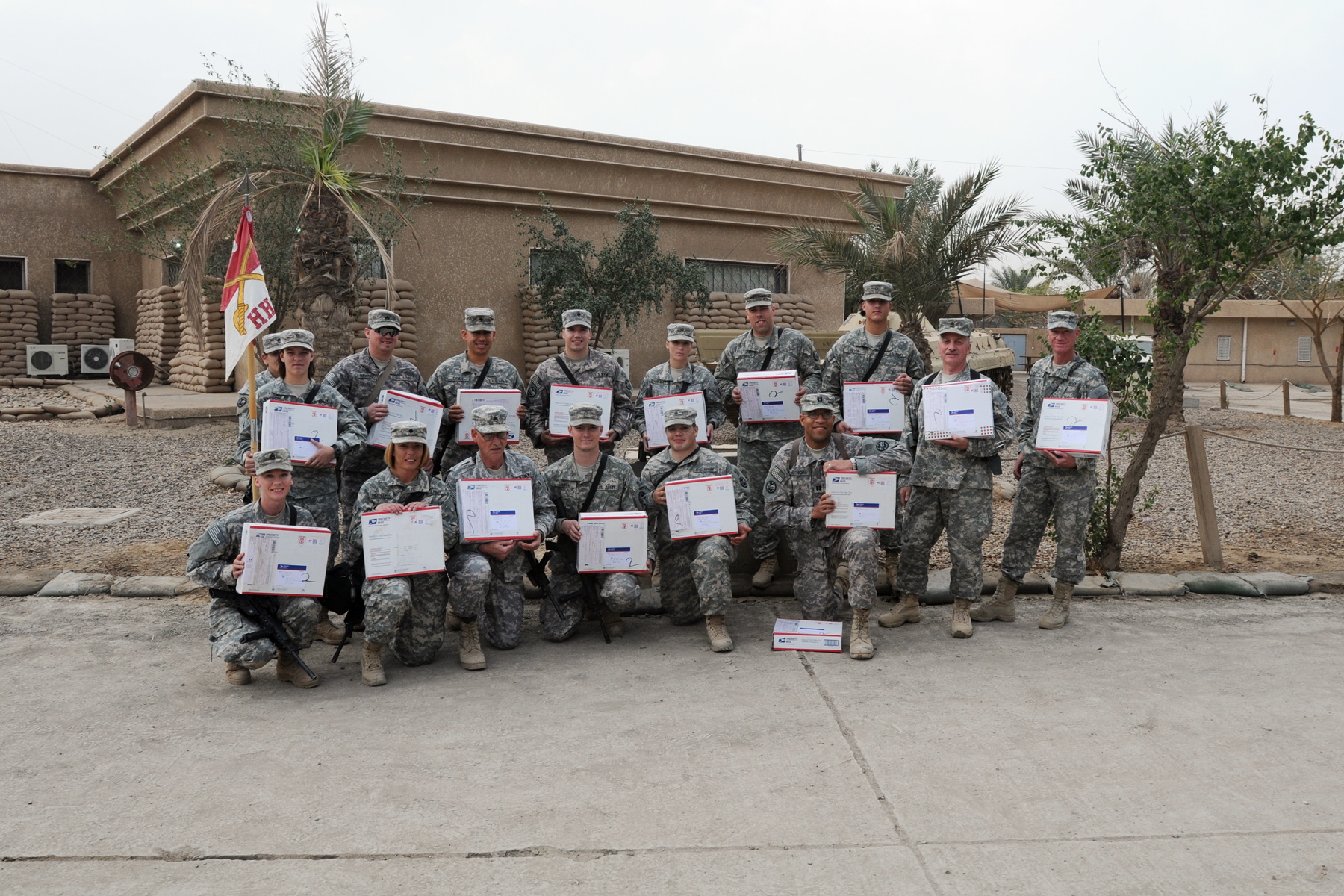
One option is pictured above.  While I was still in the classroom, my History Club provided Christmas gifts for those on duty overseas. We wrapped, labeled, and itemized customs slips–mailing the boxes to APO addresses nearly everywhere.  The soldiers pictured expressed their appreciation by sending this group photo, letting us know the packages had made it on time. Oddly enough, I don’t think they even cared what the boxes contained, it was simply being remembered while serving so far away. One soldier thanked us for adding a hometown newspaper sports section. It was the link to home that meant so much.

Support Our Troops,” bumper stickers scold incessantly next to exhaust pipes. Do gift packages overseas meet that test?  What about promised services, and psychiatric aid from the Veterans Administration to those returned?  Is it enough to purchase artificial poppies from elderly veterans planted in front of grocery stores on this day?  Honestly how can we best “Support Our Troops?”

A former student visited my classroom after serving a double tour in Iraq.  He bore that “Five Hundred Foot Stare,” so common to soldiers scarred by the horror of battle.  In an earnest voice he explained, “We build schools for them (the Iraqis) during the day, and they try to kills us at night.”  This sweet, insulated, middle class boy, born in Idaho, raised on John Wayne movies, could not comprehend the absence of welcome from the Iraqi people.  They not only failed to show gratitude, but lashed out in lethal hostility. How do I support him?

I am reminded of two messages that resonate from two memorable episodes in my career.  The first came from the Chaplain of the House of Representatives in his opening prayer at the World War Two Memorial dedication in Washington. This minister reminded the gathering “that peace is not the absence of war, but the nearness of God.”  I felt not only wise calm in his words, but a new truth in his prayer.

Then there was the sage Chinese philosopher of war, Sun Tzu who has offered his own advice from ancient times. This brilliant military strategist observed that “the best wars are those not fought.”

Gail Chumbley is a historian and author of River of January, her new memoir.


Morphine

The calendar said late May and I needed to finish the school year.  Yet, he now lay relatively helpless in his bed at the mountain cabin.  We had an overlap of time to solve.

Now, three years plus later, it would have made more sense to take off the last two weeks of the term and care for my husband.  But living forward in time, the curse of us all, I was sure the school couldn’t remain standing without me.  I was compelled to finish the academic year.

In an act of kindness, Chad’s younger brother, Peter, agreed to travel from North Carolina so I could work until the last day of school.  Underneath Peter’s offer lived an honest fear of losing his big brother to cancer.  It was easier for him to come to the mountains and see for himself than wait for second-hand news from me.

After his arrival it didn’t take too long for Chad to snap at his brother, too.  My husband felt so rotten, suffering so miserably, and his rants exploded over any provocation.  Fortunately, Peter took his brother’s outbursts in stride, seeming unaffected. I will always be grateful for his kindness and forbearance that terrible spring.

Once school adjourned, Peter left and we were on our own.  Every morning, after his loading of liquid nutrition and pain meds, we were off to the tumor center.  After his radiation treatment, or his chemotherapy we often met with other staff regarding his care.  The dietician took us aside and spent about forty five minutes showing us boxes of canned nutrition.  Neither of us could decide what the hell that was about.  The tube specialist checked his peg tube to make sure is was functioning properly.  Sometimes we saw the cowgirl, and at other times, the chemo oncologist.  I liked her enormously.  She dealt with us in a way that said “I know this is awful, and I will do my best.”

Over time the torture in his throat reached new levels of agonizing, searing heat.  Both of his physicians along with an array of nurse practitioners wrote all sorts of prescriptions for pain medications.  On his shoulder, Fentynal patches, crushed in water and injected through his tube, hydrocodone.  And injected straight through his peg–morphine liquid.  Chad also had a gargle of morphine suspension to hopefully trickle down his throat and put out the fire.  Oh, and melted percocet, too, right up the tube.

This descent into medicated hell set the stage for our “new normal.”  Living with Chad’s outrageous pain and altered personality wasn’t too easy. And a new dark age of fear and morphine closed in around us.

Bridled

Image

A blond nurse in heavy makeup called his name, and my husband dutifully rose, glancing at me to do the same.  Delaying for a moment, debating my options, I stood too.

Back in an examination room his radiation doctor, a young, attractive cowgirl, took pictures of his neck–both sides–and displayed a CT scan undeniably bearing a clear tumor profile. There was no mistake, the ENT’s diagnosis was correct–Chad had stage four tonsil cancer and surgery became paramount.  This radiation doc announced that she had all ready reserved a date for his tonsillectomy.

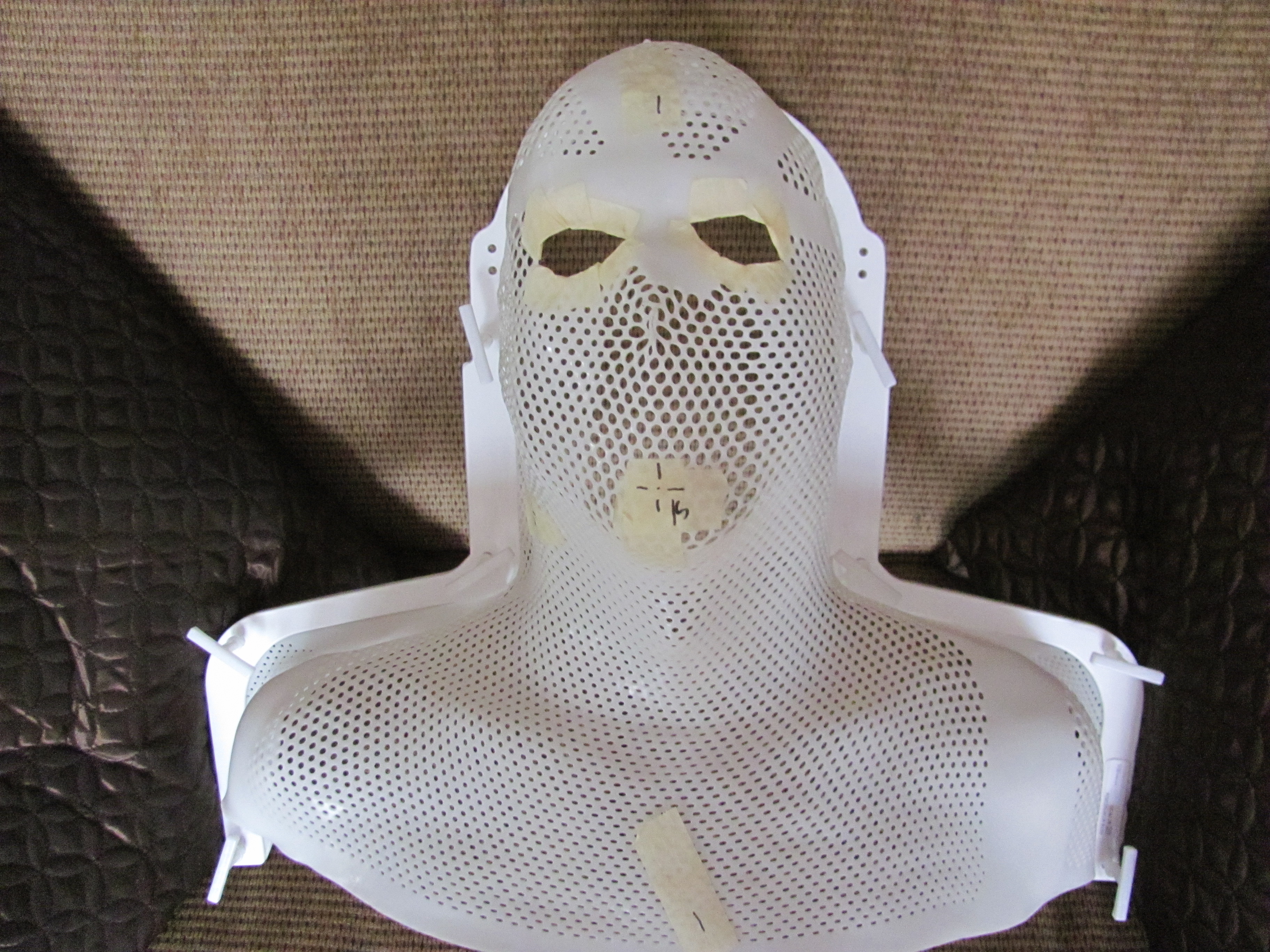
This particular oncologist was a very perky, affirming young physician.  Wearing cowboy boots, and a western cut shirt featuring mother-of-pearl snap buttons, she and her assistant in smiling upbeat tones clarified what we could expect from his cancer treatment.  She described a restraint mask, gesturing toward his imaged tumor, that she would construct.  Using the proper measurement of his jaw line and tumor dimensions, the mask would provide marked targets for the radiation laser.  Chad would have to sit for a plaster fitting soon so she could fabricate a precise mold.  The radiation would blast any unchecked cancer cells the surgery didn’t remove.

Smiling with her mouth, not with her eyes, the oncologist admitted that neck-throat-esophageal cancer is the worst type on the patient.  She elaborated her point explaining that the neck has no thick layers of skin or muscle to protect the esophagus from extensive damage.  Elaborating, the doctor continued that as soon as the tonsils were out, Chad would undergo a minor procedure to have a feeding tube placed into his stomach for sustenance.  His throat would very likely become too burned to perform a swallowing reflex.

When we arrived home I confessed to him that I didn’t think I had another crisis in me.  In my previous marriage there had been nothing but catastrophe–in this marriage we had struggled with a blended family.  Just the thought of another calamity paralyzed me from the inside out.  I honestly wanted some way to take a pass on this new one.  He just hugged me, almost in desperation, saying everything would be all right.  I wasn’t assured.