Mixed Emotions

th

It’s been uncomfortable to watch the media coverage from Louisiana about the removal of General Robert E Lee’s statue in New Orleans. As a life-long student of the Civil War the idea of removing reminders of our nation’s past somehow feels misguided. At the same time, with a strong background in African American history, I fully grasp the righteous indignation of having to see that relic in the middle of my city. Robert E. Lee’s prominence as the Confederate commander, and the South’s aim to make war rather than risk Yankee abolitionism places the General right in the crosshairs of modern sensibilities. Still, appropriating the past to wage modern political warfare feels equally amiss.

Robert Edward Lee was a consummate gentlemen, a Virginia Cavalier of the highest order. So reserved and deliberate in his life and career, that he was one of a very few who graduated West Point without a single demerit. Married to a descendent of Martha Washington, Mary Custis, Lee had American stature added to his already esteemed pedigree. (The Lee-Custis Mansion, “Arlington House” is situated at the top of Arlington National Cemetery. And yes, this General was a slave holder, however he appears to have found the institution distasteful).

When hostilities opened in April of 1861, the War Department tapped Lee first to lead Union forces, so prized were his qualities. But the General declined, stating he could never fire a gun in anger against his fellow countryman, meaning Virginians.

On the battlefield Lee was tough to whip, but he also wasn’t perfect, despite his army’s adoration. Eventually, after four years of bloody fighting, low on fighting men and supplies–facing insurmountable odds against General Grant, the Confederate Commander surrendered at Appomattox Courthouse, Virginia.

Meeting Lee face-to-face for the first time to negotiate surrender terms, Ulysses Grant became a little star-struck himself in the presence of the General, blurting out something about seeing Lee once during the Mexican War.

In a letter to his surrendering troops Lee instructed, By the terms of the agreement Officers and men can return to their homes. . .

But Robert E. Lee’s story doesn’t end there.

Despite outraged Northern cries to arrest and jail all Confederate leaders, no one had the nerve to apprehend Lee. And that’s saying a lot considering the hysteria following Lincoln’s assassination, and John Wilkes Booth’s Southern roots. The former general remained a free man, taking an administrative position at Washington College, now Washington and Lee University, in Lexington, Virginia. It was in Lexington that the General died in 1870, and was  buried.

Lee led by example, consciously moving on with his life after the surrender at Appomattox. He had performed his duty, as he saw it, and when it was no longer feasible, acquiesced. He was a man of honor. And from what I have learned regarding General Lee, he would have no problem with the removal of a statue he never wanted. Moreover, I don’t believe he would have any patience with the vulgar extremists usurping his name and reputation for their hateful agenda.

This controversy isn’t about Robert E Lee. It’s about America in 2017.

Gail Chumbley is the author of the two part memoir, River of January and River of January: Figure Eight. Also available on Amazon.
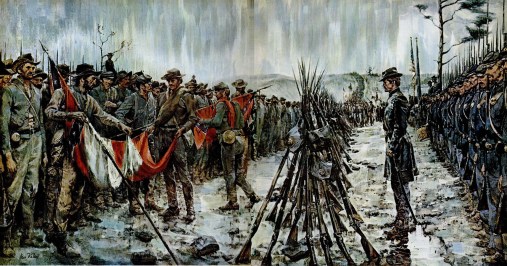
Words of Honor

appomattoxprintlarge2

Union General, Joshua Lawrence Chamberlain, in a 1901 interview for a Boston newspaper, shared his recollections of the Confederate Army’s surrender at Appomattox Courthouse, Virginia.  Tasked by General Ulysses S. Grant with the formal 1865 surrender of Rebel arms and military gear, Chamberlain described that April day in remarkably vivid detail, despite the passage of over 30 years.

“At a distance of possibly twelve feet from our line, the Confederates halted and turned face towards us. Their lines were formed with the greatest care, with every officer in his appointed position, and thereupon began the formality of surrender.

“Bayonets were affixed to muskets, arms stacked, and cartridge boxes unslung and hung upon the stacks. Then, slowly and with a reluctance that was appealingly pathetic, the torn and tattered battleflags were either leaned against the stacks or laid upon the ground. The emotion of the conquered soldiery was really sad to witness. Some of the men who had carried and followed those ragged standards through the four long years of strife, rushed, regardless of all discipline, from the ranks, bent about their old flags, and pressed them to their lips with burning tears.

“And it can well be imagined, too, that there was no lack of emotion on our side, but the Union men were held steady in their lines, without the least show of demonstration by word or by motion. There was, though, a twitching of the muscles of their faces, and, be it said, their battle-bronzed cheeks were not altogether dry. Our men felt the import of the occasion, and realized fully how they would have been affected if defeat and surrender had been their lot after such a fearful struggle.
. . . “But, as I was saying, every token of armed hostility having been laid aside, and the men having given their words of honor that they would never serve again against the flag, they were free to go whither they would and as best they could. In the meantime our army had been supplying them with rations. On the next morning, however, the morning of the 13th, we could see the men, singly or in squads, making their way slowly into the distance, in whichever direction was nearest home, and by nightfall we were left there at Appomattox Courthouse lonesome and alone.”

Gail Chumbley is the author of the two-part memoir, River of January and River of January: Figure Eight. Also available on Amazon.com

What If?

th

My students loved to play “what if,” following lessons on monumental events in my history classes. For example; what if Washington had been captured–or worse–by the British Army during the Revolution? What if the Senate had ratified the “Treaty of Versailles” at the end of World War One? Would there have been a World War Two? Or what if FDR hadn’t contracted polio? Would a walking FDR been as affective? And so on. Following these bird walks into conjecture they would look to me for some definitive answer on alternate outcomes. But I wasn’t much help. Teaching what actually happened was tough enough for this history instructor,

Still, on the 150th anniversary of President Lincoln’s death, “what if’s” might have a place . . . might provide some insight into what might have been.

We all know the story. President Lincoln, in an especially festive mood, joined his wife at Ford’s Theater for a performance of “Our American Cousin.” The nightmare of Civil War had essentially been settled with General Lee’s surrender, a week before, at Appomattox Courthouse, Virginia. The Union had been preserved, and the President had much to celebrate. Plus as many “Lincolnistas” know, our 16th president loved the theater. Stage productions became a place where a troubled Lincoln became so absorbed in performances, others couldn’t catch his attention. (As a Lincoln-lover myself, I hope “Our American Cousin” so captivated the President that he never felt a thing in his final hours).

Wilkes Booth, the pea-brained zealot who murdered Lincoln had no idea he had also killed the South’s best defender against a vengeful Congress. Had this lunatic-actor paid attention to anything besides the insanity in his head, Booth would have recognized the President as a moderate–a leader who yearned for true national unity with “Charity for all, Malice toward none.”

So, what if Lincoln, this moderate, had survived, or better yet, never been harmed? What would post-bellum America have looked like with President Lincoln at the helm? Tough to judge, but a closer look at the political situation on April 14, 1865, could provide some direction.

First of all, America would have been spared the accession of Andrew Johnson to the presidency. Bum luck for the nation to say the least. Johnson had been selected as Lincoln’s running mate in 1864 because he was a Southerner from Tennessee  who had remained loyal to the Union. Essentially a small minded, white-trash bigot, Johnson despised both the rebellious planter-elite but also newly freed slaves. On the one hand, he wanted former masters to grovel at his feet for presidential pardons, and simultaneously opposed any law that provided aid to former slaves. Where most Americans had come to trust Lincoln in varying degrees, informed Southern leaders like Alexander Stephens, freed slaves, and reluctantly, the Republican leadership in Congress, Andrew Johnson in short order alienated the whole lot.

To be fair, Lincoln was in trouble himself, with his party by 1865. But he did have some momentum going his way after General Grant’s success in Virginia. And though he pocket-vetoed a bill backed by vindictive Radical Republicans in the House and Senate, Lincoln recognized he had some compromises ahead, to settle down his critics. But, of course Lincoln died at the hands of a Southerner, unleashing zealotry on all sides.

Had Lincoln lived, harsh avenging laws aimed at punishing the South, may have taken a lighter tone. The Military Reconstruction Act, that established a military occupation of the South, the 14th and 15th Amendments may have been less forceful and strident. As an astute politician, Lincoln certainly would have avoided the ordeal of impeachment endured by Johnson at the hands of the Radicals.

Yet, there is still  much to say about the legacy of Abraham Lincoln and the “what if’s” of history. He died on Good Friday, as had Jesus, a point that wasn’t lost on the American public in 1865. Lincoln died for the cause of freedom. He died for the virtuous notion that “All Men are Created Equal.” Lincoln was crucified for the goodness in all of us, his “Better Angels of our Nature.” However, without Lincoln’s martyrdom later legislation may not have found a place in Constitutional law. The Radicals ran roughshod over Andrew Johnson’s stubborn resistance, overriding presidential vetoes that resulted in the 14th Amendment and it’s definition of citizenship with equal protection, and the Fifteenth Amendment’s guarantee of male suffrage.

Unfortunately, these amendments and other less enduring pieces of legislation were often ignored by unrepentant rebels who exacted their own punishment on freedmen. Still the body of law existed and found enforcement one hundred years later. And this same body of law came into existence because Lincoln died on Good Friday, 1865.

So perhaps the “what if” game ought to be left alone. The course of events that actually transpired built an articulate foundation of freedom, premised on human rights, that could have been otherwise absent from our nation’s history. Much as President Garfield’s murder in 1881 brought about Civil Service Reform, and JFK’s murder brought about the Civil Rights Acts of 1964 and 1965, Mr. Lincoln’s death truly gave America a “New Birth of Freedom.”

Gail Chumbley is the author of River of January available at www.river-of-january.com