Fighting Or Giving Up

A Symphony in Beeps

No dark tunnel materialized and no bright light, nor familiar voices whispering through a filmy barrier. Instead I stood on a beach in broad daylight. And I knew this beach well. The sand cushioned my bare feet while a stiff plank ran the length of my back, from my head to my ankles. “It’s a surf board” my mind explained, “see, your’e on a beach.” The location made sense. A still lake spread to my right, Cocolalla Lake in northern Idaho where I spent all my summers as a kid.

But in reality I was anesthetized, undergoing surgery at the University of Utah in Salt Lake. My colon had perforated that morning, and as I later learned my body was strapped down to a table. Still, while under I found myself in an alternative consciousness, standing on the shore of life and death.

The hardness of the board impeded easy movement, but I could shift my eyes side to side, and my feet just a little. To my left, seated on a rock wall, waited my ex-husband. That was not a good thing. Marriage to him had been difficult. He wasn’t a serious husband or father. Sadly enough his behaviors were fixed, and after our divorce he continued along his destructive path, succumbing to an early death about a year before I went under the knife. 

But at that moment he lounged on those rocks very much alive, watching me intently.

Wearing pink nylon shorts, a baggy white tank top, and flip flops, he continued to stare. Finally he spoke, “Hi Gail.” 

I reacted with contempt thinking, “Oh, Hell No!” If staying with him is what’s in store I’m not sticking around here. That’s when I shifted my eyes in the other direction, to my right where my son waited for me wading in the still, shallow water.

My son is very much alive, and I was glad to see him.

In tiny steps akin to a Tim Conway comedy skit, I made my move ignoring the guy on the seawall, shuffling instead toward my son.

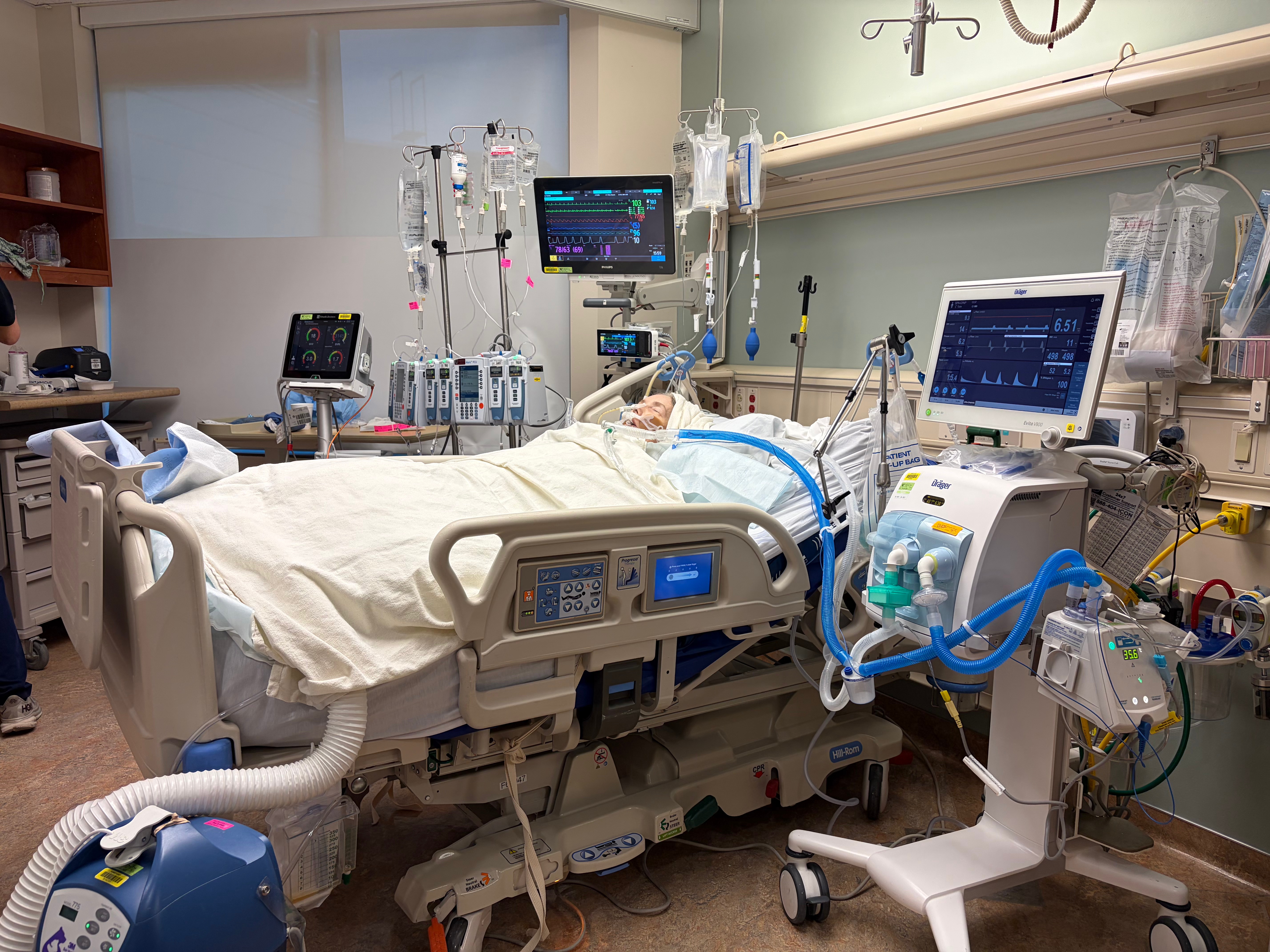
Flash to the following morning when I awoke in the intensive care unit at the U hospital. With a tube forced down my throat, my wrists tied to the side bars, my daughter stood over me with worry etched in her face. She and the ICU nurse both spoke as I struggled to convey I wanted that plastic obstruction out of my wind pipe. 

This hospital stay extended to seven days, with a repeat admission shorty after due to a related complication. The holiday season fizzled out as I was in poor shape and trying to recover..

It now has been over two months since surgery and that strange vision. The intubation tube is long gone and I am sporting a colostomy bag with a slowly healing incision down the middle of my gut. Bye bye belly button. The Home Health nurses visited every day for nearly six weeks packing gauze into two fissures pitted along an incompletely healed stomach. 

On one particular visit the nurse explained that I had indeed been strapped to a hard foam-core table in the operating room. My head, torso and legs were firmly secured down so as not to move during the procedure. But in my mind I did visit another place, a vivid locale somewhere between giving in or fighting back.

This Tuesday I will celebrate my 71st birthday, and I truly welcome the day. I have children and grandchildren who all mean the world to me. Ahead there’s athletic events, recitals, graduations, and with a little luck a wedding or two.

Besides I can’t kick the bucket right now, I must do what I can to help save the Republic and see Trump behind bars.

There is still much to do.

Biscayne Bay Syndrome

After eight long days in the ICU, days that included an excruciating extraction of his oxygen tube from his throat, grasping to remember his name, the president’s name and mine, the doctors agreed to transfer him to a regular room.  However, when the medical staff says move, they don’t actually mean it.  “Move” is code for “prepare for an unfulfilled expectation.” 

Teams of orderlies had to be placed on reserve, much like medication, liquid food, or a lab procedure.  As a part of hospital protocol, a regular room also had to be requested on the floor where cancer patients were treated.  So, again, we waited.  Chad, severely weakened, barely with the strength to move his head, drifted into and out of sleep.

To pass my time, and with some effort, I tried to read the new “Time” magazine. It was a special issue commemorating American history, featuring Benjamin Franklin on the cover, (a step in the right direction from the crap I usually consumed).  My comprehension skills limited, I looked at the pictures, and read the captions. 

After an anxious five or six hours, my husband finally moved into his new room.  Promptly a nurse’s aide came in with a bottle of something brown in her gloved hands.  Heavy set, tattooed, and very young, she cheerfully announced Chad’s bath time.  Now I wasn’t sure what I expected, but in one casual, shocking motion she unsnapped his gown and there he lay, naked, emaciated, emasculated and thankfully unaware of his condition.  Jesus taken from the cross.  Horror, shock, embarrassment, pick a word, froze me in place.  Callously robbing him of his modesty felt too much.  My poor Chad was too weakened for the embarrassment I felt for us both.

A regular in the hospital now, my face became familiar to the nurse’s station and cafeteria.  The halls antiseptically bare did feature artwork from former cancer patients.  I noticed underneath the framed pieces were the names of the artists, and their death dates.  I shuttered each time I walked by.  Another source of anguish came from watching other patients creeping along the halls, getting out of their rooms, ambulatory.  Chad’s door had caution signs saying wash your hands, wear gloves and a mask.  Another notice stated “Fall Risk.” 

Daily, the medical staff quizzed him with questions such as, “do you know where you are?”  He often answered, “Miami.”  He warmly told his oncologist that he could come along fishing on Biscayne Bay with him and his son.  Studying the nightmare from my front row seat I repeatedly despaired, “we’re never getting out of here.”  When the room finally emptied, I would try to explain to him that he lay in a hospital bed in Boise, to which he’d yell “knock that off Gail!  My son will be here soon.”

Delirium

To maintain that we fell back to sleep after talking to the oncologist, would overstate the minutes until the next phone call.  Our rest was uneasy, more trance-like accompanied by surreal images.  Soon the strained quiet shattered, when the anticipated second call arrived.  This time my sleep had been thin, and finding the phone a simple matter.  It lay where I had placed it no more than forty-five minutes earlier.  Again, for a second time that night, my girl and I lurched straight up in bed.  And for this call my voice flowed clearly, warmed up from the previous conversation.

“Hello.”

“Mrs. Chumbley?”  I am Dr. blah blah.” (Sorry)  “Your husband requires emergency surgery on his colon as a life saving procedure.  I can’t perform the operation without your permission.”

“Yes, of course.  You have my permission.  Thank you doctor.  Should I come down to the hospital?”

“This surgery can take hours.  The morning should be soon enough.”

“Thank you again, doctor.”

“You’re welcome.  Someone will call if there are any problems.”  My silent translation, “if he dies.”

I hung up the phone, and lay back down.  We both silently thought our thoughts, worried our worries, until lightly drifting off.

A thin sleep resumed.  Mine was filled the strangest dreams of the classroom, childhood friends, my parents.

Promptly, at six o’clock, I opened my eyes, just to roll over and see Catherine’s pretty blues looking straight back at me.  “We should get down there,” she whispered.

Quickly dressing, she drove me back to the hospital.  And though still very early, the day promised to be another scorcher.  She asked, “Do you want me to come up with you?”

I thought for a moment and then I told her no.  Not yet. I needed to see how he looked and what the surgeon had to say about his condition.  “You go back to bed, honey,” I encouraged.  ” I will call when I know something.”

That decision proved to be a good one.  When I found the ICU, his nurse explained to me that though he had survived colon surgery, Chad was still dangerously septic, in critical condition.  When I pulled back the turquoise curtain to his room, the body in the bed bore little resemblance to the guy I married.

This ravaged body bore testimony to his own hellish night of scalpels, staples, and anesthesia.  Now under an induced coma, his bloated and distorted figure would have better suited my earlier, anxious dreams, than the cold reality of morning.

Fear and Euphoria

The doctor told us that it would be awhile before any tests were performed on my husband.  She quietly, carefully explained that she would call me if there was news of his condition.  For the moment Chad was hooked up to a drip for pain and another for fluids.  Then this quiet, unassuming doctor made it clear we were dismissed.

Stepping outside, the three of us lingered along the broad circular drive.  The night was warm, still hanging on to the day’s exceptional heat.  I remember almost laughing when I told Carlos about the art of timing.  He unwittingly had walked into a hellish ordeal that had actually barely begun.  Making our way to the public parking area, my girl suggested I sleep at her house since it was so close to the hospital, maybe a five minute drive.  We didn’t know what the night would bring and I needed to remain close.

Soon seated in Catherine’s living room, glass of wine in my hand, I suddenly felt like me.  I somehow slipped back into my personality again when I wasn’t looking.  There was no one needing my help, no one calling my name, no one griping about how awful they felt.  For the moment I was free.  So bowed down by responsibility and fear, the absence of demands jolted me back from that alien world of caretaker.  I felt nearly giddy with my momentary freedom, not willing to contemplate what was happening in that hospital room a few miles away. Bidding goodnight to room mates, new boyfriend, and my daughter, I toddled off to bed, setting my cellphone on high.

Sleep, however remained elusive, with the adrenalin of fear, then of euphoria swirling around my mind and body.  At 1:00 AM the cell phone shrilled loudly.  I fumbled around the floor next to the bed, aware that my daughter was next to me.  Flipping the phone open, I graveled out a hoarse hello.  Catherine sat up.

“Mrs. Chumbley?  I have received he results of the CT scan and it is clear that the colon has ruptured, feces is spreading through his body.  Chad is in grave condition.  He must have surgery.  You will soon receive another call from a surgeon, Dr. ???, (I honestly can’t remember his name.)  He will perform the procedure and will require your permission.

“Should I come back?”

“I don’t see anything you can do at this point. The surgeon will call for authorization and that you can do by phone.”

“Oh, okay.  Thank you.”  I hung up.

“Maybe we should go back down,” my daughter whispered in anguish.  I thought that over.

“No.  I think we will get more sleep here than in the waiting room at the hospital.”

We drifted back off to sleep.