Hat In The Ring (2)

IMG_0955

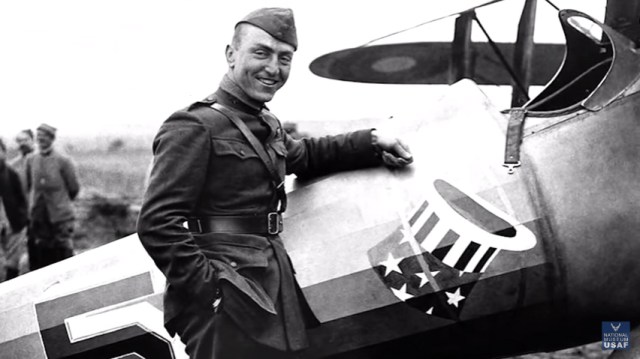
Captain Eddie Rickenbacker poses with an aircraft bearing the emblem of the 94th Aero Squadron. Image courtesy of the National Museum of the U.S. Air Force via Youtube.

This is World War One flying ace, Eddie Rickenbacker. Young Rickenbacker soared the deadly skies over France as a member of the 94th Aero Squadron. He engaged in dogfights piloting Nieuports and Spads, earning the distinction of most decorated American pilot of the war. The insignia of the 94th was the “Hat In The Ring,” seen above.

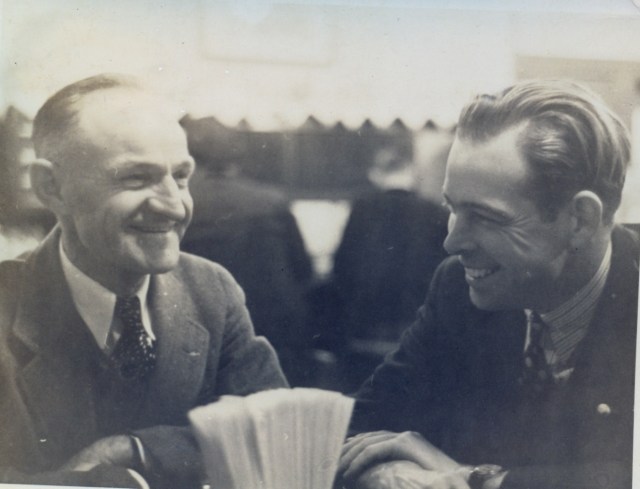
Rickenbaker0001

Here is Captain Rickenbacker in the 1950’s while he was president of Eastern Airlines. He is lunching with Mont Chumbley, a proud career pilot for Rickenbacker’s “Great Silver Fleet” from 1940 until retirement in 1969. Mont, known as “Chum” is the subject of my two-part memoir, “River of January,” and “River of January: Figure Eight.”

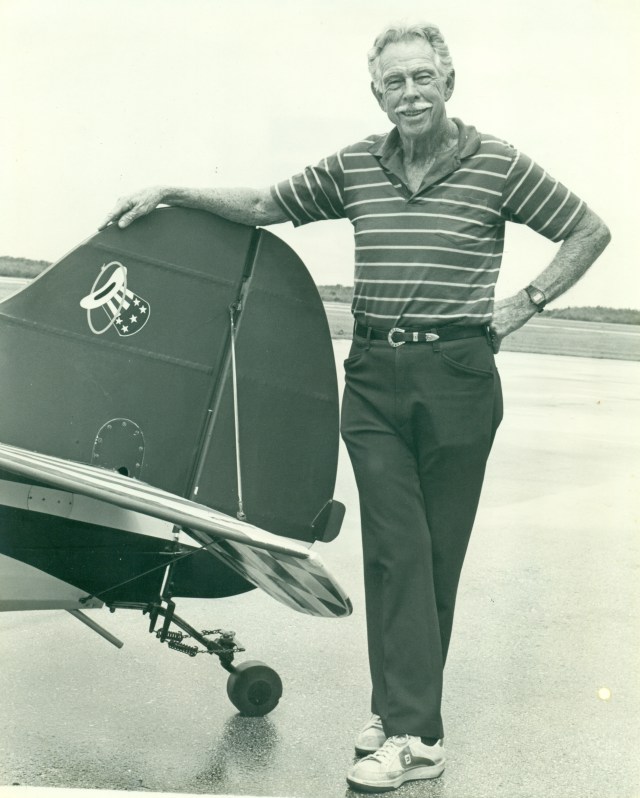
MightyMonty20001

And here stands Mont Chumbley next to his Pitts Special Aerobatic plane in the 1980’s. In memory of his famous employer, “Chum” stenciled the “Hat In The Ring” to his sports plane.

Gail Chumbley is the author of both titles available at http://www.river-of-january.com. Also on Amazon.com.


Lest We Forget

This new year begins with Americans caught in a moral quagmire. Traditional beliefs such as love of country and confidence in leadership seems to suffer from vast divisions. Our American experiment in self government has been turned on end, and what was once seen as threatening, is now open to a sliding scale of opinions. Our national values are, as sung in the musical Hamilton “Upside Down.”

I came into the world as the Cold War simmered between the US and the USSR. Khrushchev had replaced Stalin, and nuclear missiles rested uneasily, waiting for one wrong move from either side. America, caught up in the Red Scare convicted and executed suspected spies, Julius and Ethel Rosenberg. The House on UnAmerican Activities Committee, (HUAC) became the equivalent of political show trials, publicly ruining the reputations of citizens, suspected as secret Russian collaborators.

Real covert agent, Klaus Fuchs, stole nuclear secrets from the Manhattan Project at Los Alamos. David Greenglass, a physicist, turned Russian agent, and brother of Ethel Rosenberg, worked also on the Manhattan Project. English MI6 agent, Kim Philby, worked for a time in the offices of the OSS, (later the CIA) only to defect to the USSR, with all he knew of American and British secrets. American Communist and union organizer Eugene Dennis, was sentenced to five years for his affiliation with the Kremlin. Soviet spy, Whittaker Chambers renounced his Russian allegiance and became the darling of the conservative right, naming State Department official Alger Hiss as a Russian operative.

Whether true or not, many other Americans were stained with suspicion of acting as Communist agents. Joe McCarthy made a name for himself as a Commie hunting Senator. Caught in the fear were playwright Arthur Miller, screen writer Dalton Trumbo, actor Larry Parks, stage actor, Zero Mostel, movie star, Sterling Hayden, who all found their careers in tatters. Refusing to name others, HUAC branded these unfriendly witnesses as“Fifth Amendment Communists.” These accusations, for many of the accused, never washed off.

The 1950’s were dangerous years for political nonconformists.

So it is no small wonder that many Americans of a certain age are flummoxed by the denial of Russian election hacking at the highest levels of our government. This new president has repeatedly demonstrated absolutely no concern for our democracy, for fear it undermines his legitimacy. In other words he is more worried about his own hide while the most direct and sinister Russian attack ever, has infected our elective process. And worse, his band of true believers gloss over the breach as well, buying into the propagandized term of “Fake News.” Is this president truly more important than the country and people he was elected to serve? Does he understand the prime objective of Russian apparatchiks is to undermine the United States of America?

As for the members of Congress who know more of this breach, and still enable this president- is protecting your party more important than saving our democracy? Are your partisan priorities more vital than the oaths you swore to uphold the Constitution? If the answer is a blind yes, then what was the point of the suffering of that earlier generation—the ruin of artists and free thinkers, the brutal crimes of the guilty? The 33,000 loyal Americans who died fighting Communism in Korea? Or the 58,000 boys who were killed fighting the pro-Communists in the jungles of Vietnam? Are these past sacrifices meaningless in light of current political expediency? Are you going to shout ‘fake news’ while giving away our sovereignty?

America has a vibrant, if not an often difficult history. We who love our country would like a future, as well.

*It wasn’t the Ukraine, either.

And He Stood Up

th

This post is a reprint from a few years ago. They young men mentioned are now other places in their careers. Their names are used with permission.

Asked by my old high school, I had the privilege of speaking to young people on the eve of Veterans Day. My remarks appear below.

Thank You for inviting me today—It’s good to be back at Eagle High.

On October 23rd, a few weeks ago, U.S. Master Sergeant Joshua Wheeler of Oklahoma was fatally wounded in a rescue mission freeing Isis-held hostages in Iraq. He died after rushing into a firefight to support the allied Kurdish soldiers he had trained and advised. Secretary of Defense, Asthon Carter, later described the chaotic events that cost this soldier’s his life.

“As the compound was being stormed, the plan was not for U.S. … forces to enter the compound or be involved in the firefight. However, when a firefight ensued, this American did what I’m very proud that Americans do in that situation . . . he stood up and ran toward the sound of the guns. All the indications are that it was his actions, and that of one of his teammates that protected those who were breaching the compound [making] the mission a success.”

The death of Master Sergeant Wheeler spared the lives of 70 Isis-held prisoners scheduled for mass execution the following morning.

Wheeler ran to the sound of the guns. Now I can’t speak for our service men and women, and when I was asked to give this talk, I had to confer with those who have made that solemn commitment. My questions were misleadingly simple . . . why did you choose a military career? What persuaded you to risk yourself for potentially dangerous service?
I wanted to try and understand that burning force of purpose, of unquestioned focus to duty, detach from self preservation for the welfare of others. I wondered how personal fear could be swallowed when, as Secretary Carter explained, “Wheeler involved himself in the firefight.” Where does this nobility of character draw from? Where do these individuals come from—the few that can’t sit on the sideline when duty calls them from their homes?

The answer, strikingly enough, is right here, in this auditorium. Home. Here. No, not someone else from somewhere else. Here. And people, that is where America has always found It’s defenders, from every town and city.

A number of Eagle students have, from many graduating classes, chosen the disciplined military life. Once wiggly kids who, warming the same seats you now occupy, resisting, as you most surely are, the urge to check your cell phones, daydream about the newest version of Xbox, or wonder if Bogus Basin ski hill will open before Thanksgiving. They were kids just like you.
Now I don’t pretend to know the name of every Eagle Mustang who has volunteered for service, but I’d like to mention a few.

After earning a college degree as a civilian, 2004 EHS graduate Captain Greg Benjamin was commissioned an Infantry Officer, sending him north to Ft. Wainwright in Fairbanks, Alaska. From this first posting, Greg has served, so far, two Central Asian tours, first in southern, then in eastern Afghanistan. He wants you to know that he loves the training opportunities he’s experienced so far–Ranger School, Airborne, and Air Assault Schools, and leadership training. When I asked Greg, now married with small children why he chose to place himself in harm’s way, he replied, “I want to take the fight to our country’s enemies, leading America’s finest young men and women in combat and training. And change the lives of people in some of the worst places on the planet.”

Captain Joe Peterson, EHS class of 2005, made his decision after high school too. “I had a number of teammates from Eagle’s Lacrosse team, one year ahead of me, go to a service academy . . . and this kicked-off my thought process in a serious manner. I’d always held the belief of service, but this made the choice tangible for me . . . I received an invitation to visit the University of San Francisco and their ROTC department. I decided to accept.” Joey was posted in installations ranging from Fort Sill, Oklahoma, to Ft. Lewis, Washington, across the Pacific to South Korea, and Central Asia as a platoon leader in Kandahar, Afghanistan overseeing all aircraft and artillery surrounding that area. Reflecting for this talk Joe added, “It was trying at times, but . . . I am proud of my service and it added a value and perspective to my life . . . it has opened doors that are unbelievable.”

Second year West Point Cadet, Colt Sterk described his heartfelt desire to be part of something he termed, “Larger than myself.” Cadet Sterk, EHS class of 2013 explained, “When I was 14 I was given the honor of presenting a wreath at the Tomb of the Unknown Soldier, (in Arlington Cemetery). The nameless soldier in that tomb willingly lay down his life for me, a stranger. I felt a debt of gratitude. Since then I’ve always felt I was called to serve. A senior cadet told me when I was a freshman, ‘Colt in everything you do leave a footprint.’ By that he meant make an impact even if it’s only a little bit. Is it hard? Absolutely. But I know it’s where I’m meant to be.” Colton wants you to know that he visited Israel last summer for ten days studying the Israeli Palestinian conflict, and the implications in that region for the United States, and for the US Army. This semester Colt is attending the US Air Force Academy in Colorado Springs, Colorado on cadet exchange—jumping out of airplanes, and on gliding tactics. He just earned his jump wings after completing the requisite five jumps.

Colby Hyde, EHS Class, 2010 shared a different response. He said, “We are fortunate in this country that military service is not an obligation. We are unfortunate, however, in that we do not often appreciate the sacrifice of those who volunteer on our behalf. Eventually I realized that I didn’t want to be comfortable. Comfort leads to boredom and ignorance, I thought, and life is too short to accept either of those. When someone suggested applying to West Point, I could not resist. I applied, was accepted, and have never left. My life now is not comfortable by any means, and I know the hardships are yet to come. That said, I am more satisfied with my life than I ever was before. I have taken part in New York City memorials for fallen 9/11 responders, and traveled with active duty units to the deserts of Death Valley to help them prepare for combat in Afghanistan. I have traveled across Southern China, can speak, read, and write Mandarin Chinese.

I am thankful for everyone who has served me along the way, from my parents to my teachers, and I only hope I can return the favor in the years to come.” At the end of his letter, Colby added, “I have not done anything for our country yet, but I promise I will. Cadet Colby Hyde graduates from the Military Academy at West Point in 2016.

Tomorrow is Veterans Day. Now I am not here to tell anyone to enlist in military service. Truly, the life of a soldier, marine, or sailor isn’t suited for everybody. At this point in your life you should be dreaming about double diamond ski runs, video games, and Harry Potter marathons with your best friends. And also, to be frank with you, that depth of courage and commitment to duty blooms in the hearts of only an extraordinary few.

What I do want you to reflect upon when you exit this auditorium is that Captain Greg Benjamin, Captain Joey Peterson, Second year Cadet, Colton Sterk, and third year Cadet, Colby Hyde, and many, many other Eagle High School alum have solemnly sworn to protect you. And consider as well, that this oath assures these few will run toward the sound of danger–for us—just as Master Sergeant Josh Wheeler of Oklahoma.

We have remained the land of the free, because we are also the home of the brave.

Gail Chumbley

So Simple, So Basic

Napoleons-death-1024x714

Some social media platforms I’ve read lately insist public schools no longer teach this particular lesson, or that particular subject. And since I was a career history teacher, I want folks to understand that that isn’t necessarily the whole story. If your kids aren’t getting what you believe is important, the problem doesn’t lie in the public classroom. But before I delve into the obstacles, I’d like to describe a slice of my history course.

For sophomores we began the year with the Age of Discovery. As part of this unit students mapped various Native Cultures, placing the Nootka in the Pacific Northwest, and the Seminole in the Florida peninsula. Southwestern natives lived in the desert, while the Onondaga hunted the forests of the Eastern Woodlands. From that beginning we shifted study to Europe, with the end of the Middle Ages. In the new emerging era, Columbus sailed to the Bahamas, and changed the world forever. By the end of the first semester, in December, America had defeated the British in the Revolutionary War, and a new government waited to take shape until the second semester began in January.

We covered it all. And did the same for the rest of the material, closing the school year with the Confederate defeat at Appomattox Courthouse, and the trial of Reconstruction. And that was only the sophomore course.

The story of America grows longer everyday, and that’s a good thing. It means we’re still here to record the narrative.

The drawbacks? Curriculum writers, in the interest of limited time, have had to decide what information stays and what is cut. For example, pre-Columbian America, described above, was jettisoned in order to add events that followed the Civil War. In short, where we once studied Native American culture in depth, we now focus on the post-Civil War genocide of those same people. What an impact this decision has left upon our young people!

When I was hired in the 1980’s our school district had one high school. Today there are five traditional secondary schools, and also a scattering of smaller alternatives. The district didn’t just grow, it exploded. To cope with this massive influx of students, administrators reworked our teaching schedule into what is called a 4X4 block. Under this more economical system, teachers were assigned 25% more students and lost 25% of instruction time. We became even more restricted in what we could reasonably cover in the history curriculum. (I called it drive-by history.)

On the heels of this massive overcrowding, came the legal mandates established by No Child Left Behind. Students were now required to take benchmark tests measuring what they had learned up to that grade level. Adult proctors would pull random kids out of class, typically in the middle of a lesson, often leaving only one or two students remaining in their desks. These exams ate up two weeks during the first semester, and another two weeks in the Spring.

If that wasn’t enough, politicians, and district leaders began to publicly exert a great deal of favoritism toward the hard sciences, especially in computer technology. So considering the addition of new historic events, overcrowded classrooms, tighter schedules, and mandatory exams, the last thing history education needed was an inherent bias against the humanities.

Public education was born in Colonial New England to promote communal literacy. Later, Thomas Jefferson, insisted education was the vital foundation for the longevity of our Republic. Immigrant children attended public schools to learn how to be Americans, and first generation sons and daughters relished the opportunity to assimilate. In short, enlightened citizenship has been the aim of public education, especially in American history courses.

So basic, so simple.

If indeed, history classes provide the metaphoric glue that holds our nation together, we are all in big trouble. And the threats come from many sides. When our public schools are no longer a priority, open to all, we are essentially smothering our shared past.

Teachers cannot manufacture more time, nor meet individual needs in overcrowded classrooms. And both of these factors are essential for a subject that is struggling to teach Americans about America.

As Napoleon lay dying in 1821, he confessed his own power hungry mistakes, when he  whispered, “They expected me to be another (George) Washington.” Bonaparte understood the profound power of the American story.

And so should our kids.

Gail Chumbley is the author of the two volume memoir, River of January and River of January: Figure Eight. Both available at http://www.river-of-january.com and on Kindle.

Beloved #392


“So buddy, I was wondering if you have any plans tonight,” Fred Murphy said as the Mariner throttled to the Alameda dock. “It’s nice to head over to San Francisco when the opportunity presents.”

“What did you have in mind, Murph?” asked Chum.

“Is that a yes? Because there is this place pilots really like—but it’s a kind of a surprise, and you’re gonna have to trust me.”

“You, Fred? Trust you? Should I pack my service revolver?”

“Just trust me, Chum.” Murphy smiled.

That evening, a yellow taxi crawled up the steep incline of Telegraph Hill in the drizzling rain—Coit Tower front and center in the foreground. From his vantage point in the cab, Chum studied the illuminated monument—the raindrops and the wipers making it an abstract, streaky blur one moment, a defined structure the next. Their cabbie downshifted, doubling horsepower for the uphill climb to a line of apartment buildings stacked along Montgomery Street. The taxi stopped at a plain stucco building, the simple design a contrast from the adjoining buildings with ornate wrought iron balconies. Murphy paid the cab fare.

“This doesn’t look like much of a nightclub, Fred,” Chum remarked.

“Trust, remember? Besides, this is the best place in the Bay Area for fellas like us, pal. You just wait—she’s gonna love you.”

“You know I’m married, Fred.”

“Ha! Funny, Chum. So am I.”

The men ducked under the stoop and Fred gave a quick knock on the door. After a moment, a small Asian woman opened the door. She’s smaller than Bertha, Chum thought. The maid maybe?

“Lieutenant Murphy! Welcome back, welcome back,” The woman’s smile transformed in warm recognition. “You have escorted someone new to meet me, I see. Is he as skilled as you, my dear lieutenant?” Chum felt his jaw drop. Murphy laughed.

“Hello, Mother.” Murphy stooped and pecked the woman’s cheek.

Under her wire-framed spectacles, “Mother” shifted her appraising eyes back to Chum. “Welcome to my home, Lieutenant. And you are . . . ?”

Still unsure about why he was there, Chum stumbled over his answer. “Chumbley, ma’am. Lieu . . . Lieutenant Montgomery Chumbley. But please call me Chum.”

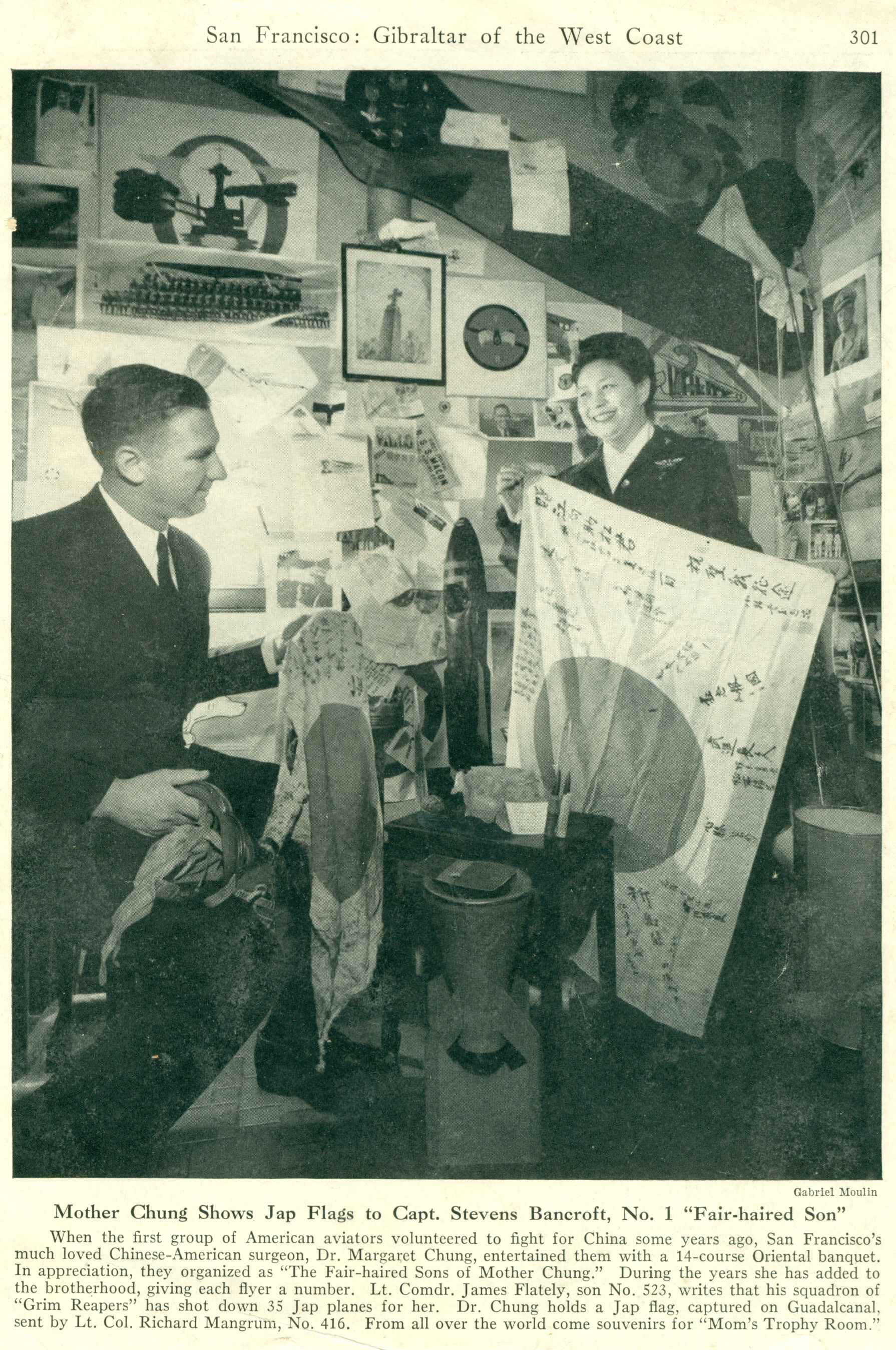
“Delighted to meet you, Lieutenant Chum. I can see that Fred did not prepare you for this visit.” Mother’s eyes returned to Murphy, conveying a light reprimand. To Chum she said, “I am Doctor Margaret Chung, but as you have already witnessed, all my sons refer to me as ‘Mother.’ Lieutenant Murphy has brought you here tonight to not simply meet a nice Chinese lady, but—I would guess—for your formal adoption into my family. Please come in, come in.” Dr. Chung gestured down a long, cluttered hall, and the two pilots complied.

Presented with such a confusion of artifacts, it was hard to know where to look first. Framed glossies of smiling aircrews, salvaged pieces from Nakajimas and Zeros—propellers, pieces of fuselages, wings—graffiti-strewn flags bearing the distinctive rising sun, spent torpedo casings, Hellcat and Corsair unit insignias, and hundreds of news clippings and snapshots of smiling pilots . . . her walls a chaotic collage of air war memorabilia. Dr. Chung studied Chum’s incredulous face as he absorbed the massive collection, visibly pleased with his reaction.

“Please find a seat, gentlemen, and allow me to explain my haphazard museum to our guest,” Dr. Chung said. Chum slumped into a stuffed wingback chair, his eyes still sweeping the memorabilia. “As you already know, Lieutenant Chum, China is presently suffering under the cruel occupation of the Japanese Empire. You need look no further than the barbarism that took place in the city of Nanking to understand my natural revulsion.”

Chum nodded. He had seen newsreels of the butchery in that city.

Dr. Chung’s eyes reflected both tragedy and determination. “I have made it my mission to raise not only awareness but also funds for the suffering people of China. It is men like you, our skilled pilots, who are striking most directly against the foe, and that kind of bravery has made you one of my dearest sons.”

Dr. Chung dropped her gaze and reached over to an end table, picking up a leather-bound ledger. She shuffled through the pages, passing inscribed signatures, finally chancing on a blank space. Holding her fountain pen, Mother began scribbling into the register. “There—done.” She glanced at Chum. “You, Lieutenant Chum, are now officially a member of the Fair Haired Bastards. Ah, let me see”—Dr. Chung silently calculated—“you are son number three hundred and ninety-two.”

She extracted a small card from a drawer in the end table and carefully filled in the blank lines. Finished, the surgeon rose and, with a handshake, presented the card to her new visitor. Chum read:

This is to certify that

Montgomery Chumbley

Is a member of Dr. Margaret Chung’s Fair Haired Bastard’s Club, San Francisco

                                                                                         Margaret J. Chung MD

Her intense eyes softened, her smile gentled. “Remain safe in those dangerous skies, Lieutenant Chum. I don’t want to lose any more of my sons.”

Chum glimpsed over to his co-pilot, then back to his exceptional hostess, grappling for something to say. “Thank you, ma’am. This is an unexpected honor, and I will do my best to defeat our enemy.”

At that, Dr. Chung beamed, offering the boys a beer. More relaxed, the doctor inquired about their aircraft, their primary duties, and what they had seen of the fighting.

“Doctor Chung, ma’am,” Chum said, still inspecting the cluttered walls. “I just have to ask. Who is Fair Haired Number One?

“Ah.” She nodded, producing a wry smile. “An excellent pilot, and he’s from this area—from San Francisco. You may know him, Lieutenant Chum. His name is Lieutenant Bancroft, Stevens Bancroft.”

Of course he is. Chum threw his head back and laughed. “Oh yes, I know him, ma’am.

Gail Chumbley is the author of the two-part memoir “River of January” and River of January: Figure Eight.” Books are available at www.river-of-january.com and on Kindle. 

gailchumbley@gmail.com

That Kid in Class

101218-A-5917D-118-rev(2)
This piece comes from a former student, Second Lieutenant. Cyrus Cappo, USA, West Point Class of 2017.
It is your right to be outraged, or offended, or annoyed by the anthem protests going on around the country today. And in these days of unprecedented access to the megaphone of social media it is your privilege to voice that outrage to estranged family members and friends from high school and coworkers and anyone else you happen to be Facebook friends with.
“It shows disrespect to the troops!” you might say through gritted teeth while furiously pounding on keys, your heart rate steadily increasing to unsafe levels about men who play sports silently and peacefully protesting their race’s treatment as second-class citizens and a President who reserves more fury for them than actual white supremacists and anti-semites. It would be your right to take such a bold and well-thought out stance, maybe even adding that this “the snowflakes have gone too far, I can’t even be safe from the tyranny of this PC culture watching a football game!”
But maybe, you my hypothetical example, could consider that standing for a flag that means many different things to many people isn’t actually what it takes to support your troops. And shockingly, neither is decorating for the Fourth of July, or sporting neat little patriotic bumper stickers and t-shirts, or even shaking a soldier’s hand to thank him or her for their service.
Bear with me, because I know this is a bit of a stretch, but just maybe supporting the troops means voting for politicians who don’t support never-ending wars without any clear objective, and that actually increase the rate of radicalization and terrorism at the low low cost of over 7000 American lives and the even lower cost of millions of middle eastern civilian lives, while simultaneously destabilizing multiple countries that allow for organizations like ISIS to gain power and a dictator like Assad to gas his own populace. That would be something I could be convinced to be outraged about. Maybe you could donate some of your time and money to organizations that are trying to prevent 22 veterans a day from killing themselves due to PTSD and the complete glut of financial and medical support that veterans receive, or if you own a business, you could even go out of your way to hire a veteran so they don’t become homeless as a thanks for their years of service. Maybe you could write a letter to a soldier who is deployed in the name of protecting, um, something something freedom, or send him or her a care package to make a day that could be their last a little less bleak.
But yikes, that would be hard and inconvenient and require some introspection and research and pure, unadulterated thought, and who has time for that, am I right? Much easier to voice outrage about football players exercising their right to protest, and using their platform of privilege to try and make the country a little bit more equal for all of us. Thank you for your tremendous sacrifice of not watching football this weekend, our country is better for it. Don’t forget to put the flag up and plan your cookout for Veterans Day, I look forward to seeing you the next time you shake my hand to thank me for my service.
Feel free to do any proofreading, this was written in bed and out of total frustration haha, I’m glad you liked it.
Cheers,
Cyrus

September 1, 1939

A civilian pilot learns of war.

17881034_303

Los Angeles

1939

On a sunny morning at the first of September, Chum arrived in the town of Winslow, Arizona, bumping down the landing strip at the airfield. Taxiing off to the side of the field, he observed a crowd collecting close to the control tower. Curious, he rolled to a stop, switched off the Waco, and hopped down. “What’s cooking?” he asked no one in particular.

A boy in greasy dungarees and black high-tops chirped up excitedly. “The Germans invaded Poland, mister. And England and France have declared war!” The boy beamed proudly, satisfied with reporting such important news.

Astonished, Chum stared blankly at the kid—countless considerations flooding his thoughts. Poor Helen. She’s been worried about what would happen. She loved France. I’ll probably be hearing from the reserves. We’re not in yet, but it’s only a matter of time.

While various scenarios dominated his thoughts, Chum refueled his plane. He then carried on with his flight plan, eventually touching down in Albuquerque—his destination. With his Waco S Series plane tethered to the ground, the pilot beelined to the small airport office, anxious for any news. The day had grown hot, but Chum barely noticed. He needed water, but the news came first. Approaching a low, dark building, he heard a voice booming from a radio:

At dawn, with no provocation or declaration of hostilities, the German army has invaded Polish territory, ruthlessly violating the country’s national integrity. Intensive bombing attacks are at this moment raining death and destruction over the cities of Poznan, Wroclaw, and Danzig resulting in considerable casualties among innocent civilians . . .

“Hey, Coop,” Chum called, hailing the manager. “What’s all this about marching Germans?”

“Been waiting on you, Chum,” the man called Coop replied, turning down the news broadcast. “Got a cable here for you from Troy. And that breaking news is all too true, pal.” Coop gestured toward the radio with his thumb.

Mumbling thanks, Chum unsealed the telegram, tuning out the now-muted announcer. He read:

Finish Albuquerque demo. Then to Troy. Big meeting. Perry

“They want you back at the nest, I’d wager,” the manager said with a knowing expression.

“Yes. Yes they do. All hands on deck, as the saying goes.” Chum tried to smile.

“Jerry’s hit Poland hard,” Coop continued. “First their heavy bombers, then the tanks, then the army marching in. Poor Poles. They don’t stand a chance. Radio announcer called the attack blitzkrieg.”

The word didn’t click. “What’s a blitzkrieg?”

Coop replied in a dark voice, “Lightning war.”

Gail Chumbley is the author of the two-part memoir, “River of January,” and “River of January: Figure Eight.” Both books are available at http://www.river-of-january.com, and on Kindle.

gailchumbley@gmail.com

The American Gentry


Note: My students used to ask how the planter aristocracy persuaded poor whites to fight for their interests in the Civil War. I think the answer lies in the power and position that the underclass envied and hoped to attain.

Please permit me to reintroduce these four figures from America’s antebellum period.

Thomas Jefferson Best recognized as the author of the Declaration of Independence, the third president of the U.S., and the man behind the 1803 purchase of the Louisiana Territory.

Andrew Jackson The celebrated hero of the Battle of New Orleans, noted Indian fighter, and seventh president of the U.S.

John C. Calhoun Congressman, turned Senator from South Carolina, who served two separate administrations as Vice President.

Jefferson Davis, a former soldier in the Mexican War, one-time Secretary of War, and later President of the Confederate States of America.

These four men forged political careers prior to the Civil War that fully embraced the social norms of early America. To a man, all hailed from the Old South, where each man shaped distinguished reputations, built spacious mansions, entertained illustrious guests, all on the backs of slave labor.

Ironically if one asked these men’s occupation, not one would have mentioned politics. Instead, each would have replied, “I am a farmer.”

To modern ears that answer feels a bit misleading and absurd. However, in the early nineteenth century, exercising dominion over large tracts of land, and cultivating crops as far as the eye could see, was viewed the most noble and honorable of pursuits. But a gnawing truth lay behind the practiced manners and broad, fertile fields. A profound self deception had also taken root, sowing an overblown sense of racial superiority, and human oppression of nightmarish proportions.

That these “farmers” were all slave masters is the cruel truth–Lords of the Lash, who derived a living “wringing their bread from the sweat of other men’s faces,” (As Lincoln so eloquently phrased).

These four planters also minimized the brutal underpinnings which sustained each man’s fiefdom. Jefferson, Jackson, Calhoun, and Davis capably hijacked, and sheltered behind “republican virtues,” including freedom and the social contract to suit their own interests.No higher authority held any sway over these planters–they were marked as privileged.

The patriarch of this sophistry was Thomas Jefferson.

Esteemed as the “Sage of Monticello,” Jefferson brilliantly articulated a vision of America where all lived freely upon private land, untroubled by outside interests. Residing upon acres of personal liberty, this master managed his estate immune from any overreaching government. For Jefferson, he and his fellow planters were the “natural aristocrats,” of the new nation, meaning they held the only legitimate claim to power. Only the elite of the community, like Jefferson, knew what was best for all.

The Sedition Act, passed by Congress in 1798, moved Thomas Jefferson to show his true political colors. President John Adams had wanted to silence political critics of his administration, and jammed this dubious legislation through Congress. In reply Jefferson authored a protest titled the “Kentucky Resolution.” In his tract, submitted to the Kentucky Legislature, Jefferson introduced the concept of ‘nullifying’ Federal law. Specifically, when a majority of state delegates, assembled in special convention, renounced a Federal statute, the law was rendered null and void within that state.

For the first time, in one pivotal moment, Jefferson’s insidious principle found its way into the bloodstream of American politics.

Ironically Andrew Jackson didn’t care for the intellectual, and philosophical Jefferson. Still, despite temperamental differences, Jackson did share Jefferson’s world view of complete dominion over his land and “people.” A ferocious master, Jackson answered to no civil law, but his own. Dabbling in both horse and slave trading, Old Hickory frequentlyoften challenged any man who questioned his conduct or honor.

To his credit Jackson did not pretend to care about high brow thinking or civic virtue. His philosophy was simple; the master was never wrong.

Before Senator John C. Calhoun of South Carolina soured into a states’ right’s militant, his political outlook had been national in scope. With unusual candor a very young Congressman Calhoun self-consciously confessed that slavery was a “necessary evil,” vital to South Carolina’s prosperity. But his marriage to a wealthy Charleston cousin elevated his social status, which in turn, adjusted Calhoun’s thinking. Assuming the role of a gentleman, while cultivating a prominent political reputation, Calhoun also became a slave master. Much like Jefferson’s Monticello, or Jackson’s Hermitage, Calhoun’s plantation, Fort Hill, was an ever-expanding operation, endlessly renovated using teams of slaves who also tended his fields.

In 1829, as Jackson’s new Vice President, Calhoun quickly butted heads with America’s new President. Steadily embittered by Jackson’s arbitrary, monarchial style, and indifference to law, Calhoun resigned the vice presidency and returned to Fort Hill an angry man. His stance on slavery hardened as well, leaving him a vitriolic defender of the practice. Under increasing pressure from Northern abolitionist, Calhoun, picked up his pen and insisted that slavery was not evil after all, but a ‘positive good.’

When Congress passed a protective tariff for northern goods, this former Vice President organized a state convention to fully resist the new Federal law. Calling his defiance “nullification,” Calhoun put into action Jefferson’s “resolution” that refused obedience to Washington.

Fortunately this particular crisis was averted by cooler heads in Congress, delaying the curse of fraternal bloodshed for a later generation.

By 1860 nullification had bloomed into full secession. No longer would the planter class tolerate insults or challenges to their natural superiority and authority.

It came as no surprise when South Carolina became the first of the eleven states to secede from the Union. Delegates attending a state convention in Columbia did not wait for the final electoral results to reject the election of Abraham Lincoln. So enraged were these aristocrats that Lincoln’s name had not even appeared on the ballot in most southern states.

I’ve added Confederate President Jefferson Davis to this piece because of his later role in perpetuating the genteel myth of the South. After four years of bloody battle and countless bullets finally settled the issue of Federal authority, Davis, released from jail began a writing career. He first penned, The Rise and Fall of the Confederate Government, followed later by A Short History of the Confederate States of America. In both of these works, Davis invented a romantic world of gentlemen, belles, and contented slaves in the fields. The fantasy was bunk, but Davis, the onetime master of of Belvoir, and Brierfield, Mississippi, somehow got in the last word.

Davis’s fanciful yarn was only concocted as a charming fable to disguise a legacy of hubris, power, greed, hate, racial exploitation, and violence.

In answer to the question posed by my history students, poor whites defended the southern gentry because they wished to live just like them.

Gail Chumbey is the author of the two-part memoir,  “River of January,” and “River of January: Figure Eight,” available on Kindle.

gailchumbley@gmail.com

Thanks for Noticing

“River of January,” and “River of January:Figure Eight” have garnered some recognition. Find out why today. Click this link www.river-of-january.com, and order your own copies, personally signed by the author.

Award winning history instructor, Gail Chumbley is the author of the two-part memoir River of January and Figure Eight.