Support Our Troops?

If we forget what is the past worth?

gail chumbley's avatarGail Chumbley

Image

The armistice ending World War One, also known as the “Great War” was signed on this day in 1918.  The idea behind Armistice turned Veterans Day, was to remember the price paid by servicemen living and dead.  A visit to Arlington Cemetery provides a sobering, powerful lesson in the extraordinary price paid by those who gave ‘Their Last Full Measure’, to quote President Lincoln.

Row after  exact row, rank and file marble headstones arc the green, rolling acreage of Mary Custis Lee’s childhood plantation. Surveying this overwhelming vista, proof of the price paid by those in arms raises a difficult, perhaps unanswerable question. How can Americans best provide solace, comfort and justice for our fighting men and women?

One option is pictured above.  While I was still in the classroom, my History Club provided Christmas gifts for those on duty overseas. We wrapped, labeled, and itemized customs slips–mailing…

View original post 351 more words

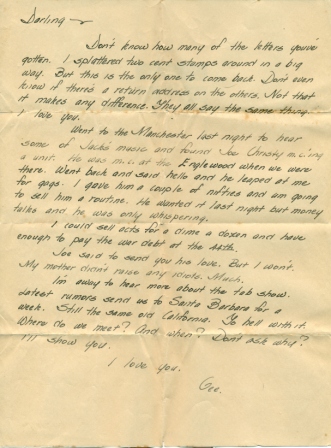
Darling, I love you, Gee

GrantLetter0001

Peppered through the vast family archive used in the writing of River of January, exist three special sets of letters. Though largely filled with conventional chatter and sentimental superlatives, these documents also provide a fascinating peek into another time and place–of a nation suffering through economic free fall, and perched on the threshold of war.

The letters frequently mention the turbulent state of international affairs, from fascist Italy, to the Spanish Civil War; episodes that eventually and inevitably led to the Second World War. Even more ink is expended discussing the difficult economic situation stemming from the fallout of the Stock Market Crash–securing theater bookings, closing business contracts, and aviation training in a downsized Navy. Still, aside from the monumental, most of the content reported simple day to day life, shared with humor and concise observations. From their correspondence these men clearly promoted themselves, vibrantly rising from the faded and yellowing paper.

The first are a series of letters mailed from a Hollywood address, composed by comedy writer, Grant Garrett. (See above). The second collection, posted almost exclusively from Europe, came from the hand of a 28-year-old Belgian entrepreneur, Elie Gelaki. Serious and painfully formal, Elie’s letter reveal a methodical mind, clearly continental in manner with a determined nature. Finally, the last, and largest collection came from Mont Chumbley, Virginia farm boy turned aviator, who looms largest in the memoir. His writing reveals a practical, warm, and straightforward young man who expressed himself in plain language.

Despite definite differences in style, these three writers did share many qualities. All were deeply ambitious, establishing successful careers in the particularly difficult years of the Great Depression. They were clearly literate and educated, in a time when many (at least in America) did not regularly attend nor graduate from secondary school. These letters rise from the ordinary, written with distinctive originality, candor, and technical accuracy.

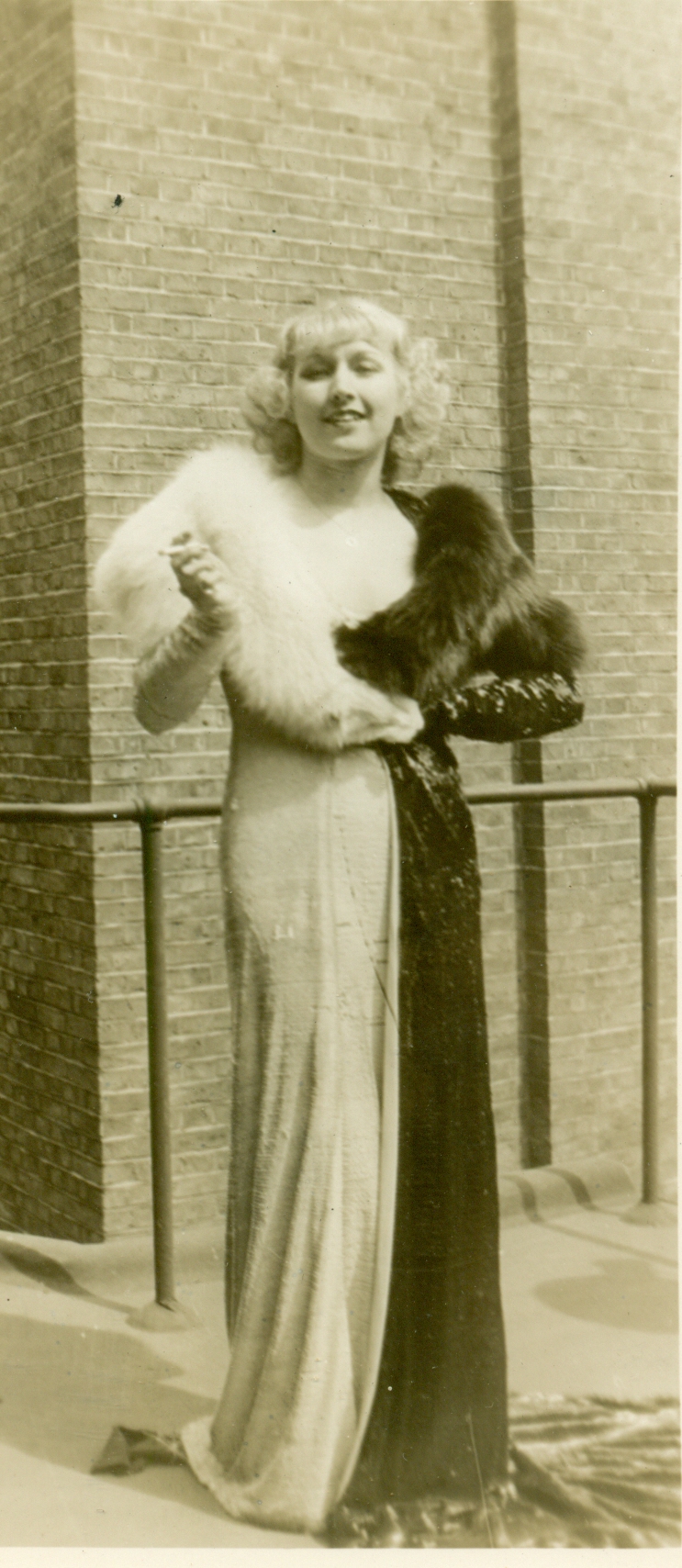
The link that tied this portion of the archive together was the beautiful New York dancer who received each letter, and preserved them all, Helen Thompson.

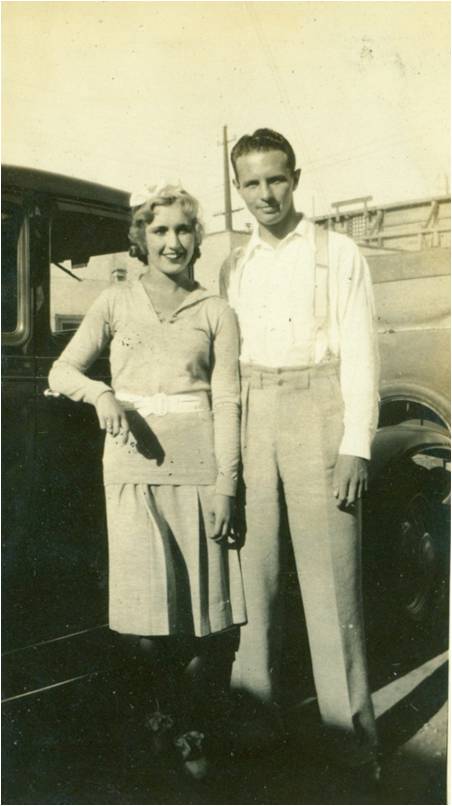
Garrett&Thompson

Grant Garrett became Helen’s first heartthrob. A native of Los Angeles, Garrett was a regular script contributor to radio shows and vaudeville acts. A talented singer and dancer in his own right, he interviewed Helen to partner with him for an upcoming tour across the country in 1931. After their junket ended, she returned to New York, and he returned to Hollywood. Now in love, the couple exchanged a series of clandestine letters, (her mother forbade Helen to see him again) with only Grant’s compositions still surviving today.

For a nineteen-year-old girl, Grant was hard to resist. Moody, smart, and funny . . . he was the essence of the tortured poet, a perfect combination of beauty, pain and passion. Of her suitors, Grant was the only one who shared her profession, and their time together forged a strong, and influential bond. Helen’s association with Grant provided something of a professional finishing school for her. From Grant she learned to laugh through tough times, and push through adversity because “the show must go on.”

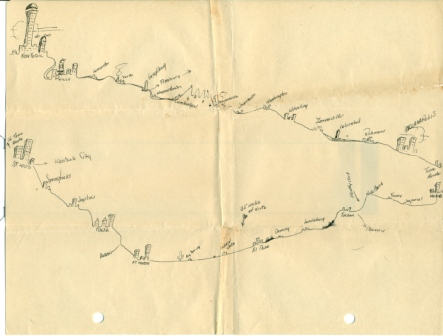
GrantMap0001

Grant’s whimsical map of a planned Garrett & Thompson reunion tour.

Next time, Belgian, Elie Gelaki.

Read more about Grant Garrett, Elie, and Mont Chumbley in River of January, available in hard copy and on Kindle.

Wounds

gail chumbley's avatarGail Chumbley

th

Rereading the original draft of my book, River of January, I reviewed the back story that propelled the book’s creation. An impossible crisis pushed me to write the work, but that narrative was cut out of the main manuscript due to length. But I still believe that the story behind the published story is important to share.

The Intensive Care Unit was the largest department on the third floor of the hospital. Reflecting back I never did figure out which direction the ward faced. Was it north toward Boise’s golden foothills or south over the blue turf of the football stadium? Someone needed to open the blinds.

The floor plan in the ward ovaled around like a carpeted arena, anchored by a nurses’ station in the infield. Three quarters of the broad ring had been segmented into tiny stalls–narrow spaces housing mechanical beds. My husband’s particular nook, squeezed…

View original post 629 more words

Oh, That’s Today!

Ambushed by the date AGAIN!

gail chumbley's avatarGail Chumbley

helenhayes600w

There were times when I’d be blathering along on some historical subject, and in a sudden epiphany realize, “and it happened today!” One time, displaying a before-and-after photo of the USS Maine in a lecture on the Spanish-American War, it dawned on me that the date was February 15, 1898–that very day. “Oh, that’s today!” sprang from my mouth. Various reactions crossed the many faces of my students. Ranging from, “she really needs a life,” to “that might be mildly interesting, but it’s not.” My kids seemed to exude more sympathy than interest in my sudden, self-induced enthusiasm. “Geez, don’t all hop up all at once,” was my usual sardonic response. Then they would laugh.

December 7th got a nod, September 17th, Constitution Day, and my personal favorite, “The Seventh of March Speech.” That one you ought to look up. Finest speech made in the Senate to my way of…

View original post 254 more words

Past As Prelude

This goes for Syria too. Old regional ties knotted in the distant past.

gail chumbley's avatarGail Chumbley

Image

I don’t remember the topic, I think it may have been health care, but a friend loudly complained, “I don’t care about the past, I care about now.”  He was annoyed with me for suggesting there was turmoil with the passage of the Social Security Act under FDR and more with Medicare under LBJ.  I have to admit that stunned me for a moment because I look behind nearly every current event that crosses the news.

As I am writing, Russian President Vladimir Putin has demanded approval to deploy troops to the Ukraine.  The demonstrators in Kiev made use of the Olympic media presence to make their move, and that was smart.  But now that the cameras have gone, Putin is laying down some payback for the distraction to his Olympics.  All done in the present tense and understandably awful.

But why?  What is the back story?  Who died and…

View original post 385 more words

West Palm Beach, 1934

th
Howard Hughes

“Night is a great time to fly—very peaceful. And things here are pretty quiet. Yeah, you got yourself a pilot.”
Refueling in Raleigh and again in Savannah, the young man managed to land the new model at the West Palm airstrip on time, taxiing to the numbered hangar about 7:30 AM the next morning.
“Who are you?” asked the tall, thin, dark-haired client. “Where’d that plane come from? You couldn’t be here all the way from New York?!”
Too groggy to argue Chum replied, “Howard Ailor sent me down with your plane. Flew here overnight.”
“Not possible” the client insisted. “That’s not the plane I ordered. This one has to be used.”
“Sir, I was asked to fly this Waco down from Roosevelt Field. It’s new, not used, and it’s yours.”
“I’m calling my head mechanic over—he’ll know if it’s new or not,” the tall man challenged. “What’s your name young man?”
“Chumbley, sir. Mont Chumbley.”
“You must be one hell of a pilot, Chumbley, if you’re not trying to put one over on me. I’ve never known any flyer that could have made that trip from New York. My name’s Hughes. Howard Hughes, but I guess you knew that. I just don’t believe you got here overnight. What time did you leave last night?”
“About ten, sir. Only stopped to refuel and eat. Can I get a lift to the train station? I need to get back to New York,” the sleepy pilot requested.
As though he wasn’t listening Hughes replied, “I don’t believe this. Ailor is pulling something here. It’s impossible that you flew here that fast.”
“Sir—Mr. Hughes, I don’t mean to be rude, but I have a business to run at Roosevelt Field. I need to get home. I’m not making any money here. Your issue is with Mr. Ailor. I delivered the plane, and now I need a lift to the train station.”
Hughes began walking toward his hangar as if Chum hadn’t spoken. He heard Hughes shout, “Get Rusty out here to look this Waco over, and get Ailor on the phone in New York.”
For the next two days Hughes and Ailor wrangled back and forth, via telephone, between Florida and New York. Chum impatiently hung around the hangar waiting for some kind of resolution.
“This engine’s used. I won’t buy the plane,” Hughes finally informed the young pilot. “But Chumbley, you sure know your way around a propeller. I’m going to keep you instead.”

Gail Chumbley is the author of River of January

“Set their Feet on the Firm and Stable Earth”

th

My mother has made it quite clear that she wants to live at home until the very end. Any member of our family daring to even think ‘assisted living’ can expect a reaming on the scale of a super nova. Mom has no reason to transplant elsewhere. She has her recliner, her adjustable mattress, her crossword puzzles, and her memories in that house. After 53 years under the same roof there is no other place–that home is the center of her universe.

Oddly enough her story somehow broaches the subject of why people do move—in this instance, the story of immigration to America.

The 19th Century American humor magazine, Puck once declared that “Princes’ don’t immigrate,” and that truth has found a lot of support in our historic record. Just a glimpse of current film footage along southern European borders powerfully demonstrate this 19th century truism. The vulnerable from Syria and other destabilized regions of the Middle East grapple with hate, fear and barbed wire to carry their families to safety.

Immigrants to American shores have all shared similar reasons to exchange the familiar, for the unknown. A brief look at America’s earliest settlers well illustrates this dynamic from 1620 to the present.

Some folks were pushed, some were pulled, but all European newcomers set foot on Atlantic shores because there was no reason to remain in the familiar.

Challenges to the Catholic Church provided the first steps toward the flow of populations to leave Great Britain. The Protestant Reformation essentially secularized the English Church, rejecting and replacing the Pope for the British sovereign as leader. Devout believers felt that King Henry’s English Reformation did not go far enough in ridding sacraments for deeper Biblical understanding. This faction became known as “Puritans,” those who wished to cleanse the English Church of all vestiges of Catholicism.

The religious struggle in the British Isles was long and complicated, but ultimately resulted in systematic Puritan persecution. Two phases of believers departed Great Britain as a consequence. First, were the Separatists led by William Bradford, who believed England was damned beyond redemption. This group settled first in Holland, then acquired funding for a journey on the Mayflower to Massachusetts Bay. Americans remember these folks as the Pilgrims.

Almost ten years later another group of mistreated reformers made landfall further north, closer to Boston. This wave of settlers, unlike the small trickle in Plymouth, came to Massachusetts Bay in a metaphoric deluge. Thousands upon thousands of Puritans departed England, driven out by an intolerant, albeit re-Catholicized crown. Called the Great Puritan Migration, refugees from religious bullying settled from Cape Cod, to the Caribbean.

The Quakers, or Society of Friends, made up another group pushed out of England. In a stratified culture of forced deference to one’s “betters,” this faith recognized the innate equality in all people. Quakers, for example, refused to swear oaths or ‘doft’ their hats in the presence of “gentlemen,” and that impudence made the sect an intolerable challenge to the status quo.

William Penn (Jr.) became a believer in Ireland, and found this punitive treatment of Quakers unjust. However, as a wall to wall adherent to peace and brotherhood, Penn used his childhood connections to the aristocracy to depart to America. King Charles II granted Penn a large tract of land in the New World, where Penn and his followers settled in the 1660’s. “Penn’s Woods,” or Pennsylvania set up shop establishing the settlement upon the egalitarian principles of Quakerism.

The father of President Andrew Jackson, Jackson Senior, stands as an excellent example representing another wave of humanity dispensable to the British Crown. Dubbed Scots-Irish, these were Scotsmen who resisted British hegemony and unification for . . ., for . . ., well forever. (Think of Mel Gibson in Braveheart.) First taking refuge in Ireland, this collection of rugged survivors, by the 1700’s, made their way to America. Not the most sociable bunch, these refugees found their path inland, eventually settling along the length of the Appalachian Mountains. Tough and single minded this group transitioned from exiles to backcountry folk.

Now the settlers in Jamestown and Georgia offer a different explanation for permanent human migration.

The London Company of Virginia, a corporation, funded an expedition to Jamestown in 1607. Soldier of Fortune, Captain John Smith and his compatriots crossed the Atlantic to get rich. Inspired by the example of Spanish finds in Mexico, these English mercenaries were hopeful of finding golden cities of their own. Almost a disastrous failure, the Jamestown colony survived, not by precious metals, but from cultivating a Native crop . . . tobacco. Eventually arrivals outnumbered departures in the stabilizing Virginia settlement, and the addictive crop paid handsome dividends for London investors.

Georgia, the most southern colony came last, founded in 1732. The brain child of social reformer, James Oglethorpe, this colony of red clay became a dumping ground for victims of England’s byzantine criminal codes. Those of the lowest rungs of English society, from petty pickpockets to hardened felons found themselves “transported” to Oglethorpe’s colony for second chances, and out of the hair of English jailers.

On a side note, slavery explicitly was forbidden in the Georgia charter. And that raises the issue of the last group forced to American shores; African slaves. These unfortunate souls did not want to leave their homes in West Africa. Much like my mother, this group did not wish a new life in a new land. Economic demands brought about this “Middle Passage,” the despicable trade in human cargo, kidnapped for the New World. Force, brutality, and exploitation wrenched these people from their lands to serve those who for contrasting reasons came to live in America. The injustice of this “African Diaspora” still plagues an American society grappling to resolve this age-old injustice.

Caution ought to guide current politicians eager to vilify and frame immigration as an inherent evil and subverting occurrence. No one lightly pulls up roots. Leaving all that is familiar is an act of desperation, a painful and difficult human drama.

Americans today view our 17th Century forebears as larger than life heroes, but their oppressors saw these same people as vermin–as dispensable troublemakers who threatened good social order. This human condition remains timeless, and loose talking politicians and opportunists must bear in mind the story of the nation they wish to lead.

Oh, and my 84-year old mother just remodeled the house, keeping her Eden fresh and new.

Gail Chumbley is the author of River of January, and the newly published River of January: Figure Eight.