Requiem For A Beauty

Image

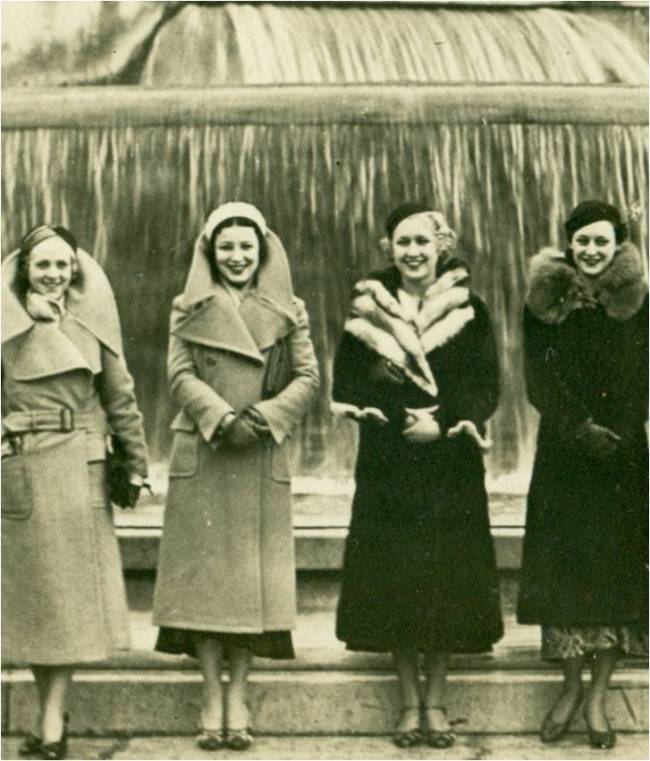
This is part of a snapshot taken in Rome in 1932.  Helen, the subject of my book, River of January stands above wearing the white fur-collared coat.  Posing next to her, in the white cap is dancer, Carmen Morales, another member of the “American Beauties,” an American ballet company.  The two girls met when both were cast in this troupe booked to dance across the cities of Europe.  They remained the closest of friends until Helen’s death in 1993.

I have perused countless pictures of Helen’s European tour, closely, (close as with a magnifying glass) the faces of her fellow dancers.  And I have decided that of all the girls in the show Carmen, next to Helen of course, was a classic  American Beauty.

From the little I could find on the internet Carmen was born in the Spanish Canary Islands around 1914, and came to the US where her father had business interests.  She trained in ballet, and after an audition was booked to tour with dance mistress, Maria Gambarelli.  On the ship’s crossing to Le Havre the girls fused together into a solid little unit, and to trouble one meant facing the wrath of all.

During their travels, Carmen met a fellow American dancer, Earl Leslie and the two fell in love.  Earl and Carmen soon married in Marseilles, and left the show when Earl received a better offer.  A German businessman wanted him to manage a string of nightclubs out of Berlin.  They took the job to give their new life together a chance.  But history was conspiring against Carmen and her new husband when Nazi authorities harassed the two and pressured them out of the country.  That was in 1934.

The couple again joined their old dance company, but by that point Helen had returned to New York.  Meanwhile Earl, Carmen and the rest of their company signed contracts to play in Argentina into 1935-36.  It was in Buenos Aires that Earl Leslie began an open love affair with another dancer and broke Carmen’s heart.

Carmen returned to New York, divorced Leslie and moved to Los Angeles to resume her show business career.  Her big break came in 1940 when she was cast by director John Ford to play in “The Long Voyage Home,” starring John Wayne.  I’m not sure how many films Carmen made, but she quickly fell into a type-cast, that of the femme fatale–a far cry from her sweet, sensitive nature.

Making her home in Sherman Oaks, California by the 1950’s, Carmen began the transition to television.  Well into the 1960’s she appeared in minor roles on a number of prime time dramas, still taking the time to step on local stages for live productions.

Through all those decades, Carmen and Helen remained great friends.  If Helen didn’t travel to Los Angeles for a visit,Carmen flew to Miami.  My husband recalls the fun his mother had entertaining her good friend, sitting around the little kitchen table, drinking bourbon on the rocks, jangling charm bracelets emphasizing the light spirits, and smoking cigarettes.

I am not sure when Carmen died.  I don’t know if it was before or after Helen.  But Carmen truly deserves to be remembered for her own journey through the twentieth century.  She lived an epic life and had stories to tell.  Sadly we will never hear them.  Except for those few with an encyclopedic knowledge of film, Carmen Morales has been left to disappear into the past.

So, when you hoist one tonight, make the toast in the memory of a real American Beauty, the lovely Carmen Morales.

Gail Chumbley is the author of River of January, available now.

Exploitation?

My husband and I have talked a lot about how his mother and aunt supported their own mother when they were girls.  By the time Helen’s father died in 1925, Helen was forced by circumstances to become a professional dancer.  She would have followed that path anyway, but had to make the decision sooner than any of them expected.  The fatherless little family desperately needed the income and the mother didn’t work outside the home.

The City of New York enforced what were called the “Gerry Laws,” age restrictions for children in show business.  The minimum age for child performers was set at 16, though Helen danced plenty before legally permissable.  With the right application of make-up and her mother along at auditions, confirming the girl was of age, she landed two contracts  still closer to 14 years-old than 16.  Helen did a little modeling for romance magazines, too, costumed in lingerie more suitable for a 20 year old.

It felt easy to judge her mother for exploiting Helen’s talent for her own financial benefit.  But after more research for the book, River of January, I found the practice of pushing children on to the stage was more common and egregious than anything concocted by Helen’s mother.

Many small children acts crossed the vaudeville stage.  These precocious kids forfeited an ordinary childhood to support their ambitious parents.  Some of the more famous child acts included Sammy Davis Jr, “Baby” June Havoc from Gypsy fame, Bobby Short, and  “Baby” Rose Marie.   These children were no more than preschoolers and unable to say no, or make any of their own decisions.  And the laws were on the books in most cities to protect children from these exploitative adults.

For the parents of these children violations meant jail time, if they were caught.  And mothers or fathers spent  as much effort dodging law enforcement as they did in promoting their little ones’ careers.

I started out this piece to honor those champions of child welfare.  I believed these reformers battled for vulnerable children, who had no one looking out for their best interests.  Then it hit me that other small children at the exact same time were more brutalized in other sectors of the economy.  These same “Gerry Laws” did nothing to spare those little kids from the hazardous mines and mills of America.

I’ve decided that these “do-gooders” chose to target theaters because the stage was so visible.  While these so-called reformers made names for themselves crusading in the theater district, other children faced greater threats laboring as virtual slaves.  Young children suffered perilous dangers, becoming victims of accidents, crushed below ground in coal mines, or mangled in the machinery of filthy factories.  Those abuses were committed out of the public eye.

The city fathers looked quite virtuous to the public, as did the police in ferreting out vaudeville’s exploitation of young children.  Bad, self-serving parents either paid big fines, or served time, satisfying the community’s outrage.

It may appear at first glance that Helen was misused by her widowed mother by going to work so young.  But in comparison to say, 4-year-old Baby Rose Marie, or the multitudes of tiny children facing 60-hour weeks in textile mills, Helen’s experience was more a joy than a sacrifice for her family.

Talent On Paper

The last time that I job searched Ronald Reagan was in the White House.  At that time, long long ago, assembling a coherent resume, wracking my brain to identify personal strengths, and figuring out what to wear was a self-flagellating ordeal.  The first district that called me led to a chatty, comfortable interview which after a few days landed me a position I soon loved.  In the meantime, while waiting,  I interviewed with a neighboring district who essentially informed me that I was so lucky to have even secured an interview with them, I needn’t expect anything else to materialize.  The two interviews left me confused–I certainly was the same person sitting before each interviewer, so what subtleties created such contrasting experiences?

Flash forward to now.  The young people in my family have all finished their educations and have entered the job market in various occupations.  They’ve described to me today’s method of the hunt.  All had to monitor various websites for employment openings, apply on-line for each posting, a telephone interview hopefully followed, an initial personal interview and, if lucky a second interview.  Even in my field, education, the process has come to involve an empirical, impersonal, but fair, aptitude test for job fitness.

And seeking employment does appear more fair.  But the process has certainly eliminated the immeasurable.  And I do understand that past abuses concerning skin color, ethnic affinity, and gender, skewed employment which explains the complexity of finding a position.  But it seems job hunting has evolved where blind equity has trumped human potential and trust.

How much of us transcends a resume?

Could Helen or Chum have excelled in their fields under today’s rules?  How spiffy would their talents look on paper?  Was it better for them that the ink was still wet writing down the qualifications for dancing or flying?  Could you or I achieve the same heights waiting for that second interview?

For both of these ambitious people, the differences came from their persistence, crossing paths with pivotal figures and providential situations.  Neither Helen, nor Chum were held back by corporate rules limiting their goals.  They took each opportunity life offered up, and by pluck, or by intuition seized the chance.

She danced in the New York Subway!  He babysat officer’s children on base in Norfolk!

Has the remedy of a faceless, genderless driven employment process improved the workforce?  Could Helen or Chum have done today what they did in the 1930’s?

Is fair really all that fair?

An Offering

  River of January is as much about the emerging entertainment industry as it is about aviation.  In particular Helen, though initially an accomplished ballerina, adapted to dance styles and built up her repertoire and versatility.  Just before the war, due to sudden circumstances, Helen took up ice skating, and through her customary hard work became an accomplished performer on ice.

From 1939 until nearly ten years later, Helen, along with her sister entertained crowds in a multitude of ice shows.  The popularity of the sport, turned artistic expression became especially celebrated following Sonja Henie‘s gold medals at the 1936 Berlin Olympics.  So popular, figure skating lent to rinks cropping up all over the country, and the sport made it to the silver screen with Henie starring in films such as Sun Valley Serenade(Not such a great movie, but the Nicholas Brothers rock)

While researching and writing, primarily for the second book, (still unfinished) I realized that my ice skating knowledge was pretty limited.  It had been the same with ballet in the first book, (now with a publisher).  What can a teacher do with such limited understanding?

Ask a kid, of course.
Two girls in my courses stepped up and obliged my request.  One of them is a very accomplished ballerina, and the other a competitive figure skater.  From them both I learned the lingo, the most popular moves, steps, and music–little tidbits to make the story line smoother.

The girl in the picture above was, as you can see, an ice skater.  Shauna was her name and she presented herself as a shy, reserved young lady who demonstrated deep wells of untapped talent and aptitude.  It was a little difficult for her to plop down sideways in a desk and shoot the breeze with me.  She wasn’t that kind of person.  Though full of smiles, it was much easier for her to answer my questions by writing them down on notebook paper.  And she shared all she could think of to share.  And Shauna knew her stuff about figure skating.

It tickled her to see my photos and programs of the early ice shows at Center Theater in Radio City Music Hall.  She shyly smiled at the wide lens portraits of colorfully costumed skaters, posing before elaborate backdrops, reflected again upward from mirrored ice.  Shauna liked the close-ups of the stars, such as graceful Janet Lynn, and comedy skater, Freddie Trenkler, costumed as a hobo.

Shauna wasn’t just a nice girl who enjoyed figure skating, though that was a big part of her heart and time.  She was a dedicated artist, a musician who played the violin (that I stepped over more than once in class) in the high school orchestra.  And it was after an evening orchestra performance a year ago October that we lost a promising, gifted young talent in a senseless car accident.  The pain of her loss ripped an abyss into all of us who knew and loved her.

I would like to publicly thank Shauna for her kind support and good counsel on some of the technical aspects of my book, and know for certain that her sweet spirit lives on in the pages of my writing.

God Speed little skater.

What Are You Waiting For?

I began a routine of driving home from school, entering the house, saying hello to my mother, and crawling into bed with Chad for a nap.  As he lay recovering physically, I needed to begin a recovery of my own, in my mind and spirit.  I had been diagnosed with PTSD, post traumatic stress disorder.  And I felt disordered.  I had order in my schedule, in my classroom, in the care of my husband, but my insides were wasted.  What this girl needed was an existential anchor and a path back to me.

My solution didn’t look like redemption at first.  And that statement requires some explanation.

Prior to Chad’s illness, prior to his father’s death, my husband found himself frequently back in Miami.  The reasons always concerned his father, but sometimes the trip was a medical emergency, sometimes an issue with the house.  Regardless of the errand, my husband packed up boxes and boxes of family mementos and shipped them to Idaho.  We, my daughter and I, enjoyed an archival Christmas each time the mail arrived.  By the time Chad’s father, Chum, had agreed to come west and live closer to us, half of our bedroom was furnished with plastic containers of Chumbley memorabilia.

Here I was, a basket case, and my room was jam packed with historic documents.  I am a historian with an active interest in research.  I teach advanced placement history.  I am operating under deficiencies near a nervous breakdown.  Still I couldn’t add one plus one and see the route to my recovery in front of my face.  It took a student to help me along.

When my course reached the Great Depression era, I always described Chum’s air race.  People did all sorts of activities during those years to make a little money.  I showed the kids the trophy, discussed the drama, and reveled along with my students over Chum’s daring.  In the same vein when we talked about the world’s descent into fascist hell, I shared Helen’s story of dancing across Europe with a backdrop of swastika’s and regimented Italy.  Inevitably one or another student would remark, “Sounds like a movie.”  And I would always agree.

A boy, a junior asked me why I was waiting to commit the story to book form.  My pat answer was not to offend anyone in my husband’s family.  This self-assured young man, Ethan, who thought more of my abilities than I did, looked me dead in the eye and accusingly challenged, “That’s just and excuse.  What are you really waiting for?”

At that juncture, my husband was lying prostrate in bed, a close colleague had died of a similar infection, another colleague’s husband dropped dead officiating a soccer match, and this boy wanted to know what I was waiting for.

I began River of January in May 2011.  The prose was terrible–more venting and judging than describing all the characters.  An editor fired me because the book stunk, and I continued to re-write, a friend helped me line by line, and I continued to rewrite, another editor asked if I was kidding with this book, and I continued to rewrite.

And dear readers, through all that time and uncertainty, Chad grew stronger and I gradually began to recognize myself in the mirror.

Writing has healing properties of enormous power.  I just hope River reflects the strength and the determination that restored my life.

The Team

Preparing for my husband’s homecoming took a bit of pre-planning.  We had airlifted out of the woods and all we owned was still up there, in the mountain cabin.  This situation called for my own impossible mission team, and they quickly materialized.  Headed by my son’s boyfriend, my daughter and a group of their kind friends a late summer Saturday turned into moving day. 

We met at a U-Haul center, rented a trailer, breakfasted at the McDonald’s next door, then off to the mountains.  By the time my mother arrived to care for Chad, the bed was neatly placed in the downstairs living room.  He had access to a bathroom two steps away, and enough room to use a walker to retrain his shriveled legs. 

None of those preparations would have been possible without “a little help from my friends.” 

Even at school all of my students, colleagues, parents and administration cut me huge swaths of slack.  I realized in the midst of the whirlwind that somehow I was living in a state of grace.  Chad was alive, my family provided support, and my school community couldn’t help enough. 

A couple of days before the state football championship, our school’s team came to the house to visit the invalid-football fan.  They signed a ball for him and sat a while, taking pictures and bringing youth and joy to his sick room

It still remained that he was quite ill, and pitifully fragile.  It became my custom to stand over his bed each morning, listening for him to breath, verifying Chad had survived the night.  And we still had a number of hospital runs ahead of us.  An obstructed bowel, a collapsed lung, pneumonia, and finally his bowel resection.  Still, despite my fears, despite all the chaos and confusion, I sensed an element of direction and purpose.

All of us, my parents, my children, my friends, students, and neighbors seem to form a team of our own.  It was a team of humanity, of support, of prayer, of goodness, and of determination.  I wouldn’t go back to that difficult time for anything, but I can savor from the distance of time that miracle of common cause. 

Fifteen Minutes

A number of years ago I attended a seminar on President Lincoln.  The title of the course was “Controlled by Events.”  That name puzzled me when I first read the brochure.  Abraham Lincoln, in my mind, was the most dogged, determined figure in American History. Because of his resolve, the Union was saved.  I later learned that the title came from a moment when the President admitted that he couldn’t manage outcomes once the dogs of war were released, just grapple with the aftermath. Now, after our battle with cancer and my husband’s close brush with death, I realize what our 16th president meant.

Through rigorous exertion Chad, my husband, succeeded in sitting up for fifteen minutes-a significant milestone. Soon after, his doctors determined he was ready for transfer to a rehabilitation hospital. This move was designed to teach Chad how to function again.  Seriously, the man could not lift a styrofoam cup, brush his teeth, shave, or comb what was left of his hair.

The nurse notified us by nine in the morning that he was scheduled for transport to the new facility sometime before lunch. Of course that meant the orderlies arrived around two in the afternoon, and Chad was tucked into his new bed in the new hospital by three. Not too bad for hospital time.  But what we heard at the new facility left me despondent, and Chad frightened and frustrated.

One by one, therapists visited us until six that evening. They introduced themselves, and gently informed us that sitting up for fifteen minutes was only the beginning. His relearning would test his endurance, reaching new levels of exertion. Critically frail, Chad grew deeply stressed because what they were asking seemed impossible. I vicariously felt his fears, and could do nothing to allay them.

I couldn’t do anything about anything.

I bumped along the currents of endless medical advice. After all, he couldn’t come home until he reclaimed something of his former body.

There he lay, bag of feces on his belly, an open, seeping surgical cut, from his naval to his groin, and the hospital was forcing him to get up and live again.

The looming deadline ahead for me was school starting again. There was no question that I had to work. We had to have the insurance, and the income if we were to survive this disaster financially. The medical bills were piling up, and I had no choices but to accept my nightmare. Then events, for a change, turned for the better.

One of my students lived behind our home, and I had hired her to tend our dogs while I spent days at the hospital. It turned out her mother was a registered nurse, who, just steps away, could be at our house within minutes. Wow, what a miracle for when he came home. Secondly, my seventy eight-year-old mother informed me she was coming to care for Chad so I could return to work. Honest to God, I didn’t want to bother other people, but had no other options. And both our neighbor and my mother assured me it was no bother, and they were glad to help. Both parties kindly offering the gift of their time and skills.

After two more excruciating weeks in rehab, I got to bring him home.  That night my mother chauffeured by my brother arrived at our door. I was sure my husband looked so much better after four weeks of hospitals and treatment. But when the both of them came in, and their faces betrayed shock by his poor condition.

In the end, unlike Lincoln, my husband survived our intense, little war. Trapped in the maelstrom, careening from one disaster to another we had no future.

Events controlled us.

Gail Chumbley is the author of “River of January,” and “River of January: Figure Eight,” a two-part memoir. Available at http://www.river-of-january.com and on Kindle.

gailchumbley@gmail.com

Five Minutes

The following was written in August, 2010

Our days crawled by slowly, his recovery measured in increments.  Transferred from the ICU one day earlier, a new face appeared in his hospital room, a physical therapist.  With a breezy air he introduced himself, shook my hand then turned toward Chad. He fulfilled his efficient entrance in one smooth motion.

Medical people no longer inspired reverence for Chad.  He had become weary of the abysmally slow institutional routine, the new faces everyday.  Still despite his disillusion he was never rude to any of the medical staff, but I received a good run down when we were alone.

This particular therapist seemed to have arrived with a plan to rebuild my husband’s ravaged, broken body and depleted endurance.  The regimen, the PT announced would start by having Chad sit up in a chair for five minutes.  And though that sounded harmless enough it quickly became one of the trials of Hercules.  With the help of the nurse, they diverted or unhooked the multitude of attachments to Chad’s body, now including pressure socks to prevent blood clots.  The two then hoisted his body to a chair by the bed.  Though bobbled around, he said nothing while the two stuffed and padded blankets around him like a newborn.  Once he seemed balanced, the PT and nurse left.  They left.

Five minutes can be a very long time in certain situations.  The last five minutes in class. The last five minutes in a dryer cycle. At this particular moment my husband immediately began to sweat, and fretted that he would faint if he didn’t lay down. I scrutinized his movement with the vigilance of a gymnastic spotter, ready to catch him if he toppled.

Wasted muscle covered by white hosiery was all that remained of his legs, his exhausted head bowed in agonizing surrender begging me to help him back into bed. Where was the therapist? Why didn’t he stay?

I waited, searching for words of encouragement, but growing equally anxious. Poor Chad grew visibly physically anguished, swaying forward.  Still no therapist.

“I can’t sit like this any longer,” he wailed.  Panicked, I resolved that if the PT didn’t come back in sixty seconds, one minute, I would press the button for the nurse.  I slowly began to reach over to the bed, for the call button pinned to his sheets.  And that was when the therapist materialized, sweeping briskly into the room followed by the nurse.

“How did that go?” he inquired brightly.  We didn’t answer, as he swiftly bent over Chad,to assess his condition.

“That was five minutes?” Chad gasped.  “Seemed longer.”

“He didn’t do so well,” I added, feeling it my duty to tell the truth. The therapist and nurse didn’t reply as they hoisted him back to bed.

He then spoke up.  “Well, the doctor wants him up to fifteen minutes before the hospital can release him.”

With that, the two blew out of the room, on to other matters, other patients.

Neither of us spoke. After a few moments Chad drifted back to sleep, lightly snoring.  I stared ahead, drained.

Gail Chumbley is the author of the two-part memoir “River of January,” and “River of January: Figure Eight.” Both books are available at http://www.river-of-january.com, and on Kindle.

gailchumbley@gmail.com