National Longevity

Titled the National Defense Education Act of 1958, this federal legislation aimed to set more rigorous standards for American public schools, and low rate loans for college students. Curricular revisions set out by the act focused primarily on math and science so America could maintain its technological preeminence across the globe.

Spurred by the launch of the Soviet-made satellite, Sputnik, panicked lawmakers believed American schools faced the danger of falling woefully behind our Russian adversaries, and the U.S. had to catch up.

Sputnik had followed a series of Cold War crises focusing on Communist threats at home and Communist aggression abroad.

Labor activist, Gene Dennis served five years in prison for his public association in the American Communist Party, while Josef Stalin kept the Red Army in East Germany, and blocked the Autobahn (freeway) into the free sector of West Berlin. Through Soviet agents the Russians had absconded with America’s hydrogen bomb secrets, and in 1953 Julius and Ethel Rosenberg were executed as Soviet spies..

Perhaps today this lone Soviet satellite would alarm no one, nor trigger such alarm, but at that perilous moment the Russians were the first to launch a hostile electronic eye in the sky. Understandably when newspapers screamed “Do you want a Soviet moon orbiting America?” President Eisenhower, and the American public answered in unison a decisive no.

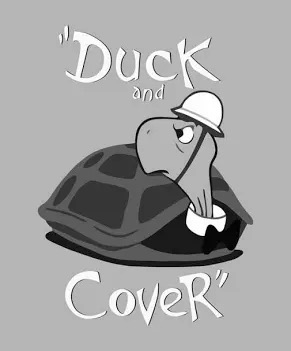
In my Spokane elementary school we practiced “duck and cover” drills to offer the veneer of protection in the event of a nuclear attack, and endured Wednesday noon air-raid tests that blared throughout the city’s neighborhoods, as they did in every American city in that era. Inside the lobby of my grandparents apartment building yellow and black Civil Defense signs pointed residents to a basement bomb shelter, to hopefully ride out a nuclear holocaust.

Though termed a Cold War, fear and anxiety simmered, permeating every aspect of national life.

Urgency filled the halls of Congress, members certain Soviet schools were producing higher level mathematicians and physicists. American schools, in the minds of legislators had to buckle down to compete in the Atomic Age. 

The crucial piece of this narrative concerning the launch of Sputnik? The United States came together as one and and met the challenge.

Our leaders wished to protect and preserve America for generations to come, and the best means of doing so centered on public schools. The United States would continue forward and American children educated so that one-day as adults, they would assume their places for a new generation..

To educate inherently implies a future–that learning is a vital investment and tomorrow will come. Education is an act of faith in America and continuity.

Sadly that period of purpose and unity is long gone.

The Department of Education is no more, universities are under siege, and public schools underfunded. No longer are students encouraged to buckle-down for their own personal, national, or existential longevity. There is no vision of a future for many of our kids.

Facts, understanding, and open inquiry is viewed as subversive.

Today’s blaring sound isn’t an air raid siren. A bellowing of conspiracists and deniers, plus the politicians who coddle them undermine our ability to effectively meet this generation’s challenges.

The dangerous years of the Cold War were scary. National defense colored every facet of our lives, especially in the classroom. JFK encouraged us to “do for our country,” and we were inspired by the challenge. Today is far less certain. Poverty, hunger, and the wealth gap smothers hope and squanders our greatest asset, our children, and that loss dims America’s longevity.

On a personal note New Math became the bane of my existence. Even today algebra and the like trigger stress and self doubt. That being said I did my best because I knew I had a future in a country that cared.

Gail Chumbley is the author of the two-part memoir, River of January, and River of January: Figure Eight. In addition Chumbley has penned two plays: Clay regarding the life of Senator Henry Clay, Wolf By The Ears, an examination of racism and slavery, and Peer Review where 47 converses with four past presidents.

Life Experience

I present history talks here and there, most recently focused on American presidents. The thesis for these programs looks at how each brought their life experiences to the presidency. For George Washington, a man who did his duty, for Andrew Jackson, his iron will, Abraham Lincoln’s push for opportunity, and Theodore Roosevelt’s sense of purpose.

This analysis rests on the old Hamilton/Jefferson dichotomy, particularly views on the proper size of government. Washington supported the supremacy of federal power, crushing the 1794 Whiskey Rebels by force, in Western Pennsylvania. Jackson had an inconsistent record on federal power. He was tough on South Carolina’s refusal to collect a new tariff, threatening to send in the military, as well. Oddly, at the same time, Jackson, without a blush, sided with the state of Georgia in removing the Cherokee and other indigenous people west. Lincoln embraced the Union, waging war, over allowing to let the government fail. Last, Theodore Roosevelt grew the size of government, and placed the federal government as the defender of righting wrongs. Set aside were National Parks, tracts of wilderness and game preserves. TR, protected America’s natural beauty for American’s for all time. Not to forget consumer protections in food and medicine.

For now, I haven’t gone beyond those four individuals, but with that premise as a guide, how do 20th, and 21st Century presidencies stand up to analysis?

Like Washington, Dwight D Eisenhower too, operated from a deep sense of duty. One of seven sons, Ike sought and received an appointment to West Point. A man of conviction, Dwight Eisenhower, as President, sent 101st Airborne to Little Rock, Arkansas to desegregate Central High School. Though not a progressive when it came to civil rights, he still enforced the law. And as a side note, Ike promoted the Federal Aid Highway Act of 1956, creating America’s first interstate freeways system. This piece of legislation came about from Ike’s early days in the army. In 1919, Lieutenant Colonel Eisenhower commanded a cross-country convoy of Army vehicles, Atlantic to Pacific, spending more time pushing rigs out of the mud than making forward progress. A lesson he never forgot.

A child of affluence, John F. Kennedy had to overcome considerable health problems and the expectations of his prominent father. Like Theodore Roosevelt, or Franklin Roosevelt, for that matter, Kennedy spent a lot of his youth ill, and hospitalized. Besides, “Jack” wasn’t meant to be the presidential nominee from the Kennedy clan, it had been his older brother, Joe Jr., his father’s first choice. Sadly Joe Jr. perished in a secret mission when his aircraft exploded over England in 1944. JFK, too, had nearly lost his life in the South Pacific, but survived, inheriting his father’s ambition.

After a brief stint in the Senate, Kennedy faced off against Richard M. Nixon for the White House. Prevailing in the 1960 contest, with his father’s sponsorship, JFK entered office and soon faced down Soviet aggression. This young president weathered a thirteen-day crisis when the Russians were detected building IRBM missile sites in Cuba. The Kennedy Administration successfully negotiated a stand down to Soviet aggression. This President, despite his medical ailments, and injured spine (from the war) most certainly fulfilled his father’s purpose.

As had Lincoln before, Bill Clinton and Barack Obama promoted opportunity. Both men rose from modest beginnings, and possessed keen minds. Clinton had been a Rhodes Scholar, and Obama a constitutional lawyer. Both men pushed for public health insurance, and the Dreamers Act protected children of Mexican nationals providing opportunity for education. Clinton was the first president to address the plight of LGBTQA in the military, (the first chief executive to utter those words). 

And not to be forgotten, opportunity was heavily woven into LBJ’s Great Society objectives.

As for Jimmy Carter, duty seemed to shape his administration. After Nixon’s scandals, and Gerald Ford’s presidential pardon, prospects dimmed in 1976 for the GOP. As president, Carter labored long to warn Americans about dependence on fossil fuels, appearing on television to discuss America’s malaise. However, the country had no interest in belt tightening, and Carter found himself replaced by Ronald Reagan. 

Reagan, HW Bush, and George W Bush are interesting commanders-in-chief. All three were nice, decent men, as well as patriots. A Navy man, Bush senior flew in the Pacific in WWII. Young Bush showed leadership in the aftermath of 911. However, in comparison to the four presidents in my programs these gentlemen aren’t as easy to label. The three were financed by large-monied interests, oil producers, and powerful lobbyist to lift regulations on business. In an interesting side note, Reagan’s own favorite president had been the 30th, Calvin Coolidge. Silent Cal once stated, “The business of America is business,” and Reagan felt the same. 

Each individual brought a unique imprint on the presidency. Extending federal power, or paring down central control. Life experiences shaped the character of each administration. Current President, Joe Biden looks out for middle and working class Americans, as he was raised in that community. Biden, looking out for the rest of us pushed the infrastructure bill and succeeded in lowering health care and drug costs for all Americans.

The last guy made it his duty, purpose, will, and opportunity, as cover for lining his own pockets and launch a coup against America.

Just saying.

Gail Chumbley is the author of the two-part memoir, River of January, and River of January: Figure Eight. Chumbley has also penned two plays “Clay,” concerning the life of Statesman, Henry Clay, and “Wolf By The Ears” an examination of racism and slavery in America.

Lost Their Way

In spite of fascist aggression in Europe the Republican Party of the 1930’s opposed foreign intervention even in the face of world war.

Staunchly isolationist, Republican members of Congress, particularly Senators William Borah of Idaho and Arthur Vandenberg of Michigan, carefully crafted legislation to block aid to democracies under Nazi threat. When World War Two did erupt in 1939 and blitzkrieg shrouded Europe isolationists refused to act. While England stood alone and fearfully vulnerable Franklin Roosevelt sent Churchill what he legally could, but certainly not enough.

Not until December, 1941 did Congress approve a declaration of war, however, not against Germany. The warlords of Japan had launched a direct air assault upon US bases on the island of Oahu, and only then did America rise to the moment.

Ironically, one week after Pearl Harbor it was Hitler who declared war against the US, and that freed FDR to channel significant aid to Great Britain, and to new ally, the Soviet Union.

Four long years of bloody trial and sacrifice finally ceased with the detonation of the Fat Man Bomb over Nagasaki. Hitler was dead, Mussolini was dead, and the Japanese islands quelled.

The war years left in its wake massive changes reshaping America. In point, no group emerged more transformed than the Republican Party. The postwar GOP fully embraced internationalism, no longer obstructing foreign aid, either military or humanitarian.

A fateful change in the aftermath of war was America’s important wartime alliance with the Soviet Union. In an ominous move Josef Stalin did not, and would not withdraw his Red Army dominating Eastern Europe. Any hope of a peaceful postwar world quickly faded. A paranoid despot, Stalin flatly refused aid from the United States for Russia and Eastern Europe, though the entire region had been shattered.

In place of the alliance a perilous atomic arms race, a Cold War, commenced between the two nations.

However, this time around a bipartisan Congress took action.

When Russian expansion threatened Greece and Turkey, President Truman quickly dispatched money and matériels, as did later President Eisenhower, who extended US support to Southeast Asia, and the Middle East.

In Congress no group took the fight against Russian aggression more seriously than the Grand Old Party. Chastened Republicans had learned well the lessons of prewar isolation and stepped up aggressively to check Soviet expansion around the globe.

Influenced by Secretary of State John Foster Dulles, and red baiter, Senator Joe McCarthy, the Republican Party pursued a dogged response to Russian aggression at home and around the globe. Risking a nuclear showdown America went toe to toe with the Soviets from the 1948 Berlin Airlift to Korea, to Vietnam.

American presidents and leaders in Congress kept up the pressure until Presidents Ronald Reagan and George HW Bush aided the 1989 fall of Russian and Eastern European Communism, ending the Cold War.

Through all of these episodes and so many others, the GOP stood tall in the fight against all foreign foes threatening the United States.

Where once Dwight Eisenhower faced down the Russians, and Nixon defended America directly with Beijing and the Kremlin, Republicans now kneel before a man who, in Helsinki, privately had unrecorded talks with the current despot of Russia, and publicly took sides with Putin at the cost of American security. Moreover, this same man, a grifter, attempted to extort Ukraine’s new President, Volodymyr Zelenskyy in order to smear his own stateside political rival. After the end of his first term the freeloader stole thousands of sensitive intelligence documents from Washington, wedging American secrets among toilet paper, plungers, and plumbing fixtures.

It’s a bit of a gob smack that older hands, men who lived through the Cold War years, Senators Mitch McConnell, Lindsay Graham and Chuck Grassley, among others, excuse and downplay 47’s outrageous, dangerous, and treasonous conduct.

So it’s easy to understand mainstream America’s distress over today’s Republican stances. (Especially Putin’s aggression into the Crimea and the war in Ukraine.)

Welcomed by the GOP, cyber interference from Russia continues to spread misinformation to undermine our elective democratic process. This party and its messiah has opened the inner sanctum of national security inviting thugs into the Capitol, and outsiders to destabilize the United States.

Where once Republicans defended America from all foreign threats they are today passively holding open the door. The party of Eisenhower and Reagan is filled with cold opportunists coddling an overgrown toddler with neofascist leanings.

The Kremlin has not changed, nor have the Chinese. And though symbolized by an elephant this Republican Party has clearly forgotten who they are.

They have lost their way.

Gail Chumbley is the author of River of January, and River of January: Figure Eight. Chumbley has also penned two historical plays, Clay and Wolf By The Ears. A third play, Peer Review.

A Silent Genius

In mid-September a few years back, I chanced upon news of James Castle Days in Crouch. The name didn’t ring any bells, but a banner over the old arts center announced the schedule of festivities. A curator from Boise drove up to share Mr. Castle’s life and work with our community, the place Castle too, called home. My dear friend who specializes in art history, joined me at the talk.  

We attended that presentation at the Community Center, and became acquainted with James Castle’s unique story that began here, in Garden Valley.

Born in 1899, young Castle appeared to have joined the world profoundly deaf. He never spoke or learned to read or write, though he attended a school in Gooding. But the boy could draw. As a child, he produced drawings and objects crafted from materials he scavenged around the family homestead in Garden Valley. To view the original location of his home, it was set on the west side of the Middlefork between the new, white barn entrance, and the Seventh Day Adventist Church. Later the family relocated to a farm in Star, then to a home near Hill Road down in Boise. Despite the moves, James pursued his art, every day from garbage inspection, to finished compositions. 

Like poet Emily Dickinson, Castle shared only a few of his works with family and others. For the most part he squirreled away pieces in unlikely spaces at each location. Behind walls, under floorboards, and any other secreted hideaway he could find. Like Beethoven, James worked in the utter silence of his internal fortress. Instead of symphonies, Castle produced images of his world.

Wrappers, labels, cardboard, blank pages from books, and even old Christmas cards were among the organic materials that made up Castle’s preferred medium. What most people considered trash, Castle manufactured into his vision of his universe. The curator explained, in her presentation, that though he was given sketch pads, and art pencils, the silent artist kept up his scrounging ways, perhaps finding unusual materials a part of his creative process. 

The artist made use of stove soot he scraped from a wood stove firebox, then mixed it with his saliva, drawing with sharpened, pointed sticks. Interiors, exteriors, letters and lists, anything that happened to catch Castle’s eye. Through other small bits of debris, he fashioned mobile objects, and though his works may appear primitive, it is his artistic experience we embrace as authentic. 

Somehow James Castle’s style appears flat, and boxy, bordering on Rocky Mountain Byzantine, but that impression is misleading. His compositions were not only complex, but depicted the interiors of empty matchbooks or canned food labels. This artist managed to duplicate what he saw into precise, complex, miniature representations.

In particular, Castle played with letters and numbers. In some pieces the precisely drawn symbols are in some kind of familiar sequence. Using small memo books the artist depicted tiny ink calendars in a conventional format, but Castle’s letters and numbers often lack a familiar order. Perhaps in his world, it is not sequence that has meaning, but atheistic precision in duplicating the shapes.  

In the 21st century, a time of aggressive social media, artists compete for attention in the overcrowded cyber world. The market is fierce. So it is almost a miracle that Castle’s creations were discovered at all. One source maintained that his work would have been, without a doubt, relegated to unappreciated oblivion if Castle hadn’t given some of his creations to his immediate family. Castle found fame due to a nephew attending art school in Oregon. This young man showed his instructor a smattering of Castle’s work, and this event introduced Castle to the art world. 

The teacher, intrigued, requested more of the collection, and an exhibit opened in Portland, then moved on to Seattle. Castle’s anonymity in the art world ended.

Still, this artist didn’t create for the critics, or for any recognition at all. True to his expression, Castle created art for its own sake, and would have continued working either way. His surrounding world remained his muse where the substance of his vision concerned recording the life he observed around him.

After his 1951 discovery, Castle’s pieces appeared in the Philadelphia Museum of Art, The Whitney in Manhattan, and even in Madrid. The Smithsonian American Art Museum has exhibited a lion share of Castle’s art, in the museum’s folk collection. Another art exhibit is in Boise, located in the last house in which he dwelled.  The beauty of the collection is that it is open to the public, meaning we all can share the vision of an extraordinary artist born along the Middlefork. Here in Garden Valley and we have the privilege of living in the same locale, along the same river, the same trees, and the same mountains that inspired Castle. 

James Castle’s life spanned through the 20th Century, America’s formative years. Wars and economic hard times ebbed and flowed, and he created. Man landed on the moon, and James continued to create. We met the Beatles, and watched color television, and Castle explored his soundless world, generating the visual snapshots he perceived in his Idaho landscape. 

At the end of the curator’s presentation, she introduced two bearded men in bibbed overalls. These elderly gentlemen were two of Castle’s nephews, and grew up with their Uncle James in the house. They mentioned that Castle happened to enjoy The Red Skelton Hour on CBS. Other than that Tuesday night slot Castle showed little interest in other shows. That struck me as rather interesting, since I, too, liked Skelton. And the difference? The comedy hour rested on Skelton’s amusing pantomime skits. So, of course Castle tuned in with the rest of the family—he could laugh along. 

The surprise of Castle is how he transcended place and time. For a child born in a tiny settlement in the Idaho mountains to emerge as an accomplished artist is remarkable. Though hearing impaired at birth, and forever silent, James Castle’s story is our unexpected Garden Valley treasure.

Gail Chumbley is the author of “River of January” and “River of January: Figure Eight. Chumbley also has written two plays, “Clay” exploring the life of statesman Henry Clay, and “Wolf By The Ears” examining the origins of racism and slavery in America.

gailchumbley@gmail.com

Bull Moose

The only thing new in the world is the history you don't know.  Harry Truman

The story began with a promise. Following his electoral victory in 1904, Theodore Roosevelt vowed to the public he would not run again in 1908. Assuming office in 1901, following the death of William McKinley, then Vice-President Theodore Roosevelt could have run in ‘08. But he had made that promise. 

Selecting an heir, TR tapped the occupation governor of the Philippines, William Howard Taft. TR believed he could happily step aside and pursue private interests with Mr. Taft in the White House. Taft did not want to be president, but his wife did. Though preferring a seat on the Supreme Court, Taft soon caved to his wife and accepted TR’s offer. 

Reform and good government played a large part in Roosevelt’s administration. He challenged unfettered capitalism, pushing for regulations of railroads, and breaking John D. Rockefeller’s stranglehold on the oil industry. One of Theodore’s paramount issues was preserving America’s treasure trove of national parks, and wilderness areas. 

TR loved the West and wished to regulate development where it wasn’t needed. After completing his term, and Taft safely elected, TR went on safari in Africa with one of his sons. By the time Roosevelt returned he learned things were not to his liking in Washington. Taft had made decisions, and endorsed policies Roosevelt had opposed during his administration. 

In short, Taft had the audacity to run his own administration. 

A big issue of contention was conservation of lands and natural resources. Unlike TR, Taft opened up Alaska’s Chugach National Forest to coal mining. Worse, Taft fired TR’s man in the Forest Service, Gifford Pinchot, a spokesman for public land as recreational for the people. Suffice it to say this, and other disputes turned ugly.

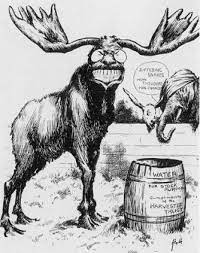
The 1912 campaign season began with TR’s new third party, the Progressive or Bull Moose Party. William Howard Taft also announced his run for a second term for the GOP. New Jersey Governor, Woodrow Wilson, received the Democratic nomination in Baltimore. 

Of course the Republican Party split between Republican conservatives, and the Progressives backing Roosevelt. And Wilson became the 28th President of the United States.

What does that moment of time portend for today? Certainly a major Republican split between traditional and reactionary members is in the offing. Much like TR’s progressive agenda, and Taft’s middle-of-the road-conservatism, GOP voters are going to have to decide. 

Clearly this same party is sliding into another major split in 2024. Is neofascism the preference of today’s organization? That one announced candidate has another term coming, and has made plenty of promises too. Will middle of the road conservatives tone him down and redeem the party in their own image? Maybe. But for today the smart money is on that 80-year-old moderate incumbent.

Gail Chumbley is the author of the two-part memoir, “River of January,” and “River of January: Figure Eight.” Chumbley has penned two historic plays, “Clay” about the life of statesman Henry Clay, and “Wolf By The Ears,” exploring the the beginnings of slavery and racism.

gailchumbley@gmail.com

Give And Take

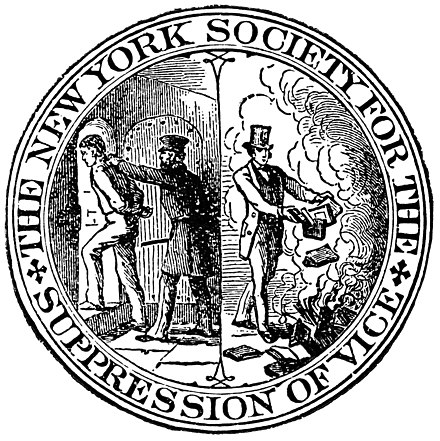
“I should say that the majority of women (happily for society) are not troubled by sexual feelings of any kind,” wrote William Acton in an 1857 medical tract. Some fifteen years later Acton’s evidence-free assumption was echoed by Postal Inspector Anthony Comstock, the founder of The New York Society for the Suppression of Vice. Comstock’s organization had been formed to monitor and enforce morality in public behavior, emphasizing in particular, the conduct of women. Any discourse on women’s sexual behavior, according to Comstock was “obscene, indecent, lewd, and immoral,” period. (Chauvinism appears to be timeless). Galvanized by his puritanical convictions, Mr. Comstock set about cleansing the moral conduct of the people of New York. (Note the Society’s Seal, above, depicts book burning, as a legitimate means to his ends.)

Finding momentum statewide, Comstock took his crusade to Washington DC, where he convinced the US Postmaster General to battle unacceptable behaviors on a national scale. Soon Congress complied with passage of the Comstock Act in 1873. This law declared that any correspondence touching on women’s birth control, contraception, and abortion were prohibited from the US mail.

Among Comstock’s many opponents, and there were more than a few, reformer and free-thinker, Ezra Heywood defied the law, publishing articles and books supporting women’s rights, and defending female sexual freedom. Mr. Heywood most notorious work, Cupid’s Yoke, insisted marriage an act of equality and balance between a man and a woman, quickly attracting government attention, when he was promptly arrested for his writings. In court, Heywood continued to argue that women were capable of controlling their own lives, and bodies, insisting the Comstock Act was destroying the liberty of conscience. Further, Heywood insisted women ought, and must have a voice in determining the size of their own families. Apparently just expressing such thoughts was enough to prove obscenity, and Heywood headed to jail for his persistence.

In the early 20th Century another movement targeted morals, this time in the film industry. Postmaster General, Will Hays, threatened Hollywood studios either to establish standards in motion picture content or the government would do the job. Known as the Hays Code, the studios prohibited profanity, nudity, violent sexuality, race mixing, and lustful kisses on the screen. In an interesting side note the film that sparked the controversy was 1934’s release of Tarzan. Maureen O’Sullivan’s Jane swimming naked alongside Johnny Weissmuller’s Tarzan sparked the scandal. Twenty Yale students, for example, stepped in front of a theater screen to halt the movie in New Haven, Connecticut.

Mr. Hay’s code remained in effect from 1934 until 1968, when the Supreme Court ruled films are art, and thus protected by the First Amendment. In place of the code, the Motion Pictures Association instead instituted the rating system we are accustomed to today. 

The specter of the Comstock Law, and the Hays Code still casts a long shadow over American culture. Instead of concentrating on public policy, and other issues; power grids, global warming, gun violence, and infrastructure, (plus many more) politicians push their private notions of morality upon the rest of us.

Women’s sexuality and healthcare are not obscene matters, nor are they open for public debate. A fixture of the 19th, and early 20th centuries was the norm known as coveture. By definition coveture meant the husband acted for his wife in all areas of life. She could not vote, nor own property in her own right, and her children belonged to her husband. She belonged to her husband. No wonder Mr. Comstock and Mr. Hays found such success in their efforts.

Those artifacts of another less enlightened age are over. Exploiting the pendulum of political opportunity, giving and taking rights from women, will no longer wash. The overturning of Roe, the war on medical aid in pregnancy, the patchwork of state reproduction laws, (14 states ban abortions from the moment of fertilization*) implies something deeply sinister. Women cannot be trusted to think for themselves, possess no self-agency like minors, or the severely mentally ill.

Absurd.

Attempting to regulate 50.4%** of the US population, (there are 100 women to every 97 men) has caused irreparable political harm to those behind today’s archaic, and reactionary movement.

See you all at the polls.

*Axios, Dec. 15, 2023

**www.census.gov

Gail Chumbley is the author of the two-part memoir, “River of January,” and “River of January:Figure Eight.” Chumbley has penned three stage plays, “Clay” about Statesman Henry Clay, “Wolf By The Ears,” an exploration of slavery and racism, and “Peer Review,” on Presidential character.

The only thing new in the world is the history you don’t know. Harry Truman

A Bright Side

Donald Trump, without a doubt has answered the centuries old question of the worst president in American history. His standing as the biggest moron lends Harding, Buchanan, Pierce, and other lackluster presidents a step up from the cellar. 

Is there a bright side to the bedlam unleashed by 45’s insanity? I believe so. Americans have witnessed how not to preside over our democracy in real time. Now that’s a powerful civics lesson. 

Once misunderstood, most American’s were reminded how the Electoral College functions—a big deal demonstrating how a candidate can win the Electoral College, but not the popular vote. From irregularities identified in the 2016 race, shocked citizens across the country wonder if this election procedure has a purpose in the 21st Century. 

The legal tradition of checks and balances took a rough bruising with Congressmen and Senators scurrying to the Oval Office to kiss the ring of their messiah. Two clearly illegal actions by the President; pressing Volodymyr Zelensky of Ukraine to open an inquiry on Hunter Biden, and Trump would offer an invitation to Washington.The second came after the January 6th insurrection using violence to disrupt the ceremonial certification of Electoral College. The House impeached both times, and the Senate refused to convict. The moral of that story? The Executive Branch went rogue and the upper chamber of the Legislative Branch failed in their duty. However, both branches somehow remained intact and horrified voters learned what they didn’t want. 

That elections and voting truly matter may be the most profound lesson of the Trump years. The right to vote is power, and denying citizens of that power became the GOP’s endgame. Even now, the far right longs to deprive many of us, especially minorities from exercising that power. The lawsuits are still flying to undermine our most sacred right under the law.

Another teachable moment touched on the Supreme Court. The 2020 death of Ruth Bader Ginsburg, and the retirement of Anthony Kennedy in 2018 shed light on manipulating the Judiciary. Senate Majority Leader, Mitch McConnell lobbed the first volley through the customary practice of filling Supreme Court vacancies. Before 2016 the sitting president had the privilege to put forth judicial nominees. That had been a long tradition. But the sitting President happened to be Barack Obama. So of course McConnell blew that up. Obama’s choice for the court was Merrick Garland, and McConnell would not hear of it.

Following the 2016 election that tradition resumed. Trump put forth Amy Coney Barrett, and later Brett Kavanaugh. Both lied in hearings to the Senate Judiciary Committee, Barrett testified she would allow Roe to remain, and Kavanaugh was a reputed date raper. The clause allowing lifetime terms for judges added gravity to Trump and McConnell’s shenanigans. 

Perhaps the Trump fiasco holds a silver lining. Americans have become more aware of the workings of our democracy, what functions under the hood, so to speak. Perhaps democracy is indeed fragile, but our near collapse into tyranny has forced us all to wake up and pay attention.

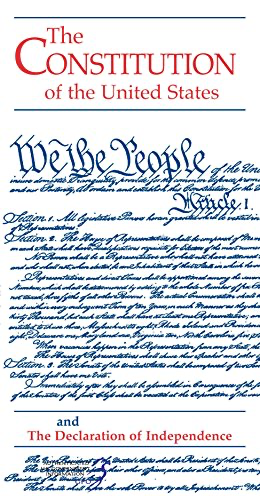
PS contact your Representative in Congress. Request a hand pamphlet of the Constitution like the one above. They have them in their DC office or their home office. We’ll show ’em.

Gail Chumbley is the author of the two-part memoir River of January, and River of January: Figure Eight. Chumbley has written two plays, Clay about 19th Century Statesman Henry Clay, and Wolf By The Ears exploring the genesis of racism and slavery in America.


The only thing new in the world is the history you don’t know

Harry Truman

Peer Review #1

Marines manned numerous doorways along the wide hallway, as clusters of tourists wandered through colorful rooms. Upstairs the President listened to the public commotion with satisfaction, not for the house, not for the job, which, in truth, had become tiresome, but for the knowledge he could drop down and set all their bourgeois hearts aflutter. 

After a moment, he made his decision, slipping down an interior stair case, stepping into the Blue Room.

As his hands automatically fluffed his hair, the President sidled up beside a class of wiggly school children snapping cell phone pictures.

“And where are you from?,” the president teased with pleasure, anticipating an excited response. He half closed his eyes, and paused, waiting for the gratifying answer.

But he heard nothing.

Bemused, the President opened one eye, then the other. The chatty children paid him no mind, in fact were moving away, following their guide into the hallway.

“Wait,” he found himself calling. “It’s me, your President. I’m here.”

He repeated, “The President of the United States.”

But the children didn’t hear. He remained alone in the Blue Room, his hair acceptably coiffed.

No further tourists entered, though dozens drifted past the doorway. He didn’t understand and he thought very hard, seeking a rational explanation.

It was at that moment that he heard a voice, quite close, and quite annoyed. 

“Am I to understand you are a New Yorker?” 

The President wheeled around toward the sound. Before him, no more than an arm’s length away stood a mustachioed gentleman, wearing pinz nez spectacles, sporting a shiny top hat. The man’s eyes blazed behind the thick round lenses, and the astonished President detected a trickle of cold sweat trace down the back of his thick neck.

“I say, are you, or are you not, a New Yorker?” The stern man spoke in a nasally, patrician voice.

“Ahh. How did you get in here,” the President stammered. “Where is my secret service protection?”

“Supercilious pup,” the man in the top hat snapped. “They tell me that YOU are from New York, and are president! A common side show huckster, President.”

The President, though alarmed, replied reflexively, “I’m in real estate. I . . .made my fortune in New York real estate.” Only the muffled din of passing tourists kept the President from panic.

“Real Estate!” The man in spectacles scornfully shouted. “I’d say you are just another scoundrel from the wealthy criminal class. In New York, swindlers like you are a dime a dozen. I made a career of exposing rascals like you.” 

The man, attired in a three-piece suit, a watch fob draping his ample waist, bore a deep scowl. “And you found your way into this office of trust. Intolerable.”

Though bewildered, the President, unaccustomed to such personal insults, felt his pique rising. “I was elected President by the largest margin in American Hist . . .”

“Poppycock,” the specter interrupted. “It is my understanding the decision rested upon a mere tilt in the Electoral system, and that outsiders interfered to make certain of your victory.” 

The strange visitor moved closer. “I’d say that you are a compromised pawn of foreign meddlers, and give not one damn for the American people.”

At this point the President had heard enough, and attempted to move his legs. He wanted very much to escape the Blue Room, but his feet remained rooted. 

“I have important things to do, you need to go,” the President’s voice trembled, trying to sound more confident than he felt.

The apparition narrowed his intense eyes, and took another step toward the unnerved President. 

“I claim more authority to this revered House and Office than your mercenary greed could ever comprehend. You belong with Tweed, Plunkitt, Fisk, Conkling, and the rest of New York’s good-for-nothings. Dishonor has followed you to the Presidency, what, with your womanizing, graft, and unsavory business connections.” The fierce apparition fixed an intense, menacing gaze. “You do not belong here, nor your parade of lackeys and opportunists.

The buzz of foot traffic grew louder, and when the President again glanced toward his unwelcome visitor, he found him gone, the Blue Room empty.

Gail Chumbley is the author of the two-volume memoir, “River of January” and “River of January: Figure Eight,” both available on Kindle.

Hard copies are available at http://www.river-of-january.com


Worth Reading

I submitted this short note to my State Senator. Feel free to copy and send to yours.

This email is in regard to the library controversy. As an educator the notion of deciding what is acceptable portends bad things to follow. Using one incident of a child’s book isn’t a full picture. Not one of us read the same thing, and that is true for children. I shudder to contemplate legal censorship as a slippery slope to authoritarianism. I know the far right is attempting to control our community, and that should be enough of a red flag to stop this bill in its tracks. Our libraries are one of the last institutions that bind us together as Americans and Idahoans. To speak plainly the bill is just a bad idea and isn’t workable. If the titles under scrutiny become public, those books sell like hotcakes. It has been since the days of Lady Chatterly’s Lover, or currently The Absolutely True Diary of a Part-Time Indian by Sherman Alexi.

As stated by Isaac Asimov “Any book worth banning is a book worth reading.”

Sincerely,

Gail Chumbley

They Were Wrong

“Slave owners and white racists were afraid that the world they had always known was slipping away from them. Fear was a great motivator—fear of change, fear of losing power, fear being that they were wrong. The roots of white anxiety over threats to enslavement and to legalize white supremacy ran deep.”

John Meacham, And There was Light. Random House, 2022, page 55.

The power of this passage left me stunned. A whirlwind of thoughts rushed all at once, promptly crystallizing into one central truth; the power of privilege and racial superiority in America has not changed in 250 years. Not. One. Bit.

Meacham’s book, a biography of Lincoln, focuses on the shaping events that made Lincoln arguably America’s greatest President. However, those same circumstances left the Southern slave power deeply offended, seething with hate and lethally dangerous. The metastasizing rancor simmered and boiled until the hate ultimately exploded into Civil War, and to Lincoln’s 1865 murder.

An 1820 law, the Missouri Compromise, sounded the first alarm below the Mason-Dixon Line. That slavery could be limited through any federal legislative act left the ruling Planter class touchy and suspicious. Sensitive to any criticism of Southern honor  and way of life inspired bitterness and fury.

Congressmen and Senators frequently squared off years before the crack of gunfire and the clash of steel. A Massachusetts Senator, Charles Sumner, endured a severe beating on the Senate floor for a fiery anti-slavery address. So volatile became the rhetoric that the House chamber adopted a “gag rule” that prohibited any mention of slavery in any form. Censorship abounded in Dixie, as well. Any abolitionists tracts, or books, such as Uncle Tom’s Cabin quickly landed in the trash bin, tossed out by Southern postal officials.

As Northern abolitionists grew more strident, Southerners grew more militant. The right to oppress and engage in human trafficking was viewed as part of the Southern landscape, and auction blocks proceeded to conduct commerce in human flesh. For victims of this trade, violence, rape, and fear remained the unquestioned prerogative of the planter class.

For abolitionists and Southerners a flash of arms became only a matter of time.

The politics of slavery entered houses of worship where politicized clergy twisted the Bible inside out to condemn or justify the right to own another person. Today’s Southern Methodist and Southern Baptists churches are enduring relics of the ecclesiastical war before the shooting war.

After four bloody years, as the guns finally silenced, the era of Reconstruction began in the hopes for a new America. Emancipated freedmen under the protection of Yankee occupiers began exercising their right to vote, enter into civil marriage, attend schools through the Freedman’s Bureau, all through the efforts of the Federal Government. However, Southern whites, still simmered and bided their time, determined and unrepentant. The shooting may have stopped, but the war was not over.

To instill compliance a guerrilla campaign of terror suppressing former slaves emerged. The Ku Klux Klan, the Knights of the White Camelia, and the White League galloped through the night, masked and menacing. These former Confederates spread fear and committed murder against any person of color who dared claim the blessings of American Liberty. 

Today, in the 21st Century, strikingly similar dynamics have reemerged.

The moment in 2008 as Barack Obama became 44th President of the United States, white power interests again reared up.

For many of us this election appeared to be proof that America had turned a positive corner in race relations, But almost at once border state Senator, Mitch McConnell of Kentucky quickly reacted decreeing “The single most important thing we want to achieve is for President Obama to be a one-term president.”

Not long after Congressional Republicans sunsetted a vital clause in the 1965 Voting Rights Act. The provision protected black voters from acts of discrimination at the polls. McConnell’s handy work placed the onus, once again on the voter to prove they were illegally denied. (Much like the old Jim Crow poll taxes and literacy tests.)

Then Trumpism arrived.

This time the violence on Capitol Hill came in the form of a coup. On January 6, 2021 white supremacists stormed the halls of Congress to stop the counting of the 2020 Electoral Vote. Back in the 1860’s, during the Civil War, no such invasion took place because the Union North stood fast against rebellion.

Human trafficking once again is considered acceptable as long as conducted by rich and powerful whites. For example, Ghislaine Maxwell, a prolific procurer of young girls for the Epstein Pedophilia Ring quipped “these girls, they’re nothing,” so reminiscent of the 19th Century.

Christian Nationalism again warps American churches. Forgotten is the example set by Jesus, and the message of his life. These same “Christians” now take pleasure in the brutality and suppression of others, willfully turning a blind eye to racism, pedophilia and misogyny, as long as the rhetoric is that of white exceptionalism.

Fearing their alpha-position slipping away, white nationalists, too, are simmering and lethally dangerous. Though hate group names have changed, the mission remains the same: fear and suppression. Proud Boys, Oath Keepers, neo-Nazi’s, MAGA, and Christian Nationalists today gallop through cyber space, surfacing for violence as was done on January 6th. Federally sanctioned ICE agents, masked and anonymous, menace American cities day and night terrorizing the weak and vulnerable and violating due process and legally obtained warrants.

The same dynamics are in play, fear of a changing America, fear of being wrong, and fearful of losing control.

Those who witnessed the dissolution of the Union believed their blood-soaked sacrifice settled for all time the issue of race and power in America. But that is clearly false.

But then is now. Now is then. Eras are intricately and forever intertwined. This nation has remembered nothing and again fallen for the same old hate and boastful ignorance of their infamous forefathers.

And they are still wrong.

Chumbley is the author of the two-part memoir, River of January, and River of January: Figure Eight. She has penned two stage plays, “Clay,” exploring the life of Henry Clay, “Wolf By the Ears,” a study of racism in America, and “Peer Review,” where 47 is confronted by four past presidents.