Logging

Creative Non-Fiction.  That is the category that River of January will market under.  I am comfortable writing in that genre because of the latitude I have in stringing together the story.  I don’t know exactly who said what to whom, through all those years, except for the letters that have been left for my keeping.  And those letters concern limited stretches of time.  So the story outcome is a combination of actual episodes and creative glue to keep the story cohesive

This approach has worked well . . .until now.  The major difference for writing in book two (yes, there is a second volume) are Chum’s logbooks.  The ramifications of possessing some twenty-odd logbooks, is that I know exactly where he was, and when he arrived and departed.  That exactness poses a problem for the creative side of composition.  Let me explain.

I placed my protagonists in Virginia at Thanksgiving, 1936.  But Chum’s logbook doesn’t put them there until the next month–Christmas of 1936.  I had to ask myself, ‘How anal is this process?’  And the answer was, Creative Non-Fiction.  I can place them loosely where I need them to keep the flow of the narrative moving.  But those damn logbooks really like to argue with me, demanding things that they are.

His literal trail is fascinating to read.  Chum carefully noted each flight he flew, the equipment, passengers, time in the air, where and when he landed.  He or should I say I can account for his whereabouts from the time he boarded his first aircraft in 1928.  The war years offer a particularly revealing journal of wartime aviation.  Added to his own notations are his official Navy orders, which are neatly attached together in a vertical file.

In so many ways Chum’s logbooks provide a connect-the-dots composition of his adult life.  Where he landed on any given day, where he was when big events took place around the globe, where he was the day I was born.  His notations provide a fine straightedge where his life took measure.

By the way there are mysteries in those logs.  He and his crew had some hush-hush missions during the war, and the logbook reflects that security.  For destinations he scribbled in some cryptic nonsense.  The only reason that I know the nature of those flights was because he told me later in taped interviews.  Thank Goodness for that.

There are some pretty cool names of places that I’d never heard of before.  Nanty Glo, Pennsylvania, Havre de Grace, Maryland, Fitler, Mississippi–FITLER!  And the war years mention islands beyond my geographic knowledge; Espirito Santo, Suva, and Numea.

I guess we would all benefit from a life logbook tracing where we have been, how long we stayed and when we left.  A picture would assuredly materialize, accounting a good deal for who we are now.

My Book Report

ImageAs I have worked on my book, River of January I’ve been told by patient listeners that my writing sounds like me.  Of course I have no idea what that means.  How do I know what I sound like?  The comment has led me to think a lot about writers that have impressed me over the years with their wonderful and unique voices.

I love Vonnegut, Helen Hooven Santmyer, Twain, Willa Cather, Steinbeck, John Irving, Wallace Stegner, Tim O’Brien, but I think I’ve decided on my favorite writing voice.

Above is one of the many covers for author, E.L. Doctorow‘s Ragtime.  The realization finally came to me from my writing struggles, that his style, his narratives have resonated deeply into my notion of good writing–good story telling.  Doctorow is just flat brilliant.  Here is an author who can take a fictitious character and move them easily through a time and place.  He folds in historic figures believably,  effortlessly into and out of the plot.  I loved how he wove in Enrico Caruso and Evelyn Nesbitt, as viewed in their own era, in a way that feels almost as intimate as a Murdoch phone tap.

Reading a Doctorow novel is a privileged journey into his rich, fanciful imagination.  Billy Bathgate glides along much the same way, luring me into the deadly world of organized crime, while keeping a light heart and affection for his shady characters.  Checking out his list of works before writing this blog tells me Doctorow has more to offer in this first winter of my retirement.

My book, too places many famous and almost famous into the story telling. But now I have recognized my North Star, and hopefully that fixed position will aid my efforts.

If I can even touch Doctorow’s genius in wedding the real to the imaginative I will count myself the luckiest kid that ever hit the keys.

Requiem For A Beauty

Image

This is part of a snapshot taken in Rome in 1932.  Helen, the subject of my book, River of January stands above wearing the white fur-collared coat.  Posing next to her, in the white cap is dancer, Carmen Morales, another member of the “American Beauties,” an American ballet company.  The two girls met when both were cast in this troupe booked to dance across the cities of Europe.  They remained the closest of friends until Helen’s death in 1993.

I have perused countless pictures of Helen’s European tour, closely, (close as with a magnifying glass) the faces of her fellow dancers.  And I have decided that of all the girls in the show Carmen, next to Helen of course, was a classic  American Beauty.

From the little I could find on the internet Carmen was born in the Spanish Canary Islands around 1914, and came to the US where her father had business interests.  She trained in ballet, and after an audition was booked to tour with dance mistress, Maria Gambarelli.  On the ship’s crossing to Le Havre the girls fused together into a solid little unit, and to trouble one meant facing the wrath of all.

During their travels, Carmen met a fellow American dancer, Earl Leslie and the two fell in love.  Earl and Carmen soon married in Marseilles, and left the show when Earl received a better offer.  A German businessman wanted him to manage a string of nightclubs out of Berlin.  They took the job to give their new life together a chance.  But history was conspiring against Carmen and her new husband when Nazi authorities harassed the two and pressured them out of the country.  That was in 1934.

The couple again joined their old dance company, but by that point Helen had returned to New York.  Meanwhile Earl, Carmen and the rest of their company signed contracts to play in Argentina into 1935-36.  It was in Buenos Aires that Earl Leslie began an open love affair with another dancer and broke Carmen’s heart.

Carmen returned to New York, divorced Leslie and moved to Los Angeles to resume her show business career.  Her big break came in 1940 when she was cast by director John Ford to play in “The Long Voyage Home,” starring John Wayne.  I’m not sure how many films Carmen made, but she quickly fell into a type-cast, that of the femme fatale–a far cry from her sweet, sensitive nature.

Making her home in Sherman Oaks, California by the 1950’s, Carmen began the transition to television.  Well into the 1960’s she appeared in minor roles on a number of prime time dramas, still taking the time to step on local stages for live productions.

Through all those decades, Carmen and Helen remained great friends.  If Helen didn’t travel to Los Angeles for a visit,Carmen flew to Miami.  My husband recalls the fun his mother had entertaining her good friend, sitting around the little kitchen table, drinking bourbon on the rocks, jangling charm bracelets emphasizing the light spirits, and smoking cigarettes.

I am not sure when Carmen died.  I don’t know if it was before or after Helen.  But Carmen truly deserves to be remembered for her own journey through the twentieth century.  She lived an epic life and had stories to tell.  Sadly we will never hear them.  Except for those few with an encyclopedic knowledge of film, Carmen Morales has been left to disappear into the past.

So, when you hoist one tonight, make the toast in the memory of a real American Beauty, the lovely Carmen Morales.

Gail Chumbley is the author of River of January, available now.

Exploitation?

My husband and I have talked a lot about how his mother and aunt supported their own mother when they were girls.  By the time Helen’s father died in 1925, Helen was forced by circumstances to become a professional dancer.  She would have followed that path anyway, but had to make the decision sooner than any of them expected.  The fatherless little family desperately needed the income and the mother didn’t work outside the home.

The City of New York enforced what were called the “Gerry Laws,” age restrictions for children in show business.  The minimum age for child performers was set at 16, though Helen danced plenty before legally permissable.  With the right application of make-up and her mother along at auditions, confirming the girl was of age, she landed two contracts  still closer to 14 years-old than 16.  Helen did a little modeling for romance magazines, too, costumed in lingerie more suitable for a 20 year old.

It felt easy to judge her mother for exploiting Helen’s talent for her own financial benefit.  But after more research for the book, River of January, I found the practice of pushing children on to the stage was more common and egregious than anything concocted by Helen’s mother.

Many small children acts crossed the vaudeville stage.  These precocious kids forfeited an ordinary childhood to support their ambitious parents.  Some of the more famous child acts included Sammy Davis Jr, “Baby” June Havoc from Gypsy fame, Bobby Short, and  “Baby” Rose Marie.   These children were no more than preschoolers and unable to say no, or make any of their own decisions.  And the laws were on the books in most cities to protect children from these exploitative adults.

For the parents of these children violations meant jail time, if they were caught.  And mothers or fathers spent  as much effort dodging law enforcement as they did in promoting their little ones’ careers.

I started out this piece to honor those champions of child welfare.  I believed these reformers battled for vulnerable children, who had no one looking out for their best interests.  Then it hit me that other small children at the exact same time were more brutalized in other sectors of the economy.  These same “Gerry Laws” did nothing to spare those little kids from the hazardous mines and mills of America.

I’ve decided that these “do-gooders” chose to target theaters because the stage was so visible.  While these so-called reformers made names for themselves crusading in the theater district, other children faced greater threats laboring as virtual slaves.  Young children suffered perilous dangers, becoming victims of accidents, crushed below ground in coal mines, or mangled in the machinery of filthy factories.  Those abuses were committed out of the public eye.

The city fathers looked quite virtuous to the public, as did the police in ferreting out vaudeville’s exploitation of young children.  Bad, self-serving parents either paid big fines, or served time, satisfying the community’s outrage.

It may appear at first glance that Helen was misused by her widowed mother by going to work so young.  But in comparison to say, 4-year-old Baby Rose Marie, or the multitudes of tiny children facing 60-hour weeks in textile mills, Helen’s experience was more a joy than a sacrifice for her family.

An Offering

  River of January is as much about the emerging entertainment industry as it is about aviation.  In particular Helen, though initially an accomplished ballerina, adapted to dance styles and built up her repertoire and versatility.  Just before the war, due to sudden circumstances, Helen took up ice skating, and through her customary hard work became an accomplished performer on ice.

From 1939 until nearly ten years later, Helen, along with her sister entertained crowds in a multitude of ice shows.  The popularity of the sport, turned artistic expression became especially celebrated following Sonja Henie‘s gold medals at the 1936 Berlin Olympics.  So popular, figure skating lent to rinks cropping up all over the country, and the sport made it to the silver screen with Henie starring in films such as Sun Valley Serenade(Not such a great movie, but the Nicholas Brothers rock)

While researching and writing, primarily for the second book, (still unfinished) I realized that my ice skating knowledge was pretty limited.  It had been the same with ballet in the first book, (now with a publisher).  What can a teacher do with such limited understanding?

Ask a kid, of course.
Two girls in my courses stepped up and obliged my request.  One of them is a very accomplished ballerina, and the other a competitive figure skater.  From them both I learned the lingo, the most popular moves, steps, and music–little tidbits to make the story line smoother.

The girl in the picture above was, as you can see, an ice skater.  Shauna was her name and she presented herself as a shy, reserved young lady who demonstrated deep wells of untapped talent and aptitude.  It was a little difficult for her to plop down sideways in a desk and shoot the breeze with me.  She wasn’t that kind of person.  Though full of smiles, it was much easier for her to answer my questions by writing them down on notebook paper.  And she shared all she could think of to share.  And Shauna knew her stuff about figure skating.

It tickled her to see my photos and programs of the early ice shows at Center Theater in Radio City Music Hall.  She shyly smiled at the wide lens portraits of colorfully costumed skaters, posing before elaborate backdrops, reflected again upward from mirrored ice.  Shauna liked the close-ups of the stars, such as graceful Janet Lynn, and comedy skater, Freddie Trenkler, costumed as a hobo.

Shauna wasn’t just a nice girl who enjoyed figure skating, though that was a big part of her heart and time.  She was a dedicated artist, a musician who played the violin (that I stepped over more than once in class) in the high school orchestra.  And it was after an evening orchestra performance a year ago October that we lost a promising, gifted young talent in a senseless car accident.  The pain of her loss ripped an abyss into all of us who knew and loved her.

I would like to publicly thank Shauna for her kind support and good counsel on some of the technical aspects of my book, and know for certain that her sweet spirit lives on in the pages of my writing.

God Speed little skater.

What Are You Waiting For?

I began a routine of driving home from school, entering the house, saying hello to my mother, and crawling into bed with Chad for a nap.  As he lay recovering physically, I needed to begin a recovery of my own, in my mind and spirit.  I had been diagnosed with PTSD, post traumatic stress disorder.  And I felt disordered.  I had order in my schedule, in my classroom, in the care of my husband, but my insides were wasted.  What this girl needed was an existential anchor and a path back to me.

My solution didn’t look like redemption at first.  And that statement requires some explanation.

Prior to Chad’s illness, prior to his father’s death, my husband found himself frequently back in Miami.  The reasons always concerned his father, but sometimes the trip was a medical emergency, sometimes an issue with the house.  Regardless of the errand, my husband packed up boxes and boxes of family mementos and shipped them to Idaho.  We, my daughter and I, enjoyed an archival Christmas each time the mail arrived.  By the time Chad’s father, Chum, had agreed to come west and live closer to us, half of our bedroom was furnished with plastic containers of Chumbley memorabilia.

Here I was, a basket case, and my room was jam packed with historic documents.  I am a historian with an active interest in research.  I teach advanced placement history.  I am operating under deficiencies near a nervous breakdown.  Still I couldn’t add one plus one and see the route to my recovery in front of my face.  It took a student to help me along.

When my course reached the Great Depression era, I always described Chum’s air race.  People did all sorts of activities during those years to make a little money.  I showed the kids the trophy, discussed the drama, and reveled along with my students over Chum’s daring.  In the same vein when we talked about the world’s descent into fascist hell, I shared Helen’s story of dancing across Europe with a backdrop of swastika’s and regimented Italy.  Inevitably one or another student would remark, “Sounds like a movie.”  And I would always agree.

A boy, a junior asked me why I was waiting to commit the story to book form.  My pat answer was not to offend anyone in my husband’s family.  This self-assured young man, Ethan, who thought more of my abilities than I did, looked me dead in the eye and accusingly challenged, “That’s just and excuse.  What are you really waiting for?”

At that juncture, my husband was lying prostrate in bed, a close colleague had died of a similar infection, another colleague’s husband dropped dead officiating a soccer match, and this boy wanted to know what I was waiting for.

I began River of January in May 2011.  The prose was terrible–more venting and judging than describing all the characters.  An editor fired me because the book stunk, and I continued to re-write, a friend helped me line by line, and I continued to rewrite, another editor asked if I was kidding with this book, and I continued to rewrite.

And dear readers, through all that time and uncertainty, Chad grew stronger and I gradually began to recognize myself in the mirror.

Writing has healing properties of enormous power.  I just hope River reflects the strength and the determination that restored my life.

Wounds

th

Rereading the original draft of my book, River of January, I reviewed the back story that propelled the book’s creation. An impossible crisis pushed me to write the work, but that narrative was cut out of the main manuscript due to length. But I still believe that the story behind the published story is important to share.

The Intensive Care Unit was the largest department on the third floor of the hospital. Reflecting back I never did figure out which direction the ward faced. Was it north toward Boise’s golden foothills or south over the blue turf of the football stadium? Someone needed to open the blinds.

The floor plan in the ward ovaled around like a carpeted arena, anchored by a nurses’ station in the infield. Three quarters of the broad ring had been segmented into tiny stalls–narrow spaces housing mechanical beds. My husband’s particular nook, squeezed into a curved corner, remained either open or sealed by simply sliding a glass door and a privacy curtain. Each morning I instinctively gauged his condition by the disposition of that entrance. Coding patients were afforded some semblance of privacy.

The sparse decor inside clearly signaled “no nonsense.” Two chairs flanked the entrance, with one small footstool. I once tried pulling out that stool to attempt a nap, but sleeping was reserved for the critical only; the nursing staff’s frenzied laps around his bed made sleep impossible.

Unconscious, bloated, with a swollen torso and bulging arms, my husband lingered on the crinkly mattress. Tubes protruded from nearly every square inch of his upper body, pumping in liquid meds and below, pumping out liquid waste material. Attached monitors loudly measured his heart and pulse rates, racketing in a relentless beeping.  I was afraid to ask the meaning of the numbers blinking on the monitor, the din adding to my fatigue. Eventually, I inquired what a normal cardio reading looked like, and the answer wasn’t reassuring. I froze in that nondescript chair, dazed, almost hypnotized, willing his numbers to improve. Still indifferent, that monitor shifted erratically, frequently setting off an alarm drawing in medical reinforcements. 

The cocktail of fluids pumped into his arms overnight had left him bloated to the point that his nose had flattened across his full, stretched cheeks. Fingers that had earlier held my hand from the stretcher now swelled to the size of cooked kielbasa—triggering thoughts of his wedding ring and his watch. My next random reflection recalled both pieces being handed to me the night before, and hopefully safe in my purse. It was a dreamy recollection. 

The worst feature of his bare torso was the ragged, opened split from his naval to his groin, sealed by a stiff grey foam substance, and a thin membrane of clear film covering the diagonal wound. I was told his body was so contaminated in septic debris that the stitches closing the incision would have healed before the toxic substances beneath had cleansed.  So this vacuum packed dressing over his wound kept the area draining and that tube, too had an attached little box, stowed under the bed that beeped and flashed. 

He looked too rubbery and inflated to be real, but with the aid of artificial ventilation forcing his breath, I could clearly hear his intake of air. 

Clinging to these subtle signs I began the litany of phone calls that had to be made to the rest of the family.  His son, my parents, his siblings . . . I hated to upset them all, but knew these relatives had to be kept in the loop. Listening quietly on the phone, my 78-year-old father finally spoke; he and my mom would pack up and come down to Boise from Spokane. I wasn’t prepared for that offer, and asked them to give me a little time. I still wasn’t convinced my husband was going to live. At that moment I had no energy for company, all my focus concentrated on watching his vital signs.

Desperation is a funny emotion. The intensity of it burns on the inside, and we fool ourselves in believing the conjured up power somehow changes reality. Maybe the instinct to inflict mental suffering on ourselves is a primal manifestation of empathy for our loved ones. He bore the physical wounds, while mine lashed and scorched my insides. Over the course of his lengthy critical care, and his slow road to recovery, I had to do something with all the bile stuffed into my psyche. Out of this pain came the healing therapy of River of January and my own recovery through writing.

Gail Chumbley is the author of the memoir River of January


Landmarks

 “Avalon,” is a lovely 1990 film directed by Barry Levinson.  The movie depicts the generations of the Krichinsky clan, a Polish-Jewish family that immigrated and settled in Baltimore.   In a touching scene toward the end of the film the lead character, played by Armin Mueller-Stahl shares a story with his grown grandson about a visit he took to his old neighborhood.  Describing his walk, Mueller-Stahl frets about the absence of familiar buildings.  Finally finding the childhood house of his now-deceased wife he reflects that it was a good thing (he found the house) because he thought for a moment that he “never was.”

Many places central to River of January also have passed into time.  New construction, commercial and residential, has erased much of what once solidly stood.  For Chum, the greatest eradication had to have been the airstrips and hangars of Roosevelt Field.  That particular airfield meant a lot to him as it was the site of his 1933 Air Race.  Today that area is all retail–the legendary field buried under department stores such as Coach, Anne Taylor, Sleep by Number, and the like.  On the other hand, Helen’s Whitby Hotel on West 45th Street still stands, though remodeled into privately owned condos.  I would also presume that many of the old vaudeville theaters, the Keith-Albee chain for example, are long gone.  Public entertainment halls are simply vestiges of a distant past where the girl turned herself inside-out to entertain New York audiences.  

I just returned from a visit to my old hometown.  Though elderly, my folks still live in the house of my childhood, a place I more frequently visit in my dreams.  On this actual trip we drove a little around the old neighborhood.  In the 1960’s, when I was a kid, my friends and I often walked to the grocery store, or a nearby soda shop called “Woodies.”  It had an unauthorized drawing of Woody Woodpecker on the front sign, and inside we played pinball and bought penny candy.  In later years, hard economic times hit the area and gang sign was more prevalent on old buildings than prosperous businesses within.  The grocery store closed, and shortly after Woody’s went out of business. 

But now, what a change!  A British-themed pub sits on the corner where once stood the drugstore that sold us our Marvel comic books.  Across the street a new high-end pizzeria, complete with outdoor dining, twinkling lights and live music–where in an earlier time a full service gas station checked oil, filled tanks and handed out Green Stamps.  And the old Woodies now?  It’s a hole in the ground.

My folks still reside in the old house, though they too have repainted and remodeled.  My mom took the opportunity of our visit to let me know that her beautiful re-done kitchen will be an asset when we sell the house.  All I could say was, “Where are you two going to live.”  She only smiled.

There is nothing we can do to stop time, (even Botox is no shield).  I pray that I can still recognize where I am in that part of Spokane as the months and years continue to blow by.  I want to be able to identify the place where I once was. 

The Diva?

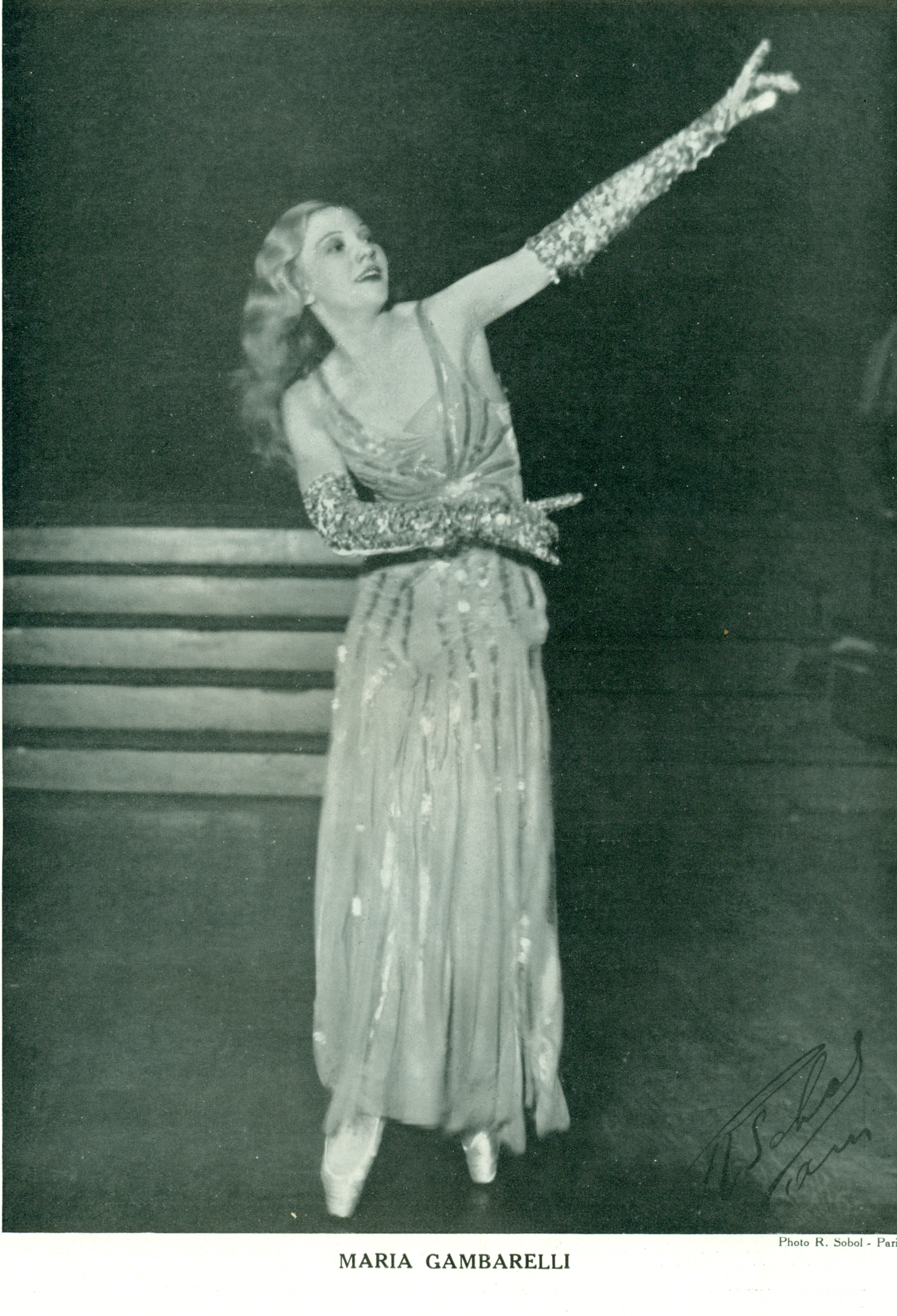
ImageAt the risk of sounding too teacher-ish, I’d like to write a bit on the woman pictured above.  However, before I discuss Maria Gambarelli, it is fitting to mention that she is just one of many interesting characters I ran across researching River of January.  It is also fair to say that Helen’s audition for Miss Gambarelli altered the course of Helen’s early career.

Born in the US to Italian parents , Miss Gambarelli began classical training at a young age.   Crossing the Atlantic she studied ballet under famed Russian dancer, Anna Pavlova.  Once back in New York, Miss Gambarelli performed with acclaim on American stages.  After an appearance on a New York radio show, Gambarelli grew to be a celebrity among audiences not interested in ballet.  In her interviews she shared stories of Italian origin, along with related folk songs.  The host, Roxy Rothafel soon made Miss Gambarelli a regular on his program, raising her profile as a dancer.

Rothafel was the man behind the construction of the Roxy Theater, which opened in New York in the late 1920’s.  Miss Gambarelli began a long term contract at the theater, performing for audiences with her company of principal ballerina’s called the Roxy-ettes.  As you may have guessed, that dance line most likely evolved into the famed Radio City Rockettes.  At least that’s the story I found.  Nailing down the past is a dicey proposition, competing with numerous other theories.  However, it does seem to flow.

This ties into my book because Helen danced for Miss Gambarelli in 1932.  The soloist had been engaged by investors to lead a dance company on a tour of European cities.  The company titled “The American Beauties,” was slated to perform first in Paris, then to Brussels, Monte Carlo, and ending in Erba, Italy.  I found in Helen’s papers that the backers worked through the William Morris Agency in New York, in conjunction with the Lartique Agency on the Champs Elysee in Paris.

Helen successfully won a spot with the troupe, and began rehearsals with ten other girls in New York.  Then the dancers experienced a near mythical crossing on the SS Ile de France to Le Havre, and by rail to Paris–all in Miss Gambarelli care.

After the endless training, all of the traveling, all of the money spent in promotion–the tour faced failure.  After only two weeks of performing at the “Le Ambassadeurs” club in Paris, Miss Gambarelli quit the tour.  And not only did she quit, she turned around and sued Lartique for breech of contract.  Miss Gambarelli wasn’t being treated up to her expectations, nor was she allowed to maintain control over the music, or the  choreography of the production.  So she quit.

When I wrote about this episode in the book I needed to find the right word to describe Miss Gambarelli’s behavior.  I couldn’t use diva, because that’s a term that didn’t become a pejorative until today.  Prima-donna is a tough one too.  In fact spell-check doesn’t even recognized Prima-donna, let alone touch on its meaning.

But, if anyone fitted the term, it was Maria Gambarelli.

In the end the tour carried on without it’s star, and evolved over time into a broader variety program.  A new headliner re-tooled the production adding more song and dance, enjoying great success by the time Helen left for New York in 1933.

The show must go on.

Hat In The Ring

Hat In The Ring

This image represents the 94th Aero Squadron, made famous by their aviation daring in World War One. Commanded by Colonel Raoul Lufbery, the 94th formed from the earlier American volunteer unit, the Lafayette Escadrille. The 94th counted in their ranks, Captain Eddie Rickenbacker. Rickenbacker became the most decorated American pilot of that war, with 26 verified German kills over France, and earning the Congressional Medal of Honor.
Later, Rickenbacker purchased Eastern Airlines, lending his famous insignia to the Great Silver Fleet. Chum was proud to have known Rickenbacker and proud to have been a part of Eastern. In retirement, Chum stenciled the “Hat” insignia on his competitive aerobatic plane in honor of his earlier career. Today REPA, the Retired Eastern Pilots Association maintains the memory of Rickenbacker and the storied days of Eastern Airlines.