Whatever your beliefs it’s time to lift your voiceand be heard
O beautiful for spacious skies,
For amber waves of grain,
For purple mountain majesties
Above the fruited plain!
America! America!
God shed His grace on thee
And crown thy good with brotherhood
From sea to shining sea!
O beautiful for heroes proved
In liberating strife,
Who more than self their country loved
And mercy more than life!
America! America!
God shed His grace on thee
And crown thy good with brotherhood
From sea to shining sea
Katherine Lee Bates, Samuel Ward
Gail Chumbley is the author of the two-part memoir “River of January,” and “River of January:Figure Eight.” She has also authored three stage plays, “Clay,” “Wolf By The Ears,” and “Peer Review,” all examining moments in American History. In addition, Gail is the co-writer of a screenplay, “Dancing On Air,” based upon the River books.
My America is a place of perpetual greatness, not this dark moment of greed and misconduct. G.C.
Remarks at Gettysburg, 1889
“In great deeds something abides. On great fields something stays.
Forms change and pass; bodies disappear, but spirits linger, to
consecrate ground for the vision-place of souls. And reverent men and
women from afar, and generations that know us not and that we know
not of, heart-drawn to see where and by whom great things were
suffered and done for them, shall come to this deathless field to
ponder and dream; And lo! the shadow of a mighty presence shall
wrap them in its bosom, and the power of the vision pass into their
souls.”
Joshua Lawrence Chamberlain
Gail Chumbley is the author of the two-part memoir River Of January and River Of January: Figure Eight. Chumbley has authored three historical plays, Clay about Senator Henry Clay, Wolf By The Ears, an examination of American slavery, and Peer Review, where 47 meets presidents from the past. Additionally, Chumbley has co-authored Dancing On Air, a screenplay depicting the true adventures of an aviator and showgirl.
In the long history of the world, only a few generations have been granted the role of defending freedom in its hour of maximum danger. I do not shrink from this responsibility–I welcome it. John F Kennedy, 1961
To American expatriates abroad and celebrities remaining at home,
Armed with your fame and recognizable voice all of you hold a public leadership role whether you choose to have one or not. Brave, out-spoken spokesmen for Democracy are a bit short on the ground and America needs her sons and daughters to rise up in defense.
No one runs us out of our home.
This is not a normal time, nothing about this administration is normal and leaving the country or remaining silent sends a message of throwing in the towel. You are abandoning the rest of us to hold the frontlines the best we can, but your face and words are needed. Too many in the press, in politics, and in the sports world are caving to accept this unacceptable lout out of fear or resignation. That behavior must end.
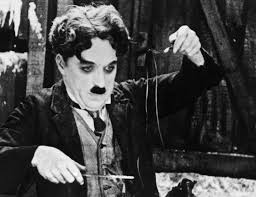
Charlie Chaplin, Adolph Zukor, and Douglas Fairbanks Jr sold war bonds during the First World War, Gable and Stewart enlisted in the service to fight Nazi tyranny. Carole Lombard lost her life in a plane crash after raising $2 million dollars for the war effort. You owe it to Dalton Trumbo, Ring Lardner and those of The Hollywood Ten who stood fast for freedom when caught in the fear of America’s Red Scare. Lena Horne, Pete Seeger and Zero Mostel, among others, faced blacklisting through the perilous period of McCarthyism. This is exactly the same ‘once in a generation’ moment testing our commitment to our democratic principles.
Leaving the country or remaining silent sends the terrible message of surrender. And leaving is selfish. Giving up on resistance essentially says to hell with the United States. This is the time when we need you most to stand tall. Liz Cheney hasn’t cut and run, nor has Adam Kinzinger. And he hates them the most because they know he’s an absurd phony. They also know they will never give up on America and neither should you.
Now that is a valiant example of patriotism. We can do no less.
Those of the future are depending on all of us to make this perilous moment right and to pass on an unsoiled America for generations to come. Moreover, our posterity will learn who stood fast in this momentary struggle for liberty and those who abandoned America in its time of need.
This is merely one chapter in the story of America and we are still a young nation. The United States is founded upon the will of the people and this administration is not your will or mine. Today’s corrupt collaborators who have prostituted our republic for momentary gain will fall by the wayside. These sycophants will share this wannabe dictator’s fate.
And that petty bag of stupid will fail, it is in his DNA. That’s what he’s always done. And there will be a lot of rebuilding ahead of us and your encouraging presence will be critical. No one runs us out of our country, nor do we forsake our duty in time of America’s need. We are not a servile people and do not bow down to anyone. Our rights according to Mr. Jefferson are derived by our Creator, and no one man can take them away.
America has come so far in realizing A More Perfect Union. The expansion of the vote, black males, women, white and black, Native Americans, and for 18-year-olds. Other gains include people with disabilities, women in the military, reproductive rights, marriage equality, and the election of America’s first black President. And all of us at home have witnessed much of this affirming progress.
So come home, we really need you in our time of peril. We need your voice, your humor, music and the public demonstration of your persistence. That goes for the rest of you with a public profile. You are still here, and we need you to step up. Do not be afraid. Stand fast and speak truth to power.
Be loud.
Gail Chumbley is the author of the two part memoir River of January, and River of January: Figure Eight. She has also authored three stage plays, Clay,Wolf By The Ears, and Peer Review. Chumbley is the co-writer of Dancing On Air a screenplay based on her River books.
President Calvin Coolidge once famously proclaimed “The business of America is business,” which meant his administration would pursue a “hands off” approach toward the business sector over the interests of the American people. In office from 1923 to 1929 President Coolidge kept to his pro-business principles that, in turn charged the roar into the Roaring Twenties.
By the end of October 1929, six months into the new Hoover Administration, Coolidge’s lax policies came due dropping the Dow Jones Industrial into free fall. This financial catastrophe capped off a decade of easy money made through frenzied and unregulated trades, not only by wealthy holders, but by regular folks taking stock tips from friends or newspapers.
A large portion of these everyday newbies purchased shares “on-margin,” meaning 10% down with 90% on credit, usually borrowed from private banks. The only collateral required was the promise of certain and endless gains. And why not? The market had grown at an astounding rate from $27 billion in the mid-1920’s to $87 billion by 1929.
Coolidge’s free-market detachment produced a carnival atmosphere with everyday people hot in the market game.
By 1932 the party was over. The now suffering nation had had enough of hands off and predatory money practices. Massive unemployment, thousands of bank failures, hunger, homelessness, and a Dust Bowl in the heartland brought America to its knees, and Democrat Franklin Delano Roosevelt to the White House.
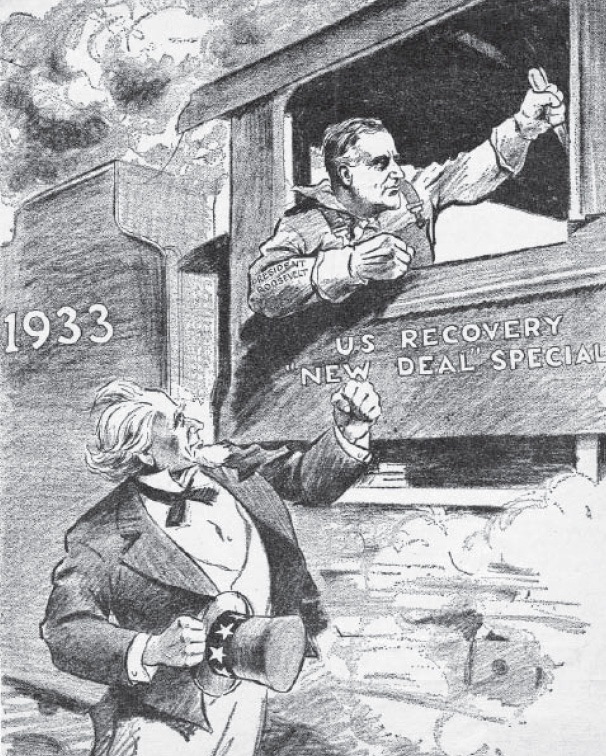
Seeing nothing beneficial for the American people in catering only to the rich, FDR brought an end to GOP policies. His administration instead offered a New Deal for economic revival. Through a massive legislative agenda Roosevelt and Congress intended to not only meet the emergency, but restore economic growth, and eliminate the conduct that led to the Depression in the first place.
One of the most popular New Deal relief programs was the Civilian Conservation Corps. Unemployed young men were put to work throughout the nation building trails and campsites in forests like the Great Smokey Mountain National Park, and urban building projects like the River Walk in San Antonio, Texas. (Consider that idle young men in Germany at the same time donned Black and Brown Shirts and broke heads for Hitler.)
Addressing the chaotic banking system FDR proposed systematic changes. Some 6000 banks had failed between 1930 and 1933 before the new president took office. Panicked depositors waited in long lines to demand their money until banks simply ran out of cash and locked their doors. Confidence collapsed.
In his first days Mr Roosevelt announced a Bank Holiday where banks closed for four days to stop panic withdrawals. Auditors then inspected banking institutions across the country and surprisingly many banks were deemed solvent and reopened. Not finished with banking, FDR also took to the radio to explain the banking system, and with his cheerful confidence encouraged the public to take cash out of their mattresses, coffee cans, and backyard holes and return deposits to local banks. Thousands did just that.
In order to prevent another such economic catastrophe the Glass-Steagall Act (1933), was passed by Congress to protect the public from high risk banking practices. One piece of the law was the Federal Deposit Insurance Corporation, FDIC, which is still in effect today. Depositors had the backing of the federal government to protect their funds from any loss. Moreover the Roosevelt Administration was determined to keep people in their homes, many of whom were facing foreclosure. The Home Owners Refinancing Act provided federal assistance to those who had paid their mortgages in good faith, but now faced eviction.
In the first hundred days of Roosevelt’s New Deal 77 laws in total were passed by Congress, all aimed at restoring the health of the country. To the majority of Americans it felt like this president truly cared about their wellbeing. Roosevelt’s ascendency to the White House, next to Abraham Lincoln’s certainly stands as the most consequential in America’s continuing experiment in self government.
On a side note Franklin Roosevelt suffered from polio and could not walk, though he believed he’d walk again. FDR never gave up. And the truth of the matter is it took a man in a wheelchair to put the United States back on its feet. Franklin Roosevelt, unlike his predecessors knew that the business of America is “We The People.”
Gail Chumbley is a history educator, author, and playwright. Her work includes River of January, River of January: Figure Eight, both available on Kindle, plays Clay on the life of Senator Henry Clay, Wolf By The Ears a study of American slavery, and Peer Review where Donald Trump meets four past presidents.
And that — that brings me to the second mode of civil disobedience. There’s a time when the operation of the machine becomes so odious, makes you so sick at heart that you can’t take part! You can’t even passively take part! And you’ve got to put your bodies upon the gears and upon the wheels, upon the levers, upon all the apparatus — and you’ve got to make it stop! And you’ve got to indicate to the people who run it, to the people who own it — that unless you’re free the machine will be prevented from working at all!!
Mario Savio, December 2, 1964
The GOP no longer pretends to care about the American people. Icons of wealth and raw power, along with compliant political figures parade in and out of Mar-a-Lago without a self-conscious blush. Former Trump critics now kiss his ring out of fear of disfavor and losing access to power. Many in the press are fearful of Trump as well, evident in the resignation of Ann Tenaes from the Washington Post over the paper’s censoring a critical Bezos cartoon, while NBC has threatened to jettison its progressive sister MSNBC.
At least smiling Ronald Reagan tried to demonstrate some kind of fidelity to American principles as his administration catered to the same rich and powerful.
This incoming crowd isn’t even trying to fake concern.
While America drowns in floods and burns in fire, both symptoms of advanced climate change, Mr. Musk has purchased access to Trump so Tesla can bring in cheaper, skilled technicians for his business operations. Not alone in his subservience, Mr. Zuckerberg too, along with Mr. Bezos, and Sam Altman, have made significant donations to Trump’s campaign while the world drowns and burns. These 21st Century tycoons intend to purchase the vain new president’s favor and clear the way for less public responsibility, and garner even more profits.
You see, in MAGA-world Trump is never wrong. Wrong doesn’t exist. The title “felon” carries no shame among supporters, nor rape, fraud, insurrection, or theft of sensitive US intelligence. Trump’s malfeasance is more a badge of honor with his supporters than a deal breaker.
American propriety and concern for the United States are sentiments of another, past era. Statesmanship, decency, and integrity are long gone. In the last days of the 2024 campaign Donald Trump mimed oral sex with his microphone, and no one at the rally appeared offended, not even so-called Christians. In any reality would President Carter had done such a thing? Would President Bush? Moreover, MAGA supporters self-righteously wrap themselves in neo-fascist certainty, nurtured by a steady diet of propaganda and misinformation. There is no longer a bottom.
Overseas enemies are delighted. Putin and Xi have waited a lifetime to overrun the United States. That simple fact should give us all pause on the political state of the nation. The Kremlin and Beijing are reveling in the certainty of easy access to the inner sanctum of American security.
And why wouldn’t they be?
Facebook CEO Mark Zuckerberg has made known he will no longer fact check posts plastered across his site. This is the same Mark Zuckerberg who threw Trump off Facebook not so long ago for disseminating misinformation. That Zuckerberg seemed to care about the country that has made his fortune. Adding insult to injury this same 21st Century robber baron announced the company will no longer practice diversity in hiring Facebook employees.
His decisions are unacceptable and unAmerican.
Though it certainly makes no difference in the larger scheme, I have decided to take a tiny seed of action by closing my Facebook account. As a writer, Facebook is a convenient way to publish my work as it appears also on Threads and Instagram. However, as Mario Savio so eloquently stated in 1964, I can no longer participate. My spirit is thoroughly sick and outraged with the alarming direction the Republican Party has eagerly chosen to sell out our nation for their 30 pieces of silver.
Though the gears and wheels have been replaced by motherboards, and circuits, the principle holds. The machine requires the public to participate, to provide the metaphoric oxygen for it to survive. And it is down to us alone, the American people. We must demand fair play and decency from the powerful.
If you feel the same please share this post, I know I can’t be alone in my objections.
Gail Chumbley is the author of the two-part memoir River of January and River of January: Figure Eight. Chumbley has also written three plays, Clay, Wolf By The Ears, and Peer Review, exploring the life of Henry Clay, the advent of chattel slavery, and four visits to DJT from past presidents.
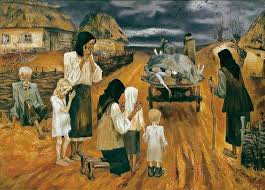
A painting by Valeriy Franchuk, “Harvest of famine” (2000)
A Reblog.
NBC news recently ran a piece on Trump meeting with Ukrainian President Volodymir Zelenskyy. In a video clip Mr. Trump announced that he had spoken with Zelenskyy about opening talks with Vladimir Putin to end the conflict between the two countries. Trump stated to the cameras that Russian President Vladimir Putin would give Ukraine a “good deal.”
Mr. Trump does not know nor does he care about Ukrainian history. If he did, the president would understand that negotiating with the Russian leader is unthinkable, a non-starter. To understand why is to look not only into Ukraine’s recent past but back into the 1930’s.
Putin’s first attempted assassination targeted Ukrainian President Viktor Yushchenko. In 2004 Yushchenko narrowly escaped death after surviving dioxin poisoning, a combination of toxic chemicals which left him weakened and permanently disfigured.
Putin, as a former KGB operative is a master of murder, and why the International Criminal Court has an arrest warrant for him.
An impulsive hustler by nature Trump shows little interest in the crimes of Vladimir Putin. After the recent meeting in Alaska, Trump again called on Zelenskyy to make a deal with Putin. That the Russian has targeted Zelenskyy in numerous assassination attempts on multiple occasions, including three failed hits in one week is of no consequence.
However this narrative reaches back further to the early Twentieth Century, when another strongman, Josef Stalin rose to power.
Following the 1924 death of Bolshevik leader Vladimir Lenin, Stalin coldly and efficiently murdered his own rivals consolidating his power as an absolute despot.
Launching his Five Year Plan, Stalin’s vision for economic prosperity, he ordered collectivization of Ukrainian farms, seizing land and harvests for Russia’s consumption. Calling farmers Kulaks, a pejorative name, Stalin justified his actions by fabricating enemies, complete with mass arrests, show trials, executions, and deporting thousands to Siberia. In that period alone thousands of Ukrainians perished in freezing rail cars, or worked to death in frigid Siberian work camps.
The total number of transportation deaths remains unknown.
However transport was not the worst weapon employed by Stalin. Ukrainian Communist party workers not only stole seasonal harvests but also the seed for future planting.
A genocide followed.
From 1930 through 1933 millions of Ukrainians starved to death or resorted to cannibalism due to Stalin’s disastrous Five Year Plan. Production dropped under the forced collective effort, and the Communist leader had to find scapegoats for the disaster, so he pinned blame on the farmers. Kulaks were dying in massive numbers on purpose to undermine the Kremin’s economic plan.
Stalin insisted he was the victim of treachery.
Called the Holodomor, (death by hunger) as it is remembered, cost the lives of somewhere between 3.5 to 5 million Ukrainians. Adding that number to those deported to Siberian gulags it is safe to say that the Ukrainian people suffered a monstrous horror.
Ukrainian memories and justifiable outrage remain vivid.
As for that ‘good deal’ with Vladimir Putin, President Zelenskyy is not interested. The Ukrainian President has no faith in Russian promises, and is not impressed by Mr. Trump and his previous effort to shake Zelenskyy down for corrupt political ends.
Today thousands more Ukrainian soldiers and civilians have lost their lives fighting this Putin-engineered war, but with national memory to guide them Ukrainians will not back down. Ever.
Independence from Russian oppression is relatively new and very fragile, and that nation will never surrender on Trump’s assurances of a ‘good deal.’ The people of that battered nation know better.
So should we.
This is the web site of the Ukrainian Embassy in DC if you’d like to make a contribution.
One central philosophy guided my years of American history instruction. The story had to feel personal to each student, after all it is their country. For the unit on World War Two, I aimed to act as a bridge between my grandparents generation to the kids seated before me. While growing up, my grandparents played a large part in shaping my world view, as the old folks often shared their life experiences. Each had a unique tale on how they committed to fight totalitarianism abroad in the 1940’s, and defend democracy at home.
All the following accounts involved inconvenience, sacrifice, and interruptions to family life. At that singular moment all they knew was to serve their country, and defeat foreign tyranny.
A new dark age lay in America’s defeat.
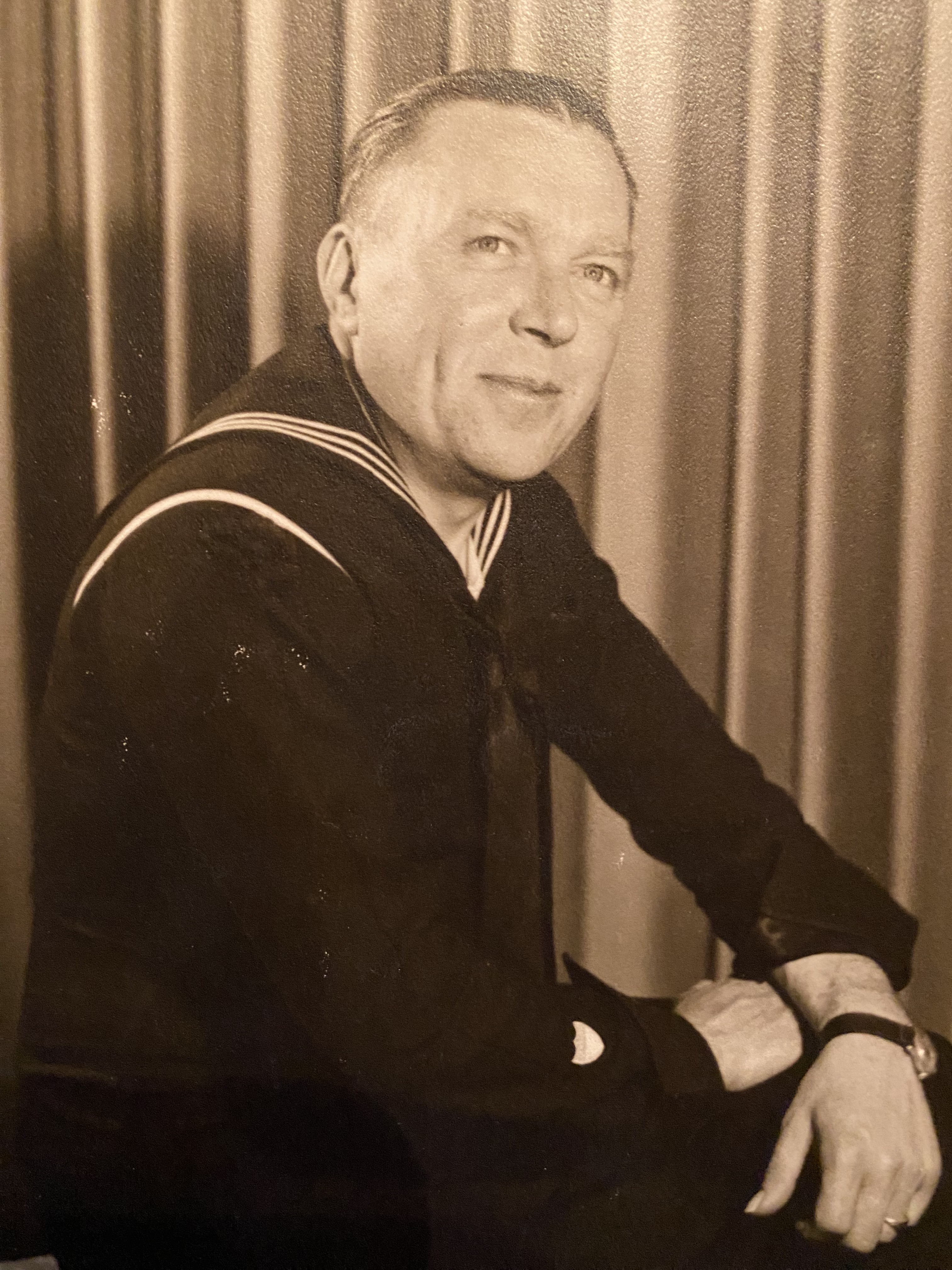
This is Ray Turner, born in 1905 in Hammond, Illinois. This young man migrated west, joining family members in Northern Idaho. Ray soon found his way to Spokane, Washington, where he found work as a postal carrier. Stopping for lunch along his mail route he met a waitress in a downtown cafe, Ailene Peterson, a single mother of one, and after a while they fell in love. Marrying in the fall of 1941, the newly weds, while on a Sunday drive caught a breaking news bulletin on the car radio that the Japanese had attack on Pearl Harbor in Hawaii. Ray turned his automobile around, motored back to Spokane, and joined the Coast Guard the next morning. Stationed out of Willapa Bay in Tokeland, Washington, Ray and the crew of the USS Manzanita patrolled the extensive, rugged Pacific coastline of Washington and Oregon monitoring for Japanese vessels. And it was aboard the Manzanita that Ray remained until August,1945 when he mustered out of the service and returned to Spokane. After a life of grandkids, holidays, and fun on his lake property, he retired from the US Postal Service, passing away in 1974.
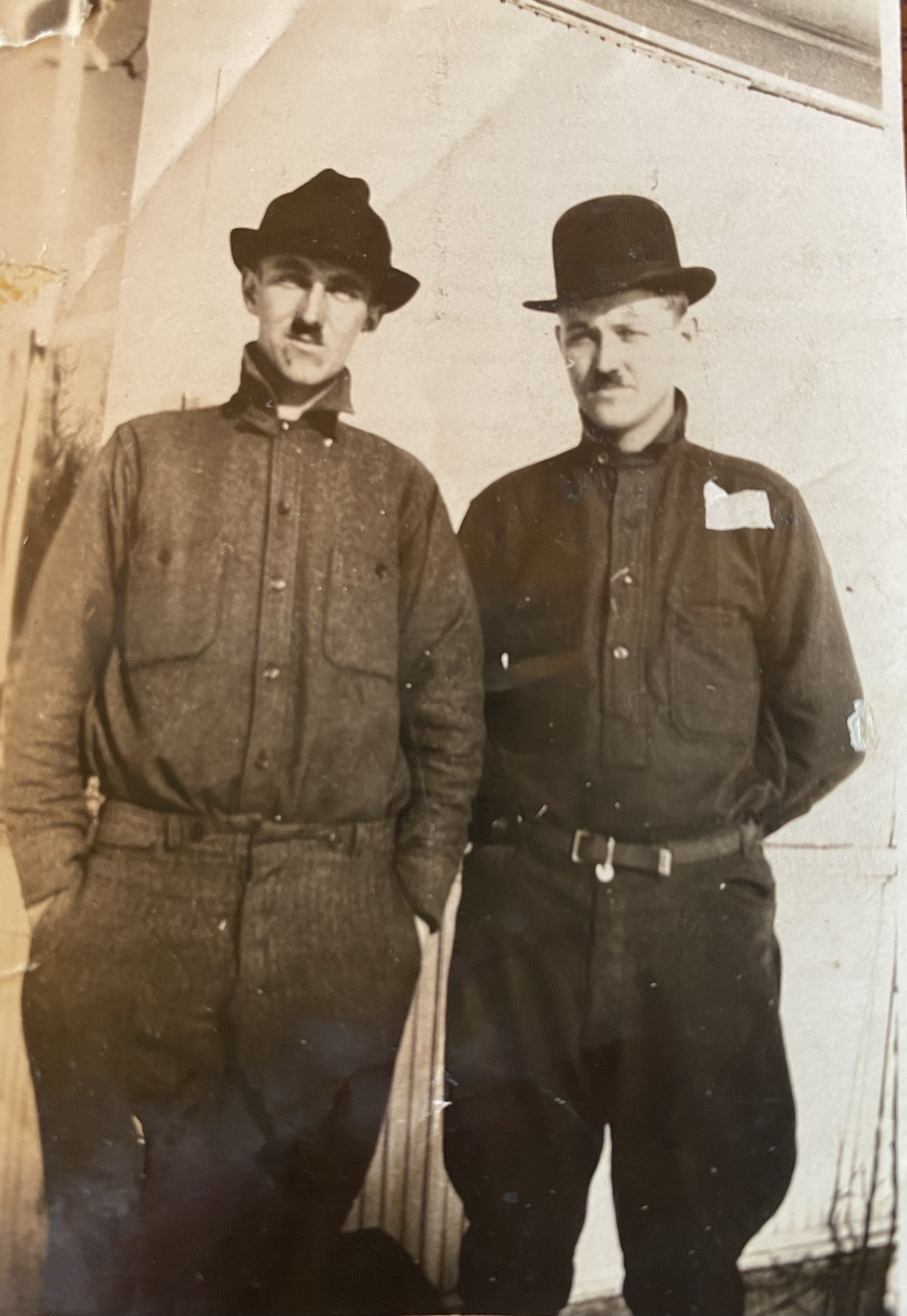
Kurtz Olson hailed from Wing River, Minnesota, born on a frigid day in January, 1905. Kurtz, as the youngest of seven children took up welding as a young man, and made a fair living during the difficult Depression years. This photo, take in the 1930’s, (Kurtz on the left) indicates that Hitler was considered harmless and laughable. That certainly changed in 1939, and after the Pearl Harbor attack brought America into the war, Kurtz packed up his wife and family and traveled west to Tacoma, Washington in search of war work. Kurtz spent his days dismantling scrap metal in a welding yard preparing the steel for conversion to ships, planes, tanks, and other war materiel. After the war Kurtz moved his family to Spokane, where he welded, owned a series of mutts, cut firewood with his son, and grandson’s. Kurtz passed on in 1989.
This GI is Joe Tucker, this snapshot taken somewhere in France around 1944. Born in Craig County, Oklahoma in 1907, Joe found himself back in uniform at the ripe old age of 37, much older than the 18 and 19 year-olds in his outfit. Joe had actually been in the army until 1939, receiving his first discharge before the war. Making his way to the Pacific Northwest he too, settled in Spokane where he met and married a widow with three children. His daughter from his first marriage lived in the city, as well, and he wanted to remain near her. Working for the Northern Pacific Railroad, with his new, larger family, Joe joined the Washington National Guard for the extra pay guard duty brought in. After Pearl Harbor the US Government nationalized the Washington Guard, and off he went to war. After training stateside, then stationed in the south of England, Joe found himself on Normandy Beach on June 7, 1944, D+1. Surviving those first days he and his fellow Guardsmen suffered through the Battle of the Bulge, finally winding their way to Germany. On one particular night, Joe stood guard duty somewhere in Germany. He heard his sergeant grouse was the soldier on duty asleep? The reply was no, it’s Tucker, and he’s awake alright. (Joe liked telling that story). Eventually Joe shipped home to reunite with his family in 1945.
From her waitressing job, Ailene Peterson, turned Ailene Turner followed her new husband Ray to the Washington coast. Traveling with her young daughter Ailene looked for war work as well. Born in 1914, in Clinton, Minnesota, Ailene had married quite young, desperate to leave her father’s stump farm in North Dakota. Husband #1, Joe Tucker had failed her, and with her young daughter in tow, sought refuge with family members in Spokane. It was in Bremerton, Washington that she found employment wiring mine sweepers for America’s Russian allies, (she said they were very rude). In later life, Ailene proudly mentioned that her work never had to be redone. She always wired it right the first time. In an operators cab of a crane, Ailene noticed the girls below waving their arms and jumping about. Shutting down the motor she heard them yell that the Japanese had surrendered, and the war was over. Ailene scrambled down from her seat, and joined the victory celebration. She, too, along with Ray returned to Spokane until her death in 1990.
Besides being my grandparent’s, and generously sharing their remarkable stories with me, what else did these people share in common? They put aside their personal lives to step up in defiance of fascism and authoritarianism. They knew that service to America, to our democracy, was their first duty.
Retelling my grandparent’s war-time sacrifices to my history students added a vividness to the coursework that encouraged the kids to do the same with their elders. That, once again is how I bridged the war years to now, making it personal for students.
President Roosevelt had characterized that moment as America’s “Rendezvous with Destiny,” and those people rose masterfully to the challenge. And despite all the hostility to democracy today, we cannot surrender to those forces, and betray our forebears who stood up to defend our way of life.
Perhaps now is our “Rendezvous with Destiny,” and this time all we have to do is vote for the Democrat over the wannabe dictator.
Once again, a new dark age lay in America’s defeat.
Gail Chumbley is the author of the two-part memoir, “River of January,” and “River of January: Figure Eight.” Both are available on Kindle. Chumbley has also penned two history stage plays, “Clay,” and “Wolf By The Ears.” She is the co-author of “Dancing On Air,” and feature length screenplay, and is working on “Peer Review,” for the stage, a series of short plays where DJT meets real presidents from the past.
When reflecting on my career as a public classroom teacher I hold on to many fond memories. The subject, American History, provided a lot of fascinating stories to share with teenagers coming of age in America. The kids came from varying backgrounds and abilities but once the door closed we focused on a subject that linked us together as one people.
One memorable lesson concerned the Second Continental Congress and adoption of the Declaration of Independence. Together we unpacked the document, followed by guided questioning to clarify the contents. Thomas Jefferson lists the extraordinary circumstances that brought about the decision to split with Britain. Part of the substance listed the abuses of the King and measures colonials had to take to be heard. Toward the end of the lesson I asked the class who they thought Jefferson might be addressing with his lengthy explanation. One boy cautiously raised his hand, an astonished expression on his face, and in a surprised voice he answered “me.”
Indeed.
Toward the end of the academic year the kids were assigned to sit down with an elder and interview the person about their recollections of life in an earlier time. Students had studied a lot of decades which prepared them for those recordings. In a particularly powerful interview a boy contacted his uncle, a Vietnam veteran, and asked him to tell about his tour of duty in that bygone war. This veteran had not spoken of his service to anyone since returning in the late 1960’s. And although this poor man wept through the recording he apparently cleansed his soul for after decades of self-imposed isolation the uncle began to join family get-togethers.
My student said it was a miracle.
Lessons from the past such as these are vital to understanding America’s present. Though the course required a great deal of writing and analysis, a sense of accomplishment filled the room with an aura of confidence, and national belonging.
Today, over a decade has passed since my retirement, and much has changed in American classrooms. Rather than sanctuaries of learning classrooms have become battle fronts in the culture wars. A small, but loud minority has succeeded in chipping away at the foundation of public education, ironically something Mr. Jefferson promoted as vital to freedom. Sadly those misguided assaults imperil our nation’s ability to survive intact.
The underlying cause appears to concern social class, power, and money. To educate all requires tax dollars, dollars fewer want to pay. Further, education implies looking toward the future, providing hope that the promise of America will pass on to new generations. Making money now and keeping it is more important than any investment in other people’s kids. Besides the upper classes can afford to educate their children, and believing they must shelter them from the lower classes. That attitude runs counter to America’s motto: E Pluribus Unum, Out of Many, One. Education is a promise that opens up a world of possibilities. That power and possibilities the well-heeled wish to hoard.
Take, for example, Betsy DuVos appointed by Trump 1.0. She took the job as Secretary of Education for the sole purpose of defunding and dismantling public schools. This is not hyperbole. As Secretary of Education, she made no secret of her contempt for public education. In her official role she pushed for school vouchers, charter schools, private institutions, all designed to ensure gated-community education. Stripping down federal education statutes and funding marked her time in Washington.
With Trump 2.0 even the Department of Education is gone. Critics attacking public education lack serious understanding of our public system, and that threatens our national viability.
History could not be more clear regarding the obligation to America’s youth. After the Revolutionary War as land opened up in the Great Lakes area, Congress passed the Northwest Ordinance (1787). This law organized a numbered survey grid mandating revenue from section 16 of the survey be earmarked for public education.
In the years after the Civil War waves of immigrants from Eastern and Southern Europe flooded upon America’s shores. To aid the newcomers settlement houses, such as the Neighborhood Guild in New York City, and Chicago’s Hull House, children attended classes to learn to be American. Too bad we can’t rally the same enthusiasm for all our kids today.
Now self-appointed curriculum experts pack local school board meetings, demanding removal of books, blaming and bullying over-worked teachers which isn’t helpful. Understandably many educators leave after only a few years, while the rest bravely persevere. What our teachers need is meaningful support as they shoulder the duty of classroom instruction plus all the distractions of behavior problems, lockdown drills, bomb threats, and active shooter protocols.
This is an issue of national self interest. There is nothing sentimental or saccharine about how it takes a village. It does take all of us. We all bear responsibility to all of our kids, for they cannot do this for themselves.
Leave teachers alone and let them continue to weave that same magic I experienced for all of our students. We have and will continue to turn potential into reality.
Whether a parent or an educator, or a retired senior, we are depending on you all to protect the patriotic long game.
Gail Chumbley is the author of the two-part memoir “River of January,” and “River of January: Figure Eight,” co-writer of the screenplay, and “Dancing On Air” based on those books. She has penned three stage plays on history topics, “Clay” on the life of Senator Henry Clay, “Wolf By The Ears” examining the beginnings of American slavery, and “Peer Review” where 47 is confronted by specters of four past presidents.
The story began with a promise. Following his electoral victory in 1904, Theodore Roosevelt vowed to the public he would not run again in 1908. Assuming office in 1901, following the death of William McKinley, then Vice-President Theodore Roosevelt could have run in ‘08. But he had made that promise.
Selecting an heir, TR tapped the occupation governor of the Philippines, William Howard Taft. TR believed he could happily step aside and pursue private interests with Mr. Taft in the White House. Taft did not want to be president, but his wife did. Though preferring a seat on the Supreme Court, Taft soon caved to his wife and accepted TR’s offer.
Reform and good government played a large part in Roosevelt’s administration. He challenged unfettered capitalism, pushing for regulations of railroads, and breaking John D. Rockefeller’s stranglehold on the oil industry. One of Theodore’s paramount issues was preserving America’s treasure trove of national parks, and wilderness areas.
TR loved the West and wished to regulate development where it wasn’t needed. After completing his term, and Taft safely elected, TR went on safari in Africa with one of his sons. By the time Roosevelt returned he learned things were not to his liking in Washington. Taft had made decisions, and endorsed policies Roosevelt had opposed during his administration.
In short, Taft had the audacity to run his own administration.
A big issue of contention was conservation of lands and natural resources. Unlike TR, Taft opened up Alaska’s Chugach National Forest to coal mining. Worse, Taft fired TR’s man in the Forest Service, Gifford Pinchot, a spokesman for public land as recreational for the people. Suffice it to say this, and other disputes turned ugly.
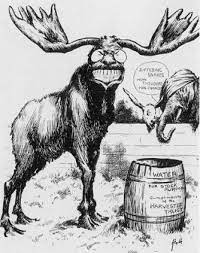
The 1912 campaign season began with TR’s new third party, the Progressive or Bull Moose Party. William Howard Taft also announced his run for a second term for the GOP. New Jersey Governor, Woodrow Wilson, received the Democratic nomination in Baltimore.
Of course the Republican Party split between Republican conservatives, and the Progressives backing Roosevelt. And Wilson became the 28th President of the United States.
What does that moment of time portend for today? Certainly a major Republican split between traditional and reactionary members is in the offing. Much like TR’s progressive agenda, and Taft’s middle-of-the road-conservatism, GOP voters are going to have to decide.
Clearly this same party is sliding into another major split in 2024. Is neofascism the preference of today’s organization? That one announced candidate has another term coming, and has made plenty of promises too. Will middle of the road conservatives tone him down and redeem the party in their own image? Maybe. But for today the smart money is on that 80-year-old moderate incumbent.
Gail Chumbley is the author of the two-part memoir, “River of January,” and “River of January: Figure Eight.” Chumbley has penned two historic plays, “Clay” about the life of statesman Henry Clay, and “Wolf By The Ears,” exploring the the beginnings of slavery and racism.
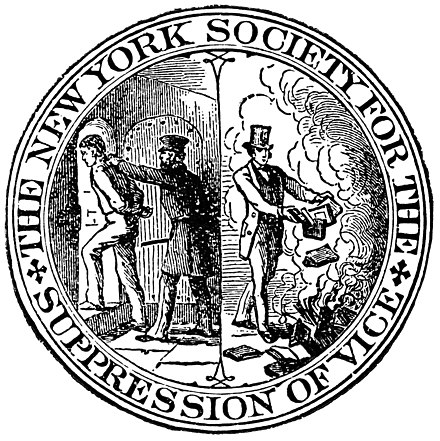
“I should say that the majority of women (happily for society) are not troubled by sexual feelings of any kind,” wrote William Acton in an 1857 medical tract. Some fifteen years later Acton’s evidence-free assumption was echoed by Postal Inspector Anthony Comstock, the founder of The New York Societyfor the Suppression of Vice. Comstock’s organization had been formed to monitor and enforce morality in public behavior, emphasizing in particular, the conduct of women. Any discourse on women’s sexual behavior, according to Comstock was “obscene, indecent, lewd, and immoral,” period. (Chauvinism appears to be timeless). Galvanized by his puritanical convictions, Mr. Comstock set about cleansing the moral conduct of the people of New York. (Note the Society’s Seal, above, depicts book burning, as a legitimate means to his ends.)
Finding momentum statewide, Comstock took his crusade to Washington DC, where he convinced the US Postmaster General to battle unacceptable behaviors on a national scale. Soon Congress complied with passage of the Comstock Act in 1873. This law declared that any correspondence touching on women’s birth control, contraception, and abortion were prohibited from the US mail.
Among Comstock’s many opponents, and there were more than a few, reformer and free-thinker, Ezra Heywood defied the law, publishing articles and books supporting women’s rights, and defending female sexual freedom. Mr. Heywood most notorious work, Cupid’s Yoke, insisted marriage an act of equality and balance between a man and a woman, quickly attracting government attention, when he was promptly arrested for his writings. In court, Heywood continued to argue that women were capable of controlling their own lives, and bodies, insisting the Comstock Act was destroying the liberty of conscience. Further, Heywood insisted women ought, and must have a voice in determining the size of their own families. Apparently just expressing such thoughts was enough to prove obscenity, and Heywood headed to jail for his persistence.
In the early 20th Century another movement targeted morals, this time in the film industry. Postmaster General, Will Hays, threatened Hollywood studios either to establish standards in motion picture content or the government would do the job. Known as the Hays Code, the studios prohibited profanity, nudity, violent sexuality, race mixing, and lustful kisses on the screen. In an interesting side note the film that sparked the controversy was 1934’s release of Tarzan. Maureen O’Sullivan’s Jane swimming naked alongside Johnny Weissmuller’s Tarzan sparked the scandal. Twenty Yale students, for example, stepped in front of a theater screen to halt the movie in New Haven, Connecticut.
Mr. Hay’s code remained in effect from 1934 until 1968, when the Supreme Court ruled films are art, and thus protected by the First Amendment. In place of the code, the Motion Pictures Association instead instituted the rating system we are accustomed to today.
The specter of the Comstock Law, and the Hays Code still casts a long shadow over American culture. Instead of concentrating on public policy, and other issues; power grids, global warming, gun violence, and infrastructure, (plus many more) politicians push their private notions of morality upon the rest of us.
Women’s sexuality and healthcare are not obscene matters, nor are they open for public debate. A fixture of the 19th, and early 20th centuries was the norm known as coveture. By definition coveture meant the husband acted for his wife in all areas of life. She could not vote, nor own property in her own right, and her children belonged to her husband. She belonged to her husband. No wonder Mr. Comstock and Mr. Hays found such success in their efforts.
Those artifacts of another less enlightened age are over. Exploiting the pendulum of political opportunity, giving and taking rights from women, will no longer wash. The overturning of Roe, the war on medical aid in pregnancy, the patchwork of state reproduction laws, (14 states ban abortions from the moment of fertilization*) implies something deeply sinister. Women cannot be trusted to think for themselves, possess no self-agency like minors, or the severely mentally ill.
Absurd.
Attempting to regulate 50.4%** of the US population, (there are 100 women to every 97 men) has caused irreparable political harm to those behind today’s archaic, and reactionary movement.
See you all at the polls.
*Axios, Dec. 15, 2023
**www.census.gov
Gail Chumbley is the author of the two-part memoir, “River of January,” and “River of January:Figure Eight.” Chumbley has penned three stage plays, “Clay” about Statesman Henry Clay, “Wolf By The Ears,” an exploration of slavery and racism, and “Peer Review,” on Presidential character.
The only thing new in the world is the history you don’t know. Harry Truman




 Gail Chumbley