A New April

Image

Right now, in classrooms across America, and overseas, thousands 17-year-olds are preparing for the AP US History exam. They, and their instructors are obsessed with cause and effect, analyzing, and determining the impact of events on the course of America’s story.  Moreover, they are crazed beyond their usual teen-angst, buried deep in prep books, on-line quizzes, and flashcards. As a recovering AP teacher, myself, I can admit that I was as nuts as my students, my thin lank hair shot upward from constant fussing.

My hair fell out too, embedding in combs and brushes, as I speculated on essay prompts, that one ringer multiple choice question, and wracking my brains for review strategies. The only significance the month of April held was driving intensity, drilling kids on historic dates; Lexington and Concord, the firing on Fort Sumter, the surrender at Appomattox Courthouse, President Wilson’s Declaration of War in 1917, the battle of Okinawa, MLK’s murder, and the Oklahoma City bombing, That was what April meant in April.

To quote John Lennon, “and now my life has changed, in oh so many ways.”  Today April holds a whole new definition. My husband rises first in the morning, putters in the kitchen, fetches coffee, tends to the dog, and is back in bed, back to sleep. Big plans for my morning include writing this blog, making some calls related to book talks, a three mile walk through the Idaho mountains, then working on Figure Eight, the second installment of River of January. What a difference!  Nowadays, getting manic and crazy is optional. My hair has grown back in, standing up only in the morning, and the only brush with AP US History occurs in my dreams; the responsibility passed on into other capable hands.

This month, at least here in the high country, has been especially beautiful. We have already enjoyed a few 70 plus degree days, and the green is returning to the flora. Our sweet deer neighbors are no longer a mangy grey, emerging from the trees wearing a warm honey coat. With a little snow still on the peaks, the sky an ultra blue, and the pines deep green and rugged, I think sometimes this must be Eden.

My years as a possessed, percolating history instructor provided a gift of passionate purpose that enriched me more than depleted.  But, now . . . I wouldn’t trade this new phase of my life for all the historic dates in April.

Gail Chumbley is the author of River of January also available on Kindle.

Idle Observations

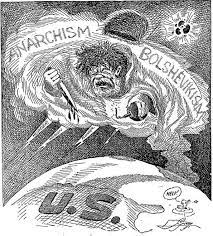
Foreign oppression has, more than once, moved American policy makers at home to react with oppression. From the French Revolution to today, overseas upheavals frighten those in power enough, to prompt the same repression at home.

For example:

Immediately after World War One, the US endured a period of destabilizing fear–America’s first Red Scare. The U.S., bitter over entering the Great War, grew intolerant of unorthodox political views and worked to silence dissent. Radicals, both homegrown and immigrants from Europe, felt the wrath of political crackdowns. Anarchists, such as emigres, Emma Goldman, and Alexander Berkman, found themselves on trial, then deported back to Russia, while a home grown Socialist, Eugene V. Debs ended up in prison. Scores of other political agitators were targeted by the Justice Department for printing radical views, and voicing public opposition.

Why the oppression?

The reaction began following the bloody 1917 Revolution in Russia. The murder of the last Romanov Tsar, with his family, paved the way for the world’s first Marxist-Leninist government, the USSR. Vladimir Ilyich Ulyanov, (Lenin) seized the reins of the Bolshevik Party, and abolished all political opposition, outlining the aims of this new workers utopia, to overturn Capitalism worldwide.

The response in the U.S. came quick and harsh. Labor organizers, the leftest union, The Wobblies, and any other radical group deemed un-American was quashed. The U.S. government viewed dissent as treason, and Congress shaped specific legislation to silence protest. First passed and signed into law came The Espionage Act, in 1917, shortly followed by the Sedition Act the next year. No public speech, publications, nor use of the U.S. Mail to criticize government policy would be tolerated. Period.

In two test cases, the Supreme Court upheld the constitutionality of both laws. The majority ruled in the first case that nonconformists and draft-resistors presented a “clear and present danger” to the US. In the second opinion the Court ruled much the same, but this time with an important dissent. Justice Oliver Wendell Holmes, wrote, ” . . . the ultimate good desired is better reached by the free trade in ideas . . .”

Still, non-conformists and dissidents endured government suppression.

The courts, the government, and public opinion merged to outlaw what they feared–an all-powerful, biased social/economic system, much like the restraint simultaneously underway in the Soviet Union.

This was not over.

After Hitler’s death in April, 1945, and the ending of WWII in Europe, Soviet leader, Joseph Stalin kept his Red Army in East Germany and Eastern Europe, nixing a promised democratic Polish government in favor of his puppet Communist regime in Warsaw. And that was just for starters. A frightening Cold War ensued between the Soviets and the West, that by 1963 witnessed the construction of an actual partition, aka, an Iron Curtain. 

In America a political fever seethed, and Congress responded. Establishing HUAC, the House Un-American Activity Committee, to sniff out citizens who leaned to the left, ruining careers and lives in the process. This second Red Scare elevated the careers of Senator Joe McCarthy, and Congressman Richard Nixon.

This post originally intended to discuss the War on Terror. The objective to cast light on the American Taliban; those promoting God, Guns, and Gasoline. But now, with Russia up to its old tricks, all of us again, have a decision to make. Will Americans excuse Putin, grow complacent and emulate his corrupt oligarchy? That path is wide open, visited upon us via the former guy. He proudly rubbed shoulders with that murderer, and publicly praised Putin’s integrity. 

But, at this very moment, another, clearer choice stands before the American public. President Zelensky has conducted a master class on the real cost of freedom.  The Ukrainian people have lain down their lives to remind us we, are the original heirs of freedom.

In that spirit, this upheaval in the Ukraine is one we must emulate here at home. When Putin attacks Ukraine, he attacks us all. We are Americans, it’s time to take a stand for our liberty. This is not a drill.

Gail Chumbley is the author of “River of January,” and “River of January: Figure Eight.” Both titles are available on Kindle. Gail has authored two historic plays, “Clay,” concerning the life of Senator Henry Clay, and “Wolf By The Ears,” examining the foundation of American Slavery.

gailchumbley@gmail.com

Retirement

No doubt that one of the primary reasons I retired was burn out.  I had worked in secondary classrooms the length of my adult life and struggled the last couple years largely due to growing political pressure.  You see, I bought into the idea that hard work paid off and came to realize that I was dead wrong. My hard work didn’t matter. None of my colleagues hard work mattered. My student performance outcomes, though well above the national average didn’t matter.  Nothing moved policy makers except that they could hire two new teachers for the price of me, and many of my fellow staffers.

When the mortgage market imploded in 2008, Southwestern Idaho flat-lined economically.  While teachers, such as myself, fought draconian budget cuts the legislature didn’t listen. They didn’t care. The brutal impact on classroom numbers and lack of materials made no difference, their ears were closed. In fact, the Great Recession instead provided an opportunity to attack our union and kill protections such as negotiations, due process, and arbitration rights. I found that regardless of my expertise and my kids remarkable growth I was handed more students in class (220 every other day) and less time to teach (down 25% a week).

When I realized I could swing retirement I took it.

I worry about what is behind me in public classrooms.  There are enormously bright kids out there begging to be challenged.  These young people are smart, but need skills and information to develop their optimum potential.  However, as long as law makers settle for cheap, keeping salaries spartan, and classrooms packed, I cannot see America preparing for the future. The results will reflect the dismal investment.

In my state the Superintendent of Education denied that teachers were leaving education due to the perceived oppression from the legislature.  And he can tell himself and the entire House and Senate that tale.  It’s just not true. Teachers want to succeed, aspire to excellence, wish to see achievement among their students.  That is why the miserly funding and lack of support by policy makers has had such a negative impact.  No one wants to go into a job already set up to fail.

Teaching as a profession shouldn’t be done at such personal sacrifice.

Living Life Forward

It was the night of February 9, 1964, a Sunday, when my older brother and I had to make a crucial decision.  We were both over stimulated, frantic, not one of our four feet remaining long on the floor. The house vibrated with our excitement and the weight of our impossible dilemma. For starters our birthday was the following day–the 10th, (though we’re not twins–he’s a year older). Still, that pre-birthday fuse had already ignited and by the 9th the two of us were banking off the walls.

The quandary we faced that Sunday night was whether to watch “Davy Crockett at the Alamo,” starring Fess Parker on Disney (The Alamo!), or the Beatles on Ed Sullivan. This was that first historic Beatles broadcast, live on American television, and we agonized between the two choices.

In 1964 there were no video players, no DVD players, no home computers, or dvr’s, in fact televisions were the size of Volkswagen’s and transmitted in glorious, flickering black and white. This difficult decision counted because there was no rewind, there were no do-overs. One gain meant one loss.

We liked Davy Crockett an awful lot.  We had watched all the previous episodes, and Davy biting the dust in San Antonio was the much anticipated grand finale. But, oh, the Beatles! And the adoration was real, palpable, an injection of adrenaline without the needle. We worshiped at the warmth of our bedroom radios, perpetually tuned in to our local AM radio station. Reverent silence accompanied replays of “She Loves You,” and “I Want To Hold Your Hand.”

What could two grade schoolers, sick with anticipation do with such a weighty conundrum?  It was 1964 and we had to choose.

Before the proliferation of electronic media, this little girl of the 1960’s viewed momentous events as they beamed across the screen. MLK’s elocution at the Lincoln Memorial, President Kennedy’s inaugural address, his assassination, and the escalating war in Southeast Asia–all experienced as reported at that moment.

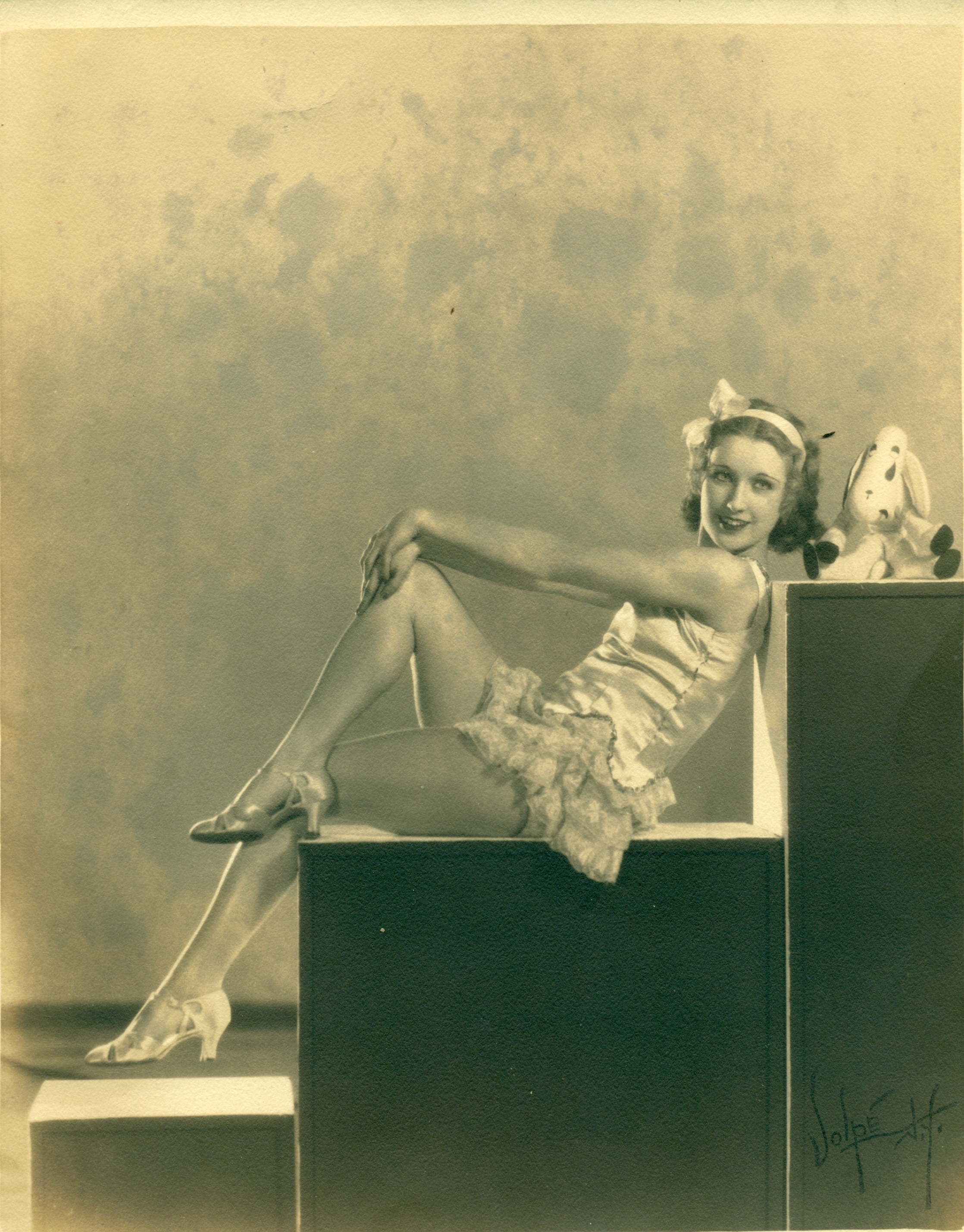
In an earlier era, when Chum flew in his air race, and Helen danced in Rio at the Copacabana, there were no camcorders or Iphones. His signature landing and Helen’s near disastrous opening night grew silent as the applause subsided, then faded in time. Much like my brother and myself in 1964, they lived life forward, one opportunity at a time.

Silent photos and written records are all that remain verifying Chum’s aerial dash through darkened skies, and Helen’s energetic dance routines. They lived life forward, embracing events as they unfolded–experienced once, then gone. I would love to see footage of Chum’s Waco airplane lifting off at dusk, or watch Helen spring across the stage. But those wishes are pipe dreams, never to happen. No vintage film or recording, (except one I found by accident) exist in the historic record. The best I can do for myself, and for readers, is try to recreate the magic of the first time around in the pages of my River of January.

Oh, by the way, I’ve never seen “Davy Crockett at the Alamo.”

ImageGail Chumbley is the author of the memoir, River of January. Also available on Kindle.

What Are You Waiting For?

I began a routine of driving home from school, entering the house, saying hello to my mother, and crawling into bed with Chad for a nap.  As he lay recovering physically, I needed to begin a recovery of my own, in my mind and spirit.  I had been diagnosed with PTSD, post traumatic stress disorder.  And I felt disordered.  I had order in my schedule, in my classroom, in the care of my husband, but my insides were wasted.  What this girl needed was an existential anchor and a path back to me.

My solution didn’t look like redemption at first.  And that statement requires some explanation.

Prior to Chad’s illness, prior to his father’s death, my husband found himself frequently back in Miami.  The reasons always concerned his father, but sometimes the trip was a medical emergency, sometimes an issue with the house.  Regardless of the errand, my husband packed up boxes and boxes of family mementos and shipped them to Idaho.  We, my daughter and I, enjoyed an archival Christmas each time the mail arrived.  By the time Chad’s father, Chum, had agreed to come west and live closer to us, half of our bedroom was furnished with plastic containers of Chumbley memorabilia.

Here I was, a basket case, and my room was jam packed with historic documents.  I am a historian with an active interest in research.  I teach advanced placement history.  I am operating under deficiencies near a nervous breakdown.  Still I couldn’t add one plus one and see the route to my recovery in front of my face.  It took a student to help me along.

When my course reached the Great Depression era, I always described Chum’s air race.  People did all sorts of activities during those years to make a little money.  I showed the kids the trophy, discussed the drama, and reveled along with my students over Chum’s daring.  In the same vein when we talked about the world’s descent into fascist hell, I shared Helen’s story of dancing across Europe with a backdrop of swastika’s and regimented Italy.  Inevitably one or another student would remark, “Sounds like a movie.”  And I would always agree.

A boy, a junior asked me why I was waiting to commit the story to book form.  My pat answer was not to offend anyone in my husband’s family.  This self-assured young man, Ethan, who thought more of my abilities than I did, looked me dead in the eye and accusingly challenged, “That’s just and excuse.  What are you really waiting for?”

At that juncture, my husband was lying prostrate in bed, a close colleague had died of a similar infection, another colleague’s husband dropped dead officiating a soccer match, and this boy wanted to know what I was waiting for.

I began River of January in May 2011.  The prose was terrible–more venting and judging than describing all the characters.  An editor fired me because the book stunk, and I continued to re-write, a friend helped me line by line, and I continued to rewrite, another editor asked if I was kidding with this book, and I continued to rewrite.

And dear readers, through all that time and uncertainty, Chad grew stronger and I gradually began to recognize myself in the mirror.

Writing has healing properties of enormous power.  I just hope River reflects the strength and the determination that restored my life.

Five Minutes

The following was written in August, 2010

Our days crawled by slowly, his recovery measured in increments.  Transferred from the ICU one day earlier, a new face appeared in his hospital room, a physical therapist.  With a breezy air he introduced himself, shook my hand then turned toward Chad. He fulfilled his efficient entrance in one smooth motion.

Medical people no longer inspired reverence for Chad.  He had become weary of the abysmally slow institutional routine, the new faces everyday.  Still despite his disillusion he was never rude to any of the medical staff, but I received a good run down when we were alone.

This particular therapist seemed to have arrived with a plan to rebuild my husband’s ravaged, broken body and depleted endurance.  The regimen, the PT announced would start by having Chad sit up in a chair for five minutes.  And though that sounded harmless enough it quickly became one of the trials of Hercules.  With the help of the nurse, they diverted or unhooked the multitude of attachments to Chad’s body, now including pressure socks to prevent blood clots.  The two then hoisted his body to a chair by the bed.  Though bobbled around, he said nothing while the two stuffed and padded blankets around him like a newborn.  Once he seemed balanced, the PT and nurse left.  They left.

Five minutes can be a very long time in certain situations.  The last five minutes in class. The last five minutes in a dryer cycle. At this particular moment my husband immediately began to sweat, and fretted that he would faint if he didn’t lay down. I scrutinized his movement with the vigilance of a gymnastic spotter, ready to catch him if he toppled.

Wasted muscle covered by white hosiery was all that remained of his legs, his exhausted head bowed in agonizing surrender begging me to help him back into bed. Where was the therapist? Why didn’t he stay?

I waited, searching for words of encouragement, but growing equally anxious. Poor Chad grew visibly physically anguished, swaying forward.  Still no therapist.

“I can’t sit like this any longer,” he wailed.  Panicked, I resolved that if the PT didn’t come back in sixty seconds, one minute, I would press the button for the nurse.  I slowly began to reach over to the bed, for the call button pinned to his sheets.  And that was when the therapist materialized, sweeping briskly into the room followed by the nurse.

“How did that go?” he inquired brightly.  We didn’t answer, as he swiftly bent over Chad,to assess his condition.

“That was five minutes?” Chad gasped.  “Seemed longer.”

“He didn’t do so well,” I added, feeling it my duty to tell the truth. The therapist and nurse didn’t reply as they hoisted him back to bed.

He then spoke up.  “Well, the doctor wants him up to fifteen minutes before the hospital can release him.”

With that, the two blew out of the room, on to other matters, other patients.

Neither of us spoke. After a few moments Chad drifted back to sleep, lightly snoring.  I stared ahead, drained.

Gail Chumbley is the author of the two-part memoir “River of January,” and “River of January: Figure Eight.” Both books are available at http://www.river-of-january.com, and on Kindle.

gailchumbley@gmail.com

What Is This Place?

This is another post from River of January, explaining the circumstances behind the work.  For the next few weeks I plan on blogging portions from the manuscript that were edited out.  The story behind the story simply made the book too long, but thoroughly describes the path to the book’s creation.

He had been unconscious for about seven hours when I returned to the hospital, in the early morning of a certain-to-be- hot day.  By the time the elevator opened, emptied and refilled, I had time to note the nearest fire stairs. The ICU needed an express lift.  Whispering footfalls down a sterile, light peach hall led to a set of double doors, electric, requiring all entrants to sanitize hands and don surgical masks.  Just reaching his ward required countless consuming steps.  At last, after a cursory discussion with the charge nurse, identifying myself, I was directed to a corner where my husband lay unconscious.   Pulling aside turquoise drapery, there he lay, swollen and spent, punctured with countless tubes dropping from suspended clear bags, attached into numerous portals in his arms, abdomen, and chest.  His delirium and thrashing in the night forced the graveyard shift to restrain his wrists in Velcro cuffs anchored to the bed railings.  For the moment, his body lay motionless, comatose and unaware.

             Attached to Chad’s lower torso, a catheter was inserted.  And across his grossly distended lower abdomen a small red ring of turned out flesh with an opaque bag adhered around the opening, leading to a fatter tube fitted into a lunchbox-size canister positioned under the bed. That, I was told, collected feces from his large intestine.

His colon had ruptured the day before, and emergency surgery was crucial to save his life.  Of course, the problems that brought us to this point had begun months before, on the other end of his body.  Chad had been diagnosed with stage four Tonsil Cancer the previous April.  Now an oxygen tube had been forced down that same raw throat, and something akin to a mini-power strip, called a ‘pick’ was inserted under his skin, between his heart and left collarbone.  Another panel of ports was visible in his left inside elbow— I assumed to provide additional openings for more of the countless IV bags that crisscrossed his high narrow bed in a canopy of plastic.  His arms, red and purple, gave evidence to the sub dermal pooling of blood from all the needle punctures through his paper thin skin.  Red abrasions tracked down his bicep, the front of his forearm and onto his gauze covered left hand, trapped in Velcro; there were more tubes sprouting from an IV underneath the white dressing.  

All of these lines connected to something, each anchored to a myriad of flashing, incessantly beeping monitors.  His body seemed a human casino—one where no one wins.  The multiple reading machines produced a frightening racket, betraying his dangerous condition.  Loudly, the devices declared his pulse rate, heart beats, and the level of oxygen in his blood, with monotonous and relentless bursts.  It didn’t help that the medical staff eyed those readings grimly as they routinely stopped and carefully charted the numbers.

Most vivid in my mind was the beading sweat dripping off of the harried ICU nurse, as he raced around the bed in tennis shoes, laboring to battle, and improve those noisy readings.  Somehow I want to remember him wearing a sweat band around his head, like Andre Agassi wore, but that couldn’t have been the case. We were in a hospital.  It also appeared that this nurse had no other patients that first morning, because apparently his only job was to try and keep my husband numbered among the living.

It was a disastrous ending to a horrible spring and summer.  All I had left was grim resolve— there clearly would be no quick resolution to the calamity that had befallen us.

Wounds

th

Rereading the original draft of my book, River of January, I reviewed the back story that propelled the book’s creation. An impossible crisis pushed me to write the work, but that narrative was cut out of the main manuscript due to length. But I still believe that the story behind the published story is important to share.

The Intensive Care Unit was the largest department on the third floor of the hospital. Reflecting back I never did figure out which direction the ward faced. Was it north toward Boise’s golden foothills or south over the blue turf of the football stadium? Someone needed to open the blinds.

The floor plan in the ward ovaled around like a carpeted arena, anchored by a nurses’ station in the infield. Three quarters of the broad ring had been segmented into tiny stalls–narrow spaces housing mechanical beds. My husband’s particular nook, squeezed into a curved corner, remained either open or sealed by simply sliding a glass door and a privacy curtain. Each morning I instinctively gauged his condition by the disposition of that entrance. Coding patients were afforded some semblance of privacy.

The sparse decor inside clearly signaled “no nonsense.” Two chairs flanked the entrance, with one small footstool. I once tried pulling out that stool to attempt a nap, but sleeping was reserved for the critical only; the nursing staff’s frenzied laps around his bed made sleep impossible.

Unconscious, bloated, with a swollen torso and bulging arms, my husband lingered on the crinkly mattress. Tubes protruded from nearly every square inch of his upper body, pumping in liquid meds and below, pumping out liquid waste material. Attached monitors loudly measured his heart and pulse rates, racketing in a relentless beeping.  I was afraid to ask the meaning of the numbers blinking on the monitor, the din adding to my fatigue. Eventually, I inquired what a normal cardio reading looked like, and the answer wasn’t reassuring. I froze in that nondescript chair, dazed, almost hypnotized, willing his numbers to improve. Still indifferent, that monitor shifted erratically, frequently setting off an alarm drawing in medical reinforcements. 

The cocktail of fluids pumped into his arms overnight had left him bloated to the point that his nose had flattened across his full, stretched cheeks. Fingers that had earlier held my hand from the stretcher now swelled to the size of cooked kielbasa—triggering thoughts of his wedding ring and his watch. My next random reflection recalled both pieces being handed to me the night before, and hopefully safe in my purse. It was a dreamy recollection. 

The worst feature of his bare torso was the ragged, opened split from his naval to his groin, sealed by a stiff grey foam substance, and a thin membrane of clear film covering the diagonal wound. I was told his body was so contaminated in septic debris that the stitches closing the incision would have healed before the toxic substances beneath had cleansed.  So this vacuum packed dressing over his wound kept the area draining and that tube, too had an attached little box, stowed under the bed that beeped and flashed. 

He looked too rubbery and inflated to be real, but with the aid of artificial ventilation forcing his breath, I could clearly hear his intake of air. 

Clinging to these subtle signs I began the litany of phone calls that had to be made to the rest of the family.  His son, my parents, his siblings . . . I hated to upset them all, but knew these relatives had to be kept in the loop. Listening quietly on the phone, my 78-year-old father finally spoke; he and my mom would pack up and come down to Boise from Spokane. I wasn’t prepared for that offer, and asked them to give me a little time. I still wasn’t convinced my husband was going to live. At that moment I had no energy for company, all my focus concentrated on watching his vital signs.

Desperation is a funny emotion. The intensity of it burns on the inside, and we fool ourselves in believing the conjured up power somehow changes reality. Maybe the instinct to inflict mental suffering on ourselves is a primal manifestation of empathy for our loved ones. He bore the physical wounds, while mine lashed and scorched my insides. Over the course of his lengthy critical care, and his slow road to recovery, I had to do something with all the bile stuffed into my psyche. Out of this pain came the healing therapy of River of January and my own recovery through writing.

Gail Chumbley is the author of the memoir River of January


Sharing Our Truth

Image

I retired from teaching last May after more years in the classroom than I care to admit.  No longer constrained by rules, rules, and more rules, I began friend-ing my former students on Facebook.  What once was ethically frowned upon, is now my link to my past career.  That being established, I have enjoyed viewing the posts the kids have put up since graduating high school.  In something akin to an educational diaspora, these 18 year- old’s are encountering their first experiences away from home.  Of course that includes washing one’s own laundry, filling up on starchy food, and getting out of bed for class without mom.

The pictures are charming.  Girls, arm in arm, who only a month ago were strangers, now glow, linked together in this new adventure as best friends.  The boys seem less inclined to pose.  Instead they splay across the floor of a dorm room, stuffing pizza and chips into their smiling mouths.

Still the experiences behind those photos may be the most profound in life.  Whether the setting is a dorm, or an apartment, or a cave, the ritual remains the same.

I remember best, parked on the bathroom floor in my dorm room, talking earnestly and laughing many late nights.  In my new family of girls, we revealed our essence to one another, creating a link that I cannot replicate today with new acquaintances.  Established when I was naively open, without those worldly defenses I have perfected over time, those friendships have endured.  Fertilized only with an occasional Christmas card, or a stray email–when we get together, we pick right up where we left off.

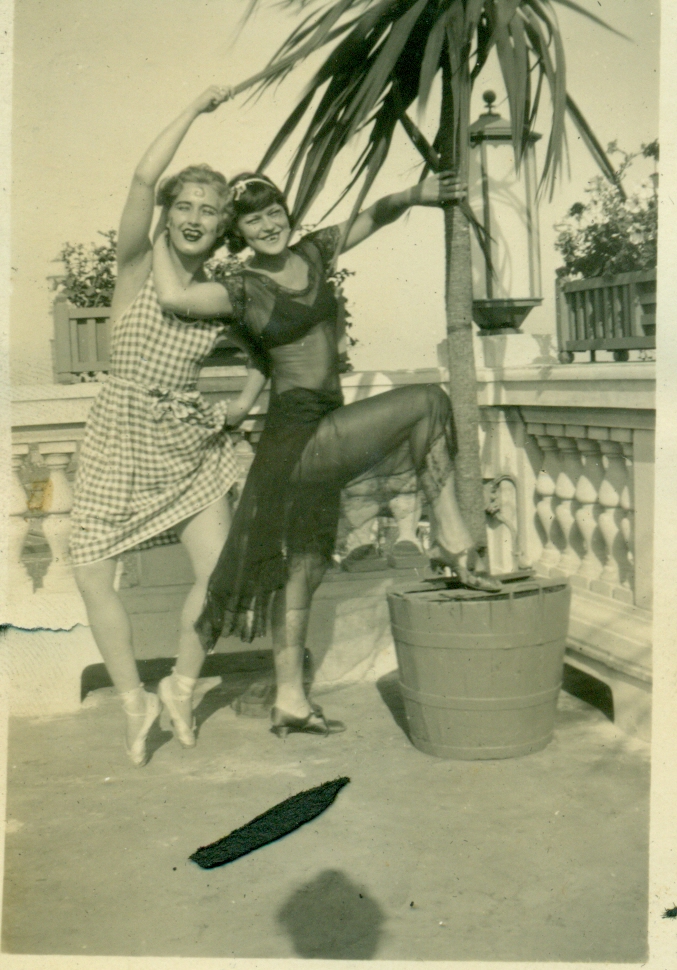
Helen, with no opportunity for college, shared a similar bonding experience with her “new” friends touring Europe.  As discussed in my book, River of January, she danced in a ballet company called, “The American Beauties,” who together performed first in Paris, and traveled as far as Algiers from 1932 to 1933.  In fact, the girl and her fellow dancers patched together their own version of a Christmas celebration at a hotel in Islamic North Africa.  She too, relished the late night yakking sessions, the joy of carrying out pranks, such as the night a group of them short-sheeted the bed of two other, unsuspecting dancers.  The picture above is a charming example of Helen purely celebrating life.

Later, these women remained some of the best friends Helen ever had.  Traveling to her home in Miami from Los Angeles or New York, the old girls sat around Helen’s little kitchen table, enjoying drinks, reminiscing and laughing.  For a short moment, seated at that tiny white table, they again were the same young dancers who had reveled in an extraordinary and memorable learning experience of their own.