Russia and the US didn’t have much contact in the 19th Century. A rumor had once circulated insisting presidential candidate, John Quincy Adams had procured American virgins for the Russian Czar when a young diplomat in Moscow. Not true, but there it is.
Still, the political tyranny of Russia has been widely understood in America as early as the 19th Century. When Abraham Lincoln condemned racism and intolerance stateside, he remarked that Russia’s oppression was, at least, less hypocritical than practiced in the United States. Lincoln’s Secretary of State, William Henry Seward later had his moment with the Czar when he negotiated the purchase of Alaska from Russia. Seward’s Ice Box, 1867 newspapers scoffed.
Some sixty years later, during World War One, revolutionaries deposed the Czar, and the last Romanov abdicated his throne. Bolsheviks arrested the former Czar, eventually shooting him, and the rest of the royal family in July, 1918. That same year President Wilson dispatched American forces to Archangel, to aid the White Russians to defeat Vladimir Lenin’s Bolsheviks, and stabilize democracy. The Whites failed, surrendering all of the vast Russian landmass into the hands of the Communists.
In the newly founded USSR, Premier Vladimir Lenin established the Comintern, the Communist International, publicly pronouncing the Soviet aim of exporting Communism worldwide, prompting in America our first domestic Red Scare.
In the following years, economic depression shrouded the globe, only dispelled by the horror of World War Two. Josef Stalin, Lenin’s cruel, and ruthless successor, struck a nonaggression pact with equally ruthless Adolf Hitler, dividing Poland as a buffer to buy time for both dictators. It comes as no surprise that neither trusted the other, and in 1941, Hitler launched Operation Barbarossa, invading the Soviet Union, bringing an abrupt, bloody end to that alliance.
After Pearl Harbor, the the Russians found themselves, by default, allied to Britain and the United States. Stalin trusted Washington about as much as he had Hitler, and in return Washington didn’t trust Stalin. Both Churchill and FDR remembered the Russians had cut and run during WWI, and the recent treaty with Hitler. Still, the two leaders went out of their way to appease their new Soviet ally.
In the last months of the European war, Stalin signaled his intentions to dominate by billeting the Red Army throughout Eastern Europe. Western allies acquiesced to Stalin’s aggression, and allowed Red forces to enter Berlin first, where the Communists didn’t leave until 1989.
A second Red Scare hit America much harder than the first. Stalin’s operatives managed to purloin atomic and hydrogen bomb intelligence, successfully delivering them to Soviet physicists to replicate. During the Kennedy Administration, the Berlin Wall sprouted up nearly overnight, and the entire Soviet Sphere of Influence made for an intense, dangerous Cold War. Conflict burned hot in America, the government attempting to flush out possible subversives, and ruining the lives of many innocent citizens. Julius and Ethel Rosenberg were executed for espionage, and Joe McCarthy accused the State Department and Army of harboring Communists. Soviet satellite Sputnik orbited the globe in 1957, the U2 spy plane crashed inside the Soviet Union in 1960, while at school we practiced ‘duck and cover’ drills. Proxy wars increased American foreign aid and deployed US forces to our allies across the free world, from Greece to Vietnam.
Some of America’s greatest Cold Warriors included President Eisenhower, JFK, Richard Nixon, and Ronald Reagan. President Reagan, in particular, while speaking in Berlin, demanded the Soviets “tear down this wall.” These Chief Executives understood that any agreements with the Kremlin required stringent verification before any closure. America’s Soviet rivals were seasoned operatives, and were, in no way, friends of the west.
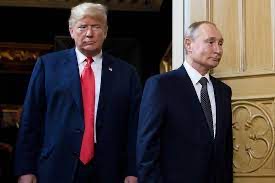
So where does this story leave us? Clearly the Kremlin has not changed. Spy networks, election hackers, and embedded operatives are perpetual threats. Maria Butina, the little Red darling of the NRA, and the GOP is an example of Russia’s recent relentless efforts. So, when an American President smiles and pays court to Vladimir Putin something serious is amiss.
Update: At a Conway South Carolina campaign stop on February 10, 2024, Trump remarked concerning NATO, “”If we don’t pay and we’re attacked by Russia, will you protect us? No, I would not protect you. In fact, I would encourage them to do whatever the hell they want.”
The Russian government is patient, and that patience has appeared to pay off. Putin’s masterpiece? He elevated a Russian asset to the White House, and convinced GOP voters to look the other way.
At this writing the entire Republican Party still remains steadfast to their Russian operative as he remains the presidential frontrunner for nomination.
Gail Chumbley is a history educator, and the author of the two-part memoir, “River of January,” and “River of January: Figure Eight,” Both available on Kindle. Chumbley has also penned three stage plays, “Clay,” “Wolf By The Ears, and “Peer Review.” In addition, Gail has co-written “Dancing on Air” a film script centered on a true 20th Century tale of Depression and War.
gailchumbley@gmail.com

 Gail Chumbley