Confessions Of An Aging Teenybopper

images

Culling through pictures, playbills, luggage tags and every sort of memento in the Chumbley archive, I discovered some odd newspaper clippings. This small sheaf of articles stood out because they had no bearing on show business, airplanes, or any other achievement of my principle characters in “River of January”. The collection, clipped together was titled, “Love and Marriage.” “Love and Marriage?” Helen was a career girl, a professional! Yet she had carefully cut them out of the paper, and valued the advice enough to keep them for over seventy odd years.

Helen was, in reality, a romantic girl, a girl who dreamed of an ideal ‘happily ever after.’
Like me.
Yes, I am a closet romantic. Despite all the years spent teaching wars, treaties,and politics, I still hold on to my teenage heart.
The boy pictured in this essay is Mark Lindsay of Paul Revere and the Raiders. The band wasn’t my favorite by any means, but he was so cute. His smile on a show, “Where the Action Is,” cut me to the core. I was infatuated, as were most seventh grade girls in America.
My hair hung straight, fortunate at a time of when straight hair was the thing, wore A-line dresses called Tent dresses, and cute little round toed pumps with crazy designed stockings. Preferred lipstick came from Yardley, an English brand, or for us poor girls, Avon. The color was frosted white, or subtly pink.
And I liked boys. Boys were the ideal “them,” the unfathomable other, the male prepubescence sirens that dominated my thoughts, and permeated all conversations with my girlfriends.
Just the opening bar to the Beatles, “Night Before,” sent me into a tail spin. Paul wanted me to love him. Sigh. And the Young Rascals asked, “How Can I be Sure?” And that tore me up. My heart and mind was an explosive combination of fantasy, adrenaline, hormones, and electric guitar riffs.
It’s still a jumble in my mind, those long ago days. But I think that is somehow the right way to remember. There was a war, (in Vietnam), riots, (in Watts), and students rising up across college campuses with an unrest detectable in my seventh grade classroom.
Most of the upheaval I processed in terms of cute boys. There, I admit it. But that was certainly a long time ago, and today those glamorized notions have been replaced with a deeper understanding of the historic record, and a trail of broken relationships. And maturity.
It hasn’t been seventy years of saving the “Love and Marriage” columns, but young girls and romantic idealism remains a constant. Younger girls are more transparent, expressing their romantic enthusiasm, but we older girls haven’t forgotten.
Just check out my playlist on itunes.
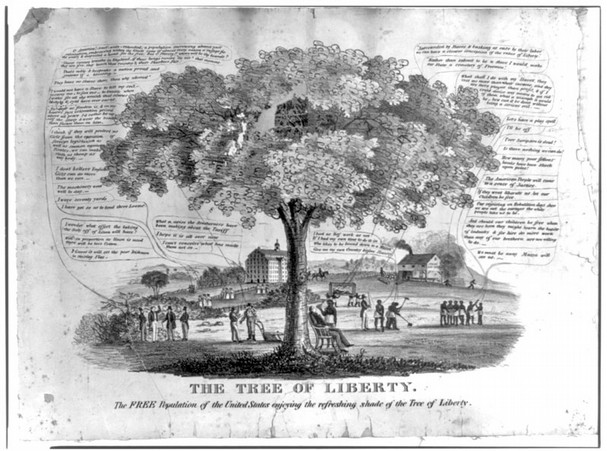
Liberty Tree

ImageOne symbol, endless interpretations. That is the age old condition of American Freedom. It is a messy affair with so many choosing to see their personal freedom as finite property. If another individual, or group realizes a gain, others record a loss.

If the Liberty Tree (above) represents that nebulous idea of freedom, the metaphor is easier to see. Made up of mostly white males, working class boys, the Sons of Liberty were the foot soldiers in the struggle for freedom. Those young men had access to guard the grounds around the trunk, and decide who could approach the tree.

Then came Scott V. Sanford, 1857 and the court ruled that slaves were slaves and absolutely prohibited  from the grounds where freedom stood.

The Fourteenth Amendment, known as the “Second Bill of Rights” guaranteed equal protection under the law to ALL Americans. Theoretically everyone was now protected under that mighty elm.

In Plessy V. Ferguson, 1896, Black Americans were allowed to peek at the tree, but only from far outside the vicinity, away from whites. If blacks felt inferior from the “Separate, but Equal” decision, that was their own problem. (Read the decision, it really says that)

Women too, steadily circled the grounds of the green–their collective eyes determined to examine the quality of the wood. Soldiers such as Elizabeth Cady Stanton, Dorothea Dix and others demanded the promise of American self-agency. Then came World War One, and women would wait no longer. Under the duo leadership of moderate Carrie Chapman Catt, and radical Alice Paul, the Nineteenth Amendment was ratified and women joined the male-dominated electoral process. These girls advanced toward their prize, though not yet able to explore the texture of the trunk.

Of course, through those many years, male interest in women’s reproduction remained paramount. “Coveture,” was a legal principle–women as property, covered by their men’s standing. Women only experienced that tree in a token sense, with permission from their father or spouse. Those brave enough to challenge the status quo, those who spoke out on reproductive rights, or even voting rights found themselves in jail. Take a look at the lives of Susan B. Anthony and Margaret Sanger. Those two women dared to touch the tree and were caught, shamed, and punished.

Roe V Wade, 1973 changed the subjugation of women for ever. In addition to the introduction of birth control pills, the girls not only circled the trunk, but were finally climbing the branches! Women could wait to start families. They could pursue education, fly airplanes, trek to the North Pole. The view from the tree top was fabulous.

But the powers of inertia, the sense of lost freedom pervaded the ranks of those who believed they were losing in this zero-sum game. Their freedom was diminished by that gained for Black Americans and women. The pull came, the courts listened, and the ropes went up again around the trunk.

In light of recent Court decisions, women are again relegated to the curb around the green. They can see the tree, but others who tout their stronger claim to freedom guard the grass. The personal proclivities of some trump the claim to self agency of others. Margaret Sanger, Mrs. Stanton, Frederick Douglass, for that matter, and Alice Paul would not be too happy with the backward turn in women’s standing concerning their autonomy. (Plus the hacking away at the Civil Rights Act of 1965)

That historic tree must spread its roots and grow to remain healthy. The reach of its branches are limitless, and no one loses freedom by sharing it’s blessings with all born to its legacy.

Happy Fourth of July.


Then There was This One

Standing outside, rain or shine, hot or cold, fire drills were a pain. They interrupted the flow of the lesson, the morning, the afternoon, the day. I especially hated that obnoxious buzz alerting all to evacuate when testing was underway.

But, there was this game we played while getting soaked, or freezing, or scrumming together to shoot the breeze. I called it the ABC Game, and here is how it played out. Someone would pick a category, say World War Two, or Harry Potter and we would take turns filling in the next word.  A is for Azkaban, for example. And it was not only fun, but kept the kids together and occupied till the all-clear bell back to class.

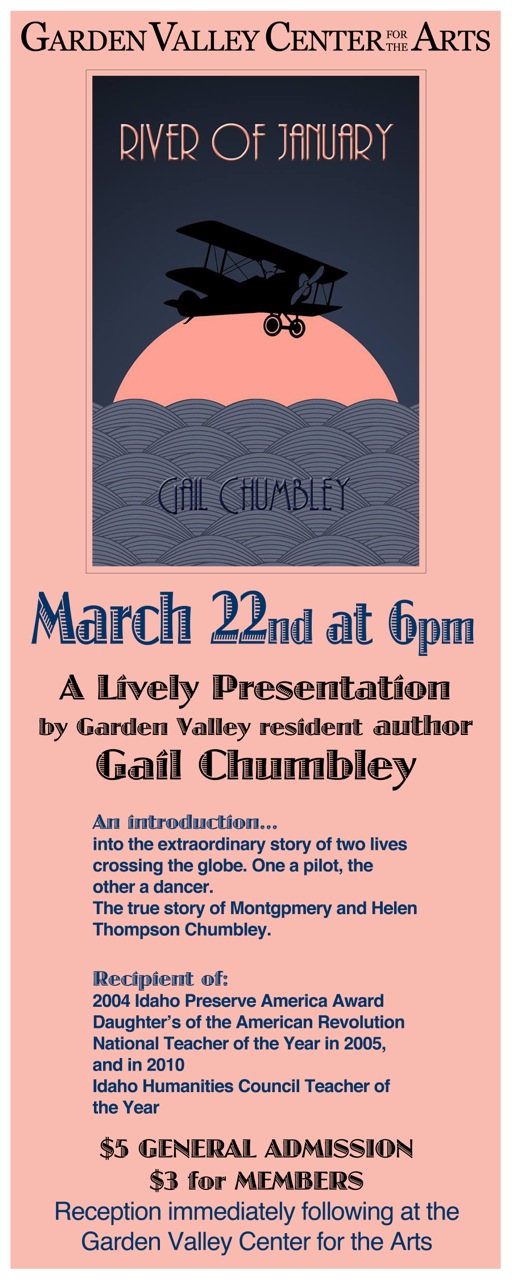
So for your reading enjoyment, and to hopefully sell some books, I shall play the ABC’s of River of January.  Ahem, here goes.

A-Aviation

B-Buenos Aires

C-Chum

D-Don Dean Club

E-Mr. Evans

F-France

G-Grant Garrett

H-Helen or Hollywood

I-Ile de France

J-Jans & Whalen

K-Mr. Koserin

L-Lartique Agency

M-Mistinguett

N-“Night Flight”

O-Ovation

P-Pan American or Palladium

Q-Queen Mary

R-Rio de Janeiro

S-Surratt

T-Thompson

U-ungent pots

V-“Voila Paris”

W-Harold Whalen

X-who knows, xylophone

Y-yawl?

Z-zeitgeist?

Order River of January today.


Increasing Value


I like speaking before crowds. The opportunity to tell stories and explain ideas was how I made my living for thirty odd years in the classroom.

Today, the breadth of my public speaking concerns discussing my book, River of January.

Before each talk my husband and I set up artifacts from the lives of my protagonists, Helen and Chum. For example I have this great picture of Helen in a chorus line dated around 1932, probably in Vienna or perhaps Brussels. There’s another of Chum posing in front of a biplane, a dashing smile exuding pure joy.

Listeners seem to enjoy poking around the display of mementos, especially after I present the slideshow describing a lot of the back story to the book.

Watching faces in the audience is something I particularly enjoy. On the table we also feature a vintage aviation trophy–tarnished, old and rather forgettable. Attendees often bypass this object until I describe the air race the object commemorates. Faces literally shift, expressions of nonchalance becomes enchanted with wonder. This trophy is clearly viewed with new eyes.

That’s the part I love the most. Inspiring a sense of wonder in a tired world weighted with cynicism.

helenhayes600w

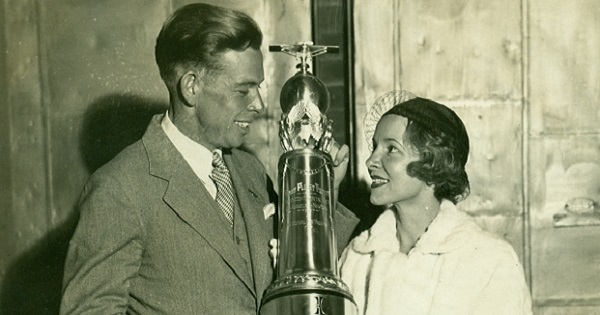
Mont Chumbley receiving trophy for first place in the Darkness Derby.

Actress Helen Hayes hands over the prize publicizing her new movie, “Night Flight.”

Capitol Theater, New York, October, 1933

A New April

Image

Right now, in classrooms across America, and overseas, thousands 17-year-olds are preparing for the AP US History exam. They, and their instructors are obsessed with cause and effect, analyzing, and determining the impact of events on the course of America’s story.  Moreover, they are crazed beyond their usual teen-angst, buried deep in prep books, on-line quizzes, and flashcards. As a recovering AP teacher, myself, I can admit that I was as nuts as my students, my thin lank hair shot upward from constant fussing.

My hair fell out too, embedding in combs and brushes, as I speculated on essay prompts, that one ringer multiple choice question, and wracking my brains for review strategies. The only significance the month of April held was driving intensity, drilling kids on historic dates; Lexington and Concord, the firing on Fort Sumter, the surrender at Appomattox Courthouse, President Wilson’s Declaration of War in 1917, the battle of Okinawa, MLK’s murder, and the Oklahoma City bombing, That was what April meant in April.

To quote John Lennon, “and now my life has changed, in oh so many ways.”  Today April holds a whole new definition. My husband rises first in the morning, putters in the kitchen, fetches coffee, tends to the dog, and is back in bed, back to sleep. Big plans for my morning include writing this blog, making some calls related to book talks, a three mile walk through the Idaho mountains, then working on Figure Eight, the second installment of River of January. What a difference!  Nowadays, getting manic and crazy is optional. My hair has grown back in, standing up only in the morning, and the only brush with AP US History occurs in my dreams; the responsibility passed on into other capable hands.

This month, at least here in the high country, has been especially beautiful. We have already enjoyed a few 70 plus degree days, and the green is returning to the flora. Our sweet deer neighbors are no longer a mangy grey, emerging from the trees wearing a warm honey coat. With a little snow still on the peaks, the sky an ultra blue, and the pines deep green and rugged, I think sometimes this must be Eden.

My years as a possessed, percolating history instructor provided a gift of passionate purpose that enriched me more than depleted.  But, now . . . I wouldn’t trade this new phase of my life for all the historic dates in April.

Gail Chumbley is the author of River of January also available on Kindle.

Western Union

Western Union

My computer crashed, but I have wonderful neighbors who are IT wonders. The little gadget is now up and working. Progress on all fronts with the book. Speaking engagements are lining up and books should be done by the end of the month.
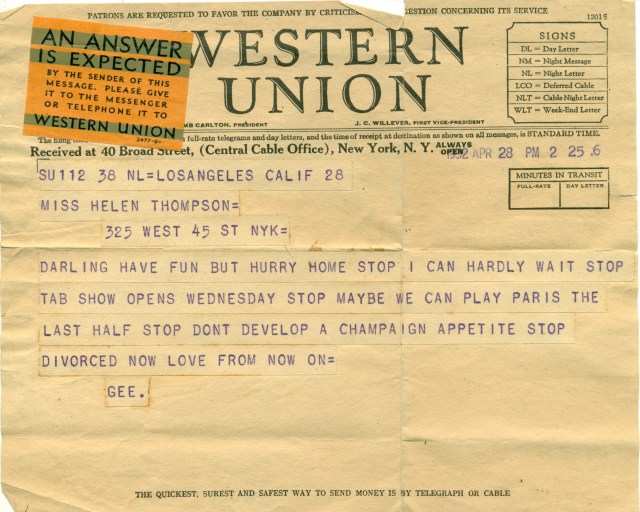
Pictured is a telegram for Helen from an admirer, before she shipped off to Europe in 1932. The story appears in the book.

Idle Observations

Foreign oppression has, more than once, moved American policy makers at home to react with oppression. From the French Revolution to today, overseas upheavals frighten those in power enough, to prompt the same repression at home.

For example:

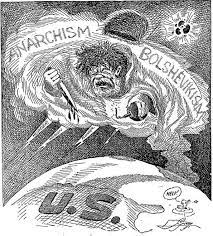
Immediately after World War One, the US endured a period of destabilizing fear–America’s first Red Scare. The U.S., bitter over entering the Great War, grew intolerant of unorthodox political views and worked to silence dissent. Radicals, both homegrown and immigrants from Europe, felt the wrath of political crackdowns. Anarchists, such as emigres, Emma Goldman, and Alexander Berkman, found themselves on trial, then deported back to Russia, while a home grown Socialist, Eugene V. Debs ended up in prison. Scores of other political agitators were targeted by the Justice Department for printing radical views, and voicing public opposition.

Why the oppression?

The reaction began following the bloody 1917 Revolution in Russia. The murder of the last Romanov Tsar, with his family, paved the way for the world’s first Marxist-Leninist government, the USSR. Vladimir Ilyich Ulyanov, (Lenin) seized the reins of the Bolshevik Party, and abolished all political opposition, outlining the aims of this new workers utopia, to overturn Capitalism worldwide.

The response in the U.S. came quick and harsh. Labor organizers, the leftest union, The Wobblies, and any other radical group deemed un-American was quashed. The U.S. government viewed dissent as treason, and Congress shaped specific legislation to silence protest. First passed and signed into law came The Espionage Act, in 1917, shortly followed by the Sedition Act the next year. No public speech, publications, nor use of the U.S. Mail to criticize government policy would be tolerated. Period.

In two test cases, the Supreme Court upheld the constitutionality of both laws. The majority ruled in the first case that nonconformists and draft-resistors presented a “clear and present danger” to the US. In the second opinion the Court ruled much the same, but this time with an important dissent. Justice Oliver Wendell Holmes, wrote, ” . . . the ultimate good desired is better reached by the free trade in ideas . . .”

Still, non-conformists and dissidents endured government suppression.

The courts, the government, and public opinion merged to outlaw what they feared–an all-powerful, biased social/economic system, much like the restraint simultaneously underway in the Soviet Union.

This was not over.

After Hitler’s death in April, 1945, and the ending of WWII in Europe, Soviet leader, Joseph Stalin kept his Red Army in East Germany and Eastern Europe, nixing a promised democratic Polish government in favor of his puppet Communist regime in Warsaw. And that was just for starters. A frightening Cold War ensued between the Soviets and the West, that by 1963 witnessed the construction of an actual partition, aka, an Iron Curtain. 

In America a political fever seethed, and Congress responded. Establishing HUAC, the House Un-American Activity Committee, to sniff out citizens who leaned to the left, ruining careers and lives in the process. This second Red Scare elevated the careers of Senator Joe McCarthy, and Congressman Richard Nixon.

This post originally intended to discuss the War on Terror. The objective to cast light on the American Taliban; those promoting God, Guns, and Gasoline. But now, with Russia up to its old tricks, all of us again, have a decision to make. Will Americans excuse Putin, grow complacent and emulate his corrupt oligarchy? That path is wide open, visited upon us via the former guy. He proudly rubbed shoulders with that murderer, and publicly praised Putin’s integrity. 

But, at this very moment, another, clearer choice stands before the American public. President Zelensky has conducted a master class on the real cost of freedom.  The Ukrainian people have lain down their lives to remind us we, are the original heirs of freedom.

In that spirit, this upheaval in the Ukraine is one we must emulate here at home. When Putin attacks Ukraine, he attacks us all. We are Americans, it’s time to take a stand for our liberty. This is not a drill.

Gail Chumbley is the author of “River of January,” and “River of January: Figure Eight.” Both titles are available on Kindle. Gail has authored two historic plays, “Clay,” concerning the life of Senator Henry Clay, and “Wolf By The Ears,” examining the foundation of American Slavery.

gailchumbley@gmail.com