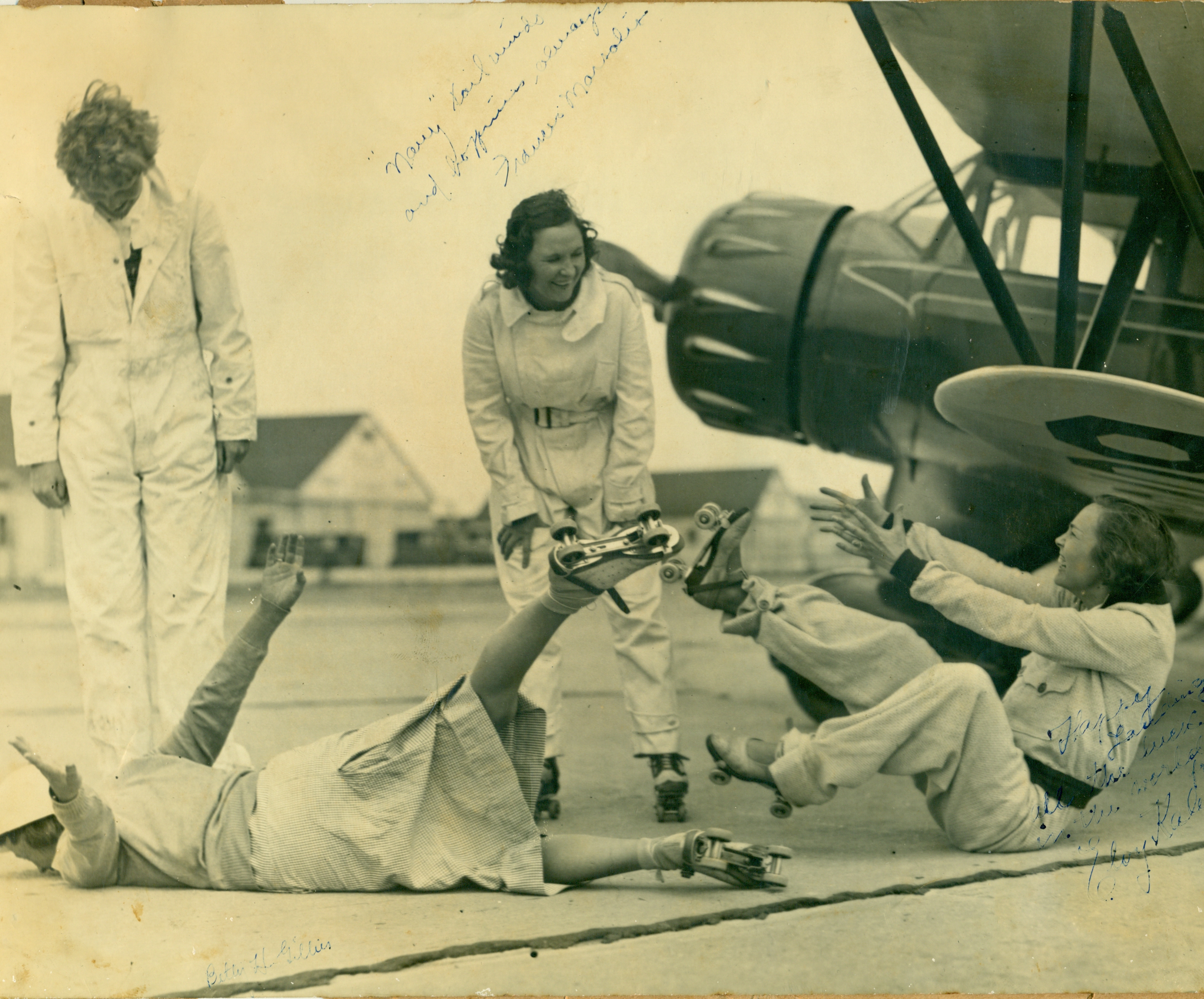
Piecing this story together didn’t come easily. Though I have had the benefit of volumes of letters, telegrams, and pictures, among other sources, I still have struggled to get the story right. The picture posted today provides an example of the most exciting finds I’ve made, but still shrouded with some doubt.
The girl in the center, in front of the Waco airplane, is Francis Marsalis Harrell. From Chum’s thick scrapbook and an interview I conducted with him, I know her to have been his girlfriend. They dated for a about a year after he left the Navy, and I believe he cared deeply for this young lady. What brought me to that conclusion was piecework and conjecture. First, during my interview sessions with Chum he lightly mentioned that his girlfriend used to time his trips into Manhattan from Long Island, but only when he drove female flight students into the city. Second, when he looked through his ancient scrapbook, coming across her picture, he had to get up and walk around on his old legs, getting water from the kitchen and using the bathroom, before we could begin taping again. I remember that clearly.
While researching my book, River of January, I gained a brief education in early aviation history. I learned that there was a group of women who closely gathered in a league known as the “Ninety-Nines.” This association of female aviators was a tight-knit assemblage, drawn together to survive in the male dominated world of flight. These women resolutely broke ground for future generations of women to find their place in the cockpit. These girls were enthusiastic and fearless pioneers.
Returning to the picture again, I found that three of these women pilots, all horsing around on roller-skates signed the photo. Francis signed it “To Navy,” her pet name for Chum. The girl on her belly and the other one on her rear end are Betty Gilles and Elvy Kalep, other Ninety-Niners. So the question for me has been, who is the fourth girl wearing her mechanic’s togs?
One morning, staring at this picture for the millionth time, the scales fell from my eyes and I saw Amelia Earhart. You might see her clearly too and wonder how I missed the obvious, or think I’m nuts for believing it’s her. So I ask myself, “Is the time right? Is the place right? Are there other pictures from this publicity shot?”
The answers are all yeses.

This picture came from a google search of Elvy Kalep.
In the effort to reconstruct the past there exists uncertainty and conjecture. However, thank goodness, also there exists logic and probability.
Boy, this has been fun.
Gail Chumbley is the author of the memoir, River of January. Also available on Kindle
 Gail Chumbley