Sorrow Mixed With Holiday Cheer

73115964-SLD-001-0016

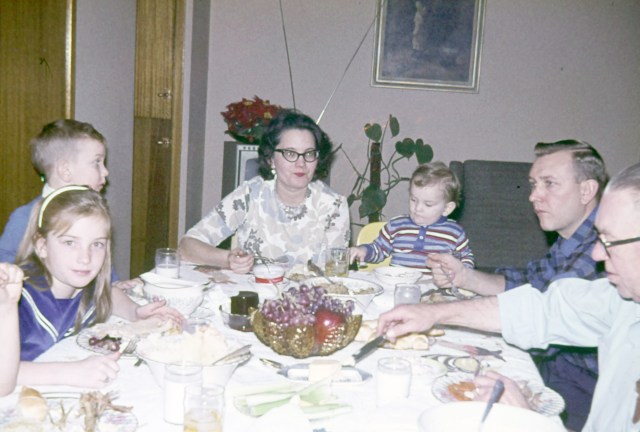
Christmas, 1965, I’m the sailor girl, he’s in blue plaid


We sat at the dining room table, my father having cleared a corner where we could both work. Agreeing to combine our efforts, we decided to write out both his and my Christmas cards in one fell swoop. These days, my visits to the folks come around more frequently—either flying or driving the three hundred miles to spend a few days back in my childhood home. And I didn’t mind addressing that stack of cards, especially with my dad sitting faithfully next to me making the job that much more special.

It’s my brothers who do the heavy lifting around the old homestead. My middle brother, in particular, visits nearly every day, pruning the shrubs, cutting the lawn, shoveling winter snow, and answering those midnight calls for transportation to the hospital which are also growing more frequent.

My youngest brother passes his weekend visits with on-sight, live-in chores. Heavy furniture moved, manure bags hauled, and removing and returning Mom’s giant window box cover, an aluminum contraption, some eight feet long. When those chores are finished, number three son whisks my father off to look at cars, both vintage, and new because they both like cars . . . a lot.

They take it easy on me when it comes to manual labor. My main job is to hang out with the folks and just go with the flow. On one earlier stay my Mom decided we should head out to the local mall. Happy to make the foray into retail-land, I wrestled her wheeled walker into the car, jockeyed for entrance onto the freeway, and we spend the afternoon simply looking around the stores, making time for a little overpriced coffee at the mall coffee spot. On this trip her sudden impulse for fun surprised me. All three of us sped the opposite direction on Interstate 90, to the Coeur de Alene Indian Casino, for some noisy, smoky, slot machine therapy.

If Caesar Milan is the Dog Whisperer, then my mother is the Slot Machine Whisperer. Stooped and round-shouldered, that little dynamo of a woman, cane in hand, cruises through islands of blinking, ringing machines, moving as smoothly as R2D2, but with more tenacity. She says ripe machines beckon to her, and damn if it isn’t true. As I sit beside her, losing my mortgage payment (at an identical machine) Mom turns ten bucks into a sweet fifty in a heartbeat. And she can get an awfully cocky for an old lady.

Bending over my work, back at the table, my Dad and I subtly figure out a production line. I copy last year’s addresses from a stack of cards, one by one, jotting them onto fresh envelopes. Stuffing this year’s card inside, I scribble into a spiral notebook each recipient for his records. My father then presses both the return address sticker and postage stamp on to the envelope corners and seals them up. This system is efficient and should have processed smoothly, except that my parents are now eighty-three, and their friends and close relatives are getting up there, too.

“This one is wrong. He’s in assisted living now. Oh, and he died just before Thanksgiving, poor guy. Say, can you put a line through that first address, and write in the new one?”

“Sure. It will still get where it’s going,” I assure him.

“She died a few months ago.” He sighs. “I’d better look at those envelopes,” he reaches for last year’s batch, “and I’ll get my address book.” Dad didn’t want to waste any more stationary. So by the time we were done with his cards, the final number had thinned down considerably, and he looked a little sad.

Despite that bitter-sweet atmosphere of sorrow mixed with holiday cheer, I found our time huddled at the end of that table somehow uplifting. Clearly our effort underscored that our lives can be measured as a series of losses. The loss of youth, of extraordinary moments too quickly expired, of dear friends, beloved pets, and the dearest of family members who leave us far too soon.

Still there was really no place I’d rather have been at that moment. I’m sixty years old and still I got to sit with my sweet, lovable, ever-constant dad, at a table we’ve shared since I was a little girl.

A precious gift indeed, in this season of joy.

Gail Chumbley is the author of the memoir, River of January also available on Kindle

Sale on Kindle for 99 cents!

th

River of January Cyber Sale

Monday 8:00 AM to Tuesday 10:00 PM

Only .99 cents on Kindle!

“It’s A Beautiful Cover”

So it’s only four minutes of fame. I’ll take it.

GC


A Wedding Is Announced

WeddingAnnouncement

Eighty two years ago today Helen and Chum married in Manhattan. Vows were exchanged at the “Little Church Around the Corner,” on East 29th and 5th Avenue. Formally known as The Church of the Transfiguration, this congregation opened its doors to show people, a group commonly shunned by other, more proper, churches in the city.

Excerpt Saturday: A Cultured Gentleman

Image

Europe
1932

After Brussels, Elie visited nearly every town Helen played, frequently heralding his arrival with a spray of flowers waiting for her at each hotel.
“Please, please invite your friends to join us on our outing,” Elie cheerfully encouraged Helen.
In Paris, where Voila was performing, Elie motored a carload of Beauties to the countryside, stopping at the Bourbon Palace of Versailles. The American girls strolled amid the recovering gardens, the graceful flowing fountains, and grand buildings that had been severely neglected during the Great War, not so long before.
“Elie, this place is magical!” Helen exclaimed. “Have you been here before?”
“Only once,” the young man replied. “We—my mother, two sisters and I, traveled to Paris after the funeral of my father in northwest France. Perhaps I will take you up there another time.”
They toured the ornate grand salons including Marie Antoinette’s Petit Trianon, the queen’s palace. Helen lost herself, dazzled with the elaborate ivory and gold friezes along the walls and ceilings, and the gold-framed paintings hung in arched cornices.
Later, standing before a vast mirror in the Hall of Mirrors, the couple caught their reflection together—Elie smiling tenderly while Helen felt an inexplicable pang of regret.
In Strasbourg, on another day trip, the pair enjoyed a 12:00 tour of the town’s beautiful Gothic cathedral.
“Oh!” Helen exclaimed, captivated by the cathedral’s ornate astronomical clock inside the transept.
Elie whispered, “Wait my dear, it gets better.”
After only a few moments, small figurines emerged from above the blue and gold clock, within a square opening of the sandstone wall. The carvings represented the phases of life, holy saints, and culminated with statuettes of Jesus and his twelve apostles. While absorbed in the intricacy of the synchronized whirring, Helen felt a touch on her hand, as Elie took her arm. Together, the two silently contemplated this majestic tribute to the Almighty’s dominion over time.
On another stop Elie caught up with Helen by driving to Geneva. In the morning, before rehearsals, the Belgian escorted the dancer on a visit to the League of Nations.
“How did you manage passes, Elie? Charlotte and Grace were told they needed a sponsor to attend,” Helen whispered in the vast paneled halls, watching Elie retrieve the official cards from his pocket.
“I have a business contact here in the city who agreed to endorse us,” Elie quietly responded.
Finding their seats in the public gallery, Helen listened as one prominent gentleman after another eloquently spoke of a peaceful world. Moved by the solemn atmosphere in the chamber, the dignified proceedings, and the sincerity of all the delegates’ remarks, she whispered to her new friend, “These men sound determined to spare the world from another war.”
“My dearest girl, I truly hope they are successful,” Elie answered emotionally, gazing at the proceedings with brimming eyes.

*

Elie was in London on business, unable to attend Helen’s ballet performance in Erba, a town in northern Italy which was a holdover obligation from the Gambarelli contract. Mistinguett permitted the rest of the cast time off while the girls rehearsed for the somber ballet—Goethe’s Faust. This dark saga, a morality tale of the man who sold his soul to the devil for worldly power, puzzled the ballerinas.
“Ballet is a serious dance form, it’s true,” complained Una, “but this performance is so grim, I’ll bet there’s no belly laughs, or knee slappers in the aisles tonight.”
A murmur of assent echoed in the dressing room.

*

The cast party after the program proved to be anything but grim or serious. Accompanied by two Italian boys, Eddie and Nikko—young men the dancers had met earlier—the crowd left the theater in a cacophony of chatter and laughter.
Parading to a nearby café, the American girls swarmed around small tables on the stone terrace. Under a garland of dim light bulbs strung around the courtyard, clouds of rising blue cigarette smoke, laughter, and chinking glasses animated the softly lit oasis, the celebration flowing easily against the night.
“Have you tasted cognac, Miss Helene?” Nikko asked, in an innocent tone.
“No, Nikko. It’s bourbon for this girl.”
“My dear, cognac is the nectar of the heavens. You must try a sip.”
Helen reluctantly stared at the cognac the Italian pushed in front of her. She cautiously raised the snifter, appraised the aroma warily, and sipped. Choking a bit, she concluded, “This isn’t bad.”
Nikko, grinning, ordered another. The more cognac she consumed, the more earnestly the dancer explained how she was properly instructed to perform Ballet spotters back in New York.
Eddie sat, enchanted, listening to the pretty American girl. He suddenly asked, “Lovely Helene, would you permit me the privilege of observing your spotters?”
Nikko winked at his friend, and then added, “I have never seen a New York spotter.”
“Go on, Helen, show us how your Mr. Evans says it should be done,” egged on Grace, weaving unsteadily around the table to watch.
“New York spotters!” demanded several voices. Looking blearily around at her audience, Helen wobbled to her feet. The little crowd applauded.
“Hop up on the table, Helen. We can’t see your footwork from here,” shouted Carmen. Helen warily looked at the tabletop. She carefully placed her knee onto the edge, testing its strength, and satisfied it wouldn’t tip or collapse, awkwardly clambered up.
She clumsily rose to her toes. Lightheaded from the alcohol, the dancer tried to focus on a fixed spot, but just couldn’t pinpoint one. One rotation she turned, then another, and Helen began to gather speed. Inevitably, and all too soon, the girl tottered, losing her footing and equilibrium. Luckily for her, spectators surrounded the table and as she listed at a dangerous angle, the boys caught her before she hit the unforgiving flagstones.
Sick and sore the next morning, the no-longer-graceful ballerina retching in the bathroom, gasped, “Nectar for the gods? Tasted more like lighter fluid. I—hate—everyone.”

*

Elie caught up with the Mistinguett Company when Helen and her friends returned to Paris. Pleased to be reunited with the lovely American girl, he offered the group another afternoon tour in his Packard.
“I have my automobile, and you can decide our destination,” he invited.
“We’ve been to The Louvre.” Carmen mentioned.
“I loved the Mona Lisa, remember, Helen?” added Charlotte.
“The Winged Victory was wonderful, too. Plus we have visited the Arch de Triomphe and the Eiffel Tower,” Helen finished. “I think that today it’s your choice, Elie.”
The Belgian looked the girls over, gazing mostly at Helen. “I believe I have an idea. Climb in. We will motor north.”
The party journeyed under a cloudless blue sky to the northeast. Eventually, after passing through some small villages, Elie veered onto a narrow road, parking his Packard in a field.
“This is the battle area known as the Marne,” he announced soberly.
The girls quietly climbed out of his vehicle almost reverently at the familiar name of the legendary site. The young man guided the group over the ribbons of scarred landscape left by the many futile attacks that made up the Marne Campaign in the Great War.
“Was your father killed here, Elie?” Helen whispered.
“No, Helen, he died later, further northwest near the Somme River. That is where he is buried.”
It wasn’t a topic she gushed over in her letters to New York. That afternoon excursion made the wreckage of war too real for a dancer from faraway America.

*

Back in Paris Helen was astonished to find a letter postmarked from Los Angeles, California. Grant’s letter seemed from another world, another lifetime. Helen slowly opened the envelope and read,

My Dearest Little Nell
As you can see I am still residing in the City of Angels. Your silence took the starch out of a booking to South America and I took a pass. I am waiting patiently for my partner to return from her world travels. Shall play nary a date till you arrive… will continue to play my hunches instead… and never doubt me even when I am not with you.

Below his note, Grant had sketched a whimsical map of the routes he planned to book for her return.
He cleverly illustrated the stops with leaning snowy mountains in Denver, oversized, smiling cactus in Phoenix, and swaying skyscrapers back in New York.
“Oh Grant Garrett, you are a charmer, and I do miss you,” she murmured, feeling a little sentimental.
“Helen, did you say something?” Grace asked, glancing up from her bed.
“Oh—no. Sorry, Grace. I didn’t mean to wake you,” the girl murmered.
Lying back on her pillow she mused, I can hardly believe it, but Grant hasn’t crossed my mind since I sailed in April. The tour has been so fast and so thrilling. For now, she yawned, I’m just glad to be here. I’m far enough away from those who spend all of their time planning my life.

Gail Chumbley is the author of River of January
A Modest History of American Labor

gailchumbley@gmail.com

th

I grew up in a union household. And truth be told, the benefits of the Steel Workers Union saw me through childhood, high school, and college, making possible my life’s work as an educator. With a combination of post-war prosperity, cheap hydro power from the Columbia River, and full industrial production at Kaiser Aluminum, my ambitions became possible.

Of course, at the time, I didn’t grasp the real cost paid by earlier generations for my opportunities. That is until I earned my degree in American History and began teaching. What I found in lesson preparation was a grim drama of determined people facing intimidation and violence. Eventually their valor made possible the emergence of America as a global economic power.

Labor strikes in the 19th Century were especially violent, frequently bathed in bloodshed, betrayal and cruelty. Functioning under the doctrine of “The Gospel of Wealth,” industrialists viewed workers as nothing more than a minor component in mass production. Government at all levels reliably sided with owners to quash any attempts labor made to realize better conditions.

Andrew Carnegie in particular detested unions, and to curb organizing dispersed immigrant workers of different tongues aside one another on the production lines. Language barriers minimized the threat of unionizing.

Another handy device, the Injunction, permitted state governors to legally use State or Federal troops in crushing workers efforts. A governor could claim interstate commerce was impeded, meaning rail carriers couldn’t get mail or goods transported. Once troops were deployed, guns blazing, strikers stood no chance.

One memorable use of the injunction concerned the Pullman Strike of 1894. Employees of the Pullman Palace Car Company endured lives dominated by the company’s powerful owner, George Pullman.

Workers lived in the company town of Pullman, Illinois. All utilities, rents, and other fees were set by the the powerful industrialist, George Pullman himself. Following the onset of the Panic of 1893, Mr. Pullman cut hourly wages, but held the line on municipal fees. Supported by the American Railway Union, (the ARU) workers voted to strike, demanding fairness during the economic downturn.

Strike leaders knew that they must, at all costs, avoid a federal injunction. To bypass any possibility of inviting trouble, the strikers took care that trains continued to move through the state. Rail workers aiding the Pullman strikers detached Pullman Cars, parked them on side tracks, and reconnected the trains.

George Pullman was not amused.

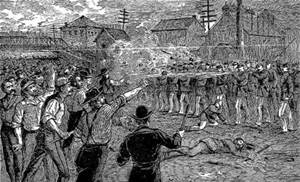
Soon enough the U.S. Attorney General issued the inevitable injunction, permitting federal troops to enter the fray. Some thirty strikers died at the hands of troopers, with many more wounded.

The Pullman Strike ended in government-sponsored violence, but this time the heavy-handed tactics used by Pullman left the general public uneasy. For a country that touted liberty and freedom, the authoritarian power flexed by the industrialist felt rather un-American.

Other labor disputes followed the same pattern; The Haymarket Riot in 1886, the Homestead Strike of 1892, all broken up by militias, soldiers, the police, or hired guns. In 1914 the Ludlow Massacre witnessed the Colorado militia using machine guns to mow down striking miners, women, and children.

Today unions remain controversial. However the role labor has played in America’s development is essential to remember. Labor Unions, in partnership with Capital, built the American middle class, and in return the middle class made the prosperity of this nation possible.

Have a thoughtful Labor Day

Gail Chumbley is the author of the two-part memoir “River of January,” and “River of January: Figure Eight.” Both titles available on Kindle.

Night Flight

Night Flight

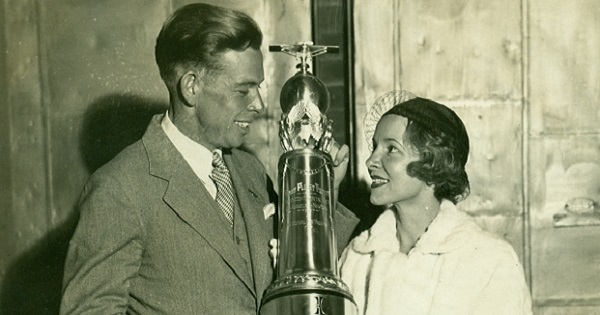
 “Night Flight,” an MGM drama premiered October 6, 1933 at New York’s Capitol Theater.

Star Helen Hayes presented Chum his hard-won first place trophy as a part of the evening’s program.

Read River of January.

helenhayes600w

Buy River of January by Gail Chumbley, also available on Amazon.