Inheritance

Harry Truman understood the gravity of his duty right off. When FDR died in April, 1945, the newly installed Vice President got the word he was now president. And what a Herculean task he had before him. A world war to end, conferences abroad, shaping a new post-war world, and grappling with the human rights horrors in both Europe and in the Pacific. Add to all of that, he alone could order use of the newly completed Atomic Bomb.

On his White House desk, President Truman placed a sign, “The Buck Stops Here.” With that mission statement Harry Truman stepped up to his responsibilities despite the formidable challenges he faced.

Did Truman inherit the worst set of circumstances of any new president? Maybe? But it is open to debate.

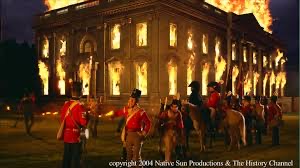
America’s fourth President, James Madison, found himself  in one god-awful mess. His predecessor, Thomas Jefferson had tanked the US economy by closing American ports to all English and French trade. Those two powerful rivals had been at war a long time, and made a practice of interfering with America’s neutrality and transatlantic shipping. Despite Jefferson’s actions the issue of seizing US ships and kidnapping sailors never stopped. By 1812 President Madison asked for a declaration of war against England that, in the end accomplished nothing but a burned out White House and defaced Capitol.

Following the lackluster administrations of Franklin Pierce, then James Buchanan, Abraham Lincoln stepped into a firestorm of crisis. Divisions over the institution of slavery had reached critical mass, and Lincoln’s election was enough for Southern States to cut ties with the North. So hated was Lincoln, that his name did not appear on the ballot below the Mason-Dixon. And the fiery trial of war commenced.

The Election of 1932 became a referendum on Herbert Hoover, and the Republican presidents who had served since 1920. Poor Hoover happened to be in the White House when the economic music stopped, and the economy bottomed out. And that was that for Hoover. His name remained a pejorative until his death. 

Franklin Roosevelt prevailed that 1932 election, in fact won in a landslide victory. Somehow Roosevelt maintained his confident smile though he, too, faced one hell of a national disaster. 

In his inaugural address the new President reassured the public saying fear was all we had to fear. FDR then ordered a banking “holiday,” coating the dismal reality of bank failures in less menacing terms-a holiday. From his first hundred days the new President directed a bewildered Congress to approve his “New Deal.” 

The coming of the Second World War shifted domestic policies to foreign threats as the world fell into autocratic disarray. FDR shifted his attention to the coming war. When President Roosevelt died suddenly, poor Harry Truman was in the hot seat. But that is where I want to end the history lesson.

If any new President has had a disaster to confront, it is Joe Biden. Without fanfare or showboating Biden, too, has stepped up to the difficulties testing our nation. 

Much like Truman and Lincoln before, 46 is grappling with a world in chaos, and a divided people at home. In another ironic twist, like Madison, Biden witnessed, a second violent desecration of the US Capitol.

To his credit, though his predecessor left a long trail of rubble, Biden understands the traditional role of Chief Executive, while clearly many Americans have forgotten, or worse, rejected. Biden is addressing the issues testing our country, not only for those who elected him, but those who did not. An American President can do no less.

Gail Chumbley is the author of the two-part memoir “River of January,” and “River of January: Figure Eight.” Both titles are available on Kindle. She has completed her second play, “Wolf By The Ears.”

gailchumbley@gmail.com
The Forgotten Cause

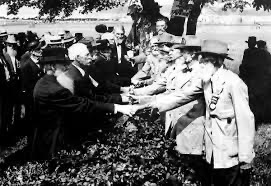
In 1938, old men aided by young volunteers shuffled off of trains and cars arriving from both sides of the Mason-Dixon Line. For the most part these gents were in their early 90’s, and looked forward to reminiscing, comradeship, and scheduled ceremonies.

Organizers had planned three full days of tours, music, and ceremony, complete with a flyover and fireworks. The Battle of Gettysburg’s 75th commemoration had begun.

There had been an earlier anniversary event, in 1913, but this time visitors knew this gathering would be the last. Those in attendance understood, as did the elderly guests of honor, that those who hadn’t fallen on that Pennsylvania battlefield in 1863, would soon join the brethren who had. 

After this commemoration, the narrative would pass from eye witness accounts into America’s collective memory.  

No longer wielding rifles, many maneuvered the grounds pushed about in wheel chairs, walkers, and canes. Old men brandished ear trumpets to catch the orations of the many visiting dignitaries. The men listened as President Franklin Roosevelt delivered remarks dedicating the Eternal Light Memorial, located near the “Bloody Angle.” Battlefield tours transported veterans, and well-wishers from Cemetery Hill, to Seminary Ridge, Little Round Top, the Devils Den, and finally the exposed fields of Picketts Charge.

There, at the stone fence, gray old men in blue, and others in gray and butternut, shook hands in reconciliation.

Ironically, left uninvited were the scores of African Americans who had harbored such hope for new lives after emancipation and the war’s end. Unfortunately, the era of Reconstruction left little to show for racial progress or Civil Rights. Instead Freedmen found a new enslavement, recognizable in every aspect, but iron chains.

Forty Acres and a Mule had never materialized, as promised by victorious Union commanders. Now relegated to tenant farming, Freedmen struggled in the same conditions as before, but now as sharecroppers. Stuck in a never-ending cycle of poverty, black farmers found insufficient harvests debited into the next season, and then the next, in an endless cycle of debt.

The Supreme Court’s 1896 ruling in Plessy V Ferguson legalized segregation by insisting any negative correlation attached to feelings of inferiority lived only in the minds of Blacks. Separate water fountains, parks, transportation, and schools worked just fine for the elderly veterans from the North and South.

The moral force of the Civil War had died as thoroughly as the nearly 7 million who had perished upon the scattered battlefields of that bloody conflict. Those veterans who reunited in 1938 Pennsylvania found white identity and brotherhood far outweighed any new birth of freedom envisioned by President Lincoln 75 years earlier.

The current occupant of the White House has made it his mission to once again assert white supremacy in an effort to rewrite American history. His feelings had been hurt by our first black President and now he seeks revenge. Of course this foolish attempt will fail, as is his custom in all things, because we know the truth of equality and this time will never forget.

Gail Chumbley is the author of the two-part memoir “River of January,” and “River of January: Figure Eight.” Both titles available on Kindle. Ms Chumbley recently completed her second stage play, “Wolf By The Ears.”

gailchumbley@gmail.com

The More They Stay The Same

This poem surfaced after the end of the Civil War. The sentiment speaks for itself. Despite the passage of time, America is again dealing with those who still cling to grievances held for nearly a century and a half.

(*Note The Freedman’s Bureau was a government agency that aided newly freed people of color. **Pardons were granted to those who swore an oath of loyalty to the Union after the war.)

The past is rather instructive, as we find ourselves still dealing with the same raw hate.

Play the link at the bottom of this post, and follow along with the words.

O I’m a good old rebel,
Now that’s just what I am.
For this “fair land of freedom”
I do not care a damn.
I’m glad I fit against it,
I only wish we’d won,
And I don’t want no pardon
For anything I done.

I hates the Constitution,
This great republic too,
I hates the Freedmans’ Buro,
In uniforms of blue.
I hates the nasty eagle,
With all his braggs and fuss,
The lyin’ thievin’ Yankees,
I hates ’em wuss and wuss.

I hates the Yankees nation
And everything they do,
I hates the Declaration,
Of Independence, too.
I hates the glorious Union-
‘Tis dripping with our blood-
I hates their striped banner,
I fit it all I could

I rode with Robert E. Lee,
For three year near about,
Got wounded in four places
And starved at Point Lookout
I caught the rheumatism
A campin’ in the snow,
But I killed a chance o’Yankees
I’d like to kill some mo’.

Three hundred thousand Yankees
Is still in Southern dust,
We got three hundred thousand
Before they conquered us.
They died of Southern fever
And Southern steel and shot,
I wish they was three million
Instead of what we got.

I can’t take up my musket
And fight ’em now no more,
But I ain’t going to love ’em,
Now that is sarten sure,
And I don’t want no pardon
For what I was and am.
I won’t be reconstructed,
And I don’t care a damn.

Gail Chumbley is the author of the two-part memoir, “River of January,” and “River of January: Figure Eight.” Both titles are available on Kindle. Gail also has penned “Wolf By The Ears,” a play in two acts.

gailchumbley@gmail.com

The Final Straw

The September 11th attacks in 2001 got our school year off to a strange start. There was, of course, the horror, and a lot of unplanned discussion about the Middle East. The course I taught covered Early American History through Reconstruction, and I couldn’t afford to take a lot of time to debrief. Nonetheless, the events of that day provided useful lessons that surfaced later in the year. 

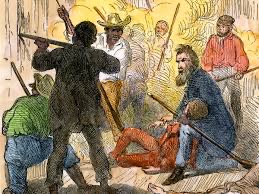
By the following Spring the curriculum arrived to the series of calamities that led to the Civil War. The last compromises crumbled, and blood had spilled at Harpers Ferry. The story then turned to John Brown, God’s Avenging Angel, determined to slay slavery. 

Brown is a complicated figure, believing he had been chosen by the Great Jehovah, to draw the sword of mighty justice.

And a debatable issue offered itself.

The link to Brown and 911 suspect, a French-Moroccan terrorist, Zacarias Moussaoui, centered on jail time. Moussaoui’s trial was underway and came up in class discussion.

John Brown had been captured in Harpers Ferry, after a standoff with Marines under the command of Colonel Robert E Lee. Intending to spark a slave insurrection, Brown and his raiders, including his sons had occupied the Federal arsenal in that river town. But once the military arrived the old man subsequently surrendered. 

As Brown awaited trial in Charles Town Virginia, the Governor, Henry Wise permitted reporters from Northern papers to interview Old Brown. To the press, Brown passionately defended his cause, insisting it was the work of righteousness. Newspaper readers throughout the North responded with support and compassion, gathering disciples for the cause of freedom.

However, in the South, the old man’s name was reviled. Viewed as a criminal below the Mason-Dixon, Brown was vilified as evil incarnate, hell bent on inciting slaves to murder their masters. Military training increased across the South, in preparation to defend their “peculiar institution.”

John Brown’s raid is often seen as one of the final straws, aside from Lincoln’s election the next year, leading to secession and a force of arms.

Prior to of horror of 911, Zacarias Moussaoui was detained in Minnesota. His immigration status apparently had irregularities, and his flight school enrollment tripped some security wires. At his trial, Moussaoui put on a noisy show, acting as his own attorney, and pitching frequent temper tantrums in the courtroom for all to see, including journalists. Initially the accused insisted he was innocent, then later confessed. Quite the circus.

During and following the conviction of the terrorist, Moussaoui demanded the judge permit him access to the press. The French terrorist had his side of the story, and he wanted to air his grievances on a national and international platform.

The judge said no. And Moussaoui today is a lifer, quietly incarcerated at Super Max in Florence, Colorado, and barely a footnote in history.

The significance of this complicated, and controversial comparison? Surely the Civil War would have transpired regardless of Brown; slavery was inconsistent in a nation that professed liberty.

But that fifteen minutes of notoriety can produce real dangerous blowback.  

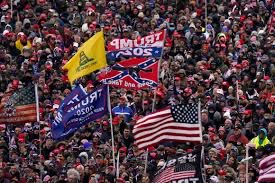
In light of the events on January 6th, thank the Lord DJT is grounded from social media.

Gail Chumbley is a history educator and author of the two-part memoir, “River of January,” and “River of January: Figure Eight. Both titles on Kindle.

Choked Me Up

 In case anyone else is interested, here’s a little editorial piece I wrote about Critical Race Theory for my community. Gail Olson Chumbley, I didn’t expect it to go where it did, but I mean every word of that last part – but I’m sure you already know that because all of us students already do pastedGraphic.png😉

I would like to share something that’s been on my mind a lot lately, and I am hoping that those who are interested can engage in a way that promotes understanding on all sides as well as help dispel concerns. The topic is Critical Race Theory and what it means to have it “taught in schools.”

First, I am a teacher, though not in Kalama school district. I say this because I want to be transparent as well as reassure you that, if you do not agree with what I have to say, I also have no control over what is taught to your children either. I’m just here to chat. I also have my PhD in Educational Leadership and administration license.

——-

So, what is Critical Race Theory? Well, We need to understand what each of these words means in their original context, which is a widely accepted (non-controversial) area of scholarship, specifically legal scholars and practitioners:

Critical = Ask questions and analyze. It doesn’t mean to criticize, but rather is used in the same sense as teaching “critical thinking skills” and encouraging youth to think for themselves – even if their conclusions are different than our own.

Race = People who receive benefits or disadvantages due to race or ethnicity. This is not limited to black and white and does not villainize anyone. Rather, it’s looking at the factors that race MAY play in the way benefits are distributed through different communities.

Theory = A perspective. It isn’t about whether this is an idea, but rather one way of looking at things. Scholars, experts, and practitioners usually use multiple perspectives (theories) to analyze (critical analysis) certain phenomena. Essentially, theories are a framework for asking questions and understanding phenomena, not a conclusion in and of itself.

So, Critical Race theory, in a sentence, is a perspective for considering history, including the systems such as government and legal systems that were built in the context of our history, in a way that asks “What role might race have played here, and how does that inform issues we face today?” It is an intentional effort to ask those questions and seek out answers based on historical events and research.

———

What does this mean for teachers?

For teachers, this is nothing new. Understanding issues of equity is something that is covered in the most basic educator preparation courses, which includes understanding how to help ALL children access equitable learning opportunities regardless of location, income, disability, language, race, gender, orientation, etc. This is a basic and constitutionally guaranteed right (WA state constitution, Article 9, Sections 1 and 2; this is what “without distinction or preference on account of race, color, caste, or sex” and “general and uniform system of public schools” means). I attended a Nazarene university in a very, very conservative area and we were talking about these issues 10 years ago and continue to do so today. I promise you, this is not a new or left-leaning movement.

———-

What does this mean for school districts?

While the State can establish general standards, the actual curriculum and practices are determined at the local district level. Curriculum adoption involves the teachers in that subject area getting together with the district office to look at a variety of curricula and analyze which ones best fit their school’s needs. They then make a recommendation to the school board (including their analysis of the curriculum and why they chose it) who then votes on whether or not to approve the recommended curriculum. You, as citizens, get involved in this process by showing up to school boards (and voting for board members in the first place!) and letting them know how you feel about the curriculum. In sum, ALL stakeholders (students, parents, teachers, community members, board members, administration) have a voice and a part to play when it comes to adopting the curriculum. The ultimate decision, though, lies with the school board on whether or not to adopt a particular curriculum.

Of course, then, individual decisions about how to teach the curriculum, including what to focus on, how to focus on it, and what students are asked to do, are largely in control of the teacher. Teachers do have rights in making these decisions, though you are always welcome to voice any concerns. It is ideal to talk to the teacher first, then the principal or counselor if the issue doesn’t get resolved, and you can also contact the district. The district will then follow through with due process to ensure the rights of parents, students, and teachers are all protected.

————-

What does this mean for students?

Students in classrooms where Critical Race Theory is taught (largely social studies) will learn about history in a way that intentionally includes parts of history that have often been left out. They are NOT told what to think about it by the teacher (or at least shouldn’t be told – that would be grounds for a complaint), but rather would be encouraged to analyze the information and come to their own conclusions. Discourse is an important part of these topics, so they would likely be encouraged to discuss these topics with their peers (and with guidance by their teachers to ensure the class stays productive, on topic, and prevent hostility).

This is a TALL order, especially in classrooms with 30+ opinionated students, so not all teachers will get it right, especially if this is new for them. For many, though, it isn’t – again, I grew up in a conservative area and I feel as though I was exposed to this by my favorite teacher of all time BECAUSE she encouraged us to explore and think for ourselves. She never once told us what to believe, but rather taught us to ask questions, seek out facts to inform our opinions, and then develop and defend our opinions, regardless of what those opinions might have been. My sister and I both had her as a teacher and, 20 years later, we have opposite opinions on just about everything, especially politics. But the one thing we can agree on is that this teacher changed our lives and inspired us both to become teachers ourselves. Countless students across all beliefs and perspectives have named her as their most influential teacher. I truly believe that this type of teaching made us better people as we learned to consider perspectives that may be different from our own, ask questions, and seek out answers that we can defend with solid evidence. Here’s to you Mrs. Chumbley, who students affectionately referred to as “Chumbledore” because she was just that magical for literally generations of students

gailchumbley@gmail.com

Richer Than Myth

We all closed our eyes and directed to imagine a stage play. The lights dim to darkness and the curtains open revealing a maid busy at a fireplace feather dusting the mantel.

I dutifully shut my eyes envisioning white marble and busts of philosophers as the servant did her thing.The instructor asked us to further imagine the play’s star dramatically entering from the wings. She asked what would we do as an audience? Clap of course, because the story is about to begin.

Right?

And that dear reader is the model history educators have employed for eons. America was just waiting for white folks to appear, so the story could begin. The implication is that nothing of significance had yet happened. Just the maid dusting the mantel.

To accept that John Wayne or James Arness won the west is but a myth for films and television. American history in noway resembles an episode of The Waltons. The reality of the narrative, stripping away the fiction is much richer when including the whole story.

Mining and ranching customs in America are largely of Spanish origin. Standard size horses spread northward from Mexico as escapees from Hernan Cortes and other conquistadors. The rendezvous system came to be under the French, and their Huron fur-trading partners. From totems, to kivas, to longhouses indigenous people developed distinct cultures. New World foods like corn and potatoes conquered Europe, and African exploitation introduced American traditions in music, food and language.

In short, the story of America didn’t start with Plymouth Rock, nor Jamestown. It isn’t sunbonnet madonnas, bravely trudging west, or white hatted heroes saving the day.

No clear lines separate villains from heroes. If the myth makes you feel good, watch “Lonesome Dove,” or “The Alamo.” Keep in mind both are works of fiction. If it’s accuracy you’re after, crack a history book, or catch a Ken Burns documentary.

Gail Chumbley is the author of the two-part memoir River of January, and River of January: Figure Eight. Both available on Kindle.

gailchumbley@gmail.com

Hysteria and Martyrs

I didn’t care what my students thought. Their opinions were no business of mine. That they knew how to express those ideas, using factual information, was my business.

To introduce point of view, and critical thinking a quick textbook analysis did the trick. In groups (I assigned) students researched various history texts to spot biases in the presentation of historic facts. 

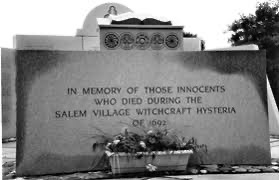
Over the years, a collection of comped survey books had accumulated on my classroom shelf. I used them for my own preparation, but decided to teach the same techniques to the kids. The task was pretty simple. All groups were asked to look up the two same topics: The Salem Witch Trials of 1692, and John Brown’s Raid at Harpers Ferry in 1859. They noted the title of the text, the authors, the publication date, and any particular word choices used to explain or describe each episode.

This was the first day of school, mind you, and holy cow the results rocked these 15-year-olds orderly world.

When each group reported their conclusions, skewed viewpoints abounded. In other words the same facts drew decidedly different conclusions.

One book blamed the Witch Trials on tensions stemming from continuous Native attacks. Another blamed simmering resentment over social class, inheritance disputes, and property ownership. Moldy grain was to blame according to the Prentice Hall book. The good people living north of Boston were tripping on ergot fungus, a hallucinogen spreading on damp wheat baked into bread.

Nearly all texts made use of the terms “fear,” and “hysteria.”

The John Brown case provided even more interesting results. If the book had been published before 2001, Brown generally came off a saint. If after, the language use grew more sinister. In pre-911 America, fighting slavery had a righteous, noble language, that justified the violence. Something to the effect that, in the name of the mighty Jehovah, Brown martyred himself to strike a blow against evil. By contrast, books published after the collapse of the Twin Towers dismiss Brown’s means as unfortunate, though slavery was still bad.

By the end of this exercise students often seemed flummoxed asking “who can we believe?” 

“Yourself, of course, and your analysis skills,” I always replied.

Gail Chumbley is the author of the two-part memoir “River of January,” and “River of January: Figure Eight.” Both titles available on Kindle.

For more explanation on this lesson email at gailchumbley@gmail.com

You’ve Been Played

Strains between North and South had reached critical mass by November, 1860. Escalating tensions burst with the election of America’s first Republican President, Abraham Lincoln of Illinois. The South Carolina legislature reacted by voting their state out of the Union on December 20th, a mere month later. By Spring 1861, the Confederate States of America consolidated, and on April 9th cannons fired upon a Union fort in Charleston Harbor. So began a bloody fraternal war. 

A longstanding question is how in the world did Planters, a small slice of the southern population, convince a mass of their social inferiors to risk life and limb, defending their aristocracy? The answer is rather simple, and lamentable. Folks from the lower rungs lived by the social rules fixed by the wealthy elite. The Planter Class established the rituals of polite society, and every white man below the Mason-Dixon hoped to someday to join their ranks (acquiring land and slaves).

The lower classes defended a minority they ached to join.

A small middle class of land holding farmers, and city professionals, also labored to reach the same social summit. In other words, acquiring the trappings of wealth, punched one’s ticket to ride.

Beneath this merchant-landholding tier massed poor whites. These desperate souls were left to precariously scratch out some kind existence as itinerant tenants. Contempt for this hardscrabble class is still evident through pejoratives that are still in use. Belittling terms like crackers, trash, hillbillies, and rednecks linger on in our lexicon.    

The Old South, in general, also distrusted the outside world. Foreigners, Yankees, Catholics, Jews, and immigrants, meaning anyone who might challenge rigorous, aristocratic formalities. The consequences for this delicate arrangement were profound. As the North industrialized, innovated, and modernized, Southern society languished, governed by reactionaries, more interested in public manners and bloodlines.

Outraged and insulted by Yankee ways, the wealthy roused the lower classes to defend Southern traditions, while in reality, barring any real opportunity of upward mobility.

This dynamic remains modern American politics. The GOP, in our time, is requiring the same fidelity. Party leadership honestly does not wish to serve you. All candidates want is your money and your vote to protect their interests, (especially the guy at the top). These characters are happy to rile voters through exhibitionism, and scapegoating whatever grievance you wish, especially piling it on minorities, the poor and the dispossessed.

But remember this, the traffic is one way only, and you are serve them, not the other way around. Keep delivering cash and power to the top, and nothing changes.

In short, you’ve been played by your chosen betters.

Gail Chumbley is the author of the two-part memoir, “River of January,” and “River of January: Figure Eight.” Both are available on Kindle.

gailchumbley@gmail.com

Breaking Point

The American system of government requires reasonable, motivated legislators. And no, there is nothing quick about lawmaking. That a Congressman or Senator will get all they want is another no. The legislative process requires willingness, study, and compromise. It is little wonder citizens become frustrated with the pace, but that is American lawmaking. And despite the drawbacks, our frame of government is the best that exists in the world. Period.

When factions choose violence, know this, insurrection is no solution. Never has been. Acts of brutality, in fact, mangle the fabric of our society. The Far Right, along with their gutless congressional enablers will, sooner or later, reap the consequences of their lawless behavior.

As Tom Petty aptly titled the mindset, these are Rebels Without a Clue.

South Carolina Congressman Preston Brooks, in 1856, felt much the same. This impetuous “gentleman” possessed a velcro sensibility to perceived slights, and could lash out unexpectedly. Raised in the Southern canon of the code duello, Brooks believed physical retribution a mandatory response in defense of reputation and honor. Years earlier young Brooks had traveled to Washington DC in order to challenged another he believed had insulted his father, Whitfield Brooks. For this impulsive action young Preston hobbled on a cane, limping for the rest of his short life.

Hate was in the very air of Capitol Hill during the 1856 session of Congress. The “irrepressible conflict,” of slavery, weighed as heavily as the damasked draperies in the US Capitol.

The question at that moment concerned the extension of slavery into expanding territories. One law after another had either permitted, or limited the peculiar institution onto the western prairies. This was also when Brooks arrived to take his new seat in the House of Representatives.

The admission of Kansas cut from Nebraska Territory drove the headlines of that moment. Would the Nebraska Territory split into two new states, one free, and one slave? The decision weighed heavily, challenging the delicate equilibrium in the Senate.

Into this tinderbox stepped Senator Charles Sumner of Massachusetts, and his powerful speech that gripped not only Congress but the whole, volatile nation. Titled “The Crime Against Kansas,” this fiery abolitionist and orator cursed the institution of slavery belittling southern defenders as enamored with the “harlot slavery.”

That oratory lit the spark igniting Congressman Preston Brooks.

Following Senator Sumner’s two-day denunciation, the chamber quieted, and members wandered in and out, chatting or working at their fixed desks. Charles Sumner himself, was seated on the Senate floor, focusing on the papers before him. That was the moment Representative Brooks sidled up behind the preoccupied lawmaker.

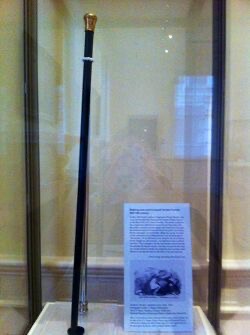
Brooks made some remarks at the Senator’s desk, then lifted his cane and came down hard on Sumner’s head. Over and over the enraged South Carolinian beat his quarry, Sumner struggled, trapped halfway between his chair and bolted-down desk. Finally the cane cracked, and Brooks strolled out of the Senate Chamber.

Sumner lay groaning on the Senate floor, a bloody mess.

In the days following, Preston Brooks was both reviled and feted by enemies and compatriots. As a point of order, the young Congressman resigned his seat and left for home.

Gifts of canes were sent to this Southern hero who had taught those Yankees the physical price of loose talk.

This episode accomplished nothing of substance. A mini Civil War exploded on the Kansas Prairie, and Brooks died from some ailment. And Charles Sumner? He survived the assault, later to lead a Jehovah-like revenge on the Reconstructed South.

Why does this matter? How does this concern today? Because America is a nation of laws, the same slow, thoughtful process designed by the Framers. When agitators choose the path of violence, the recoil whipsaws uncontrollably. The Sumner Brooks episode provided a prelude to Civil War. Lasting stability rests on methodical lawmaking through thought, analysis, and compromise.

Take it from me, the past does portend the future.

Gail Chumbley is the author of the two-part memoir, River of January and River of January: Figure Eight. Both titles are available on Kindle. Chumbley is also the author of two plays, “Clay” on the life of Henry Clay, and “Wolf By The Ears,” exploring the beginnings of American racism and slavery.

gailchumbley@gmail.com