I Want My GOP
https://chumbleg.blog/2018/04/13/i-want-my-gop-3/
— Read on chumbleg.blog/2018/04/13/i-want-my-gop-3/
Worth a reread.
I Want My GOP
https://chumbleg.blog/2018/04/13/i-want-my-gop-3/
— Read on chumbleg.blog/2018/04/13/i-want-my-gop-3/
Worth a reread.
A moment of grave consequence.
“Our lives, our fortunes, and our sacred honor.”
Sun Valley Idaho is especially beautiful in the fall. We had driven to the resort through steep, intimidating mountain passes, to finally descend among groves of whispering Aspen trees. We had traveled over for a book presentation on “River of January,” the first volume of my two-part memoir at the local Library. We had arrived with hours to spare.
With tons of time to kill we walked the boarded walkways of Blaine County’s most famous community. My eyes were peeled for a glance of the the rich and famous; perhaps Arnold, maybe Bruce, or Demi, or even Tom and Rita. They pop up once in a while to relax in the natural beauty, away from the rat race.
Wandering, we chanced across a dress shop, and I slipped inside the glass door, leaving my husband sitting on a bench outside. The clothes were beautiful; plaids in silky fabric, and fashionable…
View original post 320 more words
Sun Valley Idaho is especially beautiful in the fall. We had driven to the resort through steep, intimidating mountain passes, to finally descend among groves of whispering Aspen trees. We had traveled over for a book presentation on “River of January,” the first volume of my two-part memoir at the local Library. We had arrived with hours to spare.
With tons of time to kill we walked the boarded walkways of Blaine County’s most famous community. My eyes were peeled for a glance of the the rich and famous; perhaps Arnold, maybe Bruce, or Demi, or even Tom and Rita. They pop up once in a while to relax in the natural beauty, away from the rat race.
Wandering, we chanced across a dress shop, and I slipped inside the glass door, leaving my husband sitting on a bench outside. The clothes were beautiful; plaids in silky fabric, and fashionable shoes among displays of accessories. The owner was on her phone, behind the counter, speaking to what sounded like a potential customer.
And she was clearly French.
I continued to browse the merchandise, but was more taken with the French lady. I had a good reason.
She soon closed her call, then addressed me. “May I help you?,” the lovely woman trilled.
“Well, maybe.” I replied. “I’m a writer. In fact, I’m here to discuss my new memoir at the library. By any chance have you heard of Mistinguett?”
The shop owner stopped, and looked into my eyes. “Oo La La!” she gasped. “She is a legend.” I smiled, my day made.
Mistinguett was a French music hall entertainer, born late in the 19th Century. At one time this singer-dancer was the highest paid entertainer in Europe, best remembered for her torch song, Mon Homme. Americans might recognize the tune better as My Man, a hit, first for Ziegfeld headliner, Fannie Brice, and later Barbra Streisand.
A fun fact about Mistinguett is she had her legs insured for 50 Francs during her prime. Another fun fact is she discovered Maurice Chevalier, pulling him from the chorus, and making him a star.
The best news about Mistinguett concerns Helen Thompson. Just a girl, this American dancer who’s life story appears in “River of January,” toured with the “Oo la la” French legend from 1932-33.
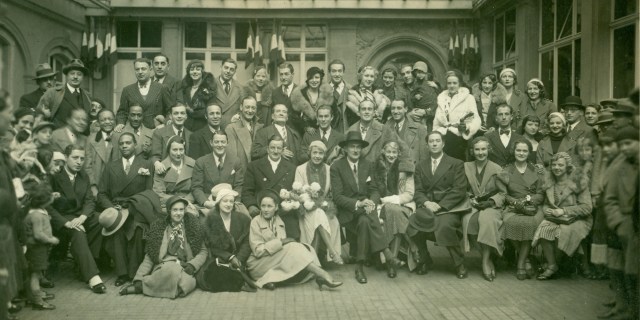
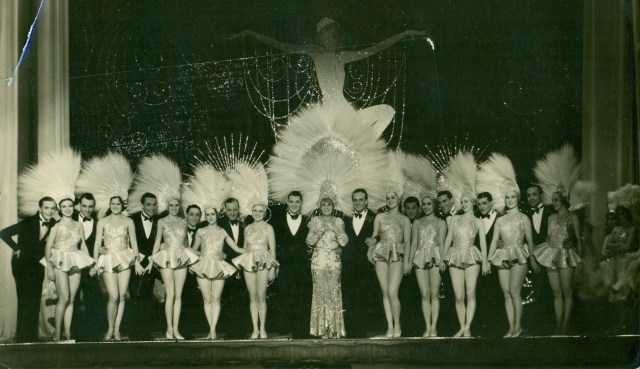
Enjoy this film clip of the iconic entertainer, dated 1936, and look for Helen in the cast photos of Viola Paris, the Mistinguett variety show from three years earlier.

Mistinguett sits in front holding flowers. Helen Thompson is in the top row center right–the blonde wearing the fur-collared coat.

Here Mistinguett is wearing a giant head dress, and Helen is second girl to the right.
Gail Chumbley is the author of the memoir “River of January,” and “River of January: Figure Eight.” Also available on Amazon.com
This is a reprint of an earlier post.

It’s been uncomfortable to watch the media coverage from Louisiana about the removal of General Robert E Lee’s statue in New Orleans. As a life-long student of the Civil War the idea of removing reminders of our nation’s past somehow feels misguided. At the same time, with a strong background in African American history, I fully grasp the righteous indignation of having to see that relic where I live and work. Robert E. Lee’s prominence as the Confederate commander, and the South’s aim to make war rather than risk Yankee abolitionism places the General right in the crosshairs of modern sensibilities. Still, appropriating the past to wage modern political warfare feels equally amiss.
Robert Edward Lee was a consummate gentlemen, a Virginia Cavalier of the highest order. So reserved and deliberate in his career was Lee, that he is one of the few cadets who graduated West Point without a single demerit. Married to a descendent of George and Martha Washington, Mary Anna Randolph Custis, Lee added stature to his already esteemed pedigree. (The Lee-Custis Mansion, “Arlington House” is situated at the top of Arlington National Cemetery. And yes, this General was a slave holder, however he appears to have found the institution distasteful).
When hostilities opened in April of 1861, the War Department tapped Lee first to lead Union forces, so prized were his leadership qualities. But the General declined, stating he could never fire a gun in anger against his fellow countryman, meaning Virginians.
On the battlefield Lee was tough to whip, but he also wasn’t perfect, despite his army’s thinking him so. Eventually, after four years of bloody fighting, low on fighting men and supplies–facing insurmountable odds against General Grant, the Confederate Commander surrendered at Appomattox Courthouse, Virginia.
Meeting Lee face-to-face for the first time to negotiate surrender terms, Ulysses Grant became a little star-struck himself in the presence of the General, blurting out something about seeing Lee once during the Mexican War.
After speaking with General Grant, in a letter addressed to his surrendering troops Lee instructed, By the terms of the agreement Officers and men can return to their homes. . .
But Robert E. Lee’s story doesn’t end there.
Despite outraged Northern cries to arrest and jail all Confederate leaders, no one had the nerve to apprehend Lee. And that’s saying a lot considering the hysteria following Lincoln’s assassination, and assassin John Wilkes Booth’s Southern roots. The former general remained a free man, taking an administrative position at Washington College, now Washington and Lee University, in Lexington, Virginia. It was in Lexington that exhausted Lee died in 1870, and was buried.
Robert E. Lee led by example, consciously moving on with his life after the surrender at Appomattox. He had performed his duty, as he saw it, and when it was no longer feasible, acquiesced. He was a man of honor. And from what I have learned regarding General Lee, he would have no problem with the removal of a statue he never wanted. Moreover, I don’t believe he would have any patience with the vulgar extremists usurping his name and reputation for their hateful agenda.
This current controversy isn’t about Robert E Lee at all. It’s about America in 2017.
Gail Chumbley is the author of the two part memoir, River of January and River of January: Figure Eight. Also available on Amazon.
A repost from 2016.

We all know the story.
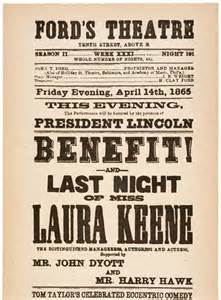
On a mild April night, President and Mary Lincoln attended the final performance of the popular comedy, “Our American Cousin,” at Ford’s Theater. Lincoln, by all accounts was in a light, blissful mood. A week earlier Confederate forces commanded by Robert E. Lee had surrendered at Appomattox Courthouse, Virginia, and except for some dust ups, the Civil War had ceased. We also know that John Wilkes Booth, and fellow conspirators plotted to kill, not only the President, but the whole order of presidential succession; Vice President Andrew Johnson, Secretary of State William Seward, etc . . . but only Booth followed through with that night’s mayhem.
Andrew Johnson took office in a whirlwind of shifting circumstances. In the year up to President Lincoln’s death a notable power struggle had taken shape between the President and Congress. America had never before endured a civil war, and the path to reunion had never been trod. As President, Lincoln believed the power to restore the Union lay in the executive branch—through presidential pardon. But an emerging faction in the Republican Party, called the Radicals saw the issue differently. These men operated from the premise that the Confederate States had indeed left the Union—committed political suicide at secession—and had to petition Congress for readmission. (Congress approves statehood). And this new president, Andrew Johnson, was determined to follow through with Lincoln’s policies.
Unfortunately, Johnson was by temperament nothing like Abraham Lincoln. Where Lincoln had a capacity to understand the views of his opponents, and utilize humor and political savvy, Johnson could not. Of prickly character, Andrew Johnson entered the White House possessed by deeply-held rancor against both the South’s Planter Class, and newly freed blacks.
This new Chief Executive intended to restore the Union through the use of pardons, then govern through his strict interpretation of the Constitution. Johnson had no use for Radical Republicans, nor their extreme pieces of legislation. Every bill passed through the House and Senate found a veto waiting at Johnson’s desk, including the 1866 Civil Rights Act, and the adoption of the Freedmen’s Bureau.
Congress consistently overrode Johnson’s vetoes.
Reconstruction began in a vicious power struggle. And much of the tumult came from Andrew Johnson’s inability to grasp the transformation Civil War had brought to America. While the new president aimed to keep government limited, the Radicals and their supporters knew the bloody struggle had to mean something more—America had fundamentally changed. Nearly 700,000 Americans dead, the emancipation of slavery, the murder of Father Abraham, and a “New Birth of Freedom” had heralded a seismic change.
But Johnson was blind to this reality, seeing only an overreaching Congress, (google the Tenure of Office Act) and Constitutional amendments that had gone too far. And so it was a rigid and stubborn Andrew Johnson who eventually found himself impeached by a fed-up House of Representatives. Johnson only holding on to his broken presidency by a single Senate vote.
There have been other eras in America’s past that fomented rapid change. The Revolution to the Constitutional period, the First World War into American isolationism, and the Vietnam War stirring up protest and rapid social change. These moments all concluded with reactionary-leaning presidencies. No less transpired with the 2016 election of Donald Trump.
2008 to 2016 witnessed social change of a new order. Administered by America’s first African-American President, liberty stretched further bringing about change to Americans secretly oppressed.
Gay marriage became the law of the land, upheld by the Supreme Court in the landmark decision Obergefell V Hodges.
The trans community found a champion in Bruce, now Caitlin Jenner.
Health care became available to those trapped in grinding poverty and preexisting conditions.
Undocumented young people were transformed into “Dreamers.”
And though he didn’t ‘take yer guns,’ President Obama did successfully direct the mission to nab Osama bin Laden, America’s most wanted man.
So when former students began sending horrified texts to me, their old history teacher on election night, 2016, I provided the only explanation history offered. The Obama years instituted rapid changes that the reactionary right could not stomach. (And yes, racism is certainly the most evident part of the equation).
So now we deal with a Donald Trump presidency. But, Mr. Trump would be wise to acknowledge and accept what transpired through the Obama years. The stubborn truth about expanding the ‘blessings of liberty,’ is that no one is willing to give them back. When push comes to shove, the new president may find himself facing the fate of Andrew Johnson.
Update. The overturning of Roe was not merely an outrage, but folly of the highest order.
Gail Chumbley is the author of River of January and River of January: Figure Eight. Also on Amazon.
Sharing wonder.
A visitor with the “Darkness Derby” trophy
Reno is situated in a golden bowl below mountains that separate Nevada from California. This enormous basin pulsates with life; upscale strip malls, flashy casinos, and relentless traffic following endless suburban growth.
To the north, off the beltway circling the “Biggest Little City,” sits Stead, Nevada, a locale clearly not touched by the same affluence as the rest of the region. A boarded up Catholic church, a Title-I elementary school and a Job Corps Center secured behind a grim, chain link fence, indicate that the very poor live world’s away from the prosperous south.
But at the end of this impoverished section of road, the world changes. Parachutists drift overhead in swatches of white, zigzagging through a deep blue autumn sky. Aircraft of every model and engine size wait, tied down on the asphalt, wing to wing. Vintage bi-planes, silvery jets, oddly shaped…
View original post 629 more words

Below is a letter that I recently sent to the Idaho Senate. The upper house of the legislature was considering a bill to provide vouchers for private education. My thoughts centered on the role public schools play in ensuring an American identity.
Good Morning,
My name is Gail Chumbley, and I am a retired teacher now living in Garden Valley. Those of us who spent our careers working with children know we always remain teachers, and why I write to you this morning.
Public schools were established in early America as a place where children learned the tools of literacy; reading, writing, and computing numbers. The thinking behind these first American schools was to prepare contributing members of society, insurance for the continuity of the community. Enlightened self-interest guided public instruction, confident that the future rested in good, capable hands.
During the 19th and 20th Centuries schools spread across the growing nation to continue investing in the future, and curriculums added more courses that created citizenship. History provided a sense of belonging and common cause, while Civics added the structure of the political system, explaining the “how” of active participation. Students pledged the flag, sang patriotic songs, and shared in the remarkable story of our shared experiment in self-government.
Today this common foundation of America is crumbling. With so many choices for education, a crazy quilt of competing curriculums, home schooling, online classes, magnet schools, alternative schools, and private schools increasingly fray the fibers of our shared American experience. And this morning you have the option to approve another blow to all of us , vouchers for private schools.
HB590 has threatened not only legal problems, but ethical issues which concern not only our State but our Nation’s unity. Public schools have historically provided a vital link for students; our children find more that bind them together, than tear them apart. The growing exclusivity of “choice,” has had a dire outcome socially and economically.
As educators of America’s past have recognized, our kids deserve to learn what holds them together as a people, and in that understanding ensure Idaho’s and America’s future are left in steady hands.
Please vote no on HB590
Sincerely,
Gail Chumbley
Gail Chumbley is the author of the two-part memoir “River of January,” and “River of January: Figure Eight. Available at http://www.river-of-january, and at Amazon.com

A civilian pilot learns of war.

Los Angeles
1939
On a sunny morning at the first of September, Chum arrived in the town of Winslow, Arizona, bumping down the landing strip at the airfield. Taxiing off to the side of the field, he observed a crowd collecting close to the control tower. Curious, he rolled to a stop, switched off the Waco, and hopped down. “What’s cooking?” he asked no one in particular.
A boy in greasy dungarees and black high-tops chirped up excitedly. “The Germans invaded Poland, mister. And England and France have declared war!” The boy beamed proudly, satisfied with reporting such important news.
Astonished, Chum stared blankly at the kid—countless considerations flooding his thoughts. Poor Helen. She’s been worried about what would happen. She loved France. I’ll probably be hearing from the reserves. We’re not in yet, but it’s only a matter of time.
While various scenarios dominated his thoughts, Chum refueled his plane. He then carried on with his flight plan, eventually touching down in Albuquerque—his destination. With his Waco S Series plane tethered to the ground, the pilot beelined to the small airport office, anxious for any news. The day had grown hot, but Chum barely noticed. He needed water, but the news came first. Approaching a low, dark building, he heard a voice booming from a radio:
At dawn, with no provocation or declaration of hostilities, the German army has invaded Polish territory, ruthlessly violating the country’s national integrity. Intensive bombing attacks are at this moment raining death and destruction over the cities of Poznan, Wroclaw, and Danzig resulting in considerable casualties among innocent civilians . . .
“Hey, Coop,” Chum called, hailing the manager. “What’s all this about marching Germans?”
“Been waiting on you, Chum,” the man called Coop replied, turning down the news broadcast. “Got a cable here for you from Troy. And that breaking news is all too true, pal.” Coop gestured toward the radio with his thumb.
Mumbling thanks, Chum unsealed the telegram, tuning out the now-muted announcer. He read:
Finish Albuquerque demo. Then to Troy. Big meeting. Perry
“They want you back at the nest, I’d wager,” the manager said with a knowing expression.
“Yes. Yes they do. All hands on deck, as the saying goes.” Chum tried to smile.
“Jerry’s hit Poland hard,” Coop continued. “First their heavy bombers, then the tanks, then the army marching in. Poor Poles. They don’t stand a chance. Radio announcer called the attack blitzkrieg.”
The word didn’t click. “What’s a blitzkrieg?”
Coop replied in a dark voice, “Lightning war.”
Gail Chumbley is the author of the two-part memoir, “River of January,” and “River of January: Figure Eight.” Both books are available at http://www.river-of-january.com, and on Kindle.
gailchumbley@gmail.com