Still wondering.

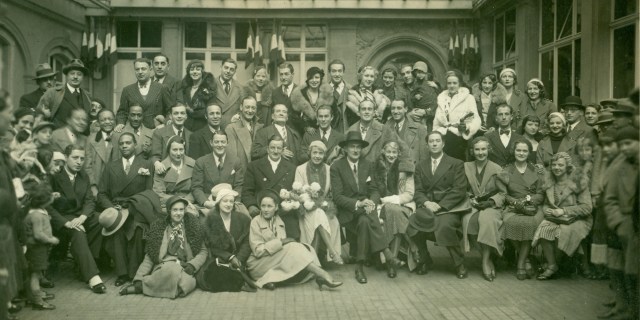
Mistinguett is front center. Helen is in the back wearing the light color fur collar. But look to the left middle.
Today’s mystery question–who are those two African-American gentlemen sitting together?
Still wondering.
Mistinguett is front center. Helen is in the back wearing the light color fur collar. But look to the left middle.
Today’s mystery question–who are those two African-American gentlemen sitting together?
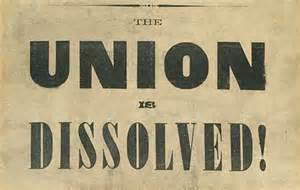
A divided national party . . . voices of extreme rhetoric . . . an ugly, contentious primary season. Does this spell doom for two-party system?
Sounds modern, doesn’t it? But the year was 1860, and the party in question was founded by Thomas Jefferson, and shaped in the image of Andrew Jackson: The antebellum Democratic Party.
On the eve of Civil War, the future of the Union appeared in fatal doubt. Political leaders in the Deep South: South Carolina, Georgia, Alabama, Mississippi, and Florida had all but washed their hands of the centrally powerful United States. Adding to the precarious atmosphere, a faction of Democrats in the North promoted a policy to permit slavery into the western territories under the principle of Popular Sovereignty, or direct vote. Others voices in the northern branch of the Democratic Party believed the Southern States should depart the Union in peace. And these pro-secession advocates became the most worrisome threat for Senate leader, Stephen A. Douglas of Illinois, the leading Democratic candidate for the presidency in 1860.
Douglas found himself in a hell of a spot. He fervently burned to lead his party to the White House and save his nation, dangerously poised on the verge of civil war. As the principal heir to Senate leadership, Douglas had spent over twenty years in Congress working to stave off Southern secession, taking over when Kentucky Senator, Henry Clay, the “Great Compromiser” died. Clay had also spent most of his earlier career drawing up one concession after another in a noble attempt to preserve the nation. Eventually the effort wore him out, and Senator Douglas pick up the cause.
As far as Douglas was concerned, slavery wasn’t a moral issue, but a bump in the road. The issue could easily be decided by the good folks migrating west. Douglas believed if settlers didn’t want slavery, they would decline to establish laws necessary for supporting the “peculiar institution.” He was wrong—dead wrong. Slavery had, by 1860 become an issue impossible to solve. And it was here, underestimating the power of the slave issue, that the Illinois Senator imploded his party and his career.
The new Republican Party had formed six years earlier in Wisconsin, established on one central principle—slavery would not extend into the western territories, period. And this new party grew fast. Composed of splinter groups, this now fully unified party maintained that free labor was an integral component of free market capitalism. The presence of slavery in growing regions of the West would devalue free labor, and undermine future economic growth.
Now, don’t get me wrong, these Republicans did not sing Kumbaya or braid their hair. These men did not believe in equality between the races—they were not abolitionists. Economic principles drove their political platform, (Emancipation came later with the transformation of President Lincoln in the fire of war).
For Stephen Douglas the approaching 1860 election meant vindication for his support of popular sovereignty, and reward for his faithful political service. And Douglas was no political hack. He fully understood the solvency of the Union lay in the delicate art of sectional balance, and his ascendancy to the White House as a Democrat would go a long way to placate the Southern hotheads. But this Illinois Senator failed, once again, to fully comprehend the temper of the nation, or of his own party. The era of seeking middle ground had passed—America’s course had been set toward industrial modernity with no place for an antiquated, barbaric labor system.
Charleston, South Carolina, was selected as the site of the 1860 Democratic convention. Chaos immediately broke loose on the convention floor. While Southern Democrats demanded strict, exact language guaranteeing the extension of slavery in the territories, Northern Democrats and those from California and Oregon pushed for Douglas’ popular sovereignty. This tense deadlock forced the latter faction to walk out and reconvene in Baltimore where party business could move forward.
Southern Democrats moved on as well. In a separate Richmond, Virginia convention Southern Democrats nominated Kentuckian John C. Breckinridge.
In Baltimore, Douglas indeed gained the Democratic nomination, preserving his precious principle of local elections determining the western expansion of slavery. Bolting Democrats in Richmond went further adding an absolute protection of slavery to their platform. Middle ground vanished.
Though a long shot, a third faction of the Democratic Party broke ranks calling themselves the “Constitutional Union Party.” I’m not sure what they stood for, but clearly it wasn’t support for Douglas or Breckinridge. Convening in Baltimore as well, in May of 1860, this coalition nominated John Bell of Tennessee.
So what can we make of this 1860 fiasco today, in 2016? If I could attempt a bit of divination I would suggest that the political party that can present the most united front will prevail in the general election. If current Republican candidates continue to employ such wide-ranging, and scorching tones to their rhetoric, and stubbornly defend the innocence of their loose talk, the party may run head long into oblivion, as did the Democrats of 1860. If the roaring factions, so loudly represented by each GOP aspirant goes too far, the fabric of unity will shred, crippling the Republican’s ability to field serious candidates in the future.
Looking at the past as prelude much is at stake for the unity of the GOP. In 1860 party divisions nearly destroyed the Democratic Party, and launched the nation into a bloody civil war. And though Republicans at that time elected our greatest Chief Executive, Abraham Lincoln, the Democrats suffered for decades, marginalized as the party of rebellion. And even the best lessons left by the past are still forgotten in the heat of passion by those who know better. The Democrats shattered their party unity once again a hundred years later, splintered by the Vietnam War, social unrest, and racial strife. This is truly a cautionary tale for today’s splintering Republican Party.
Zealots do not compromise, and leading GOP candidates are spouting some pretty divisive vitriol. Southern Democrats self righteously rejected the national party certain it no longer represented them, and ultimately silenced the party of Jefferson and Jackson for decades. The lesson is clear for today’s Republicans. By tolerating demagoguery, extremism, and reckless fear-mongering in their field of contenders, the RNC may indeed face a similar demise. Now its true that no party can be all things to all citizens, nor should hardened splinter groups run away with the party.
The American public demands measured and thoughtful candidates—and both parties are expected to provide candidates of merit and substance.
We deserve leaders worth following.
As Senator Stephen Douglas refused to recognize that the political skies were falling around him, and his party, the modern Republican Party must not.
Gail Chumbley is the author of River of January, a memoir. Available on Kindle
 In the film A More Perfect Union, James Madison, played by actor Craig Wasson asks Benjamin Franklin, (Fredd Wayne) if the Commonwealth of Pennsylvania had good government. Franklin barely takes a breath before replying, “Alas no. It is controlled by one faction or another.” That line–whether authentic or not, seems to resonate in the historic record.
The bloody struggle over slavery, followed later by the violence of the civil rights movement, provides the clearest examples of state governments hiding agendas behind the 10th Amendment, and it’s political progeny–the States’ Rights doctrine.
How did this misunderstanding begin? And why so quickly after the ratification of the tightly-scrutinized Constitution in 1787? How did controversy emerge almost at once challenging the authority of the Federal Government in relation to the state?
The answer lies in the industrious pen of Virginia Planter, Thomas Jefferson.
Now, whether Mr. Jefferson intended to condemn the nation to…
View original post 785 more words

Still looking for that right gift for that special person on your list?
Order River of January, a historical memoir as a perfect present, today.
Also available on Amazon.com
To all of the wonderful libraries in Washington, Oregon, and Idaho my deepest thanks! Gail Chumbley, “River of January.”

There was only one entrance off of the main arterial into the library parking lot. It wasn’t quite 10:00 AM yet, but spaces were filling up fast.
On foot, bebopping up the sidewalk, dressed completely in black, ear buds stuffed under his stocking cap, was the happiest Goth in creation. His belly jiggled over his black jeans, keeping time with his silent/screaming music.
A young mother followed close behind, a stack of books awkwardly vised under one arm, and she clutched her baby with the other, cautiously balancing both loads. Both visitors gathered at the same sealed entrance. The time was 9:58.
Old, young, the well dressed, alongside tattooed Walmart shoppers were preparing for their morning visit to the public library. How wonderful.
As the doors finally slid apart, this mass of incongruous patrons flocked inside, striding with purpose and authority to their appointed places. A no-nonsense aura filled the…
View original post 425 more words
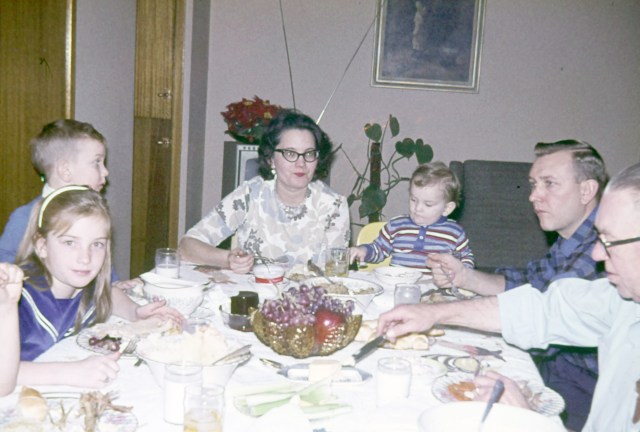
Christmas, 1965, I’m the sailor girl, he’s in blue plaid
We sat at the dining room table, my father having cleared a corner where we could both work. Agreeing to combine our efforts, we decided to write out both his and my Christmas cards in one fell swoop. These days, my visits to the folks come around more frequently—either flying or driving the three hundred miles to spend a few days back in my childhood home. And I didn’t mind addressing that stack of cards, especially with my dad sitting faithfully next to me making the job that much more special.
It’s my brothers who do the heavy lifting around the old homestead. My middle brother, in particular, visits nearly every day, pruning the shrubs, cutting the lawn, shoveling winter snow, and answering those midnight calls for transportation to the hospital which are also growing more frequent.
My youngest brother passes his weekend visits with on-sight, live-in chores. Heavy furniture moved, manure bags hauled, and removing and returning Mom’s giant window box cover, an aluminum contraption, some eight feet long. When those chores are finished, number three son whisks my father off to look at cars, both vintage, and new because they both like cars . . . a lot.
They take it easy on me when it comes to manual labor. My main job is to hang out with the folks and just go with the flow. On one earlier stay my Mom decided we should head out to the local mall. Happy to make the foray into retail-land, I wrestled her wheeled walker into the car, jockeyed for entrance onto the freeway, and we spend the afternoon simply looking around the stores, making time for a little overpriced coffee at the mall coffee spot. On this trip her sudden impulse for fun surprised me. All three of us sped the opposite direction on Interstate 90, to the Coeur de Alene Indian Casino, for some noisy, smoky, slot machine therapy.
If Caesar Milan is the Dog Whisperer, then my mother is the Slot Machine Whisperer. Stooped and round-shouldered, that little dynamo of a woman, cane in hand, cruises through islands of blinking, ringing machines, moving as smoothly as R2D2, but with more tenacity. She says ripe machines beckon to her, and damn if it isn’t true. As I sit beside her, losing my mortgage payment (at an identical machine) Mom turns ten bucks into a sweet fifty in a heartbeat. And she can get an awfully cocky for an old lady.
Bending over my work, back at the table, my Dad and I subtly figure out a production line. I copy last year’s addresses from a stack of cards, one by one, jotting them onto fresh envelopes. Stuffing this year’s card inside, I scribble into a spiral notebook each recipient for his records. My father then presses both the return address sticker and postage stamp on to the envelope corners and seals them up. This system is efficient and should have processed smoothly, except that my parents are now eighty-three, and their friends and close relatives are getting up there, too.
“This one is wrong. He’s in assisted living now. Oh, and he died just before Thanksgiving, poor guy. Say, can you put a line through that first address, and write in the new one?”
“Sure. It will still get where it’s going,” I assure him.
“She died a few months ago.” He sighs. “I’d better look at those envelopes,” he reaches for last year’s batch, “and I’ll get my address book.” Dad didn’t want to waste any more stationary. So by the time we were done with his cards, the final number had thinned down considerably, and he looked a little sad.
Despite that bitter-sweet atmosphere of sorrow mixed with holiday cheer, I found our time huddled at the end of that table somehow uplifting. Clearly our effort underscored that our lives can be measured as a series of losses. The loss of youth, of extraordinary moments too quickly expired, of dear friends, beloved pets, and the dearest of family members who leave us far too soon.
Still there was really no place I’d rather have been at that moment. I’m sixty years old and still I got to sit with my sweet, lovable, ever-constant dad, at a table we’ve shared since I was a little girl.
A precious gift indeed, in this season of joy.
Gail Chumbley is the author of the memoir, River of January also available on Kindle
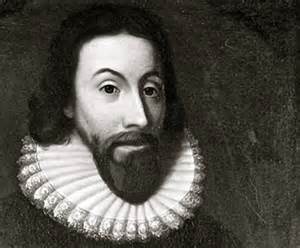
“We must entertain each other in brotherly affection. We must be willing to abridge ourselves of our superfluities, for the supply of others necessities. We must uphold a familiar commerce together in all meekness, gentleness, patience, and liberality. We must delight in each other; make others conditions our own; rejoice together, mourn together, labor and suffer together, always having before our eyes our commission and community in the work of the same body. So shall we keep the unity of the spirit in the bond of peace.”
Governor John Winthrop, Massachusetts Bay Colony 1630
Happy Thanksgiving.
Gail Chumbley is the author of River of January available on Kindle and at River of January



 Gail Chumbley