Night Flight

Night Flight

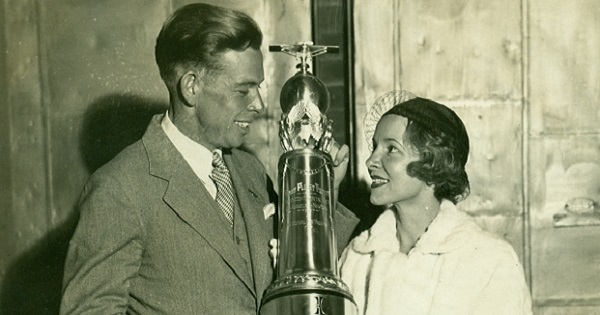
 “Night Flight,” an MGM drama premiered October 6, 1933 at New York’s Capitol Theater.

Star Helen Hayes presented Chum his hard-won first place trophy as a part of the evening’s program.

Read River of January.

helenhayes600w

Buy River of January by Gail Chumbley, also available on Amazon.

A French Legend

Miss2

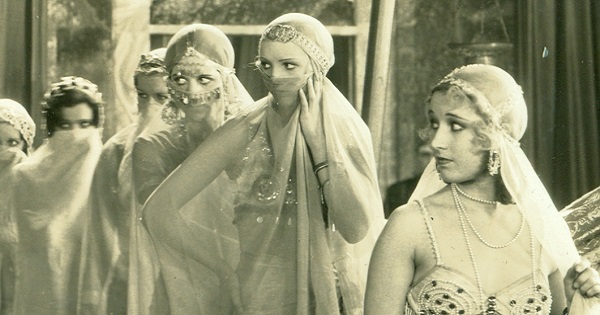
“Rumor has it that Mistinguett served as a spy for the French government during the Great War while she was dancing across the continent. They may be watching her again because of that new leader in Germany,” Lillian remarked as the company sunned themselves on exclusive Larvotto Beach.
“Who told you such a thing, Lillian?” Una, another dancer, asked skeptically.
“Didier, the older stage manager at the Terminus—he seems to know all about Miss.”
Charlotte’s eyes grew large. “How thrilling!”
“And she’s had many affairs with younger men,” Lillian continued, enjoying the attention. “You’re familiar with Maurice Chevalier?”
“Of course.”
“Supposedly they shared a passionate, very public romance. Miss launched his career when she plucked him from a music hall chorus line and cast him into his first film, La Valse Renversante.”
“No!” Charlotte blurted.
“Oh, yes!”
“Isn’t he a lot younger?”
“Thirteen years, according to Didier.”
“Lucky woman!” Charlotte said. The rest of the girl’s laughed at her response.

Page 75, River of January

Talk Back Wednesday

rojcover10

You’ve read the book, now share your reflections or questions.

Finish this sentence, ‘Chum’s greatest personal asset had to be . . . ‘

or

‘Helen traveled across the US and around the Atlantic world because?’

Post your responses and we’ll talk.

I would love to hear from you,

Gail

“River of January,” Oregon City Edition

Women600whelenhayes600w

             Hellooo Portanders!

Gail Chumbley presents her new work, “River of January,” Thursday, August 20th, 7:00 PM at the Oregon City Library.

Description OREGON CITY OREGON CARNEGIE LIBRARY copy.jpg

606 John Adams Street

Be grand to see you there!

Doesn’t Change Anything

Washington's-Farewell-to-his-Officers

There are folks out there in America who object to the term bellicose when describing Ronald Reagan’s foreign policy. The Texas State School Board a few years ago objected to the term “capitalism,” deeming it too loaded with negative meaning. Okay, play with terminology, putty up and pretty up the image of the past on state standards and guides, because it really makes no difference in the classroom.

Recently the College Board acquiesced to political pressure on AP US History curriculum objectives. I can understand the thinking behind this move by those who design and correct the yearly three hour exam. Those designers simply don’t need the controversy, nor do they need states to eliminate AP US from American classrooms. But the compromise actually actuates few modifications in day to day lessons, speedily delivered by harried AP teachers. Reality dictates the content of the course, and limited by time and the massive content, most are lucky to reach bellicose Ronald Reagan before the annual May exam.

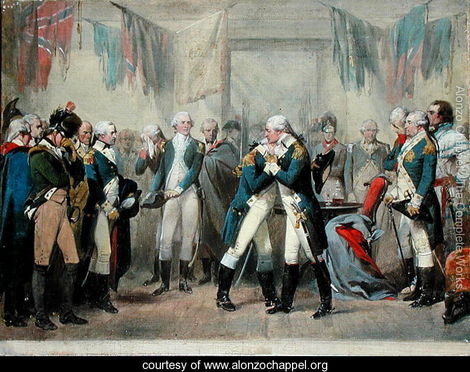
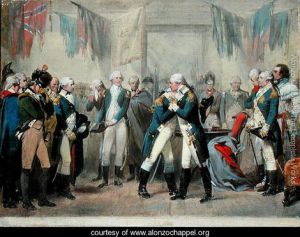
The painting above depicts General Washington’s Farewell to his Officers at Fraunces Tavern in New York. The work was the creation of artist Alonzo Chappel, and commemorates a party hosted by the victorious, but solemn Washington. This same picture, over a century later, was viewed by teetotalers with dismay. Prohibitionists, concerned by the tavern setting, especially with the wine carafe and goblet resting the table simply scrubbed the image out. Easy enough. Adjust the past to fit today’s present.
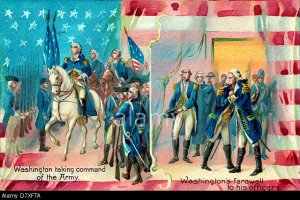
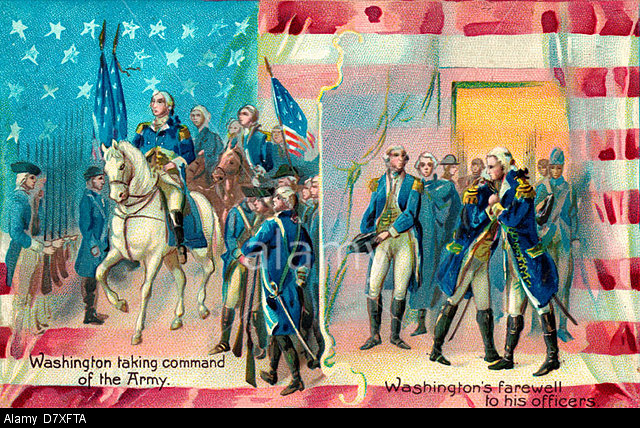
D7XFTA Washington taking command of the Army and Washington's farewell to his officers - two scenes from George Washington's Military life

D7XFTA Washington taking command of the Army and Washington’s farewell to his officers – two scenes from George Washington’s Military life

Yet, resurfacing the past, doesn’t actually change anything. Alcohol played a huge role in Colonial America. It just did. In fact, with reference to the 1980’s, all an instructor has to do is produce a couple of line graphs of military spending from 1981 to 1989. Any kid can deduce the trend in military expenditures. Read a couple of speeches in class–Ike’s Farewell Address to the country for example, and students certainly understand the deafness of the Reagan Administration to General Eisenhower’s cautionary words on the perils of the military-industrial complex.

And all those critics who scorn the notion of teaching higher level thinking haven’t spent a moment working with high school students. You can’t fool these young people, they are a lot smarter than you think. Any examination at primary materials, aside from textbooks, or any other ancillary stuff reveals a truth sans any political spin.

So go ahead and bleach the course objectives. Go ahead and whitewash topics such as the genocide of Native peoples, or the insider manipulation that has torpedoed the stock market over and over. It doesn’t matter really. I always told my students that the greatest thing about American History is that we examine it, warts and all, with eyes bravely open. That’s is the source and the strength of our nation’s greatness.

Gail Chumbley is the author of the memoir, River of January

Much Obliged

Peacock0002

Thank you for taking part in “River of January’s” free Kindle Weekend! Enjoy the story with my compliments.

Stay in touch. As you finish the book, drop me a line, add a review on Amazon.com, and be sure to tell a friend.

For more, visit the photo gallery at www.river-of-january.com

Book Two, “The Figure Eight” is in progress.

This Week, 1935

IMG_0191

The old pilot’s time with us grew to mean a great deal to me, personally, but made it that much harder to let him go at the end.

Chum’s last years brought him out west to Boise. It was much easier for my husband to care for him than the semi-regular flights to Miami, sorting out some kind of preventable crisis. Once his father settled in here, they were together every day at the assisted living facility. I believe their time together gave both of them a lot of comfort.

As for Me? I just loved to sit and talk to my father-in-law. If he had felt more spry I would have dragged him into my history class for my own version of “Show & Tell.” I mean, really! William Howard Taft was in the White House the year Chum was born! His life was a damn book. (see River of January)

On one particular Sunday we drove over for a visit, and brought him Mexican food . . . Chum’s favorite. I was anxious to talk to him because we had rented “The Aviator” the night before, the film about Howard Hughes, and Chum had worked for the millionaire at one time.

Me: So we watched a movie about your old buddy, last night–Howard Hughes.

Chum: Ha. He kept the Kleenex business in the black.

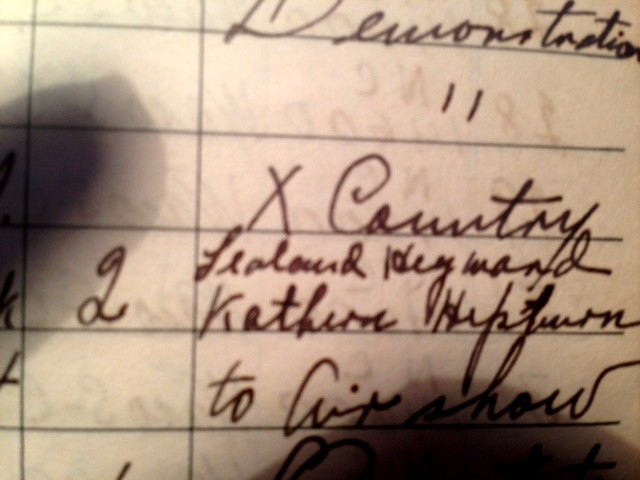
Me: (Oh, geez! How could he know that?) And your old girl friend, Kathryn Hepburn.

Chum: Yeah. Katy. She was a nice girl.

Me:(Katy? A nice girl?)

Chum: Her boyfriend, that theater producer, Leland Hayward–I taught him flying lessons, and she came along.

Me: Yeah. (Yeah)

And here it is folks, if you didn’t see at the top. The old history student has to whip out the proof. Have a nice weekend.

  IMG_0192

Gail Chumbley is the author of River of January. Available on Amazon.

The Meat Grinder

7804d740-1a8d-3515-a0cb-5ba757515e12

101 years ago today, Serb teenager, Gavrilo Princip shot and killed the heir to the Austro-Hungarian throne, on the heir’s fateful visit to Sarajevo. That one deadly act, carried out over a century ago, set into motion a series of events which ultimately resulted in the unimaginable bloodbath of World War One.

Last Wednesday while presenting my memoir, “River of January,” to a library group, an unexpected gasp came from a listener in the seats. My brain flew into immediate damage control “What I had said, (did I cuss?) Was the projector working behind me? Were my pants zipped? After only a heartbeat the cause dawned on me.

It was a 1928 snapshot of Mont Chumbley, the story’s central figure, beaming across the screen. He was uniformed in the garb of a Navy Seaman Recruit, proudly shouldering his rifle. He looks dignified in his pose, pleased at successfully becoming a part of the United States Navy—but his achievement had also left his family back on the Virginia farm in deep crisis.

Young Mont, “Chum” had required his father’s permission to join up, and the father had adamantly refused to go along with the idea. To modern ears, such as the listener Wednesday night, this obstruction seemed unpatriotic, a father ought to be proud; a military career today is considered noble and honorable. But not back in 1928.

The line that earned that unexpected gasp came after a direct quote from Chum. “Back then, in Norfolk there were signs in the parks saying, ‘Dogs And Sailors Keep Off The Grass’.”

We forget, but after the 1918 Armistice, America was truly sorry it had committed to war against Germany. The universal feeling was fighting in Europe had been a monumental mistake, and one that would never, ever be repeated. The country doggedly pursued isolation for twenty years until Japanese Zeros hit the Pacific fleet at Pearl Harbor in 1941. Between 1919 and 1941 military budgets were annually slashed, recruitment limited, and the military faced near elimination by a nation and Congress bent on going it alone.

The Treaty of Versailles that officially ended the war, along with its League of Nations was soundly defeated by a non cooperative US Senate. The Washington Naval Treaty of 1921 strictly limited the number of ships each maritime nation could possess, and the Kellogg-Briand Pact, an agreement between the US and France literally outlawed war. The public also grew convinced that American bankers and arms producers had only pushed for war to increase their profits. Companies like Dupont Chemical, and the banking House of Morgan were dubbed “Merchants of Death.”

Internationalism was dead, Fortress America was born.

That was the political climate surrounding Mont Chumbley’s ambition to join the Navy and learn to fly airplanes. Understandably his family fervently opposed this decision, and his father did all he could to block his son’s hopes for a military career. Mont’s aunt said it best, “The military is a refuge for scoundrels.”

And even after enlisting, young Mont learned his chances of getting into a cockpit were slim to none in light of draconian budget cuts inflicted on the Navy.

America’s enthusiasm for foreign involvement, the military, and war had fallen into fanatical disfavor. The meat grinder that had been World War One left our nation outraged and remorseful . . . America would never make that same mistake again.