The Working End of Tomorrow

815528365b25248630140a659ad44ffa


“A politician looks forward to the next election cycle, while a statesman looks forward to the next generation.” This admirable sentiment has been attributed to a number of speakers including Thomas Jefferson and the 19th Century Reverend James Freeman Clarke. But I heard the quote attached to President Gerald Ford. Whoever uttered these words has my full endorsement.

This morning began well. I awoke from a dream-filled sleep of taking roll, presenting lessons, and interacting with my students. They were all mixed up, hailing from a multitude of graduating classes, but still they were all my kids. I knew them well. In point of fact, most of my nights pass in a flowing narrative of teacher dreams, and I’ve gotten fairly used to this regular occurrence. The joke since retiring is, “I work so hard at night I should still be on the payroll.”

At any rate, after waking up, my mood remained jovial, still dialed in to happy. Tapping on my iPhone a picture appeared of a former student, now in a military uniform singing with three other soldiers. He and his brothers-in-arms were performing a rendition of the National Anthem at a public event. In another post a young lady, newly attending college revealed her fears about losing interest in reading for pleasure—a concern she happily resolved by opening a new book. Scrolling down the wall a bit, a wonderful family picture appeared of one of the kindest student’s I’ve had the pleasure to know. She posed before a Christmas tree with her three little boys, the youngest only two months old. Her husband’s caption clearly revealed his love for her and his boys. These posts are just, well, just so cool!

Not all teaching reminders and memories are as bright as those that I experienced this morning. Still, I wouldn’t have missed my time with these young people for a king’s ransom. Magic occurred in those classrooms; pure joy a guaranteed bi-product of the learning process.

I discovered over the years, that basic to the art of teaching and learning, is a faith in the future, a tangible something waiting ahead for every individual—a realized dream. All the hours of classroom preparation devoted to listening and thinking skills, observation, and problem-solving, were simply a training ground for young people to eventually find their place in the larger world.

While grappling with today’s incessant demands, it is far too easy to gloss over thoughts of the future. Caught up in the crowded moments that make up the present, many lose sight of the certainty of tomorrow. Teachers, however, are not permitted the luxury of settling in the moment. We must skip ahead of the “now,” planning and adjusting, then planning further. Intrinsic to our professional calling is the absolute assurance of a looming future, and we have to get our kids ready.

Perhaps stake holders could gain some perspective by casting aside trivial, momentary agendas—the noisy culture wars taking place across media battlegrounds, jousting in never ending finger pointing. Those distractions impede the progress available to our students, who are rapidly passing through the system. These kids are here today and gone tomorrow, quite literally.

When I assessed my students in class, I often envisioned them as adults, figuring out their individual niche. With that objective as my guide, I tried to design the best methods available to reach practical benchmarks. Even so, in the end, I had to let each class move on, a natural continuation forward to meet their futures, hopefully carrying my small contribution. An act of faith.

With our eyes vigilantly fixed on the countless tomorrows yet to come, would teachers be considered President Ford’s definition of statesmen? I’d like to think so.

Gail Chumbley is a retired educator and author of River of January. Also available on Kindle. Watch for “River of January: Figure Eight” this Fall.

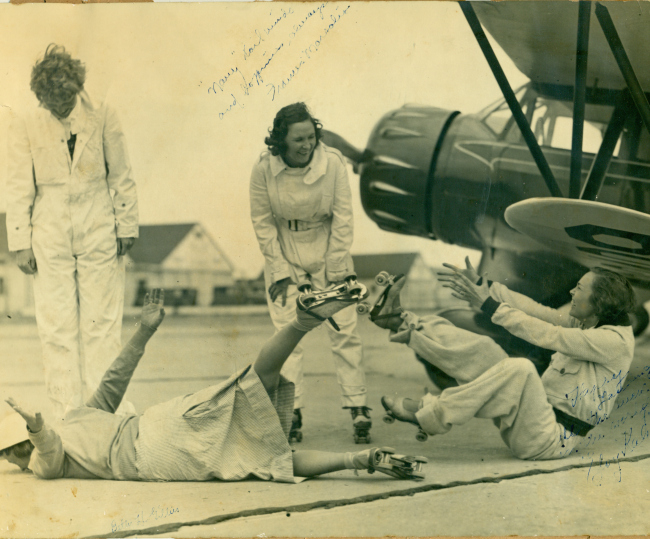
Amelia Earhart?

One of the more satisfying moments researching “River of January.”

gail chumbley's avatarGail Chumbley

Image

Piecing this story together didn’t come easily.  Though I have had the benefit of volumes of letters, telegrams, and pictures, among other sources, I still have struggled to get the story right.  The picture posted today provides an example of the most exciting finds I’ve made, but still shrouded with some doubt.

The girl in the center, in front of the Waco airplane, is Francis Marsalis Harrell.  From Chum’s thick scrapbook and an interview I conducted with him, I know her to have been his girlfriend.  They dated for a about a year after he left the Navy, and I believe he cared deeply for this young lady.  What brought me to that conclusion was piecework and conjecture.  First, during my interview sessions with Chum he lightly mentioned that his girlfriend used to time his trips into Manhattan from Long Island, but only when he drove female flight students into…

View original post 296 more words

A Mouse In My House

gail chumbley's avatarGail Chumbley

Image

I could hear a mouse under the bed. Crisp little maneuvers, poking around the books and pictures stored down there. Now, I am not afraid of mice, that’s more of a snake issue, but still, this little varmint rooting around wasn’t exactly relaxing.

I woke my husband, and he didn’t complain or resent my waking him so late. He doesn’t like home invasions any more than I do. Instead he hopped up and found a mouse trap on the porch, slapped peanut butter on the trip latch, then just as promptly hopped back into bed and fell asleep.

Now, sleep wasn’t so easy for this girl–conking out after such a creepy discovery. I rolled to my side listening as that little critter resumed his inventory of my stuff.  My stomach tensed some, waiting for the steel of death to suddenly snap. It might as well have been a grenade with…

View original post 303 more words

Air Race, Willie Whopper Cartoon, 1933

willie_whop1

https://www.youtube.com/watch?v=S66wOkha0aU

A vintage piece of celluloid from the Golden Age of Aviation. This cartoon has it all: racism, sexism, the boy hero, the hairy villain, and a hot girl (Earhart, sexy?). Reminded me of the pod races in Star Wars. This whimsical cartoon premiered  the year Chum won his air race, “The Darkness Derby.”


River of January is available on Amazon.com and www.river-of-january.com

The Great Silver Fleet

The Silver Fleet in a Golden Age!

gail chumbley's avatarGail Chumbley

The Great Silver Fleet

This photo is a DC3, part of Eastern Airlines “Great Silver Fleet” of passenger liners. The plane is on display in the Air and Space Museum at the Smithsonian. We had suspected that Chum had flown this aircraft, but weren’t quite certain. Finally, I had the chance to look over his logbooks and matched the tail number to this plane. Chum captained this particular aircraft in February, 1946, six months after the war ended. If you find yourself on the National Mall, you can duck into the Air and Space, where you’ll find this beauty still on exhibit.

View original post

Brussels, November, 1932

HVienna0001

From the new memoir, River of January . . .

Booked at the Palace Hotel in Brussels, the show’s new variety lineup fused seamlessly. First the star, Mistinguett, with the ballet troupe opened the evening program. Helen, unable to dance both with her friends and in her solo, chose the latter. Happily, it became a crowd favorite. Though she would have liked to dance with the company, Helen knew the ovations she garnered were well worth watching the opening from the wings. Next on the bill was synchronized dancing from American Earl Leslie and his line of hoofers, followed by the other company entertainers and their specialties.
The program closed with the full cast in a colorful, peacock-inspired, extravaganza. It featured Mistinguett center-stage, supporting a headdress of colossal feathered plumes of blue, turquoise, and purple, shimmering above her blonde hair. Her “Beauties” were costumed in silvery tutus, sequined halters, and tight, sparkling caps, each sprouting over sized silver feathers, flanking their star from both sides.
The male dancers, in black tuxedos, peeked out between each feathered girl. Under the dazzling lights, the symmetrical tableau moved patrons to their feet, applauding and shouting for more.
For a second night more flowers appeared, and this time a note accompanied the gift on Lillian’s dressing room table. As she again picked up the vase and turned toward the trash bin, Carmen stopped her, “At least read the note first, Lillian.”
“Yeah Lil, c’mon!” the other dancers chanted.
“Who wrote it?” asked Grace.
“Is it signed?” wondered Carmen.
Rolling her eyes, the dancer huffed dramatically, then slit open the note with a nail file and read in a flat, monotone:

You were really wonderful in your solo specialty and all through the review and I do want once again to ask you if you will let me pilot you through town in my car when and for as long as you may care. Should you not care to see or know me, please allow these flowers to tell you of my admiration, and remember that you have a person who cares for you in the little city of Brussels.

“But I didn’t have a solo,” Lillian exclaimed. “The only one who had a solo was…”
The girls stood silently, and then all eyes shifted to Helen. Lillian laughed once—a bit annoyed, and handed the vase to her friend, saying, “I believe these belong to you.”
Banter erupted again, now aimed at Helen.
“Jeepers girl, he admires you!” and “Wonder who it is that cares for you in this little city, kid?”
Helen took their teasing in stride, curtsying and blowing kisses. But when the dancers began chatting about the imminent cast party, Helen lowered herself onto a rickety stool and read on. “I feel I must say that I am not an ‘old butter and egg man’ … I am just twenty-eight and not too ugly … My only fault is that I think you are my ideal.”
Her eyes lingered on the words “my ideal.” Unexpectedly charmed, Helen appraised this communiqué with new eyes, and decided to follow the mysterious sender’s written instructions on how and where to meet him.
She dressed quickly and quietly to avoid any friendly needling. Helen hurried out the dressing room, heaving open the steel stage door into the quiet alley behind the theater.
Stepping to the corner of the building, she peeked around to the snow-lined, busy street. Helen carefully studied the faces of the bundled up after-theatre crowd crunching by, and scrutinized moving and parked automobiles. From her vantage point, She soon spied a grey Packard, emitting white-blue exhaust from a quietly idling engine. Scanning the note again, Helen felt certain that the young man would be waiting in that car. Her stomach faintly roiling, she stepped forward, trying to distinguish the driver through his frosty door window.
Helen realized, “Oh, he looks nice,” and shyly continued to approach his vehicle. The driver stepped out of his door, all smiles.
“You must be Lillian,” he beamed, “I am Elie. Elie Gelaki,” he added, bowing to kiss Helen’s gloved hand. She noticed that the young man’s voice formally articulated his clear English.
She bashfully smiled and felt her face grow warm. “Actually, I’m Helen,” she clarified. “I do hope that I am the one the message was meant for…”
Elie Gelaki unexpectedly gazed at her forcefully. “I meant you.”
The two stood self-consciously beside the running automobile.
“Why don’t I take you inside this café? It is quite cold tonight.”
“That would be lovely, Mr. Gelaki,” Helen smiled, more relaxed.
The young man gently took hold of her arm, explaining, “I’m Elie, and this street is quite icy.” He courteously escorted the dancer into a nearby coffee house.
“So you are the Helen Thompson on the bill, not Lillian Ward,” he said after they were seated. “I am sorry about the confusion. I hope it was of no embarrassment to you.”
“No more than usual,” the dancer laughed. “My friends spend more time teasing each other than dancing.” She paused, changing the subject. “Tell me about yourself, Elie.”
“I am a native of Palestine. But now I live here, in Brussels, with my mother and two sisters. My dear father has been for dead for some time.” He noticed Helen suddenly frown. “Did I say something offensive?”
“No. I’m sorry. My father died some years ago, too.” Helen’s own grief abruptly gripped her heart. After Floyd Thompson died, after his funeral, she knew something truly good had vanished forever from her world.
Her frown turned into a sympathetic smile. His face glowed in reply
Elie changed the subject. “I have recently founded a new photo company. I call it Polyfoto International,” he stated proudly. “At this time I am expanding my interests in Europe, across North America, and on into Asia.
“What type of photography do you specialize in?” Helen politely asked.
“ I will accompany you into my studio and photograph your lovely face. Then you will know,” Elie responded.
While he chatted about his life and work, Helen studied the Belgian. He wasn’t terribly tall, and had a clear complexion, subtly suggesting a childhood of freckles. His thick hair ranged from light brown to dark blonde and he combed it back off of his forehead. Elie gazed at her from olive green eyes speckled with glints of brown and gold. Though he seemed a serious man, he smiled broadly as he spoke in his appealing English, and his laughter was deep and friendly.
“Would you consider joining me for lunch tomorrow?” he asked. “I would be happy to guide you on a personal sightseeing tour of the city afterward.”
“Love to,” she answered promptly, drawn toward this young man. Elie thanked her with a happy grin.
The troublesome doubt dawned on her later, as she tiptoed into her dark hotel room.
“He’s Jewish,” she whispered to herself. “My mother would just die if she knew I was seeing a Jew.”
Yet, despite all the prejudice against Jewish people, she liked Elie and decided to give the young man a chance. He seemed nice, and she wanted to see the sights around Brussels.

River of January is available on Amazon and at www.river-of-january.com

The New Frontier

MomDad1[1]

These are my folks. Today is their 62nd anniversary, and unlike my last anniversary post, mom and dad are still alive and kicking, arguing about the same trivial nonsense in the same house where I grew up.

Example-Dad:We drove to Minnesota in ’68 in that black Chevy. It’s just before we bought the white one.

                  Mom: (condescendingly) Dave, you had sold that truck already, we drove the white one.

And so it still continues, even into their eighties. It’s that kind of banter that seems to keep them young. And it’s funny, but that is how they endure in my memory, as young parents, with small children. Though I was one of the brood of four, the two of them remain youthful, and optimistic in my mind’s eye, raising their family in the heady years of JFK’s New Frontier.

After their almost teenage marriage, Dad and Mom bought a modest house on a modest street. My dad worked shifts at Kaiser Aluminum, sweating over pots of white-hot molten ore, spewing the kind of heat that would have made Andrew Carnegie happy. If my father could snag a “double,” stay on for an extra shift to earn more cash, he would jump at the opportunity. Dad wasn’t really a workaholic, because he was foremost a family man, and played as hard as he labored. Still, at the same time he sought financial security, and knew ‘all blessings flowed’ from contract negotiations, remaining a proud member of the Steel Workers Union.

In contrast my mother preferred staying home. She still does. Her home has been, and always will be her sanctuary. She is an interesting individual. As a teacher I can state for certain, if there had been aptitude testing for school children in the 1930’s, my mother would have qualified for a gifted and talented program. No joke–if we analyzed the hours the woman has spent reading, her eyes have scanned print more than looking at my dad. Mom’s face is available in both hard cover and paperback, (no e-book format yet). I think that if she couldn’t read, my mother would wither up and blow away.

Well, after some difficulties in those early years, my older brother arrived on February 10, 1954. And they named him Dale for my mother’s uncle. The next year, I showed up on February 10, 1955. It seemed to make some sort of cutesy sense that I should be called Gail. The timing of our precisely dated births convinced my mother, and maybe even my dad, that all God’s children naturally arrived on February 10th. (You’d think birthday parties would have been easier to plan, but my mom says no).

The path they have tread through the years was not exactly paved with gold. My dad’s employer, Kaiser Aluminum semi-regularly initiated lay offs as the metals market waned. But, was he daunted? Not by a long shot–he had a trick or two up his plaid flannel sleeve. My father, at heart, was not a factory drone, he was an outdoors man, a tree expert to be precise, equipped with winches, come-alongs, Swede saws, augurs, and thermoses of bad coffee. Dad just started his own business, a tree removal and yard clean-up enterprise. And though he actually made more money than at the plant, his practical, family-man side, the side that considered his wife and children, sent him back for the medical insurance and a retirement pension.

My dad always knew how smart my mother was, and instead of feeling intimidated, he was proud. Even today the woman can clear the board on “Jeopardy,” faster than Alex Trebeck with his cheat sheet. In the early years of the 1960’s, he convinced her to challenged the Postal Civil Service Exam, which she passed in spades. Instead of resenting Mom going to work, he encouraged her natural smarts and her remarkable abilities as a positive thing.

Now my mom wasn’t as convinced. Like I said before, she liked being a haus frau. However, her talents shined from the beginning, drawing attention from the postal hierarchy, who saw her as management material. So, after the birth of my youngest brother in 1962, mom entered the workplace and blossomed, eventually becoming a supervisor and working, for the most part with air mail at the airport. She memorized every air route, every airport designation, every schedule, with few mistakes. Her memory skills are almost scary. (I don’t know why he still bothers to argue with her).

So today my young, Kennedy-era parents are celebrating their 62ned wedding anniversary. They will eat dinner at 4:00, and chat about some earlier vacation . . . perhaps the Mesa Verde, the Custer Battlefield, or the semi annual holy pilgrimage to Minnesota, the land of his people. Maybe they’ll reminisce about the time I dropped her diamond watch into the toilet, or the chronic illness that plagued my younger brother through his childhood. Maybe they’ll laugh about the sauna they built, proud to have imported the authentic stove all the way from Sweden. After waiting weeks for the package to arrive it finally came by post. Opening the box they read it was made in Bellevue, Washington, five hours away by interstate.

I think their marriage just might be a good one.

Gail Chumbley is the author of the memoir River of January.

The Flemish Bend

HMPlanePic0001

This couple married 78 years ago today. On Friday the 13th. In New York City. Defying traditional convention. Archaic superstitions were of no interest to this modern couple, that kind of thinking belonged to the past.

Mont “Chum” Chumbley, and his bride, Helen Thompson Chumbley only looked forward, challenging and prevailing over old horse and buggy thinking. Theirs was a new era, a dynamic era, one of flight and of film. And this powerful force of optimism rendered one life time together too brief. So now their spirits carry on in my head, and in the pages of my book, River of January.

To say Helen and Chum were happy together would be shallow pandering–and an insult to the complexity of their distinctive temperaments. Still, their story has power, enduring power, pressing me on, returning time after time to their papers, searching for signposts of truth and direction.

A Flemish Bend, the title of this piece, ironically does have its roots in the distant past. The Bend is a sailors knot, also known as a square or figure eight knot. The same shape in mathematics is the symbol for infinity. The love Helen and Chum shared, as imperfect as it seemed at times, was powerful, and proved to be endless.

I too have been snared in those powerful cords, and for better or worse speak for their remarkable lives, lives too dynamic to have died with their passing.

And I’m grateful. It’s an honor. Happy anniversary Helen and Chum.

Order River of January, and enjoy the journey.

Plastics

From August, 2013

gail chumbley's avatarGail Chumbley

One-Word-Plastics

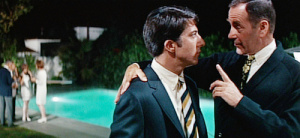
In Mike Nichols classic, The Graduate, Dustin Hoffman’s character is the guest of honor at his own graduation party.  Shaking hands, thanking well-wishers, one attendee herds him outside and says, “One word.  Plastics.”  There is no context or warning for the advice, and the exchange is well timed–very funny.

Turns out that the recommendation from the film was sage advice.

My husband was diagnosed with throat cancer back in the spring of 2010.  Following seven weeks of daily radiation, and powerful opiates, combined with a freighter load of other drugs, his colon ruptured by August.  Simultaneous to the colon perforation, chaos erupted as well.  The next twelve fateful hours involved a life-flight trip on a helicopter over the mountains, life and death surgery, followed by eight harrowing days in the hospital ICU.  In summary his recovery took better than three years, as he was literally coming back from the…

View original post 553 more words