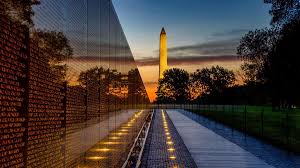
It was early August in 1964 when two American ships cruised into the Tonkin Gulf near the coastline of North Vietnam. The long narrow country facing the South China Sea had been divided following World War Two as had Germany and Korea. The demilitarized zone bisecting Vietnam lay somewhere near 17th parallel with the French controlling the South and Nationalist Chinese in the North.
From 1946 until 1954 the French and the Northern army, the Vietminh, jockeyed to unify the country, culminating with the Battle of Dien Bien Phu where the French got their clocks cleaned and arbitration in Geneva formalized the 17th parallel boundary. The US took an active interest in the fate of Vietnam because this was the Cold War Era. It was as if a global chess match shaped foreign policy with Soviet and Chinese Communism, and western democracies calculating strategic moves. As the preeminent post war power, the United States took the forefront in limiting Communist aggression, first in Korea, and then Vietnam.
By 1964 President Lyndon Johnson set his sites on Vietnam to limit the threat of Communist influence. To the President this was a backward country and people, and an overwhelming American force would easily conclude any resistance from Vietnamese Communists. After all how could people in black pajamas defeat the greatest nation in the world? President Johnson only needed a pretense, or provocation to commit American forces south of the demilitarized zone.
And that provocation cruised into the Gulf of Tonkin in early August of 1964. First the US destroyer, Maddox followed by another destroyer, the Turner Joy reported receiving fire from North Vietnamese forces. The ‘Gulf of Tonkin Incident’ as it became known resulted with President Johnson deploying Marines to Vietnam in March of 1965.
And that my friends was how the United States blundered into a land war in Southeast Asia.
Unknown to Johnson or his Warhawk cabinet was the character of their foe. Ho Chi Minh had been a Vietnamese Nationalist from his earliest days. Educated in France, Ho Chi Minh, as a student, bought a suit in Paris and made his way to the Hall Of Mirrors in Versailles. World War One had ended and he had hoped to plead Vietnam’s desire for relief from French Colonial occupation to President Wilson. But of course racism prohibited his entrance and embittered, Ho bided his time returning to Vietnam in 1941. He and his Vietminh worked with the Americans fighting Japan believing independence would come at the hands of the United States.
That didn’t happen.
Over time Ho Chi Minh became the indispensable man in freeing Vietnam. A George Washington if you will, of the Vietnamese people. President Johnson ought to have understood that.
But no.
The American land war escalated and the bombing raids under “Operation Rolling Thunder” and Nixon’s “December Bombing” did nothing to bring the North Vietnamese to heel.
From President’s Johnson to Nixon to Gerald Ford the conflict dragged on until in 1973 all American forces came home. Over 58 thousand Americans died in Vietnam and the truth was the provocation that sparked the war never happened. The Gulf of Tonkin Incident. For real. The so-called incident had been fabricated.
Now we again are under the knuckle of a completely vacuous man who believes he can bomb a nation and culture centuries old. Ramping up force garners nothing from a proud people, in this case the Persians, to quit. Like the deadbeat he is, Trump believes he can wear down the Iranians like a window installer he’s refused to pay. But he doesn’t know who he is dealing with, and he can’t sue or counter sue or in anyway wait out Iran until they tire and give up. That will never happen, like it never happened in Vietnam.
A greedy, hateful, racist goomba from Queens cannot win this fabricated war. Reality doesn’t work like that.
Gail Chumbley is the author of the two-part memoir “River of January,” and “River of January: Figure Eight,” co-writer of the screenplay, “Dancing On Air” based on those books. She has penned three stage plays on history topics, “Clay” on the life of Senator Henry Clay, “Wolf By The Ears” examining the beginnings of American slavery, and “Peer Review” where 47 is confronted by specters of four past presidents.
 Gail Chumbley